Employer of Record India: How US Companies Hire Without a Visa or Entity
The question comes up in almost every conversation US tech founders and engineering leaders have about India hiring: do we need a visa for this? The short answer is no. And understanding why changes how most companies think about building a team in India. No one needs a visa to be employed in their own country. An engineer in Bangalore working for a US company is not a foreign worker under immigration law, they are an Indian employee, hired and paid in India, working remotely. Visas are for pe

ByNilesh Parwani / October 28, 2026 / 7 min read
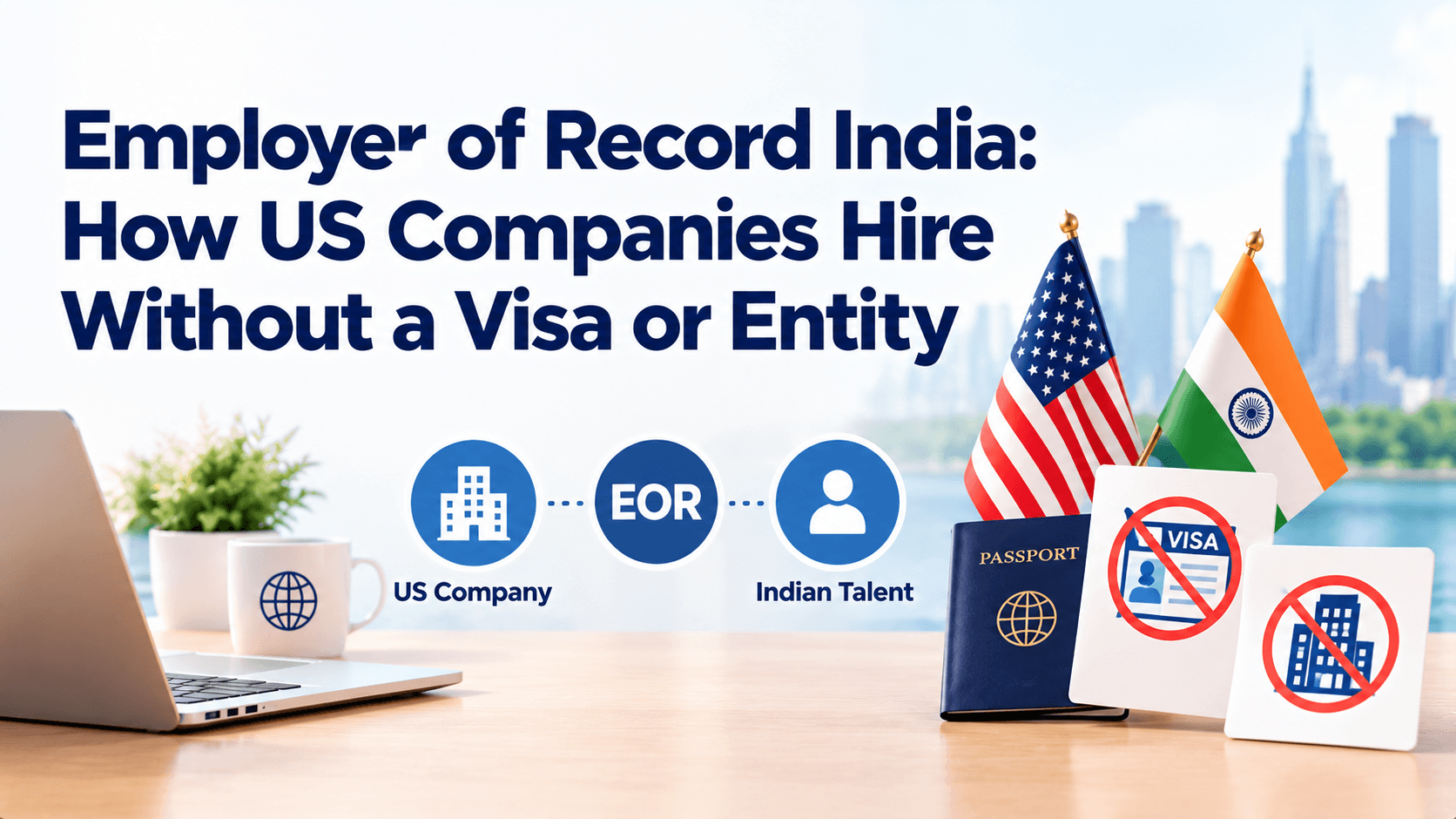
The question comes up in almost every conversation US tech founders and engineering leaders have about India hiring: do we need a visa for this?
The short answer is no. And understanding why changes how most companies think about building a team in India.
No one needs a visa to be employed in their own country. An engineer in Bangalore working for a US company is not a foreign worker under immigration law, they are an Indian employee, hired and paid in India, working remotely. Visas are for people crossing borders to work. When the work stays in India, there is no immigration question.
What there is, instead, is an employment law question. How do you legally employ someone in India if your company has no Indian legal presence? That is where the employer of record model comes in.
What an Employer of Record Actually Does
An employer of record, EOR, is a company that employs workers on behalf of another business. In the India context, this means the EOR is the legal employer under Indian law. They sign the employment contract. They run the payroll. They make the statutory deductions. They handle compliance with Indian labor regulations.
The client company, your US business, manages the work. You set the role requirements, run the interviews, direct the engineer’s day-to-day tasks, and control the output. The EOR handles everything that requires an Indian legal entity.
This split is sometimes called a co-employment model, though in practice the US company has very limited formal employment liability. The EOR absorbs the compliance risk.
The result: you have a full-time employee in India, protected under Indian employment law, without your company needing to be registered in India at all.
Why You Cannot Just Pay Someone Directly
Some US companies try to sidestep the EOR by paying Indian engineers as independent contractors, running payments through wire transfer or a platform like Wise, treating the person as a 1099-equivalent.
This works right up until it does not.
India’s labor law does not have a clean contractor category equivalent to the US independent contractor classification. The line between contractor and employee under the Contract Labour (Regulation and Abolition) Act and state-level Shops and Establishments Acts is drawn based on the actual nature of the work relationship, not what the contract calls it.
If an Indian “contractor” works regular hours, takes direction from the client, uses client-provided tools, and has no other clients, Indian courts and labor authorities will typically treat them as an employee. That reclassification triggers unpaid statutory contributions: Employees’ Provident Fund (EPF), Employees’ State Insurance (ESI) where applicable, gratuity accrual, and notice period obligations.
The exposure is not just financial. Misclassification disputes in India can result in demands for back payment of all statutory contributions, with interest. For a company that has been running contractor arrangements for two or three years, that is a real liability.
The EOR model eliminates this risk entirely. The worker is a compliant employee from day one.
What Indian Employment Law Requires
When someone is employed in India, the following statutory obligations apply, all of which the EOR manages on your behalf.
Employees’ Provident Fund (EPF). For employees earning below a monthly wage threshold, EPF contributions are mandatory: 12 percent of basic salary from the employee, 12 percent from the employer. For higher-earning employees, EPF remains optional but common as a retention benefit.
Employees’ State Insurance (ESI). For employees earning below approximately INR 21,000 per month, ESI contributions apply, 0.75 percent from the employee, 3.25 percent from the employer. Most senior engineers in US-facing roles will exceed this threshold, making ESI less relevant at that level.
Professional Tax. A state-level tax deducted from the employee’s salary, varying by state. Typically minimal, a few hundred rupees per month, but mandatory where applicable.
Gratuity. After five years of continuous employment, an employee is entitled to a gratuity payment on separation: 15 days of last drawn salary for each year of service. The EOR accrues this liability over the employment tenure.
Notice period. Indian employment contracts typically include a 30- to 90-day notice period. The EOR enforces the contractual terms and manages any separation process.
Leave entitlements. Paid leave, sick leave, and public holidays are mandated under state-level Shops and Establishments Acts. The specifics vary by state, but most India tech employment contracts provide 18 to 21 days of paid annual leave, plus national and state public holidays.
None of this requires your US company to understand Indian labor law in detail. The EOR handles all of it. But understanding what is covered helps you evaluate whether an EOR is actually delivering compliance, not just charging for it.
How the Onboarding Process Works in Practice
The practical sequence for hiring through an India EOR is simpler than most US companies expect.
Step 1: Role brief. You tell the EOR what you are looking for, seniority level, technical stack, role requirements. Kaamwork sources matched profiles within 24 hours.
Step 2: Interviews. You run your own technical interviews with the shortlisted candidates. The EOR does not screen for culture fit or technical depth on your behalf, that is your call to make.
Step 3: Offer. Once you select a candidate, the EOR issues the employment offer under their Indian entity. The offer reflects your compensation terms and the required statutory benefits.
Step 4: Onboarding. Background verification, document collection, EPF enrollment, and payroll setup. With Kaamwork, this takes 48 hours after offer acceptance.
Step 5: Working. The engineer starts. They are on your Slack, in your standups, committed to your sprint. From your side, it looks like any other remote hire. The EOR runs payroll, manages the compliance calendar, and handles any HR administration in the background.
The interview-to-offer conversion rate on Kaamwork profiles runs at 65 percent, a signal that the sourcing is genuinely pre-screened, not a volume play.
What It Costs: EOR India in Numbers
The cost structure for India EOR hiring has two components: the employee’s salary and the EOR fee.
A mid-level software engineer in India, three to six years of experience, strong with modern stacks, earns $45,000 to $60,000 per year in salary. Senior engineers with seven-plus years and specializations in distributed systems, ML infrastructure, or similar areas run higher, typically $65,000 to $90,000.
The Kaamwork EOR fee is $599 per month, per employee, on top of the employee’s salary. That covers payroll processing, statutory compliance, HR administration, and ongoing legal and regulatory monitoring.
Fully loaded annual cost for a mid-level engineer: $52,000 to $67,000.
For comparison, a mid-level software engineer in a US metro costs $150,000 to $220,000 fully loaded, base salary, employer payroll taxes, health insurance, equity, and overhead allocation. The India EOR hire runs at 30 to 40 percent of that figure.
The alternative to the EOR model, setting up your own Indian entity, costs $20,000 to $150,000 in legal and registration fees and takes three to six months. Once the entity exists, it requires ongoing compliance: annual filings, registered office maintenance, provident fund and ESI registrations, and local finance and HR overhead. That infrastructure makes sense at 50-plus employees. For a team of two to fifteen engineers, the EOR is almost always the right answer.
What “No Entity Required” Actually Means
The employer of record India model is not a workaround or a gray-area arrangement. It is the standard mechanism that global companies use to hire compliantly in countries where they have no legal presence.
The EOR holds a valid Indian private limited company registration. It is registered with the Employees’ Provident Fund Organisation (EPFO) and the relevant state labor authorities. It files TDS (tax deducted at source) returns, maintains proper employment records, and operates under the full scope of applicable Indian law.
When USCIS or any US regulator asks whether your company has employees in India, the correct answer is: your company has contractors or vendors in India, one of whom is an EOR that employs engineers on your behalf. Your US company has no Indian payroll, no Indian employees, and no Indian tax obligations.
That distinction matters for US tax purposes as well. Properly structured EOR arrangements do not create a permanent establishment risk in India, the EOR is the employer, not an agent of the US company conducting business in India. Kaamwork’s India EOR model is structured specifically to avoid permanent establishment exposure.
Common Questions From US Companies Evaluating EOR India
Can I manage the engineer directly?
Yes. Work direction, performance feedback, project assignments, sprint planning, all of that is between you and the engineer. The EOR does not sit in the middle of your team’s day-to-day operations.
What happens if I need to let someone go?
The EOR manages the separation process. For employees with less than five years of tenure, standard notice period terms apply. Gratuity obligations begin at five years. The EOR handles the documentation, final settlement, and statutory requirements.
Can the engineer work with contractors or freelancers on my behalf?
That is a separate question from their employment status. As an employee, they can manage contractors you engage directly, but the EOR arrangement covers only their own employment, not any third parties.
Does the EOR model work across India, or only in certain states?
A properly structured EOR operates nationally. An engineer in Pune, Hyderabad, Chennai, or any other city can be employed under the same arrangement. State-level Shops and Establishments registrations vary, but the EOR handles those.
If you want to get into the cost detail more specifically, by seniority level and city, the software engineer salary breakdown covers the numbers. And if you are coming to this from the H-1B angle and want to understand the comparison directly, the H-1B alternative piece runs through the cost and timeline side by side.
FAQ
What is an employer of record in India?
An employer of record (EOR) in India is a company that legally employs workers on behalf of a foreign business. The EOR signs the employment contract, runs Indian payroll, handles statutory deductions (EPF, ESI, TDS), and manages all compliance with Indian labor law. The client company manages the work itself.
Can a US company hire employees in India without setting up an entity?
Yes. Through an employer of record India arrangement, a US company can hire full-time compliant employees in India without incorporating locally. The EOR’s existing Indian entity covers the legal employment requirement. Entity setup costs $20,000 to $150,000 and takes three to six months, the EOR bypasses that entirely.
Does hiring in India through an EOR create tax liability in the US?
No, when properly structured. The EOR is the Indian employer, not an agent of the US company. A correctly structured EOR India arrangement does not create permanent establishment risk or Indian tax liability for the US client. The US company pays a service fee to the EOR, not Indian wages directly.
How long does EOR India onboarding take?
With Kaamwork, profiles are sourced within 24 hours of a role brief. Onboarding after offer acceptance takes 48 hours, background verification, EPF enrollment, and payroll setup. The engineer can be working within the first week.
What is the cost of an employer of record in India?
The employee’s salary plus the EOR fee. Kaamwork charges $599 per month, per employee, on top of the agreed salary. For a mid-level engineer earning $45,000 to $60,000 per year, the total annual cost runs $52,000 to $67,000 fully loaded.
Is an EOR India arrangement legally compliant?
Yes. A reputable EOR India provider maintains all required Indian registrations, company incorporation, EPFO registration, state labor registrations, and handles all statutory obligations: EPF, ESI, professional tax, TDS, gratuity accrual, and leave entitlements. The US client company has no direct Indian employment liability.
Share this article

Founder & CEO | Kaam.Work
Nilesh Parwani, a Kelley School BBA graduate, worked at UBS and Warburg Pincus before founding PrintBell (acquired by Cimpress). In 2020, he launched kaam.work, a remote work platform focused on flexible talent and distributed teams.