Why Your Offshore Team Has 30% Attrition, and Mine Has 5%
High offshore attrition isn't inevitable. Discover how an India Employer of Record (EOR India) helps US companies hire in India without an entity and strengthen India remote hiring.

ByNilesh Parwani / June 29, 2026 / 11 min read
- Why Most Offshore Teams in India Have 30% Attrition (Or More)
- The Contractor Trap
- No Local Human Support
- Wrong Salary Benchmarking
- Cultural Isolation
- The Vanilla EOR Problem
- What 5% Attrition Actually Looks Like
- Knowledge That Compounds
- Real Cross-Border Trust
- A Capital Argument
- The Role of an India Employer of Record in Reducing Offshore Attrition
- What Kaamwork Does Differently: A Practical Breakdown
- You Own Every Hiring Decision
- Onboarding in 48 to 72 Hours
- India Market Salary Advisory
- Local HR on the Ground
- Career Lifecycle Management
- Belonging Through Physical Touchpoints
- GCC and Owned Entity vs Kaamwork EOR: The Overhead Problem
- The bureaucracy layer builds fast.
- The 'Low Cost Office' Problem
- Overhead Costs Eat the Savings
- The Kaamwork Alternative: Agile by Design
- The Real Cost of Ignoring Attrition
- Is Your Current Offshore Setup Built to Retain?
- How to Switch to a Model That Retains Talent
- Conclusion
- Frequently Asked Questions
I get a version of the same call every few months.
A founder based in the US. Their offshore team in India is falling apart. Two engineers resigned this week. A third gave notice last Friday. The staffing agency they are using shrugs. They say this is normal. This is just how India hiring works.
It is not normal. And it is not inevitable.
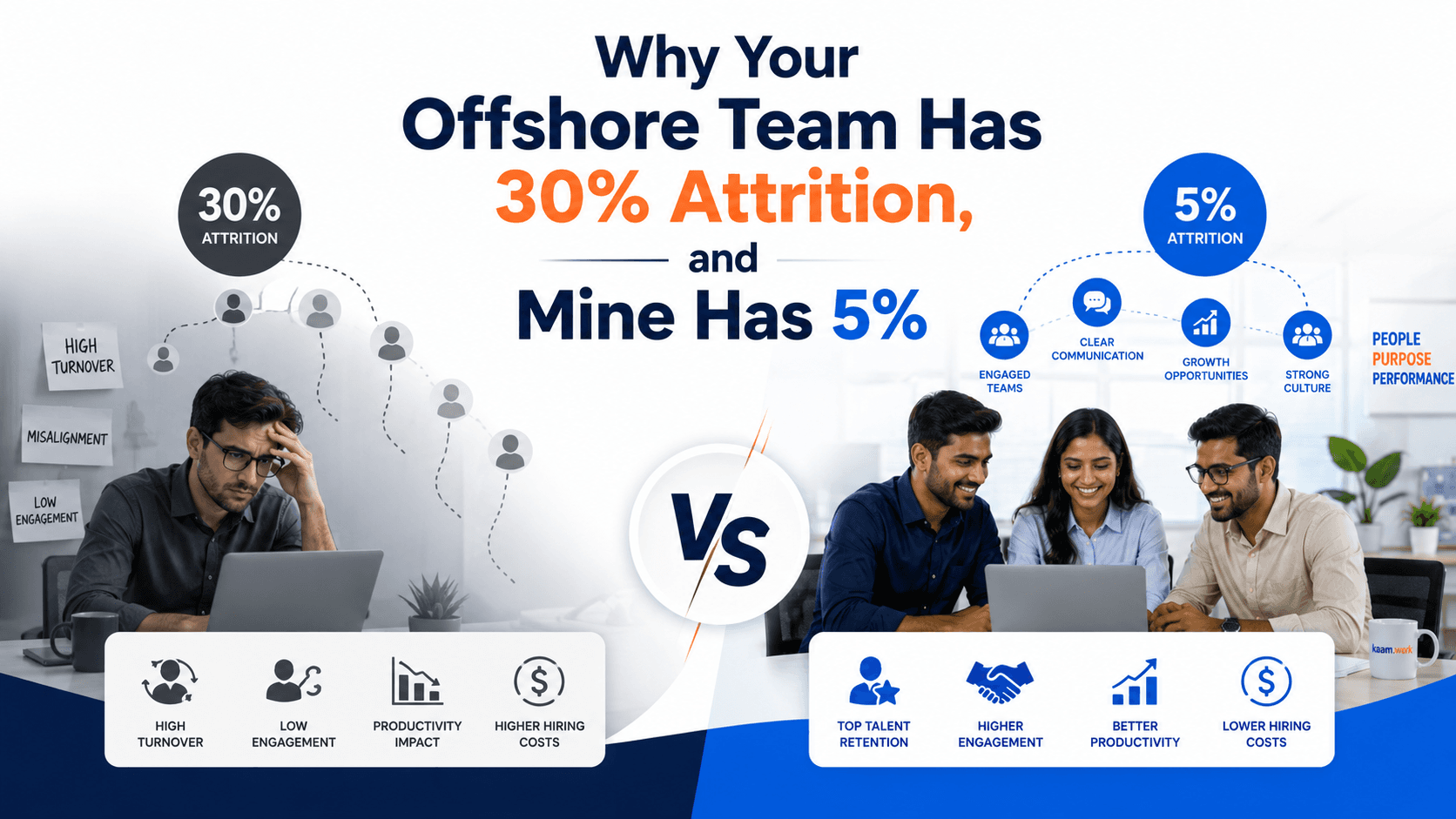
We work with companies like Advance Auto Parts and TripAdvisor as their India employer of record. Our attrition rate across those teams is under 5%. The average offshore team, built on a contractor or agency model, sees 25 to 30%. That gap is not luck. It is a structural difference.
This article explains what creates that gap and how you can get to the other side of it.
Why Most Offshore Teams in India Have 30% Attrition (Or More)
First, a clarification on the numbers.
India's overall IT sector attrition rate has been declining. According to Aon's survey of over 1,000 companies, the national average dropped to 17.1% in 2025. But that headline number hides a wide range. The BPO sector still runs above 30%. The IT services sector, specifically in Bengaluru, consistently tracks between 22 and 25%. And companies that rely on staffing agencies or contractor models routinely report attrition at 30% or higher on their own teams.
The 30% in this article's title refers to the latter. The companies that build offshore teams through the wrong model. Not the country average. Their individual experience.
Here is what I consistently see when a company's offshore setup is broken.
The Contractor Trap
A staffing agency places an engineer. On paper, the engineer is working for you. In practice, they are working for whoever pays them. They have no employment relationship with your company. No career path. No sense of belonging. When someone offers them Rs 6,000 more a month, they take it. Nothing is holding them.
This model creates a revolving door. The agency fills the seat. The seat empties. The agency fills it again. They charge you every time.
No Local Human Support
When something goes wrong for your offshore engineer at 9 pm IST, who do they call?
In most offshore setups, the answer is nobody. There is an automated ticket portal. There is an email address that responds in 48 hours. There is no human.
That feeling compounds over months. Engineers who feel unsupported start looking. They do not announce it. They just leave.
Wrong Salary Benchmarking
US teams often apply flat conversion logic to Indian salaries. They look at the exchange rate, divide their US salary range, and arrive at a number that looks reasonable from San Francisco.
That number looks low to an engineer in Bengaluru who knows the market. They accept it to bridge a gap. Six months later, a better-benchmarked offer arrives in their inbox. They take it.
This is entirely preventable. It just requires someone who knows the India market to review your salary bands before you make an offer, not after you lose the hire.
Cultural Isolation
No town halls. No swag kit when they join. No offsite. The offshore team is treated as a cost center, not a colleague. They know it. They feel it. They act on it.
Engagement surveys consistently show that offshore employees who feel like outsiders are the first to leave. They are not looking for free lunches. They are looking for a signal that they matter to the company they work for.
The Vanilla EOR Problem
Even companies that have moved past contractor models sometimes land with a standard EOR provider that does payroll and nothing else. Compliance is managed. Onboarding happens. Then the EOR disappears.
What happens to that employee at 12 months? Who is running their appraisal? Who is managing their career growth? Who knows if they are disengaged before they send the resignation email?
Most vanilla EOR providers have no answer to these questions. That gap is where attrition lives.
What 5% Attrition Actually Looks Like
Low attrition is not just a vanity metric. It changes how a team functions.
Knowledge That Compounds
When engineers stay for two, three, four years, they build deep familiarity with the codebase and the product. They stop needing to ask basic questions. They start solving problems proactively. Your offshore team becomes sharper every sprint instead of being reset every quarter.
Pritesh Panjikar, a frontend developer, has been on the Kaamwork platform for over three years and has been promoted twice. That kind of continuity does not happen by accident.
Real Cross-Border Trust
Long-tenured offshore engineers build genuine working relationships with the HQ team. Not just functional ones. Real ones. Communication speeds up. Collaboration improves. The daily friction of managing a distributed team goes down over time instead of staying constant.
A Capital Argument
Replacing a mid-level engineer in India costs between 50 and 75% of their annual salary when you factor in recruiter fees, manager time, onboarding, and the productivity gap while the new hire gets up to speed. New hires typically take three to six months to reach full output.
On a team of 10 with 30% attrition, you are replacing three engineers every year. That is a significant financial drain, entirely separate from the operational disruption.
On the same team with 5% attrition, you are replacing half a person per year. The savings are real and measurable.
The Role of an India Employer of Record in Reducing Offshore Attrition
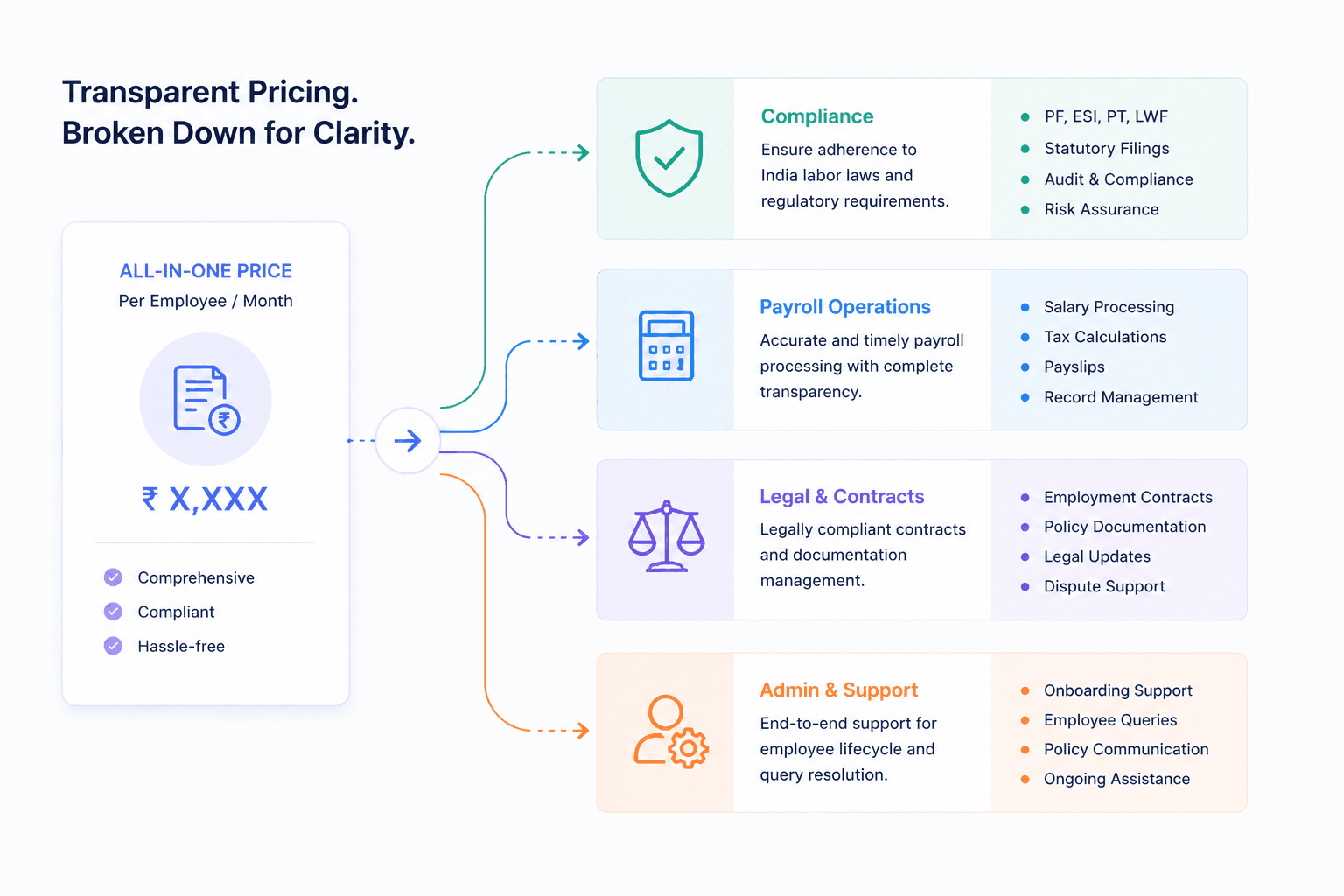
An India employer of record is a locally registered company that legally employs your India team on your behalf. You retain full control over hiring decisions, salaries, titles, and day-to-day work direction. The EOR handles the Indian legal and compliance infrastructure: employment contracts, payroll processing, Provident Fund contributions at 12%, ESI, TDS withholding, gratuity, and statutory filings.
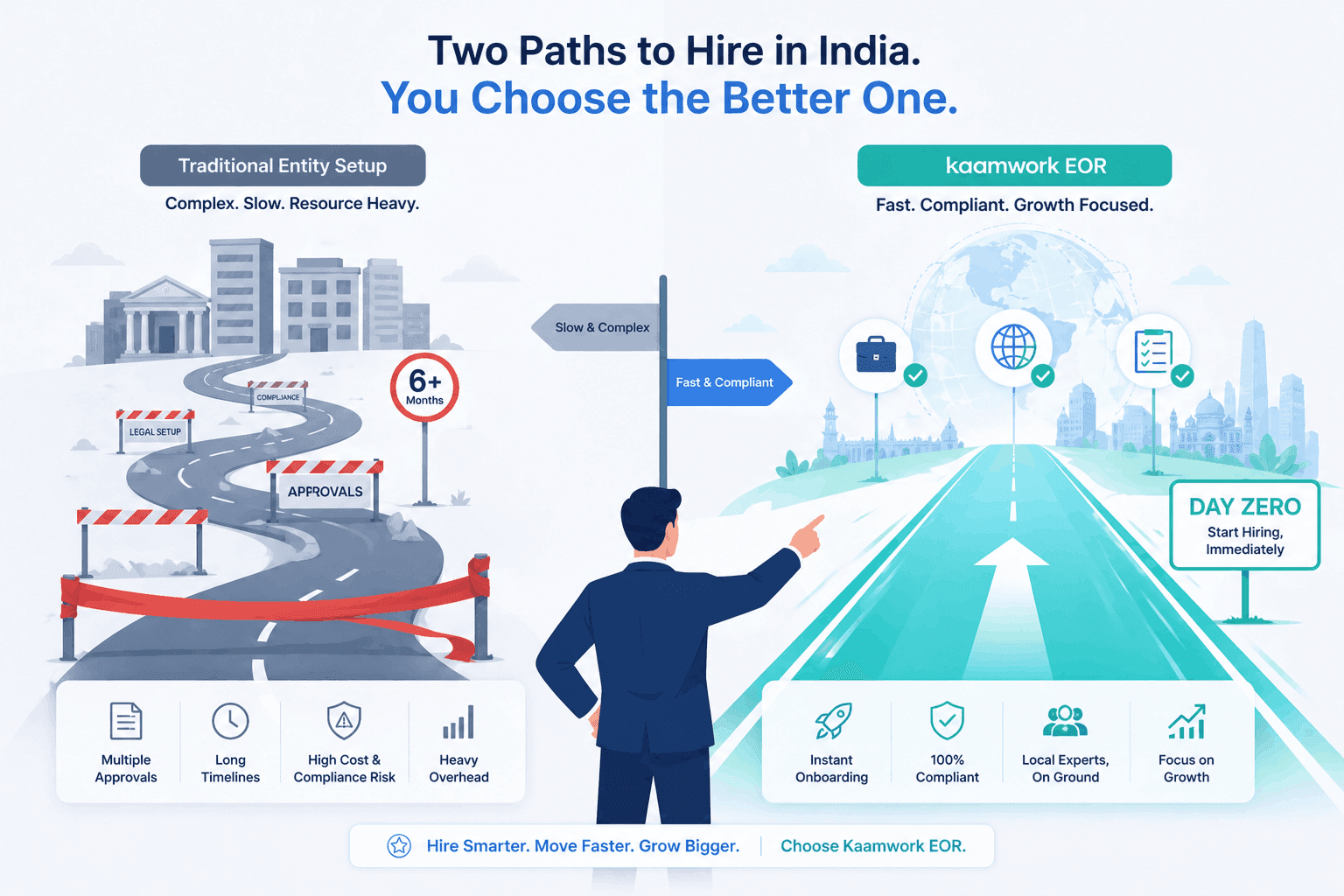
This removes the need to set up your own Indian entity, which typically takes three to six months and requires a sustained investment in local finance, legal, and HR infrastructure.
The compliance case for an india employer of record is well understood. The retention case is not.
Most EOR providers treat their job as done once the employee is onboarded and the first payroll runs. The employee is now legally employed, correctly paid, and compliant. The EOR's work is finished.
What happens next is the part most providers do not touch. The 6-month check-in. The 12-month appraisal. The conversation about career growth. The flag that an employee is disengaged before it becomes a resignation. The local HR support that makes someone feel like a person, not a payroll line item.
This is the gap between compliance and retention. And it is where Kaamwork is built differently.
What Kaamwork Does Differently: A Practical Breakdown
We describe our model as a tech EOR platform plus local HR support. Here is what that means in practice.
You Own Every Hiring Decision
This is not outsourcing. You are interviewed. You choose. You set the salary and the title. You manage the work. We handle the India-side legal execution so that hire is fully compliant from day one.
You are not buying a managed team. You are building your team, with Kaamwork as the infrastructure that makes it possible.
Onboarding in 48 to 72 Hours
There is no entity setup wait. No 60-day registration process. No compliance backlog to clear before your first hire can start. Once you have made an offer and the candidate accepts, onboarding happens within three business days.
India Market Salary Advisory
Before you make an offer, we tell you what the market is actually paying for that role in that city. This is not a generic benchmark. It is real data from our experience across multiple companies hiring in the same talent pools.
One conversation here can prevent six months of avoidable attrition. An under-market offer might get accepted. It will get revised.
Local HR on the Ground
Your offshore engineer has a real human contact when something goes wrong. Not a portal. Not a ticket. A person who knows them by name.
We operate as your ears and eyes on the ground. We proactively surface concerns before they escalate into resignation letters. This early detection is one of the most underrated retention tools available.
Career Lifecycle Management
Appraisals, promotions, and performance reviews all run through the Kaamwork platform. Your offshore team can see a clear career path. They know what the next level looks like and how to get there.
This matters more than most US founders realise. Indian tech professionals are not just looking for good pay. They are looking for a future. When you give them one, they stay.
Belonging Through Physical Touchpoints
Welcome kits when new hires join. Periodic offsites. Customised benefits packages that reflect what your specific team values. These are not perks. They are signals.
The offshore team is not just a Slack handle. They are colleagues. When they feel that, they behave like colleagues. They stay, contribute, and grow.
GCC and Owned Entity vs Kaamwork EOR: The Overhead Problem
Some founders decide that the answer to offshore attrition is to build their own India entity or a global capability center. I understand the instinct. Full control, your own infrastructure, your own culture.
But here is what that actually looks like in practice.
The bureaucracy layer builds fast.
Before your first engineer writes a single line of code, you need a Country Head. A Head of HR. A finance manager. A local compliance officer. A registered entity, which takes three to six months to establish and requires sustained legal and accounting support.
Each layer adds overhead cost and slows every decision. You wanted speed. You got a committee.
The 'Low Cost Office' Problem
When an Indian country head sits between your US product manager and the engineering team, something happens. Communication slows. The India team starts to feel like a different operation rather than a core part of the company. They hear about decisions after they are made. They contribute to execution, not to strategy.
That feeling creates its own kind of attrition. Engineers who feel like they are in a second-tier operation start looking for roles where they feel more central.
Overhead Costs Eat the Savings
The 65% salary cost advantage of hiring in India disappears quickly when you add entity setup costs, office leases, statutory filings, local HR headcount, and compliance management. Companies that have done both consistently tell us that owning an entity absorbs 80% of the savings in overhead. Kaamwork fees, by contrast, replace that overhead at a fraction of the cost.
The Kaamwork Alternative: Agile by Design
With Kaamwork, each US manager works directly with their India team. There is no Country Head in the middle. Decisions happen at the team level. The India engineer understands the product and the mission because they are hearing it directly from the people building it.
That direct connection drives engagement. When your offshore engineer feels like a core part of the team rather than a distant resource, they stay.
The overhead savings also create a retention loop. When you are not spending on entity infrastructure, those savings can go into better appraisals and increments for the India team. Better compensation drives retention. This is the compounding effect that takes an offshore team from 25% attrition to under 5%.
You can read more about how this model works on our talent-centric model page.
The Real Cost of Ignoring Attrition
The direct cost is visible. Recruiter fees. Onboarding time. The productivity gap while a new hire finds their footing.
The hidden cost is larger.
• Knowledge walks out the door: When a senior engineer who has been with you for 18 months resigns, months of codebase familiarity and institutional context leave with them. That is not recoverable in a sprint or two.
• The team stays in catch-up mode: With 30% attrition on a 10-person team, you are constantly inducting new members. The team never reaches its ceiling because it is perpetually in a learning phase.
• Your India brand suffers: Bengaluru's tech community is small and highly connected. A reputation for high turnover or poor employee experience spreads fast. It makes every subsequent hire harder and more expensive.
• Replacement cost compounds: At 50 to 75% of annual salary per replacement, three exits a year on a 10-person team translates to a significant annual spend just to stay in place. That is money that should be going into product.
Is Your Current Offshore Setup Built to Retain?
Before you look for a new EOR, answer these questions honestly.
• Do your offshore engineers receive structured, annual appraisals? If your answer is 'the vendor handles it', that is not a retention strategy. That is a gap.
• Does your offshore team know your company mission? If their connection to the company is limited to a task list, they are contractors at heart regardless of their employment contract.
• Has your offshore team ever met your HQ team in person? Offsites and town halls are not perks. They are retention tools.
• Who does your offshore engineer call when something goes wrong at 9pm IST? If there is no clear answer, they are already thinking about their next move.
If two or more of those answers are uncomfortable, you are likely already losing people you should be keeping.
How to Switch to a Model That Retains Talent
If you decide to make a change, here is how I would think about it.
1. Audit your actual attrition number. Most companies track overall headcount, not offshore team attrition separately. Get the real number first.
2. Ask your current provider what they do after onboarding. If the answer is process payroll and manage compliance, you have your diagnosis.
- Review your salary bands with someone who knows the India market. One honest look at your current compensation structure can prevent months of avoidable attrition.
4. Identify who the local HR contact is for your offshore team. If nobody knows, create that point of contact before the next resignation hits your inbox.
5. Talk to Kaamwork. Companies currently on another EOR can switch through a structured transition path without operational downtime. The transition is planned, not disruptive.
Conclusion
The team with 30% attrition does not have a bad team. They have a bad model.
The offshore talent in India is exceptional. When you build the right infrastructure around them, they stay, they grow, and they deliver. When you treat them as interchangeable contractors managed through a portal, they leave. It is that straightforward.
Choosing the right Indian employer of record is not just a compliance decision. It is a retention decision. If you are ready to build an offshore team that stays for the long run, talk to us at Kaamwork.
Frequently Asked Questions
- What is an India employer of record?
An india employer of record is a locally registered company that legally employs your India-based team on your behalf. It manages payroll, statutory contributions like Provident Fund (12%), ESI, and TDS, as well as employment contracts and compliance. You retain full control over hiring decisions, salaries, and day-to-day work direction.
- What is a healthy attrition rate for an offshore team in India?
Under 10% is considered stable for a full-time offshore team. The Indian IT sector average sits between 13 and 17% nationally, though specific cities and models see higher rates. Kaamwork's clients average under 5%. Companies using contractor or agency models often see 25 to 30% on their own teams.
- How does an Indian employer of record help reduce offshore attrition?
A standard EOR removes compliance friction, which is a good start. But attrition is ultimately a retention problem, not a compliance problem. An EOR that also provides local HR support, career lifecycle management, salary benchmarking, and proactive employee engagement addresses the actual causes of attrition, not just the legal structure around them.
- What is the difference between a GCC and using an EOR in India?
A GCC (Global Capability Centre) is your own legal entity in India, requiring significant upfront investment in infrastructure, a local leadership layer, and ongoing overhead. An EOR removes that overhead entirely. Your team is employed through the EOR's existing legal infrastructure, which means you can onboard your first hire in days rather than months and scale without building a parallel corporate structure.
- What is the difference between Kaamwork and a standard EOR?
Most EOR providers handle payroll and compliance, then step back. Kaamwork's model pairs the technology platform for compliance with on-the-ground local HR support. This means proactive employee engagement, structured appraisals and promotions through the platform, salary benchmarking, welcome kits, and offsites. The compliance is the baseline. The retention infrastructure is the differentiator.
- How quickly can I switch from my current EOR to Kaamwork?
Kaamwork has a structured Switch to Kaamwork path designed specifically for companies transitioning from another provider. The transition is planned, not disruptive. Your team remains employed throughout, and the switch does not require operational downtime.
Share this article

Founder & CEO | Kaam.Work
Nilesh Parwani, a Kelley School BBA graduate, worked at UBS and Warburg Pincus before founding PrintBell (acquired by Cimpress). In 2020, he launched kaam.work, a remote work platform focused on flexible talent and distributed teams.