India EOR pricing: what you'll actually pay in 2026
Every EOR provider has a pricing page. Deel says $599/month. Oyster says $699/month. RemoFirst says $199/month. Buyers compare those numbers, pick the cheapest one, and think the job is done. It's not. The monthly platform fee is the visible layer of India EOR pricing. The invisible layer, the one that actually determines what you pay, is the employment cost sitting underneath: salary, provident fund contributions at 12% of PF wages (per EPFO), ESI at 3.25% employer share (per ESIC), gratuity

ByNilesh Parwani / April 24, 2026 / 15 min read
- India EOR pricing at a glance
- The short answer: the monthly fee is only the beginning
- Public starting prices in 2026
- What these prices usually include
- What they do NOT replace
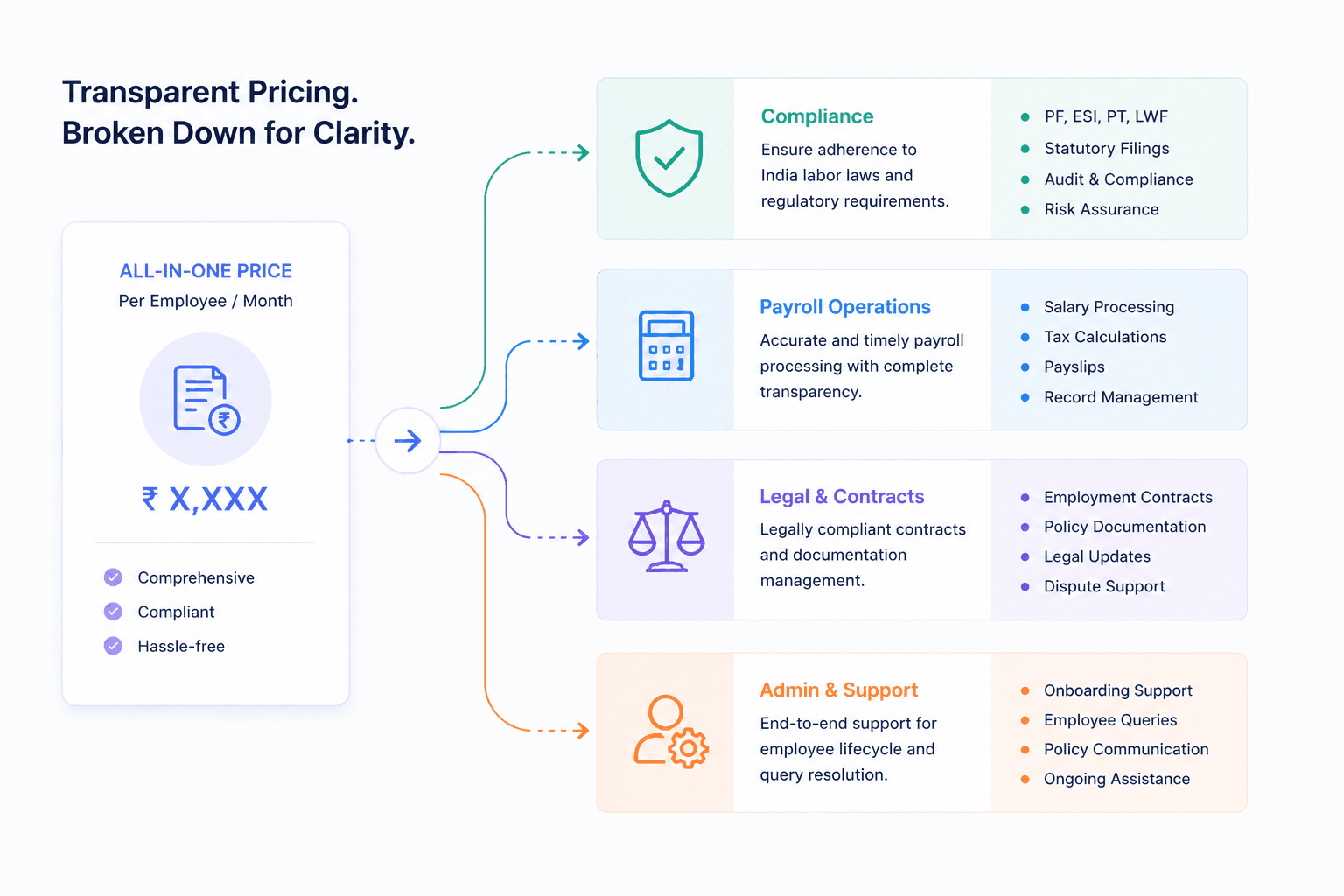
- What makes up the true cost of India EOR?
- Layer 1: EOR platform fee
- Layer 2: Employee salary
- Layer 3: Statutory employer costs
- Layer 4: Benefits and optional extras
- Provider pricing comparison: Deel vs Oyster vs RemoFirst vs Multiplier
- Deel ($599/mo)
- Oyster ($699/mo)
- RemoFirst ($199/mo)
- Multiplier ($400/mo)
- Editorial note on pricing accuracy
- Statutory costs in India that sit on top of the monthly fee
- EPF: the 12% you can't avoid
- ESI: only applies below the threshold, but hits hard when it does
- Gratuity: the accrued liability nobody budgets for
- Professional tax: state-specific, not uniform
- Bonus and leave liabilities
- Why the same EOR fee can produce very different total costs
- Benefits and optional costs buyers often miss
- Insurance and supplemental benefits
- Equipment, onboarding, and admin extras
- Offboarding, severance, and final settlement
- Volume discounts and contract commitments
- Real cost scenarios: what you'll actually pay
- Scenario 1: one employee on a premium EOR
- Scenario 2: one employee on a low-cost EOR
- Scenario 3: team of 10
- Scenario 4: team of 25+
- Which India EOR is cheapest, and which is best value?
- Cheapest list price
- Mid-priced
- Premium-tier
- Best value depends on use case
- When the monthly fee matters most
- Very small teams (1-3 hires)
- Mid-size teams (10-20)
- Large India teams (25+)
- What you'll actually pay for India EOR in 2026
Every EOR provider has a pricing page. Deel says $599/month. Oyster says $699/month. RemoFirst says $199/month. Buyers compare those numbers, pick the cheapest one, and think the job is done.
It's not.
The monthly platform fee is the visible layer of India EOR pricing. The invisible layer, the one that actually determines what you pay, is the employment cost sitting underneath: salary, provident fund contributions at 12% of PF wages (per EPFO), ESI at 3.25% employer share (per ESIC), gratuity accrual, professional tax, insurance, equipment, and whatever else your specific hire needs. Two companies using the same EOR provider, paying the same monthly fee, can end up with total employer costs that differ by 30-40% depending on salary band, state of employment, and benefits package.
This guide breaks down all of it. Provider pricing, statutory costs, hidden extras, and real cost scenarios with actual math. Because if you're comparing India EOR providers on monthly fee alone, you're comparing the wrong number.
India EOR pricing at a glance
Sources: EPFO contribution schedule, ESIC rate notification, Payment of Gratuity Act 1972, Payment of Bonus Act 1965, state professional tax slabs.
The short answer: the monthly fee is only the beginning
Public starting prices in 2026
Here's what the big global EOR providers list on their pricing pages as of early 2026:
- Deel: $599/month per employee (public pricing page)
- Oyster: $699/month per employee (per comparison sources including EOR HQ)
- RemoFirst: $199/month per employee (public pricing page)
- Multiplier: $400/month per employee (per comparison sources including EOR HQ)
These are starting prices. Actual pricing depends on country, volume, contract length, and negotiated discounts. But they give you the bracket.
What these prices usually include
The monthly EOR fee typically covers the compliance infrastructure: registering the employee under a local entity, drafting an India-compliant employment contract, running monthly payroll with correct salary structuring, calculating and depositing PF and ESI contributions, withholding TDS under Section 192 of the Income Tax Act, filing statutory returns, issuing payslips and Form 16, and providing an HR platform for leave management, document storage, and basic employee support.
That's the administrative backbone. And for most providers, the fee covers it reasonably well.
What they do NOT replace
The monthly fee does not include the employee's salary. It does not include the employer's share of provident fund contributions. It does not include ESI premiums. It does not include gratuity liability. It does not include professional tax, statutory bonus obligations, health insurance, equipment, onboarding costs, or offboarding reserves.
Those costs sit on top of the platform fee. And for a mid-to-senior employee in India, they're significantly larger than the fee itself.
What makes up the true cost of India EOR?
Layer 1: EOR platform fee
This is the number on the pricing page. It ranges from $199 to $699/month depending on provider, and it's the only cost that shows up in a side-by-side comparison of EOR vendors. For a detailed guide to what EOR actually does in India, see the full breakdown at.
The fee is real, but it's the smallest component of your total monthly employer cost for any employee earning above entry-level wages.
Layer 2: Employee salary
Salary is the single largest component. A mid-level software engineer in Bangalore might cost Rs 1,20,000-1,80,000/month in CTC. A senior data scientist could run Rs 2,50,000-3,50,000/month. An entry-level QA analyst in Pune might be Rs 40,000-60,000/month.
The EOR fee is the same regardless of salary. But the statutory costs that sit on top of salary scale proportionally. A Rs 3,00,000/month employee generates far more employer-side statutory cost than a Rs 60,000/month employee, even though both are on the same EOR plan.
Layer 3: Statutory employer costs
This is where most foreign buyers underestimate. India has mandatory employer contributions that are calculated as percentages of salary components, and they're not optional. The EOR provider handles the compliance, but the cost flows through to you.
EPF: 12% of PF wages (per EPFO). ESI: 3.25% for employees earning below Rs 21,000/month gross (per ESIC). Gratuity accrual: approximately 4.81% of basic wages, accrued as a long-term liability. Professional tax: state-specific, typically Rs 200 per month in most states, up to Rs 2,500/month in states like Maharashtra. Statutory bonus: applicable where wages fall under the Payment of Bonus Act threshold.
For a detailed walkthrough of PF, ESI, TDS mechanics, and the November 2025 Labour Code changes, see the complete employer of record India guide.
Layer 4: Benefits and optional extras
On top of statutory costs, most companies provide additional benefits: group health insurance (often Rs 5,000-15,000+/year per employee depending on coverage and family inclusion), life insurance, meal vouchers, internet allowances, and similar perks. Equipment procurement, typically a laptop and peripherals, runs $800-$2,000 as a one-time cost. Some EOR providers bundle basic insurance in their fee. Others charge separately.
Provider pricing comparison: Deel vs Oyster vs RemoFirst vs Multiplier
Sources: Provider public pricing pages (accessed March 2026), EOR HQ comparison data.
Deel ($599/mo)
Deel is the most recognizable name in global EOR. Their India operations run through a local entity, and they handle PF, ESI, TDS, and professional tax as part of the standard service. The $599 starting price is for a single employee; per EOR HQ's negotiated pricing data, companies hiring 20+ employees can potentially negotiate down to the $400-$500/month range. Deel also offers contractor management at a lower tier, which some companies use as a bridge before converting to full-time EOR.
Oyster ($699/mo)
Oyster's listed starting price of $699/month makes it the most expensive provider by list price among the four compared here. The platform is well-built for distributed teams and includes compliance features, but the India-specific depth of documentation and support varies. For companies already using Oyster in other markets and adding India, the premium may make sense operationally. For India-first or India-heavy hiring, it's harder to justify on price alone.
RemoFirst ($199/mo)
RemoFirst's $199/month price point is aggressively low and attracts budget-conscious buyers. The question is what you're getting for that price in the India market specifically. India payroll involves salary structuring decisions that directly affect PF liability (the 50% basic-pay floor under the Labour Codes), ESI applicability thresholds, and tax optimization. For companies running payroll in India, the depth of local expertise matters. A lower price is only cheaper if the compliance quality holds up. For more on India payroll complexity, see the payroll guide.
Multiplier ($400/mo)
Multiplier sits in the middle tier at approximately $400/month. They have a strong Asia-Pacific presence and have been building out India operations. For companies that want more India depth than a pure-global provider but don't want to pay premium pricing, Multiplier is worth evaluating. Their platform handles standard compliance, and pricing can be negotiated for multi-employee deployments.
Editorial note on pricing accuracy
These prices are starting prices pulled from public pricing pages and comparison sources as of early 2026. Every provider offers custom pricing based on country, employee count, contract duration, and negotiated discounts. The number you actually pay will almost certainly differ from the listed starting price. Use these as brackets for comparison, not as quotes.
Statutory costs in India that sit on top of the monthly fee
This is the section that matters most. And it's the section that most EOR pricing comparisons skip entirely.
When a foreign buyer compares Deel at $599 versus RemoFirst at $199, the instinct is to see a $400/month difference and call it a day. But the statutory employment costs that sit on top of both fees are identical, they don't change based on your EOR provider, and they're often larger than the fee itself.
EPF: the 12% you can't avoid
The employer's share of the Employee Provident Fund is 12% of PF wages (per EPFO's current contribution schedule). The employee also contributes 12% from their salary, but that's a deduction from their CTC, not an additional employer cost.
Here's the part foreign buyers miss: the PF contribution is not included in the EOR provider's monthly fee. The EOR handles the calculation, deduction, and deposit. But the actual money comes from the employer, on top of the platform fee.
For an employee with PF wages of Rs 1,00,000/month, the employer's PF contribution is Rs 12,000/month. That's roughly $144/month at current exchange rates. On its own, it's close to the cost of a budget EOR provider's entire monthly fee.
After the November 2025 Labour Code changes, the wage definition rules became stricter. The 50% basic-pay floor means companies can't aggressively minimize PF wages through allowance-heavy structures the way some did historically. This has pushed PF costs higher for many salary bands.
ESI: only applies below the threshold, but hits hard when it does
The Employee State Insurance scheme requires employer contributions of 3.25% for employees earning gross wages below Rs 21,000/month (per ESIC's latest notification). The employee contributes an additional 0.75%.
For higher-salary tech roles, ESI typically doesn't apply because most engineers, developers, and data scientists earn well above the threshold. But for operations staff, junior QA, support roles, or any position in the Rs 15,000-21,000/month range, ESI adds a meaningful percentage on top of salary.
This is one of the reasons two employees on the same EOR plan can have different total costs. Salary band determines ESI applicability.
Gratuity: the accrued liability nobody budgets for
Under the Payment of Gratuity Act 1972, employees who complete five years of continuous service are entitled to a gratuity payment calculated as 15 days' wages for each year of service. Smart EOR providers accrue this liability monthly, typically at approximately 4.81% of basic wages, rather than hitting you with a lump sum when an employee eventually exits.
But here's the thing. Many foreign buyers looking at short-term or project-based EOR engagements don't expect gratuity to matter. "We're only hiring for two years." Fine. But if the employee stays for five, the liability crystallizes. And if your EOR provider hasn't been accruing it monthly, you'll get a bill at the end that you didn't plan for.
Gratuity is one of the most overlooked line items in India EOR cost comparisons.
Professional tax: state-specific, not uniform
Professional tax varies by state in India. Karnataka charges Rs 200/month for most salaried employees. Maharashtra charges up to Rs 2,500/month for higher salary brackets. Some states don't levy it at all.
It's a small number individually, but for companies building teams of 15-20 people across multiple Indian states, the variation adds up. And it's another cost that sits outside the EOR platform fee.
Bonus and leave liabilities
The Payment of Bonus Act requires employers to pay a statutory bonus (minimum 8.33%, maximum 20% of wages) to employees earning below the salary threshold specified in the Act. Leave encashment for unused earned leave is another liability that accumulates and must be settled at exit, actually sometimes even during employment depending on company policy.
These costs are periodic rather than monthly, which is exactly why they get missed in monthly EOR pricing comparisons.
Why the same EOR fee can produce very different total costs
Two companies, both using the same EOR provider at the same monthly fee, hiring employees in India. Company A hires a senior backend engineer in Bangalore at Rs 2,00,000/month CTC. Company B hires a customer support lead in Pune at Rs 45,000/month CTC.
Company A's statutory employer costs (PF, gratuity accrual, professional tax) will be significantly higher in absolute terms because they're percentage-based on a larger salary. Company B might trigger ESI contributions that Company A's hire doesn't, because the lower salary falls below the ESI threshold.
Same provider. Same fee. Different total employer cost. That's why comparing EOR pricing on platform fee alone gives you an incomplete picture.
Benefits and optional costs buyers often miss
Insurance and supplemental benefits
Most companies hiring in India through EOR provide group health insurance. Coverage levels range from Rs 3,00,000 to Rs 10,00,000+ per employee per year, with premiums varying based on coverage amount, family inclusion, and insurer. Some EOR providers include basic insurance in their fee; others offer it as an add-on at $30-$100+/month per employee.
Beyond health insurance, companies sometimes add life insurance, personal accident cover, meal vouchers (up to Rs 2,200/month tax-free under current rules), and internet or home-office allowances. These are optional but increasingly expected by mid-to-senior candidates in the Indian market.
Equipment, onboarding, and admin extras
Laptop procurement in India typically costs $800-$1,500 for a standard development machine, up to $2,000+ for higher-spec configurations. Kaamwork handles laptop procurement and shipping as part of its onboarding service, but this is a cost that sits outside the monthly EOR fee regardless of provider.
Some providers charge separately for background verification, document notarization, or expedited onboarding. These are typically one-time costs in the $50-$200 range per employee, but they add up when you're hiring a team.
Offboarding, severance, and final settlement
India's labour laws require specific procedures at employee exit: notice period (typically 30-90 days or pay in lieu), earned leave encashment, gratuity payment if eligible, and a full-and-final settlement that reconciles all pending amounts. If the exit involves a layoff or retrenchment, additional severance obligations may apply under the Industrial Relations Code.
These costs are real but often zero in a buyer's initial budgeting because they're thinking about hiring, not about what happens when someone leaves. A good EOR provider accrues for these liabilities from day one. A cheaper one might not.
Volume discounts and contract commitments
EOR pricing is negotiable. Per EOR HQ's data on negotiated pricing, Deel's rate for companies hiring 20+ employees can drop to the $400-$500/month range. Most providers offer annual contract discounts versus month-to-month pricing. And some offer bundled pricing when you combine EOR with contractor management or other services.
The catch: volume discounts lock you into commitments. If you're uncertain about headcount, a slightly higher monthly fee with flexibility might be cheaper overall than a discounted rate with a 12-month minimum.
Real cost scenarios: what you'll actually pay
These scenarios use approximate numbers to illustrate how the different cost layers combine. Your actual costs will depend on specific salary structuring, state of employment, benefits decisions, and provider pricing.
Scenario 1: one employee on a premium EOR
Hiring a mid-level frontend developer in Bangalore through a premium EOR provider.
The EOR fee is $599 of that total. The employment cost underneath is roughly $1,058. The fee is about 36% of the total employer cost. The salary and statutory costs are 64%.
Scenario 2: one employee on a low-cost EOR
Same employee, same salary, same city. But using a low-cost provider at $199/month.
The savings versus the premium EOR: $400/month in platform fee. That's real money. But notice the total is $1,257 versus $1,657. The fee difference is $400, but total cost difference is also just $400 because everything else is identical.
The statutory costs don't care which provider you use. They're set by Indian law.
The real question is whether the lower-cost provider delivers the same quality of compliance, salary structuring, and HR support in India. If they do, the savings are genuine. If they cut corners on PF structuring or miss a professional tax filing, the "savings" could cost you in penalties and employee trust.
Scenario 3: team of 10
Hiring 10 engineers across Bangalore and Hyderabad, average CTC of Rs 1,50,000/month per person.
The monthly fee difference across 10 employees is $4,000. That matters. But the combined salary and statutory cost is roughly $19,693/month, which is the same regardless of provider. At this scale, the fee difference is about 16% of total employer cost. Salary and statutory obligations make up 84%.
Scenario 4: team of 25+
At 25 employees with an average CTC of Rs 1,80,000/month, your monthly salary and statutory bill alone crosses roughly $60,000+. The EOR fee at $599/month adds $14,975. At $199/month, it adds $4,975.
But at this headcount, a different calculation enters the picture: EOR versus setting up your own entity. Entity setup in India costs $15,000-$50,000 upfront with ongoing annual compliance costs (per industry estimates), but eliminates the per-employee EOR fee entirely. For 25 employees on a $599/month EOR, you're spending roughly $180,000/year on platform fees alone.
That's the point where the comparison shifts from "which EOR provider" to "should I still be using an EOR at all." For a deeper analysis of when entity setup makes more sense, see the EOR vs subsidiary comparison.
Which India EOR is cheapest, and which is best value?
Cheapest list price
RemoFirst at $199/month is the lowest listed price among major global EOR providers operating in India. For companies hiring one or two employees for short-term projects where India compliance depth is less of a concern, the price point is attractive.
Mid-priced
Multiplier at approximately $400/month occupies the middle ground. Stronger Asia-Pacific presence than pure-global providers, without the premium pricing of Deel or Oyster.
Premium-tier
Deel at $599/month and Oyster at $699/month represent the premium bracket. Deel has the strongest brand recognition and widest global coverage. Kaamwork also operates at the $599/month tier but differentiates on India-specific depth: the platform is built for India hiring specifically, with dedicated compliance teams, salary structuring expertise, and onboarding support that goes beyond what global-first providers typically offer.
Best value depends on use case
Cheapest list price is not the same as best value. An EOR provider that charges $199/month but doesn't properly structure salary to optimize PF contributions, or doesn't have the operational depth to handle multi-state professional tax filings, or doesn't accrue gratuity liability correctly from month one, isn't actually cheaper. The cost just shows up later, either as compliance penalties or as unexpected bills at offboarding.
For India specifically, the quality of local compliance and payroll operations matters more than it does for markets with simpler employment frameworks. India has federal and state-level labour laws, four new Labour Codes effective since November 2025, and employer obligations that vary by salary band, state, and sector.
Best value is the provider that gets the total employer cost right from month one, not the one with the lowest line item on the pricing page.
When the monthly fee matters most
Very small teams (1-3 hires)
For one to three employees, the monthly fee difference is highly visible in your budget. The gap between $199/month and $599/month per employee is $400-$1,200/month across the team. At this scale, every dollar of platform fee represents a meaningful percentage of your total India hiring spend. If the lower-cost provider delivers adequate India compliance, the savings are proportionally significant.
Mid-size teams (10-20)
At 10-20 employees, the fee delta multiplies. $400/month difference x 15 employees = $6,000/month or $72,000/year. That's a real budget item. But at this scale, salary and statutory costs also multiply, and they dominate total spend. The fee comparison still matters, but you're now spending more time evaluating operational quality, HR responsiveness, and compliance accuracy than you are comparing monthly rates.
Large India teams (25+)
At 25+ employees, the EOR-versus-entity question becomes more relevant than the provider fee comparison. Your annual EOR fees at premium pricing cross $150,000+, which approaches or exceeds the cost of incorporating and maintaining your own entity in India. Companies at this scale should be modeling the breakeven point between EOR and entity, not just shopping between EOR providers. Kaamwork supports this transition with consulting on India entity structure for companies that outgrow the EOR model.
What you'll actually pay for India EOR in 2026
The provider fee is the part you see on the pricing page. The employment cost is the part that actually determines your budget.
For a single mid-level hire in India, expect total monthly employer cost in the range of $1,200-$2,500 depending on salary, benefits, provider, and state. For a team of 10, expect $20,000-$30,000+/month in total employer cost, of which the EOR fee is $2,000-$7,000 and everything else is salary and statutory obligations.
Compare total monthly employer cost, not just the subscription fee. Ask providers to break down salary structuring, PF contribution basis, ESI applicability, gratuity accrual method, and what's included versus extra. The providers who can answer those questions clearly for the India market are the ones worth paying for.
If you want to see what your specific team would cost, the Kaamwork cost calculator models total employer cost including all statutory components. Or just get on a call and get real numbers for your roles.
Disclaimer: This guide provides general information about India EOR pricing as of April 2026. Statutory contribution rates, thresholds, and regulatory requirements are subject to change. Employer costs vary by employee salary, state of employment, benefits structure, and individual circumstances. This content is not legal, tax, or financial advice. Consult qualified professionals for decisions specific to your situation. Statutory rates cited from EPFO, ESIC, Payment of Gratuity Act, Payment of Bonus Act, and state professional tax legislation.
Share this article

Founder & CEO | Kaam.Work
Nilesh Parwani, a Kelley School BBA graduate, worked at UBS and Warburg Pincus before founding PrintBell (acquired by Cimpress). In 2020, he launched kaam.work, a remote work platform focused on flexible talent and distributed teams.