India's AI talent boom: why Hyderabad, Pune, and Chennai are the new Bangalore
Bangalore is still India's largest and deepest AI talent market. That is not changing any time soon. But something else is happening that most US and European employers have not caught up to yet. GCC expansion, salary inflation, and intense hiring competition in Bangalore are redistributing AI talent and AI hiring across India's other major cities. Hyderabad is growing its AI and GCC footprint faster than any other Indian metro. Pune is quietly becoming a strong base for applied AI and product

ByNilesh Parwani / April 26, 2026 / 12 min read
- India's AI talent market at a glance
- India's AI boom is bigger than Bangalore
- Bangalore still leads, but the market is broadening
- AI demand is scaling through GCCs, not just startups
- The next wave is about distribution, not replacement
- Why companies are looking beyond Bangalore
- Talent saturation and competition
- GCC expansion is driving new geographic choices
- Specialized AI hiring is replacing broad-based hiring
- Cost pressure matters, but it needs careful framing
- Hyderabad: the fastest-rising AI and GCC hub
- Why Hyderabad is gaining ground
- Where Hyderabad is strongest
- Why employers like Hyderabad
- What Hyderabad means for hiring strategy
- Pune: the quiet winner for applied AI and product engineering
- Why Pune matters
- Where Pune fits best
- Why Pune is underestimated
- Chennai: the underrated AI and enterprise engineering hub
- Chennai's place in India's AI map
- Why Chennai is strategically interesting
- The trade-off
- Are these really tier-2 cities? Not exactly, but they show where the market is going
- Hyderabad, Pune, and Chennai are not classic tier-2 cities
- But they are the bridge to the next phase
- The true tier-2 story is just beginning
- What GCC expansion tells us about the future of AI hiring in India
- AI hiring is increasingly tied to GCC strategy
- Location strategy is now a competitive advantage
- Why this matters for employers
- Salary pressure and the "lower than Bangalore" opportunity
- What we can say confidently
- What needs careful wording
- What this means for your hiring strategy
- Don't default to Bangalore for every AI hire
- Match city to function
- Build a portfolio approach
- Prepare for the real tier-2 phase
- The future of India AI hiring will be multi-city
Bangalore is still India's largest and deepest AI talent market. That is not changing any time soon. But something else is happening that most US and European employers have not caught up to yet.
GCC expansion, salary inflation, and intense hiring competition in Bangalore are redistributing AI talent and AI hiring across India's other major cities. Hyderabad is growing its AI and GCC footprint faster than any other Indian metro. Pune is quietly becoming a strong base for applied AI and product engineering teams. Chennai is emerging as an underrated hub for enterprise AI and data platform work.
And behind all three, a wave of true Tier-2 cities (Mohali, Jaipur, Kochi, Indore, Coimbatore) is starting to show up in GCC expansion plans for the first time.
This article covers what is actually happening in each city, what it means for employer hiring strategy, and why the companies building AI teams in India through models like EOR (kaam.work/solutions/eor-india) are increasingly thinking in terms of city portfolios rather than single-city bets.
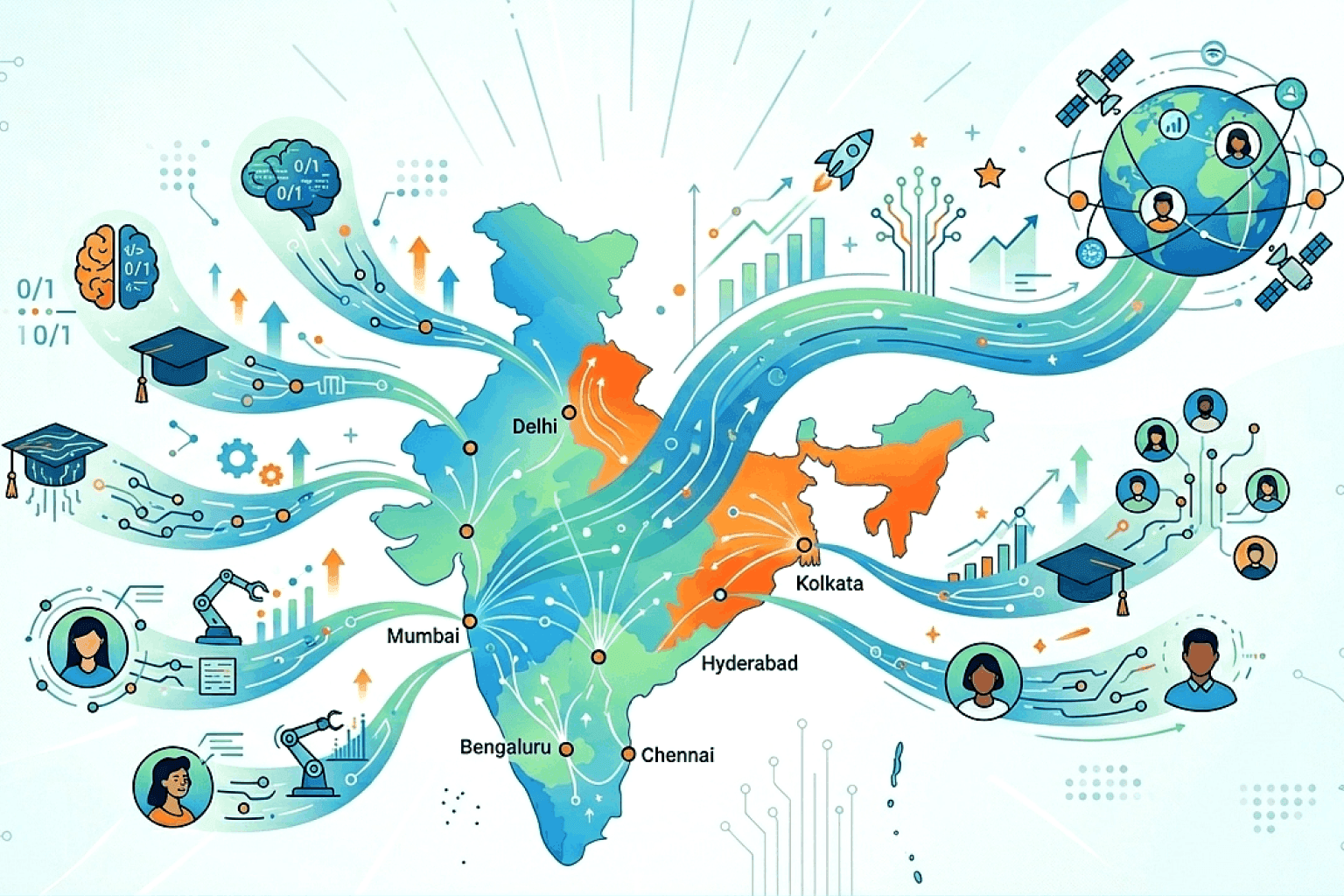
India's AI talent market at a glance
Sources: NASSCOM 2025–2026 workforce reporting, CBRE India GCC research, Economic Times GCC and AI hiring coverage.
India's AI boom is bigger than Bangalore
Bangalore still leads, but the market is broadening
Bangalore accounts for the largest share of India's AI job market by every measure: volume of openings, senior talent density, startup presence, and GCC concentration. CBRE and Economic Times reporting puts Bangalore's tech workforce at over 1 million, making it one of the largest technology labor markets in the world. When most international employers think "hire AI talent in India," they think Bangalore. And that instinct is not wrong.
But it is incomplete.
AI demand is scaling through GCCs, not just startups
India's AI workforce reached 126,000+ AI-aligned roles as of 2025–2026, according to industry workforce tracking from NASSCOM. That growth is not primarily startup-driven. GCCs operated by companies like Salesforce, Qualcomm, Wells Fargo, SAP, and DBS Bank are adding AI, ML, and data science capacity across multiple Indian cities. Bangalore, Hyderabad, and Chennai are consistently named as the primary hubs in this expansion.
The shift matters because GCC hiring follows a different geographic logic than startup hiring. Startups cluster where founders and venture capital cluster, which means Bangalore. GCCs open where the talent-cost-infrastructure equation works best, which increasingly means Hyderabad, Pune, and Chennai alongside Bangalore.
The next wave is about distribution, not replacement
Nobody is arguing that Bangalore will stop being India's AI capital. What is happening is that the network around Bangalore is widening. More employers, especially international ones building their first or second India team, are distributing AI hiring across multiple cities rather than concentrating everything in one metro. That is a strategy shift worth understanding.
Why companies are looking beyond Bangalore
Talent saturation and competition
Bangalore's depth is also its pressure point. With a tech workforce exceeding 1 million professionals (per CBRE data cited by the Economic Times), the city has more qualified engineers than any other Indian metro. But it also has more employers competing for them. Google, Flipkart, Swiggy, Razorpay, and dozens of well-funded startups are all hiring from the same senior AI pool. For an international employer entering the market for the first time, that competition is real. You are not just competing on salary. You are competing on brand, mission, and speed.
GCC expansion is driving new geographic choices
India's top six cities account for 94% of the country's GCC footprint, according to CBRE India research. But within that top six, the distribution is shifting. Hyderabad's share of new GCC capacity has been growing faster than Bangalore's in 2025 and 2026. Chennai and Pune are both expanding their GCC presence. The geography of India's technology workforce is being reshaped by decisions happening inside global companies right now.
Specialized AI hiring is replacing broad-based hiring
Economic Times reporting on GCC workforce trends in 2026 shows a clear pattern: large capability centers are shifting away from volume-based hiring surges toward targeted recruitment of AI, cloud, and cybersecurity specialists. That specialization favors cities where the talent-to-competition ratio is better. In Bangalore, every AI specialist has five offers. In Hyderabad, the ratio is more manageable. In Pune and Chennai, it is more manageable still.
Cost pressure matters, but it needs careful framing
Non-Bangalore cities generally offer lower compensation pressure and lower operating costs. The exact gap depends on role, seniority, city, and company type. It would be easy to claim a blanket "30 to 40% savings" but the reality is messier. For some roles (senior ML engineers with GCC pedigree), the Hyderabad-to-Bangalore gap might be 10 to 15%. For applied AI and data science roles at mid-level, the gap in Pune or Chennai can be wider. The honest answer: compensation outside Bangalore is meaningfully lower in most cases, but the exact number needs benchmarking against the specific role you are hiring.
Hyderabad: the fastest-rising AI and GCC hub
Why Hyderabad is gaining ground
Hyderabad has moved from "second city" to genuine alternative over the past three years. GCC reporting from 2025 and 2026 consistently names Hyderabad alongside Bangalore as a primary hub for AI, ML, and data analytics hiring. Mid-market GCCs alone are projected to add 40,000 jobs across India by the end of 2026, according to Economic Times reporting, with Hyderabad called out as a key hub for that expansion.
The city's engineering ecosystem runs deeper than many international employers realize. Qualcomm runs significant chip design and AI research operations in Hyderabad. DBS Bank operates a major technology center here. SAP, Novartis, and Deloitte all have substantial Hyderabad engineering footprints. And the pipeline of engineers rotating out of these operations into the broader market creates a hiring pool with genuine production AI experience.
Where Hyderabad is strongest
Enterprise AI and platform engineering are Hyderabad's sweet spot. The GCC concentration means the city's engineers tend to have experience with large-scale systems, cloud infrastructure, and data platform work. AI/ML roles, data analytics, cloud architecture, and cybersecurity are the skill clusters growing fastest here.
For companies building product or platform teams that need to process significant data volumes, Hyderabad's workforce has a practical advantage: many candidates have already done this kind of work at GCC scale.
Why employers like Hyderabad
The hiring environment is less frantic than Bangalore. You are still competing for good people, but the offer-to-close ratio is better. Salary expectations are lower, attrition is more moderate, and the city's infrastructure (particularly the HITEC City and Financial District corridors) supports a professional work environment that global companies recognize.
What Hyderabad means for hiring strategy
Hyderabad is the strongest option for companies that want India AI capability at scale without Bangalore's full compensation and attrition pressure. If you are building a team of five or more AI engineers and you want a GCC-grade talent pool at a better cost ratio, this is the first city to evaluate (kaam.work/blog/building-offshore-teams-india-odc).
Pune: the quiet winner for applied AI and product engineering
Why Pune matters
Pune is part of the top cluster of GCC cities in India, sitting alongside Bangalore, Hyderabad, Chennai, Delhi NCR, and Mumbai in the group that accounts for nearly all of India's GCC operations. The city's engineering ecosystem has been quietly strong for decades, anchored by a dense university network (Pune University, COEP, Symbiosis) and a deep bench of IT product and services companies.
Where Pune fits best
Applied AI teams, product engineering, analytics-heavy functions, and mid-cost execution teams. Pune is not where you go for cutting-edge AI research hires. It is where you go when you need a reliable team of four to eight engineers who can build, integrate, and maintain ML pipelines for a product that already has a roadmap.
Companies like Barclays, Persistent Systems, and Cummins run engineering operations in Pune that include data science and analytics functions. The talent coming out of these organizations has practical, production-oriented experience.
Why Pune is underestimated
Less brand visibility than Bangalore or Hyderabad. Pune does not generate the same headlines or thought leadership coverage. But for employers who want strong technical execution without peak-market intensity, that lower visibility is an advantage. Fewer employers chasing the same candidates means faster hiring cycles and better acceptance rates.
The city's culture also skews toward stability. Engineers in Pune tend to stay longer than their Bangalore counterparts, partly because the cost of living is lower and partly because the job-hopping culture is less intense.
Chennai: the underrated AI and enterprise engineering hub
Chennai's place in India's AI map
Chennai appears alongside Bangalore and Hyderabad in nearly every 2025–2026 report on India's GCC and AI growth trajectory. It is the third or fourth city named, depending on the report, and it is consistently treated as a growing market rather than a mature one.
That positioning actually works in Chennai's favor. The city is not saturated, which means less competition for candidates, better retention, and more room to build.
Why Chennai is strategically interesting
Enterprise engineering depth is Chennai's core strength. PayPal, Caterpillar, BNY Mellon, and Standard Chartered all run engineering centers here. Freshworks, which reached a $3.5 billion valuation (per its 2021 IPO pricing) and built much of its engineering organization in Chennai, demonstrated that the city can support product-grade engineering at scale. Zoho, headquartered in Chennai, has built one of India's largest self-funded software companies with engineering teams that span product, infrastructure, and AI.
Chennai's AI-specific depth is narrower than Bangalore's or Hyderabad's. Where Chennai excels is in the infrastructure that supports AI: data engineering, platform reliability, backend systems, and enterprise integration. If your AI team needs a strong data platform underneath it, Chennai has the engineers who build that layer.
The trade-off
Chennai has less "AI buzz" than Bangalore. The startup ecosystem is smaller, the venture capital presence is thinner, and candidates with five years of pure ML model-building experience are harder to find here than in Bangalore or Hyderabad. But for enterprise-oriented teams where you need stable, long-tenure engineers working on data pipelines, model serving infrastructure, and backend AI systems, Chennai's lower attrition and practical engineering culture are genuine advantages (kaam.work/blog/silicon-valley-to-bengaluru-hiring-model-india).
Are these really tier-2 cities? Not exactly, but they show where the market is going
Hyderabad, Pune, and Chennai are not classic tier-2 cities
This distinction matters. Hyderabad, Pune, and Chennai are major Indian metros with populations exceeding 5 million each, established tech ecosystems, and significant GCC presence. Calling them "tier-2" would be inaccurate. They are India's second tier of AI hiring markets, which is a different statement.
But they are the bridge to the next phase
The same forces pushing AI hiring from Bangalore into Hyderabad, Pune, and Chennai (cost pressure, talent competition, GCC geographic diversification) are already pushing exploratory expansion into cities below these four. That is the pattern to watch.
The true tier-2 story is just beginning
Economic Times reporting on GCC expansion trends names cities like Mohali, Jaipur, Kochi, Indore, Coimbatore, and Bhubaneswar as emerging locations where costs and competition are lower and infrastructure is developing. None of these cities has a mature AI talent ecosystem today. But five years ago, nobody was calling Hyderabad an AI hub either.
The trajectory is clear. As the top four cities get more expensive and competitive, the next ring of Indian cities will absorb an increasing share of GCC and technology hiring. Companies that start building relationships and sourcing pipelines in these markets now will have an advantage when the shift accelerates.
What GCC expansion tells us about the future of AI hiring in India
AI hiring is increasingly tied to GCC strategy
India's GCCs are no longer back-office operations running payroll and IT support. They are building products, running AI research, and owning technical strategy for global enterprises. That shift changes the geography of AI hiring because GCCs choose cities based on talent availability, infrastructure, cost structure, and expansion capacity, not based on where the founders happen to live.
The 2025–2026 data is consistent: GCCs are adding AI, ML, data analytics, and cloud roles at scale. Mid-market GCCs (companies with fewer than 500 GCC employees) are projected to add 40,000 positions by end of 2026, per Economic Times analysis. A meaningful share of those roles are AI-adjacent.
Location strategy is now a competitive advantage
Companies are no longer just asking "can we hire AI talent in India?" That question was answered years ago. The question now is "where in India should we build our next capability center or AI pod?" And the answer depends on what you are optimizing for.
If you want speed and depth, Bangalore is the answer. If you want scale at a better cost ratio, Hyderabad. If you want reliable applied AI execution, Pune. If you want enterprise engineering stability, Chennai. The city-level decision has become a strategic variable, not an afterthought.
Why this matters for employers
City choice affects everything downstream: compensation benchmarks, attrition rates, time to fill, candidate quality by role type, and long-term team stability. Treating all of India as one market and defaulting to Bangalore for every hire leaves real value on the table. The employers getting this right are the ones thinking about city-role fit with the same rigor they apply to role-candidate fit.
Salary pressure and the "lower than Bangalore" opportunity
What we can say confidently
Bangalore has the most competitive talent market in India for AI roles. Compensation expectations are highest here, driven by competition from global GCCs, well-funded startups, and other international employers all chasing the same senior engineers.
Hyderabad, Pune, and Chennai all offer lower compensation pressure than Bangalore for equivalent roles. This is consistently supported by salary benchmarking data from SalaryExpert, hiring activity data from job platforms, and GCC expansion patterns that explicitly cite cost as a factor in city selection.
For applied AI, data science, and product engineering roles at mid-level, the gap between Bangalore and these other cities is often meaningful. Enough to change the math on team size and hiring speed.
What needs careful wording
A blanket "30 to 40% lower than Bangalore" would be too clean. The actual gap varies by role, seniority, company type, and specific city. A senior ML engineer with GCC experience might command only 10 to 15% less in Hyderabad than in Bangalore. A mid-level data scientist in Pune might cost 20 to 25% less. A data engineer in Chennai might be 15 to 20% less.
The directional signal is clear: building outside Bangalore saves money. The specific savings require role-level benchmarking, which is something the cost calculator at kaam.work/global-cost-calculator handles on a case-by-case basis.
Stating this honestly makes the argument stronger. Employers trust data that acknowledges complexity over data that pretends everything is simple.
What this means for your hiring strategy
Don't default to Bangalore for every AI hire
The instinct to hire in Bangalore is understandable. It has the most candidates, the most brand recognition, and the deepest talent at every level. But for many roles, the cost and competition pressure of Bangalore is a liability rather than an advantage. If the role does not specifically need Bangalore's unique depth (senior research, startup-grade product builders, highly specialized ML architects), consider whether another city gives you a better outcome.
Match city to function
The most effective India AI hiring strategies match city strengths to role requirements:
Bangalore for senior and leadership hires, research-adjacent roles, and positions where you need the absolute deepest candidate pool. Hyderabad for enterprise AI teams, platform engineering, and scaling from five to twenty engineers at a competitive cost ratio. Pune for applied AI, product engineering, and analytics teams where reliable execution matters more than cutting-edge novelty. Chennai for data platform teams, backend AI infrastructure, and roles where long-term retention and engineering stability are priorities (kaam.work/core-services/onboard-and-manage).
Build a portfolio approach
The companies getting the best results from India AI hiring are not betting everything on one city. They anchor a senior team in Bangalore or Hyderabad, then expand into a second city for scale or cost efficiency. Some run distributed teams across three cities, using remote-first practices to let the best candidate win regardless of geography.
This portfolio model is easier to execute than it sounds, especially through an EOR that handles compliance across Indian states without requiring a separate entity in each city. Kaamwork operates across all four cities with the same flat $599/month per employee model (kaam.work/pricing), which means adding a Pune hire to a Bangalore team does not require any new infrastructure.
Prepare for the real tier-2 phase
The forces pushing AI hiring from Bangalore to Hyderabad, Pune, and Chennai will eventually push it further. Mohali, Jaipur, Kochi, Indore, Coimbatore, and Bhubaneswar are not ready for large-scale AI team building today. But they will be. Companies that build sourcing pipelines and local relationships in these markets ahead of the curve will have an advantage when the shift happens.
The future of India AI hiring will be multi-city
Bangalore still matters, and it will continue to matter for a long time. If you need the single deepest pool of senior AI talent in India, there is no substitute.
But India's AI hiring story is no longer a one-city story. Hyderabad has real depth in enterprise AI and is growing faster than any other metro. Pune is a practical, cost-effective base for applied AI and product teams. Chennai offers stability and enterprise engineering strength that Bangalore cannot match at the same cost.
The 126,000+ AI roles across India are not evenly distributed, but they are more distributed than they were two years ago. And the distribution will keep widening as GCCs expand, salary pressure in Bangalore intensifies, and employers discover that building in a second or third Indian city is not a compromise. It is a strategy.
Start with the cost calculator at kaam.work/global-cost-calculator to see what your India AI team costs by city. Then talk to us about building the plan (kaam.work/talk-to-us).
Disclaimer: Workforce and GCC data referenced in this article is based on 2025–2026 reporting from NASSCOM, CBRE India, and the Economic Times. Salary comparisons are directional and based on industry benchmarking; actual compensation varies by role, seniority, company, and city. Kaamwork pricing is current as of April 2026.
Share this article

Founder & CEO | Kaam.Work
Nilesh Parwani, a Kelley School BBA graduate, worked at UBS and Warburg Pincus before founding PrintBell (acquired by Cimpress). In 2020, he launched kaam.work, a remote work platform focused on flexible talent and distributed teams.