H-1B vs EOR: Complete Cost Comparison Calculator
Every H-1B cost calculator online does the same thing: add up USCIS filing fees and give you a total. Useful, but it answers the wrong question. The question most employers actually need answered is not "what does H-1B cost?" It is "should I sponsor at all, or is there a faster and cheaper way to hire this person?" This calculator does both. Enter a role, salary, and candidate location, and get a side-by-side comparison of H-1B sponsorship cost versus EOR employment cost. The tool routes you in

ByNilesh Parwani / April 26, 2026 / 9 min read
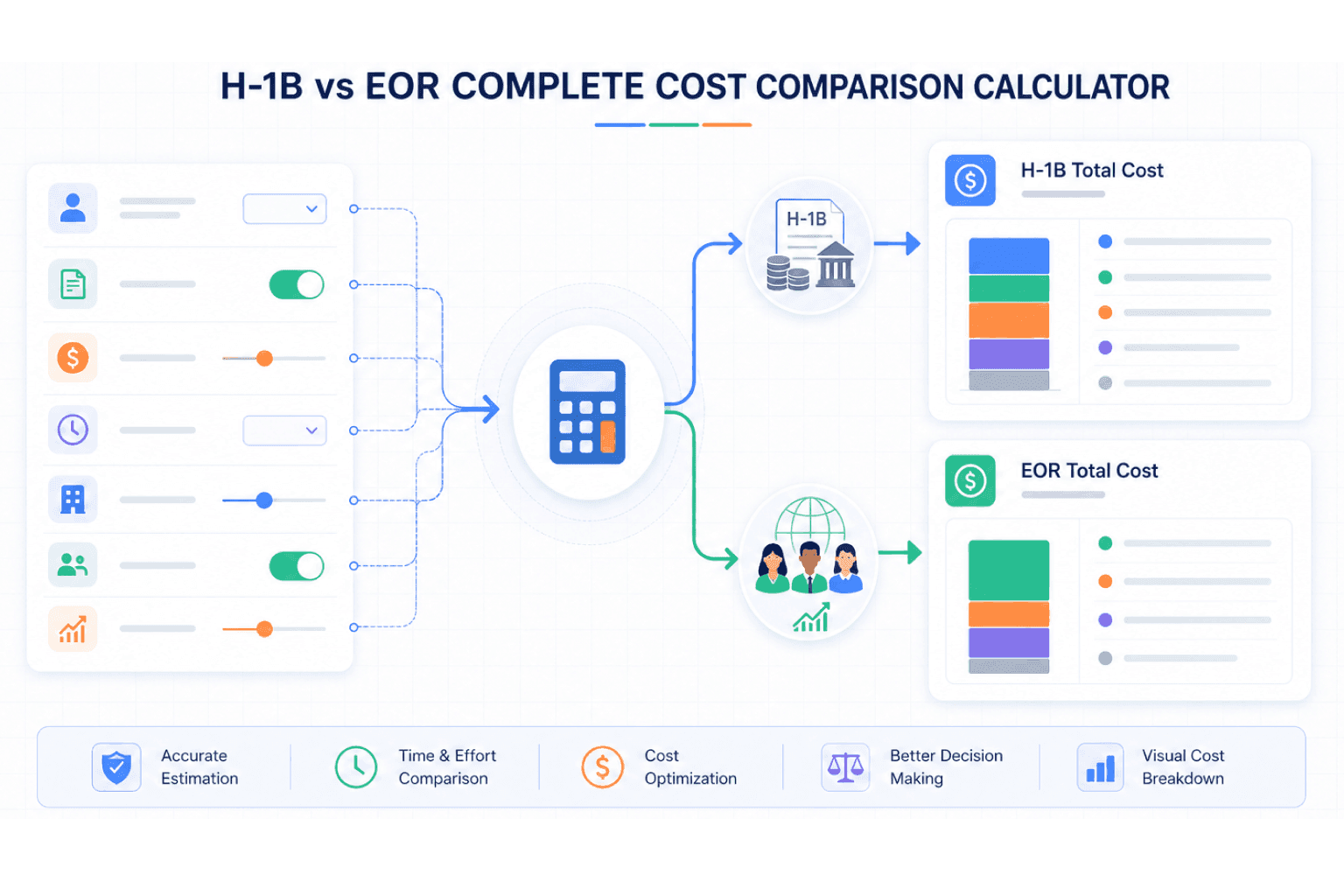
- H-1B vs EOR at a glance
- Use the calculator
- Inputs
- Outputs
- What the H-1B cost calculator includes
- Standard H-1B fee inputs
- Conditional H-1B cost inputs
- Non-fee business inputs
- What the EOR cost calculator includes
- Core EOR inputs
- Why location matters
- What the EOR output shows
- How the calculator classifies your scenario
- Three H-1B cost buckets
- How the result reads
- Example results scenarios
- Scenario 1: software engineer already in the US
- Scenario 2: overseas engineer needing US relocation
- Scenario 3: same engineer hired through EOR in India
- Scenario 4: finance team comparing a four-hire budget
- Why this calculator is better than a basic H-1B cost calculator
- It compares two hiring models, not one fee stack
- It accounts for 2026 H-1B fee changes
- It uses location-based EOR logic
- It supports finance, HR, and talent decisions
- After you calculate: get the full breakdown
- Instant results, no gate
- Detailed breakdown available
- FAQ
- How accurate is this H-1B cost calculator?
- Does every H-1B case cost $100,000+?
- Why is EOR cost different by country?
- When is H-1B still the better option?
Every H-1B cost calculator online does the same thing: add up USCIS filing fees and give you a total. Useful, but it answers the wrong question. The question most employers actually need answered is not "what does H-1B cost?" It is "should I sponsor at all, or is there a faster and cheaper way to hire this person?"
This calculator does both. Enter a role, salary, and candidate location, and get a side-by-side comparison of H-1B sponsorship cost versus EOR employment cost. The tool routes you into the correct H-1B scenario before calculating, because the difference between a $12,000 domestic filing and a $120,000 covered overseas case is too large to average away.
Indian nationals account for 71% of all approved H-1B beneficiaries according to USCIS FY 2024 data. For most employers, the H-1B question is really an India hiring question, and that is exactly where the EOR comparison becomes relevant.
H-1B vs EOR at a glance
Source: USCIS 2026 fee schedules, Kaamwork EOR pricing.
Use the calculator
Inputs
The calculator asks eight questions. Each one changes the output.
Role and base salary set the benchmark for both sides of the comparison. Employee location determines whether the case is domestic or requires consular processing. Employer size affects which ACWIA and asylum fee tier applies.
Four yes/no toggles handle the rest: whether US relocation is needed (triggers the supplemental fee logic), whether premium processing is selected ($2,965 as of March 1, 2026 per USCIS), whether the case involves outside-US consular processing, and whether the candidate is already in the US on a valid status.
These inputs route you into one of three H-1B cost scenarios before the calculation runs. That routing is what makes the output useful rather than generic.
Outputs
The results page shows five things at once:
Estimated total H-1B employer cost, including fees, legal, and optional business-impact inputs. Estimated total EOR annual cost, including salary, statutory contributions, and platform fee. The first-year cost difference between the two models. A time-to-hire comparison showing H-1B timeline against EOR onboarding. And a risk note flagging lottery dependency or relocation assumptions where they apply.
[CALCULATOR TOOL — interactive form and results display]
What the H-1B cost calculator includes
Standard H-1B fee inputs
These fees apply to every H-1B petition filed in 2026. The calculator uses current USCIS fee schedules:
- Registration fee: $215 per beneficiary (paid during the annual cap registration window, typically March)
- I-129 filing fee: $780 standard, or $460 for small employers under 25 full-time equivalents and nonprofits
- ACWIA training fee: $1,500 for employers with 26+ employees, or $750 for under 26
- Fraud prevention and detection fee: $500 (initial petitions and change-of-employer filings)
- Asylum program fee: $600 for 26+ employees, $300 for under 26, $0 for nonprofits and qualifying research institutions
- Premium processing: $2,965 (optional, effective March 1, 2026 per USCIS)
- Attorney and legal fees: variable, calculator defaults to $5,000 with an editable field
For a standard domestic case where the candidate is already in the US and no supplemental fee applies, total employer filing cost typically lands between $6,000 and $20,000 depending on company size and premium processing.
Conditional H-1B cost inputs
Two additional fees apply in specific circumstances.
The Public Law 114-113 fee adds $4,000 for employers with 50+ US employees where more than 50% of the workforce holds H-1B or L-1 status. This targets H-1B-dependent employers, primarily large IT services firms.
The $100,000 supplemental fee applies to certain new petitions where the beneficiary requires consular processing, as described in the September 2025 presidential proclamation and USCIS guidance. It does not apply to every H-1B case. The calculator asks qualifying questions and includes it only when the scenario matches the covered criteria.
For the full narrative breakdown of every fee, see the H-1B employer cost guide.
Non-fee business inputs
This is where most H-1B calculators stop. The business cost of sponsorship extends well beyond government fees.
Time to hire is the big one. The H-1B lottery runs once per year, with registration typically in March and employment start no earlier than October. Add consular processing, potential Requests for Evidence, and relocation logistics, and the gap between "we want this person" and "this person ships their first commit" can stretch past 12 months. That is not just inconvenient. It is expensive.
Cost of vacancy matters for finance teams building this into a budget. SHRM research suggests unfilled senior engineering roles cost $4,000 to $7,000 per week in lost productivity, though the real number depends on team and function. Internal HR and legal coordination, relocation costs for overseas candidates (flights, temporary housing, visa stamping travel), and the opportunity cost of management time spent on immigration paperwork all add up.
These inputs are optional in the calculator but available for teams that want the full cost picture.
What the EOR cost calculator includes
Core EOR inputs
The EOR side models total employer cost for hiring the same role in India, or another country, through an Employer of Record:
Employee salary is entered as annual cash compensation and converted to USD. The monthly EOR platform fee defaults to $599 (Kaamwork pricing) and is editable for comparison. Employer statutory contributions cover provident fund (12% of basic salary), ESIC (3.25%), gratuity provision, professional tax, and TDS administration. Optional benefits like medical insurance and laptop procurement can be toggled on.
Why location matters
Employer-side taxes and contributions vary significantly by country. In India, employer contributions typically add 15–20% above the base salary. In the UK, employer National Insurance adds roughly 13.8% above the NI threshold. In Brazil, employer costs can exceed 70% on top of salary. The calculator adjusts automatically based on the selected employee location.
This is the same approach that Remote and Deel use in their employee cost calculators, and it is the right model for the EOR half of the comparison.
What the EOR output shows
The result includes annual EOR platform fee, estimated employer payroll burden for the selected country, total first-year employment cost, time-to-hire estimate (typically under three weeks for India, sometimes closer to ten days when the pipeline is warm), and a note confirming no visa dependency and no entity setup required.
How the calculator classifies your scenario
Three H-1B cost buckets
The calculator routes every user into one of three scenarios before running the math. This matters because the cost gap between scenarios is enormous.
Standard domestic case. Candidate is already in the US on a valid status (F-1, L-1, or other). No consular processing needed. No supplemental fee. Total filing cost: $6,000 to $20,000. This is what most existing H-1B calculators are built for, and it is the scenario where H-1B can still make financial sense.
Large-employer / additional-fee case. Employer has 50+ US employees with high H-1B/L-1 workforce dependency. Adds the $4,000 Public Law fee. Total: $10,000 to $24,000.
Covered overseas case. New petition requiring consular processing where the supplemental fee applies. Adds $100,000 on top of everything else. Total: $103,000 to $125,000+. This is the scenario that blows up the H-1B vs EOR comparison.
How the result reads
The output does not just show two numbers. It gives a directional recommendation.
"H-1B may cost less" appears in standard domestic cases where the candidate is already in the US and the role requires physical US presence. "EOR is significantly cheaper" appears in covered overseas cases and most scenarios where the role does not require US-based employment. "EOR is faster" appears in every scenario, because there is no lottery, no annual cap, and no consular wait.
The goal is a decision output, not a fee output.
Example results scenarios
Scenario 1: software engineer already in the US
A mid-level software engineer on F-1 OPT, being sponsored for H-1B by a 200-person SaaS company in Austin. Base salary: $145,000. No consular processing. Premium processing selected.
H-1B total filing cost: approximately $12,500 (registration + I-129 + ACWIA + fraud + asylum + premium + legal). Timeline: lottery in March, start date October if selected. Lottery risk: yes, selection not guaranteed.
EOR comparison: hiring the same skill level in India at $40,000 annual salary would cost approximately $54,000 total first year. But the person stays in India. Different model.
In this scenario, if US presence is required, H-1B is the right path. The filing cost is manageable and the candidate is already local.
Scenario 2: overseas engineer needing US relocation
A senior data engineer in Bangalore, same 200-person company. Base salary: $165,000. Consular processing required. Covered under the supplemental fee.
H-1B filing cost: approximately $118,000 (all standard fees + $100,000 supplemental + legal). Timeline: 8–14 months. Add $10,000–$15,000 for flights, temporary housing, and settling-in logistics.
First-year total before the person writes a line of code: roughly $295,000 (fees + relocation + salary).
Scenario 3: same engineer hired through EOR in India
Same engineer. Same skills. Stays in Bangalore. Annual salary: $65,000 (senior data engineer, Bangalore market rate per SalaryExpert 2026 estimates). EOR fee: $599/month.
Total first-year cost: approximately $82,000 (salary + employer statutory contributions + platform fee). Timeline: under three weeks from signed offer to first day. Visa risk: none.
First-year savings versus the covered H-1B scenario: approximately $213,000. That is the budget for two additional senior hires in India. Or three mid-level ones.
Scenario 4: finance team comparing a four-hire budget
A VP of Finance modeling a plan to hire four engineers this year. Two are already in the US (standard H-1B). Two are overseas candidates (covered scenario).
H-1B path for all four: approximately $25,000 in filing costs for the two standard cases, plus $236,000 for the two covered cases, plus $620,000 in US-rate salaries. Total first-year: approximately $881,000.
Hybrid path: sponsor the two domestic candidates via H-1B ($25,000 in fees) and hire the two overseas candidates through EOR in India ($164,000 total cost for both). Combined first-year: approximately $499,000.
That is $382,000 in first-year savings while accessing the same four engineers. Finance teams tend to notice that number.
Why this calculator is better than a basic H-1B cost calculator
It compares two hiring models, not one fee stack
VisaVerge, H1B Score, and VisaGuide all provide useful H-1B fee calculators. They answer "what does H-1B cost?" They do not answer "is there a cheaper, faster alternative?" This calculator puts both options side by side.
It accounts for 2026 H-1B fee changes
The calculator includes the $2,965 premium processing fee effective March 1, 2026 per USCIS, the $100,000 supplemental fee for covered cases, and the current I-129 fee schedule. It routes you into the correct scenario rather than assuming every case looks the same.
It uses location-based EOR logic
The EOR side adjusts employer costs based on the employee's country. India, the Philippines, Brazil, Poland: each has different statutory contributions and tax obligations. The calculation is specific to the location you select.
It supports finance, HR, and talent decisions
The downloadable summary and scenario comparison are designed for budget conversations, not just immigration planning. Finance teams can model first-year cost impact across multiple hires and hiring models in one place.
After you calculate: get the full breakdown
Instant results, no gate
The top-line comparison shows immediately. H-1B estimated total cost, EOR estimated total cost, first-year savings, which model is faster, which carries less risk. No email required for the core result.
Detailed breakdown available
For teams that need to bring numbers into a budget meeting or a hiring committee conversation, the detailed output includes a downloadable PDF with the full fee-by-fee breakdown for both models, a country-specific hiring cost summary for the EOR scenario, and a side-by-side comparison formatted for finance review.
Enter your email to receive the full breakdown, or talk to a Kaamwork hiring strategist who can walk through the specifics for your team and your roles.
FAQ
How accurate is this H-1B cost calculator?
Fee inputs are based on current 2026 USCIS fee schedules, including the cap-season registration requirement and premium processing increase effective March 1, 2026. Attorney fee estimates use industry averages and are editable. The $100,000 supplemental fee logic follows USCIS guidance on covered scenarios. For specific legal questions about your petition, consult a qualified immigration attorney. This tool provides planning-grade estimates for budgeting purposes, not legal advice.
Does every H-1B case cost $100,000+?
No. The six-figure scenario applies only when the beneficiary requires consular processing and the petition meets the conditions described in the September 2025 proclamation. Standard domestic cases (candidate already in the US, change of status) do not trigger the supplemental fee and typically cost $6,000 to $20,000 in total filing costs. The full fee breakdown is in the H-1B employer cost guide.
Why is EOR cost different by country?
Employer-side taxes, social contributions, pension obligations, and labor law requirements vary by jurisdiction. In India, employer contributions add roughly 15–20% above base salary. In Brazil, the figure can exceed 70%. The calculator models each country's statutory burden separately, which reflects how total employment cost actually works. Remote and Deel structure their employee cost calculators the same way.
When is H-1B still the better option?
When the role genuinely requires physical US presence and long-term US-based employment. Client-facing positions with on-site requirements, roles tied to security clearance, and positions governed by US-specific regulatory frameworks may justify sponsorship. For most software, data, product, and engineering roles where the work can be done remotely, EOR offers a faster and cheaper path to the same talent pool. The calculator shows you which scenario applies to your specific hire.
Disclaimer: Fee estimates are based on published 2026 USCIS fee schedules, the September 2025 presidential proclamation, and industry-standard legal cost ranges. This tool provides planning-grade estimates for budgeting purposes and is not legal advice. Consult an immigration attorney for petition-specific guidance. EOR pricing reflects Kaamwork rates current as of April 2026.
Share this article

Founder & CEO | Kaam.Work
Nilesh Parwani, a Kelley School BBA graduate, worked at UBS and Warburg Pincus before founding PrintBell (acquired by Cimpress). In 2020, he launched kaam.work, a remote work platform focused on flexible talent and distributed teams.