Employer of Record India: The Definitive 2026 Guide
India is one of the world's most attractive markets for hiring engineering, data science, product, and operations talent. Over 1.5 million engineering graduates per year (per AICTE), a mature GCC ecosystem, competitive salaries, and English as a working language make it a natural extension for companies building distributed teams. But the compliance layer between "we want to hire someone in India" and "that person is legally employed, paid correctly, and receiving all statutory benefits" is mor

ByNilesh Parwani / April 25, 2026 / 15 min read
- EOR India at a glance
- What is an employer of record in India?
- Definition
- What an India EOR typically handles
- What the client company still controls
- Why use an EOR in India in 2026?
- Faster market entry
- Local compliance is getting harder, not easier
- State variation still matters
- India is too important to ignore
- Legal framework for hiring employees in India through an EOR
- Companies Act context
- FEMA context
- Income tax and TDS on salary
- EPF (Employee Provident Fund)
- ESI (Employees' State Insurance)
- Gratuity
- Bonus, Shops and Establishments, and local compliance
- India's new Labour Codes and what they mean for EOR in 2026
- What changed in November 2025
- Why this matters for payroll and CTC design
- Why EOR becomes more valuable during transition
- Key practical issue: wage definition and salary restructuring
- True employer cost in India: full CTC breakdown
- Base salary is not the full cost
- Statutory employer cost components
- Example: higher-paid senior employee
- Why "gross salary" and "CTC" confuse foreign employers
- State-by-state nuances: Karnataka vs Maharashtra vs Telangana
- Karnataka (Bangalore)
- Maharashtra (Pune, Mumbai)
- Telangana (Hyderabad)
- What actually differs across states
- EOR vs payroll outsourcing vs PEO vs entity setup in India
- EOR
- Payroll outsourcing
- PEO (Professional Employer Organization)
- Own entity (subsidiary)
- How to hire employees in India through an EOR
- Step 1: define role, compensation, and city
- Step 2: confirm employee vs contractor classification
- Step 3: build compliant offer letter and contract
- Step 4: register payroll and statutory accounts
- Step 5: run monthly payroll and deductions
- Step 6: manage leave, benefits, and exits
- How much do employer of record services cost in India?
- EOR service fee
- Statutory cost sits on top of the platform fee
- Why the cheapest EOR is not always the lowest-risk option
- Common mistakes global employers make in India
- Confusing gross salary with full employer cost
- Assuming India is one uniform labour market
- Ignoring PT and state-level registrations
- Treating payroll outsourcing as a substitute for EOR
- Underestimating post-Labour Code payroll redesign
- Waiting too long to define benefits and exit rules
- When employer of record in India makes the most sense
India is one of the world's most attractive markets for hiring engineering, data science, product, and operations talent. Over 1.5 million engineering graduates per year (per AICTE), a mature GCC ecosystem, competitive salaries, and English as a working language make it a natural extension for companies building distributed teams.
But the compliance layer between "we want to hire someone in India" and "that person is legally employed, paid correctly, and receiving all statutory benefits" is more complex than most international employers expect. India's employment system involves federal and state-level labour laws, mandatory provident fund and insurance contributions, tax deducted at source on every salary payment, professional tax that varies by state, gratuity liabilities, and (since November 2025) a new set of Labour Codes that changed how wages, benefits, and employment contracts work.
An Employer of Record handles all of that. The EOR becomes the legal employer in India, manages payroll, statutory compliance, and employment contracts, while your company retains full control over the employee's work, performance, and career development. No entity required. No six-month incorporation process. Kaamwork operates this model at a flat $599/month per employee (kaam.work/pricing), with onboarding typically completed within days.
This guide covers everything a foreign employer needs to understand before hiring in India through an EOR in 2026.
EOR India at a glance
Sources: EPFO, ESIC official contribution schedules, Income Tax Act Section 192, Ministry of Labour and Employment.
What is an employer of record in India?
Definition
An Employer of Record in India is a local entity that legally employs workers on behalf of a foreign company. The EOR handles employment contracts, payroll processing, statutory deductions and contributions, benefits administration, and compliance with Indian labour laws. Your company manages the employee's day-to-day work, sets performance expectations, and makes all decisions about role, compensation, and team integration.
The EOR model is not outsourcing. The employee works exclusively for your company, on your tools, building your product. The EOR handles the employment infrastructure so you do not have to set up a local entity in India.
What an India EOR typically handles
Local employment contracts compliant with Indian labour law. Monthly payroll including salary structuring, provident fund contributions, ESI contributions where applicable, TDS withholding, and professional tax. Registration with EPFO, ESIC, and state labour authorities. Benefits administration including medical insurance, gratuity provisioning, and leave management. Onboarding documentation, background verification coordination, and equipment procurement. Exit management including notice period handling, final settlement, and statutory full-and-final calculations (kaam.work/core-services/onboard-and-manage).
What the client company still controls
Everything that matters for building a productive team. You decide who to hire, what to pay them, what they work on, how they are evaluated, when they are promoted, and what tools they use. The EOR handles the compliance wrapper. You handle the team.
Why use an EOR in India in 2026?
Faster market entry
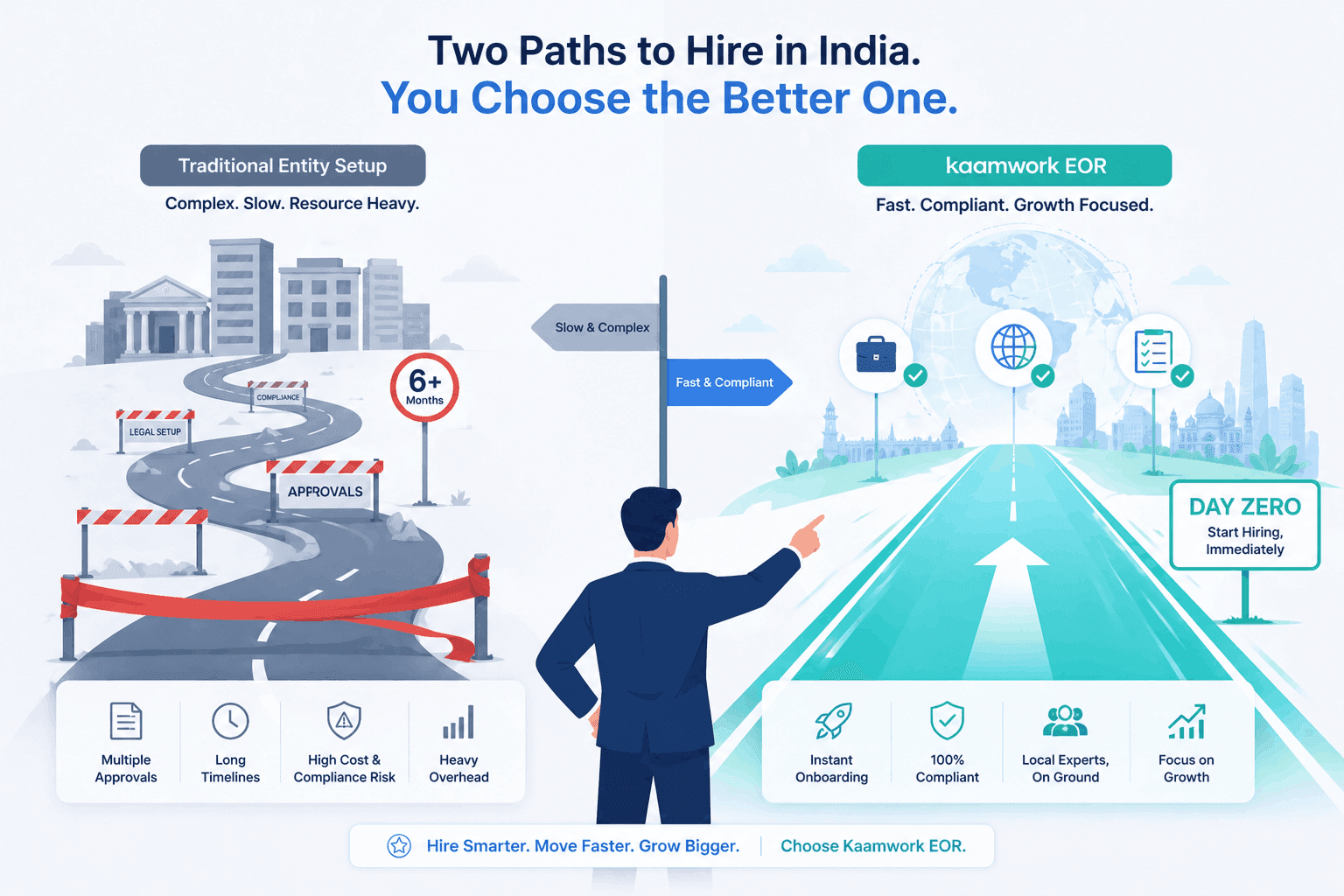
Setting up a wholly owned subsidiary in India requires incorporation, director appointments, bank account opening, PAN/TAN registration, GST registration if applicable, EPFO and ESIC registrations, and ongoing annual compliance including audit, board filings, and ROC submissions. The process typically takes 6 to 12 weeks and costs $15,000 to $50,000+ in legal, accounting, and setup fees depending on complexity. Through an EOR, your first employee can be onboarded and working within days.
Local compliance is getting harder, not easier
India's four new Labour Codes took effect on November 21, 2025, replacing 29 legacy labour laws with a new compliance framework. The codes changed wage definitions, benefit calculations, fixed-term employment rules, retrenchment thresholds, leave policies, and working-time rules. Central and state rules are still being notified and interpreted, creating a transition period where compliance expertise is more valuable than at any point in the past decade.
Foreign employers navigating this environment without local expertise are taking on significant risk. An EOR with deep India compliance knowledge absorbs that risk.
State variation still matters
Even with national Labour Code standardization, state-level rules remain important. Professional tax rates and filing requirements differ between Karnataka, Maharashtra, and Telangana. Shops and establishments registration requirements vary. Leave calendars and local holiday schedules differ. Payroll designed for a Bangalore employee is not identical to payroll designed for a Hyderabad or Pune employee.
India is too important to ignore
India's AI workforce alone has crossed 126,000+ roles (per NASSCOM 2025-2026 reporting). GCCs operated by global enterprises are expanding across Bangalore, Hyderabad, Pune, and Chennai. The talent pool for software engineering, data science, ML, and product development is structurally deeper than any other market at comparable cost levels. Companies that wait for compliance to become "simple" before hiring in India will wait indefinitely. The EOR model exists so they do not have to.
Legal framework for hiring employees in India through an EOR
Companies Act context
A foreign company establishing a "place of business" in India falls within the Companies Act's foreign-company registration framework, which carries its own set of MCA compliance obligations including annual filings, audits, and governance requirements. The EOR model allows foreign companies to hire employees in India without creating their own legal entity, avoiding the full Companies Act compliance footprint.
FEMA context
The Reserve Bank of India administers FEMA regulations and notifications that govern cross-border transactions, foreign direct investment, and the establishment of foreign offices in India. While EOR does not eliminate all FEMA considerations for companies doing business in India, it significantly reduces the operational burden of navigating India-market entry, because the foreign company is not establishing its own presence on the ground.
Income tax and TDS on salary
Under Section 192 of the Income Tax Act, employers are required to deduct tax at source (TDS) on salary payments. The employer estimates each employee's annual taxable income, calculates the tax liability under the applicable regime (old or new), and deducts a proportional amount from each monthly salary payment. TDS must be deposited with the government by the 7th of the following month, per CBDT's recurring tax calendar.
TDS is not a flat rate. It depends on the employee's estimated annual income, applicable deductions, and chosen tax regime. This makes it more complex than PF or ESI, which are percentage-based. An EOR handles TDS computation, deduction, deposit, and annual Form 16 issuance for each employee.
EPF (Employee Provident Fund)
The employer's EPF contribution is 12% of PF wages, making it one of the largest statutory cost items in India payroll. The employee also contributes 12% from their salary. Monthly PF remittance is typically due by the 15th of the following month.
PF wages are determined by salary structuring. The way you split an employee's compensation between basic pay, HRA, special allowance, and other components directly affects the PF contribution base. After the November 2025 Labour Codes, the wage definition rules have become more prescriptive, with the 50% basic-pay floor affecting how companies structure CTC.
ESI (Employees' State Insurance)
The employer's ESI contribution is 3.25% of gross wages for covered employees, per ESIC's official contribution schedule. ESI provides medical, disability, and maternity benefits. It applies only to employees whose wages fall below the ESI threshold (currently ₹21,000 per month). Higher-paid employees are not covered, which means ESI is a meaningful cost factor for junior and mid-level hires but not for senior roles.
ESI remittance is due within 15 days of the last day of the calendar month, per ESIC rules.
Gratuity
Gratuity is a lump-sum payment owed to employees who complete five or more years of continuous service. It is calculated based on the employee's last drawn salary and years of service. While the actual payment happens at exit, the liability accrues from day one, and responsible employers provision for it monthly.
Under the new Labour Codes, the wage definition used for gratuity calculation may change for some employers, which affects the long-term cost. This is one of the areas where the November 2025 changes have created the most payroll-design complexity.
Bonus, Shops and Establishments, and local compliance
Statutory bonus applies to employees earning below a specified threshold and is governed by the Payment of Bonus Act. The bonus obligation depends on the employee's salary level and the employer's profitability.
Shops and Establishments registration is required in most Indian states for any establishment employing workers. The registration process, renewal cadence, and requirements vary by state. Local compliance also includes adherence to state-specific leave rules, working-time regulations, and holiday calendars.
India's new Labour Codes and what they mean for EOR in 2026
What changed in November 2025
India's four Labour Codes took effect on November 21, 2025, replacing 29 legacy laws with a consolidated framework:
The Code on Wages (2019) standardizes wage definitions and payment rules. The Industrial Relations Code (2020) changes retrenchment, layoff, and standing-order thresholds. The Code on Social Security (2020) broadens coverage and updates contribution frameworks. The Occupational Safety, Health and Working Conditions Code (2020) consolidates workplace safety, working hours, and employment-conditions rules.
Why this matters for payroll and CTC design
The most immediate impact for employers is the wage-definition change. The codes require that "wages" (as defined for the purpose of PF, gratuity, and other benefit calculations) constitute at least 50% of total remuneration. Many Indian employers had structured CTC with basic pay well below 50%, keeping PF and gratuity costs lower. The new rules push basic pay upward, which increases employer contributions.
Employer guidance from EY and KPMG warns that companies should review compensation structures and payroll systems immediately. Economic Times reported that many firms have had to rework pay and hiring structures because of these implications.
Why EOR becomes more valuable during transition
During a period where central and state rules are still being notified and practical interpretation is evolving, foreign employers face elevated compliance risk. An EOR with deep India expertise absorbs that risk by designing compliant salary structures, handling the transition from legacy rules to new code requirements, and staying current with emerging state-level notifications.
EY notes explicitly that employers should prepare for compliance changes immediately rather than waiting for full regulatory clarity. For foreign companies without local HR and legal teams, that preparation is exactly what an EOR provides.
Key practical issue: wage definition and salary restructuring
The 50% wage-floor rule affects every Indian employee's salary structure. For foreign employers accustomed to offering a flat salary number and letting "someone in India figure out the structure," this is a wake-up call. Salary structuring in India is not cosmetic. It directly determines PF contributions, gratuity liability, leave encashment calculations, and statutory bonus exposure. Getting it wrong costs real money.
An EOR designs the salary structure for compliance from day one, rather than forcing a restructuring later.
True employer cost in India: full CTC breakdown
Base salary is not the full cost
Foreign employers accustomed to US or UK payroll often treat "salary" as the cost of employment. In India, the employer's cost to company (CTC) includes salary plus multiple statutory contributions paid by the employer on top of the employee's gross pay. The monthly platform fee of an EOR sits on top of that.
Statutory employer cost components
For a mid-level employee earning ₹80,000 per month gross (approximately $11,500 per year), the employer cost breakdown looks roughly like this:
This is a simplified example. Actual costs vary by salary structure, state, ESI applicability, benefits selections, and bonus obligations.
Example: higher-paid senior employee
For a senior engineer earning ₹2,00,000 per month gross (~$28,800/year), the PF contribution base may be capped at ₹15,000 statutory minimum or structured at a higher basic. Gratuity accrual increases proportionally. ESI does not apply. Professional tax applies at state-specific rates. The EOR fee remains flat at $599/month.
At senior salary levels, the statutory contributions become a smaller percentage of total cost, and the EOR fee becomes an even smaller fraction.
Why "gross salary" and "CTC" confuse foreign employers
In the US, salary and employer cost are close to the same number (plus healthcare and 401k match). In India, the gap between what the employee takes home and what the employer pays is significant because of PF, ESI, gratuity, and tax structuring.
CTC (cost to company) includes everything: gross salary, employer PF, employer ESI, gratuity, insurance, and any other benefits. Gross salary is what appears on the payslip before employee deductions. Take-home pay is what hits the employee's bank account after PF, ESI, TDS, and PT deductions.
Foreign employers who quote a "salary" to a candidate in India without understanding the CTC model will either overshoot their budget or confuse the candidate. An EOR translates the offer into proper Indian salary structure from the start (kaam.work/core-services/run-payroll).
State-by-state nuances: Karnataka vs Maharashtra vs Telangana
Karnataka (Bangalore)
Karnataka's professional tax portal currently shows a standard monthly deduction of ₹200 for most salary brackets, with a specific ₹300 deduction for February (the annual "additional month"). Karnataka PT is administered through the state's e-portal and requires employer registration, monthly deduction, and periodic return filing.
Bangalore is India's most expensive hiring market. Salary expectations run 15-25% above national averages for equivalent roles. Attrition is the highest among major Indian cities. Labour registrations follow Karnataka Shops and Establishments rules, which have their own registration and renewal requirements.
Maharashtra (Pune, Mumbai)
Maharashtra publishes its profession-tax rate schedules on the MAHAGST portal. PT rates are slab-based and apply at higher rates for higher salary brackets than Karnataka's flatter structure. Maharashtra PT administration involves separate employer enrollment, monthly deduction, and annual return filing.
Pune and Mumbai follow Maharashtra Shops and Establishments Act requirements for labour registration. Leave policies in Maharashtra have their own state-specific nuances, though the new Labour Codes introduce more national standardization.
Telangana (Hyderabad)
Telangana administers professional tax through the state Commercial Taxes Department under the Telangana Tax on Professions, Trades, Callings and Employments Act, 1987. PT rates, thresholds, and filing mechanics are distinct from both Karnataka and Maharashtra.
Hyderabad's hiring environment is the fastest-growing AI and GCC hub in India. Salary pressure is meaningfully lower than Bangalore, and employer costs reflect that gap.
What actually differs across states
Professional tax rates and administration are the most visible difference, but they are not the only one. Labour registrations (Shops and Establishments) have state-specific requirements. Leave calendars include state-specific restricted holidays. Working-time rules and overtime calculations can differ in implementation. And the practical rhythm of compliance filings (frequency, portal systems, penalty structures) varies.
Foreign employers who assume "India payroll" is one thing will discover that payroll in Karnataka, Maharashtra, and Telangana involves three different PT portals, three different registration processes, and three different filing calendars. An EOR handles all of this across states without requiring the employer to learn each system.
EOR vs payroll outsourcing vs PEO vs entity setup in India
EOR
Best for companies hiring employees in India without their own local entity. The EOR is the legal employer. You direct the work. Fast to start, low compliance burden, and the most common model for first-time India hiring. Kaamwork operates this model with flat $599/month pricing and onboarding in days (kaam.work/solutions/eor-india).
Payroll outsourcing
Best for companies that already have an India entity and need payroll administration support. A payroll outsourcing provider processes monthly payroll, handles PF/ESI filings, computes TDS, and manages compliance returns. But the legal employer is your entity, not the payroll provider. If you do not have an India entity, payroll outsourcing alone does not solve your problem.
PEO (Professional Employer Organization)
PEO is a US-centric co-employment model that does not translate cleanly to India's legal framework. Indian labour law does not recognize co-employment in the way US PEO arrangements work. Companies searching for "PEO India" usually need either an EOR (if they have no entity) or payroll outsourcing (if they have one). Deel correctly notes this distinction in their India hiring guidance.
Own entity (subsidiary)
Best for companies planning permanent, large-scale India operations with direct commercial activity (invoicing, contracting, FDI). Setting up a private limited company in India gives you full legal control but requires $15,000 to $50,000+ in setup costs, 6-12 weeks minimum timeline, and ongoing annual compliance (audit, ROC filings, company secretary, tax returns). Makes sense at 40-50+ employees when the India strategy is confirmed as long-term.
Many companies start with EOR and migrate to their own entity once the team reaches scale and the business case is proven. This EOR-first, entity-later approach is the path most commonly recommended in 2026 India market-entry guidance (kaam.work/eor-india-vs-subsidiary).
How to hire employees in India through an EOR
Step 1: define role, compensation, and city
Specify the job title, responsibilities, seniority level, and target city. City matters because salary expectations, professional tax, and candidate availability all vary. Use market benchmarks for the specific role and location (kaam.work/global-cost-calculator).
Step 2: confirm employee vs contractor classification
India has strict employee-versus-contractor classification rules. If the person works exclusively for your company, uses your tools, follows your schedule, and reports to your managers, they are almost certainly an employee under Indian law regardless of what the contract says. Misclassification creates legal and financial risk. An EOR ensures proper employee classification from the start.
Step 3: build compliant offer letter and contract
The employment contract must comply with Indian labour law, including the applicable Labour Codes, state-specific Shops and Establishments requirements, and company-specific policies. The EOR drafts and issues the contract, ensuring all mandatory clauses (notice period, leave entitlement, PF/ESI eligibility, salary structure) are included.
Step 4: register payroll and statutory accounts
The EOR registers the employee with EPFO for provident fund, ESIC for state insurance (if applicable by salary threshold), and the relevant state PT authority. This registration is mandatory before the first salary payment.
Step 5: run monthly payroll and deductions
Monthly payroll processing includes computing gross salary, deducting employee PF, employee ESI (if applicable), TDS, and professional tax, then disbursing net pay. The employer contributions (employer PF, employer ESI, gratuity accrual) are calculated and remitted to the relevant authorities by their respective due dates: TDS by the 7th, PF and ESI by the 15th.
Step 6: manage leave, benefits, and exits
The EOR administers leave balances, medical insurance, and any supplemental benefits. If an employee exits, the EOR handles notice period compliance, final settlement computation (including leave encashment, gratuity if applicable, and any pending reimbursements), and statutory full-and-final processes.
How much do employer of record services cost in India?
EOR service fee
The India EOR market shows wide pricing variation in 2026. Wisemonk advertises India EOR starting from $99/month. HiveDesk frames the broader market around $300-$500/month. Deel, Remote, and Kaamwork are positioned at $599/month. Papaya Global and Oyster sit in the $599-$699/month range. RemoFirst offers $199/month.
The service scope behind these fees varies. Lower-priced providers may offer basic payroll and compliance. Higher-priced providers typically include deeper HR support, benefits administration, onboarding coordination, and local expertise.
Statutory cost sits on top of the platform fee
The EOR fee covers the provider's services. The employee's salary, employer PF contribution, employer ESI contribution, gratuity accrual, professional tax, and any benefits are separate costs borne by the client company. For a mid-level employee earning ₹80,000/month gross, total statutory employer costs add approximately 15-20% on top of the gross salary.
Why the cheapest EOR is not always the lowest-risk option
India payroll compliance has real consequences for errors. Late PF remittance carries penalties. Incorrect TDS computation creates tax-department scrutiny. Wrong salary structuring under the new Labour Codes can trigger PF underpayment liability. The cheapest EOR fee saves money only if the provider actually handles compliance correctly. Quality of service, India-specific expertise, and responsiveness to state-level compliance nuances should weigh as heavily as monthly fee in the buying decision (kaam.work/best-employer-of-record-india).
Common mistakes global employers make in India
Confusing gross salary with full employer cost
The gap between what the employee takes home and what the employer pays is 20-35% in India once PF, ESI, gratuity, and PT are factored in. Foreign employers who budget only for "salary" will overshoot by the time all statutory costs are added.
Assuming India is one uniform labour market
Professional tax rates, labour registrations, leave calendars, and compliance filing mechanics all differ by state. A payroll setup for Karnataka does not automatically work for Maharashtra or Telangana.
Ignoring PT and state-level registrations
Professional tax is a small amount per employee (₹200-₹300/month in most states) but missing the registration and filing obligations creates compliance risk disproportionate to the amount. State Shops and Establishments registration is equally easy to overlook and equally important.
Treating payroll outsourcing as a substitute for EOR
If you do not have an India entity, payroll outsourcing does not solve your legal-employer problem. You need an EOR first. Only companies with an existing India entity can use payroll outsourcing as a standalone solution.
Underestimating post-Labour Code payroll redesign
The November 2025 Labour Codes changed wage definitions, which affects PF, gratuity, and benefit calculations. Companies that copied old salary structures without reviewing them against the new rules are exposed to compliance gaps (kaam.work/india-labour-codes-2025-foreign-employers).
Waiting too long to define benefits and exit rules
Medical insurance, leave policies, and notice periods should be decided before the first hire, not figured out later. In India, once an employee is onboarded with a specific benefit structure, reducing benefits is legally and practically difficult.
When employer of record in India makes the most sense
EOR is the strongest hiring model when you want speed (onboarding in days rather than months), compliant employment without an India entity, and the flexibility to start small and scale based on results. In 2026, the case is even stronger because India employment compliance is more dynamic than at any point in the past decade. The Labour Code rollout, evolving state-level rules, and increasingly prescriptive wage-structure requirements mean that local expertise is not optional.
The smartest buyers compare not just EOR provider fees, but total employment cost by role and city, state-level compliance capability, and whether the provider can support their long-term India operating model as it evolves from first hire to full team.
Start with the cost calculator at to model your India employer cost. Compare EOR vs entity economics at kaam.work/eor-india-vs-subsidiary. Or talk to us directly about building your India hiring plan (kaam.work/talk-to-us).
Disclaimer: This guide is based on Indian employment law, EPFO and ESIC official contribution schedules, Income Tax Act provisions, and 2025-2026 Labour Code implementation guidance from the Ministry of Labour and Employment, EY, and KPMG. It is not legal advice. Consult a qualified Indian employment lawyer for situation-specific guidance. Kaamwork pricing is current as of April 2026.
Share this article

Founder & CEO | Kaam.Work
Nilesh Parwani, a Kelley School BBA graduate, worked at UBS and Warburg Pincus before founding PrintBell (acquired by Cimpress). In 2020, he launched kaam.work, a remote work platform focused on flexible talent and distributed teams.