EOR India vs Setting Up a Subsidiary: Complete Comparison
This is a decision most companies get wrong by defaulting to whichever model they've seen their competitors use. A Series B SaaS company with four hires doesn't need a subsidiary. And a Fortune 500 planning a 200-person GCC doesn't need to stay on EOR forever. The right answer depends on team size, duration, revenue needs, and how much operational control you actually require on the ground. This guide breaks down the EOR-vs-subsidiary decision across every dimension that matters: speed, cost, c

ByNilesh Parwani / April 25, 2026 / 15 min read
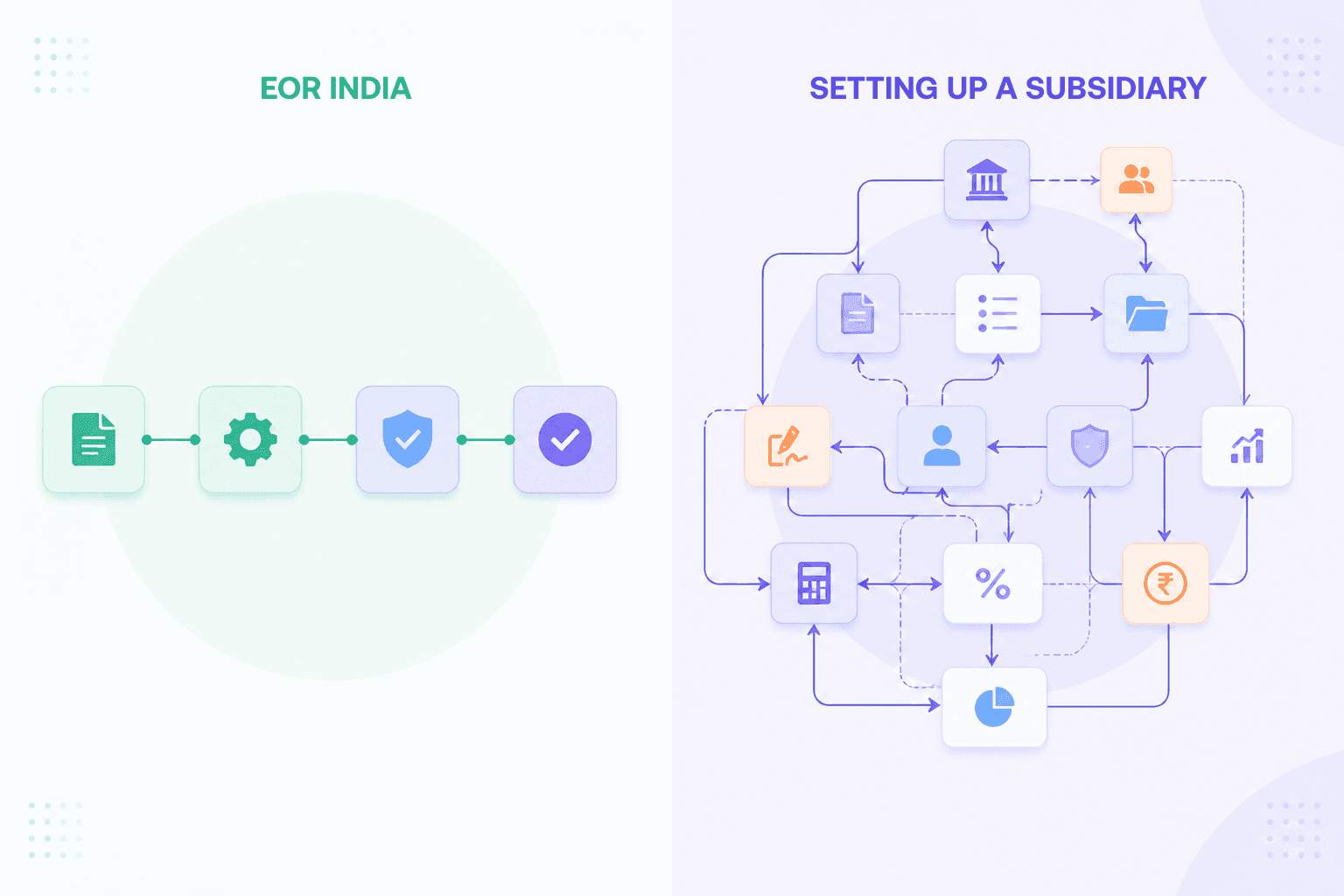
- EOR vs subsidiary: master comparison
- The short answer: EOR is better for speed, subsidiary is better for control
- Use EOR when
- Use a subsidiary when
- The real decision is not either/or forever
- What is an EOR in India?
- EOR model
- Why companies choose it
- What EOR does not replace
- What does it mean to set up a subsidiary in India?
- Usual structure
- What setup involves
- Why companies still choose it
- EOR India vs subsidiary: side-by-side comparison
- Comparison table
- Best use case for each
- Setup time: 48 hours vs 3-6 months? What's realistic?
- EOR timeline
- Subsidiary timeline
- Recommended editorial phrasing
- Cost comparison: EOR fee vs entity setup cost
- EOR cost
- Subsidiary setup cost
- The real cost is not just setup
- Break-even analysis: when does a subsidiary start making more sense?
- Why the "50 employees" rule is too blunt
- Better way to frame break-even
- Suggested scenarios
- Best editorial takeaway
- Compliance and risk: which model is safer?
- EOR reduces day-one compliance burden
- Subsidiary gives control but full responsibility
- Risk is not only legal
- Control, branding, and long-term strategy
- Why subsidiaries win on control
- Why EOR still wins for many first-phase expansions
- The hybrid path
- EOR first, subsidiary later: the best hybrid model for many companies
- Why this path works
- When to migrate
- Migration considerations
- Scenario-based recommendations
- Startup hiring first 2 employees
- SaaS company building a 12-person pod
- Enterprise opening long-term GCC
- Company uncertain about India strategy
- When to use EOR in India and when to set up a subsidiary
This is a decision most companies get wrong by defaulting to whichever model they've seen their competitors use. A Series B SaaS company with four hires doesn't need a subsidiary. And a Fortune 500 planning a 200-person GCC doesn't need to stay on EOR forever. The right answer depends on team size, duration, revenue needs, and how much operational control you actually require on the ground.
This guide breaks down the EOR-vs-subsidiary decision across every dimension that matters: speed, cost, compliance, control, exit flexibility, and the break-even point where a subsidiary starts paying for itself. Kaamwork operates the EOR model at a flat $599/month per employee with no entity required, but we'll be honest about when a subsidiary is the smarter long-term play.
EOR vs subsidiary: master comparison
Sources: Ministry of Corporate Affairs (MCA) incorporation timelines, KPMG India entity setup cost estimates (2025), Deloitte India market entry advisory (2026).
The short answer: EOR is better for speed, subsidiary is better for control
Most comparison articles stop at that line. The real question is which dimension matters more for your specific situation right now, and whether the answer changes in 18 months.
Use EOR when
You need to hire quickly and can't wait 3-6 months for entity setup. You're testing the India market with a small team and want to validate before committing to a permanent structure. You don't need a local entity for invoicing, FDI, or direct commercial activity. And you want the flexibility to scale up or wind down without the legal burden of entity liquidation.
For most companies making their first India hires, this is the right starting point. The EOR handles employment contracts, payroll, PF, ESI, TDS, and state-level compliance while you focus on hiring and building.
Use a subsidiary when
You're committing to India as a long-term operational hub with 15-50+ employees. You need a local entity for invoicing Indian clients, receiving FDI, or establishing direct commercial relationships. And you're prepared to absorb the setup cost, timeline, and ongoing governance obligations that come with full legal control.
Subsidiaries make sense when the India strategy is confirmed, the team is large enough to justify the overhead, and local commercial activity requires entity presence. For a more detailed breakdown of how the EOR model compares operationally to running your own entity, see the full EOR vs owned entity comparison.
The real decision is not either/or forever
Here's the thing most guides miss. The choice between EOR and subsidiary isn't permanent. The most common path in 2026 is to start with EOR, prove the India hiring thesis, build the initial team, and then migrate to a subsidiary once the team reaches scale and the business case justifies entity setup.
This hybrid approach eliminates the biggest risk of subsidiary setup: spending $30,000-$50,000 and six months incorporating an entity before you've confirmed that India hiring actually works for your company. It also eliminates the biggest limitation of EOR: lack of direct commercial capability once your India operations mature.
What is an EOR in India?
EOR model
An Employer of Record in India is a local company that legally employs workers on behalf of a foreign company. The EOR signs the employment contract, runs payroll, handles statutory contributions (PF, ESI, TDS, professional tax, gratuity), manages benefits, and ensures compliance with India's Labour Codes and state-level regulations. Your company retains full control over the employee's work, performance, and career progression.
The employee works exclusively for your company. They sit in your meetings, use your Slack, ship your code. The EOR handles the legal paperwork. That's it.
For the full legal framework, wage-definition rules, and state-by-state compliance details, see our definitive EOR India guide and the EOR India solution overview.
Why companies choose it
Speed. A new hire can be onboarded in days rather than the months required for entity incorporation. Cost efficiency for smaller teams, because the EOR fee is predictable and there's no setup investment. And risk reduction, because the EOR absorbs compliance responsibility during a period when India's Labour Codes are still being interpreted at the state level.
But the single biggest reason is pragmatic: most companies entering India don't know yet how large their India team will become. EOR lets you start without overcommitting.
What EOR does not replace
EOR does not give you a commercial entity in India. You cannot invoice Indian clients, receive FDI, or establish a registered office through an EOR arrangement. You don't hold a Companies Act registration, a GST number, or a local bank account. And for IP-heavy operations, the chain of ownership runs through contractual assignment rather than direct entity control.
If your India presence needs to generate local revenue, contract directly with Indian customers, or hold regulatory licenses, EOR alone won't get you there. You'll need an entity eventually.
What does it mean to set up a subsidiary in India?
Usual structure
The standard vehicle is a private limited company, typically structured as a Wholly Owned Subsidiary (WOS). This requires at least two directors (one must be an Indian resident), a registered office address in India, and compliance with FDI regulations under FEMA and RBI guidelines. Depending on the industry, FDI may require government approval or may fall under the automatic route per DPIIT FDI policy.
What setup involves
Incorporation with the Ministry of Corporate Affairs (MCA). Director Identification Numbers (DINs) for all directors. Digital Signature Certificates. PAN and TAN registration with the Income Tax Department. Opening a bank account, which often takes 2-4 weeks on its own due to KYC requirements. GST registration if applicable. EPFO and ESIC registration for payroll compliance. And then the ongoing obligations: annual audit by a chartered accountant, ROC filings, board meetings, statutory registers, company secretary appointment (mandatory above a certain threshold), and income tax returns.
That's not a weekend project. The full incorporation process typically takes about 6-8 weeks, actually closer to 10-12 once you account for director identification delays, bank account opening, and the inevitable back-and-forth with the Registrar of Companies.
Why companies still choose it
Control. With a subsidiary, you are the legal employer, the commercial entity, and the registered presence. You can invoice Indian customers, contract with local vendors, hold a GST number, and operate as a full participant in the Indian market. IP sits within your entity. Employment relationships are direct. And at scale, the per-employee cost of running your own entity is lower than paying EOR fees for 40-50+ people.
For companies with confirmed long-term India plans, direct commercial needs, and teams large enough to absorb the overhead, a subsidiary is the right structure. The question is timing, not whether.
EOR India vs subsidiary: side-by-side comparison
Comparison table
Best use case for each
EOR wins when speed, flexibility, and low upfront cost matter more than commercial entity capability. This covers most early-stage India expansions, market-testing phases, and companies hiring fewer than 15 people.
Subsidiary wins when you need local commercial presence, direct employment control, and the team is large enough to distribute the fixed costs of entity governance across enough employees to make the math work. That threshold varies, but it's rarely below 15 employees and often closer to 30-40 before the subsidiary genuinely costs less per head than EOR.
Setup time: 48 hours vs 3-6 months? What's realistic?
EOR timeline
You'll see "hire in 48 hours" on plenty of EOR provider websites. And it's technically possible in some cases. But the realistic timeline for most EOR hires is 3-10 business days. That includes background verification, employment contract drafting and signing, payroll registration, and benefits enrollment.
If the candidate has all documents ready, the EOR has pre-registered in the relevant state, and there are no background-check delays, you might see onboarding in 2-3 days. But most hires involve at least one bottleneck: a missing document, a state registration that takes a few days, or a benefits enrollment that requires verification. Plan for a week. It's still dramatically faster than any entity setup.
Subsidiary timeline
MCA incorporation itself can be completed in about 2-3 weeks if everything is clean. But "everything is clean" is an optimistic assumption. Director DINs, digital signatures, registered office documentation, and the MOA/AOA drafting process frequently introduce delays. Then add bank account opening (2-4 weeks with current KYC requirements), PAN/TAN registration, GST registration, and EPFO/ESIC setup.
Realistic end-to-end timeline: 8-12 weeks for a straightforward incorporation, 14-16 weeks if there are complications. KPMG's India market-entry advisory notes that first-time foreign incorporations often exceed initial timeline estimates due to documentation requirements and regulatory coordination.
Recommended editorial phrasing
Be honest with candidates and your board. EOR onboarding takes about a week in most cases. Subsidiary setup takes about three months, actually closer to four once you factor in the bank account and post-incorporation registrations. Neither number is the marketing version, but both are numbers your CFO can plan around.
Cost comparison: EOR fee vs entity setup cost
EOR cost
Kaamwork's flat EOR fee is $599/month per employee. No setup fees. No percentage-of-salary markup. The fee covers employment contracts, payroll processing, statutory compliance, and benefits administration. On top of the platform fee, the client pays the employee's salary, employer PF, ESI where applicable, gratuity accrual, and professional tax. See the payroll breakdown for how those components work.
The broader India EOR market ranges from $199/month (RemoFirst, per their published pricing) to $599-$699/month (Deel, Remote, Papaya Global, Oyster). Service scope varies significantly at different price points.
For 10 employees on Kaamwork, the annual EOR fee is $71,880 ($599 x 10 x 12). That's the total platform cost before any employee salaries.
Subsidiary setup cost
Legal incorporation, director appointments, registered office, and basic MCA compliance: $5,000-$10,000 in legal and consulting fees according to Deloitte's 2026 India market-entry cost benchmarks. Bank account setup, PAN/TAN, GST registration, and initial statutory registrations: $2,000-$5,000. First-year audit, company secretary, and ROC compliance: $3,000-$8,000. Payroll software and HR infrastructure setup: $2,000-$5,000.
Fully loaded first-year cost for a subsidiary: $15,000-$30,000 for a clean, straightforward setup. Complex cases involving FDI approvals, multiple states, or specialized industry registrations can push this above $40,000. In Indian rupees, that's roughly ₹12.5 lakh to ₹32.5 lakh+ depending on scope.
The real cost is not just setup
The annual cost of maintaining a subsidiary runs $8,000-$15,000 per year in audit, company secretary, ROC filings, tax returns, and governance overhead, per KPMG India compliance cost estimates. This is before any payroll costs. You also need either an in-house HR/payroll team or an outsourced payroll provider, adding another $500-$2,000/month depending on team size and complexity.
Subsidiary setup cost is a capital expenditure. Subsidiary maintenance cost is a recurring operating expense. Both need to be factored into the break-even analysis against EOR fees.
Break-even analysis: when does a subsidiary start making more sense?
Why the "50 employees" rule is too blunt
You'll find guides citing 10-15 employees or 50 employees as the break-even threshold. Both numbers are overly simplified. The break-even depends on at least four variables: the EOR fee you're paying, the annual cost of entity maintenance and payroll infrastructure, the average salary of your India team, and how long you plan to operate in India.
A company paying $199/month per employee on a budget EOR will reach break-even with a subsidiary at a much higher headcount than a company paying $599/month. And a company hiring senior engineers at ₹2.5 lakh/month has very different unit economics than one hiring junior developers at ₹60,000/month.
Better way to frame break-even
Instead of a single threshold number, model it as a comparison:
Annual EOR cost = (monthly fee x headcount x 12)
Annual subsidiary overhead = (entity maintenance + payroll admin + HR staff/outsourcing)
When annual subsidiary overhead is lower than annual EOR cost, and you've recouped the initial setup investment, the subsidiary wins on pure cost.
For Kaamwork pricing at $599/month, the math looks roughly like this:
Suggested scenarios
At 1-5 employees, EOR wins almost always. The annual EOR fee is comparable to or less than the first-year subsidiary setup cost alone. No break-even case exists at this scale unless you have immediate commercial entity needs.
At 6-15 employees, EOR is often still the better call, especially if the team might shrink or the India strategy is still proving itself. The annual cost gap between EOR and subsidiary is real but not dramatic, and the flexibility value of EOR offsets it.
At 15-40 employees, it becomes case by case. If the team is stable, growing, and planned for 2+ years, the subsidiary math starts working. If there's uncertainty about long-term headcount, EOR preserves optionality.
At 40-50+ employees, the subsidiary often wins on cost alone, and the operational maturity of a 40+ person team usually justifies the governance overhead. Most companies at this scale also need local commercial capabilities that require an entity.
Best editorial takeaway
The break-even isn't a number. It's a combination of headcount, duration, cost tolerance, and operational maturity. Companies that reduce this to "get a subsidiary at 50 people" miss situations where an entity makes sense at 20, and situations where EOR still makes sense at 60.
Compliance and risk: which model is safer?
EOR reduces day-one compliance burden
With an EOR, compliance responsibility sits with the provider. They handle Labour Code adherence, PF and ESI registration and remittance, TDS computation, state-level professional tax, and employment contract compliance. If something goes wrong with a statutory filing, the EOR's entity faces the regulatory consequences.
This matters in 2026 because India's Labour Codes, which took effect in November 2025, are still being interpreted at the state level. The wage-definition changes alone forced salary restructuring across the market. An EOR with India expertise navigates this transition for you. For how alternative registration routes work for foreign companies, see the guide on foreign company registration alternatives.
Subsidiary gives control but full responsibility
With your own entity, you control everything. You design the salary structure, choose the benefits provider, set internal policies, and manage employee relations directly. But you also bear full regulatory responsibility. Late PF remittance? Your entity faces the penalty. Incorrect TDS computation? Your entity handles the Income Tax Department scrutiny. Non-compliant employment contract? Your entity's liability.
Most subsidiaries hire a company secretary and work with a chartered accountant to manage ongoing compliance. Larger operations build internal HR and legal teams. The cost of this infrastructure is part of the subsidiary overhead that makes the break-even analysis meaningful.
Risk is not only legal
The less obvious risk is structural. Companies that set up a subsidiary prematurely, before validating the India hiring model, can find themselves locked into an entity that's expensive to maintain and slow to wind down. MCA strike-off procedures take 6-18 months. Liquidation is even longer.
And companies that stay on EOR too long can miss the cost savings and operational advantages of running their own entity once the team has reached sufficient scale.
The risk, in both cases, is mismatching the employment structure to the stage of your India operations.
Control, branding, and long-term strategy
Why subsidiaries win on control
A subsidiary gives you direct employment relationships, your own entity name on offer letters, full control over benefits design, and direct IP ownership. For companies building Global Capability Centers or planning to hire 50-100+ people, this level of control matters.
Employees in a subsidiary work for your company. Their LinkedIn says your company name. Their provident fund shows your entity. No intermediary.
Why EOR still wins for many first-phase expansions
Control is only valuable when you have something to control. A company hiring its first two engineers in India doesn't need the overhead of entity governance for the sake of seeing its name on a PF statement. The practical control over work, tools, performance, and compensation is identical under EOR, and that's what matters during the building phase.
EOR also wins on optionality. If the India experiment doesn't work, you wind down the EOR arrangement in weeks. If you built a subsidiary, you're looking at months of liquidation paperwork.
The hybrid path
The pattern that works for most companies: start on EOR, build the team, validate the model, and transition to a subsidiary when the team size, duration, and commercial needs justify it. This path gives you speed at the start and control at maturity. More on this below.
EOR first, subsidiary later: the best hybrid model for many companies
Why this path works
You avoid spending $15,000-$50,000 and 3-4 months on entity setup before knowing if India hiring works for your company. You start generating value from your India team immediately while the long-term structure takes shape. You make the subsidiary decision with real data: actual team size, actual retention rates, actual salary costs, and actual operational needs. Not projections.
Kaamwork clients regularly follow this path. The EOR handles employment for the initial team, and when the company is ready to incorporate, the transition happens with employment continuity and compliance handoff. This is how it's supposed to work. You can model your India costs before making the entity decision.
When to migrate
The migration signal is usually a combination of factors, not a single trigger. Repeatable demand for India hiring, meaning you're not guessing whether you'll have 20 people next year. Local revenue needs that require a GST number and invoicing capability. A team size of 15-40+ where the EOR fee math starts favoring entity overhead. And direct contracting needs with Indian customers or vendors that require entity presence.
If you're checking two or more of those boxes, it's time to start the subsidiary process. The incorporation can run in parallel with ongoing EOR employment, so there's no gap in coverage.
Migration considerations
Employment transfers from EOR to subsidiary require careful handling. Employees need new contracts with the subsidiary, and the transfer should preserve continuity of service for gratuity and leave accrual. Payroll handoff means setting up PF, ESI, and TDS under the new entity's registrations. Benefits, including medical insurance, need to transfer without gaps.
The migration is manageable but not trivial. Budget about 8-12 weeks for the process after the subsidiary is operational, actually closer to 14 weeks if benefits re-enrollment gets complicated. For the payroll components involved, see the India payroll guide for foreign companies.
Scenario-based recommendations
Startup hiring first 2 employees
Use EOR. There is no scenario where setting up a subsidiary for two employees makes financial or operational sense. The setup cost alone exceeds two years of EOR fees. The incorporation timeline delays your first hire by months. And if the hires don't work out, you're stuck with an entity you don't need.
A Series A startup that needs a backend engineer and a QA lead in Bangalore should be onboarding through EOR within a week, not filing MCA incorporation papers.
SaaS company building a 12-person pod
Often EOR first, with a subsidiary revisit after proof. A 12-person engineering pod costs about $86,256 per year in EOR fees at $599/month. That's real money. But the subsidiary alternative involves $20,000-$40,000 in setup, 3-4 months of delay, and the ongoing governance overhead.
If the pod is the first India team and the company isn't sure whether it'll grow to 30 or shrink to 6, EOR preserves the optionality. Revisit the entity decision after 12-18 months with actual performance and retention data.
Enterprise opening long-term GCC
Subsidiary, or EOR-to-subsidiary. An enterprise with a board-approved India GCC strategy, a target headcount of 50-100+, and local commercial requirements should plan for a subsidiary from the start. But even here, many enterprises use EOR for the first 6-12 months to get the initial team productive while the subsidiary incorporation runs in parallel. Your first 10-15 hires are working through EOR while the entity is being set up. Once the subsidiary is operational, employees transfer over.
Company uncertain about India strategy
EOR, specifically for optionality. If the India decision is "let's try hiring two people and see how it goes," EOR is the only model that makes sense. You're paying for flexibility and the freedom to change direction. If it works, scale up. If it doesn't, wind down cleanly.
The worst outcome is spending $30,000+ and four months on a subsidiary for a team that might not exist in a year.
When to use EOR in India and when to set up a subsidiary
EOR is the right structure when you need speed, flexibility, and low commitment. Subsidiary is the right structure when you need permanence, commercial presence, and direct control. The hybrid path, starting with EOR and migrating to a subsidiary when the data supports it, is the best approach for most companies entering India in 2026.
The companies that get this wrong usually make one of two mistakes: they set up a subsidiary too early, before validating the India model, and end up with an expensive entity they might need to liquidate. Or they stay on EOR too long, paying per-employee fees that exceed what their own entity would cost at their current team size.
The decision framework is straightforward. If you're hiring fewer than 15 people and don't need local commercial capability, start with EOR. If you're planning 40+ people with long-term India operations, plan for a subsidiary. If you're somewhere in between, start with EOR and set a review trigger at 12-18 months.
Model your specific India hiring cost at . Or talk to us about which structure fits your India plans.
Disclaimer: This guide reflects Indian company law, MCA incorporation procedures, FEMA/FDI regulations, and 2025-2026 Labour Code implementation as of April 2026. It is not legal or tax advice. Cost estimates are based on published benchmarks from KPMG, Deloitte, and publicly available EOR provider pricing. Consult a qualified Indian corporate lawyer and chartered accountant for situation-specific guidance. Kaamwork pricing is current as of April 2026.
Share this article

Founder & CEO | Kaam.Work
Nilesh Parwani, a Kelley School BBA graduate, worked at UBS and Warburg Pincus before founding PrintBell (acquired by Cimpress). In 2020, he launched kaam.work, a remote work platform focused on flexible talent and distributed teams.