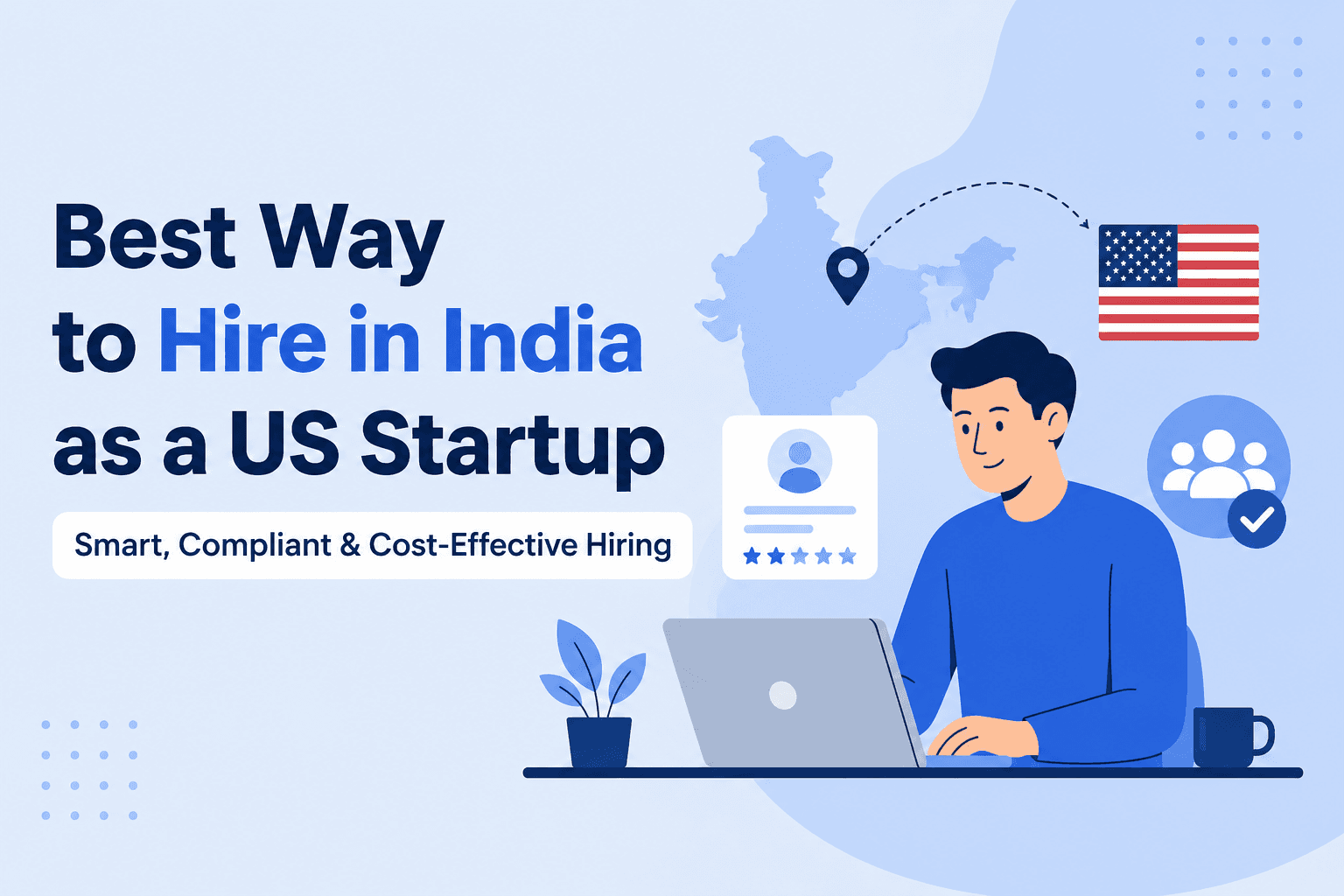
Best Way to Hire in India as a US Startup
Hiring in India as a US startup usually comes down to three models: contractor, your own entity, or Employer of Record (EOR). This guide breaks down the real costs, compliance risks, and why EOR is often the smartest option for startups hiring 1 to 20 employees in India.

ByNilesh Parwani / July 9, 2026 / 5 min read
Most US founders overcomplicate this. There are three ways to hire in India. For almost everyone reading this, one of them is the obvious answer.
I have helped hundreds of US startups work through this decision. The confusion is always the same: too many options, not enough clarity on what each one actually costs or risks. So here is the complete breakdown on how to hire in India, including the compliance details most guides leave out.
The Three Ways to Hire in India
Contractor
Fast to start. Zero setup cost. You find someone, agree on a rate, they invoice you monthly. It feels simple.
The problem shows up later.
If your contractor works full-time hours, uses equipment you provided, and works exclusively for your company, Indian labour authorities treat that as employment regardless of what the contract says. When you hire in India through a contractor agreement, authorities look at how the relationship actually functions, not what you call it.
Misclassification means backdated liabilities from the first day of the original engagement, not the reclassification date. That includes EPF contributions at 12% of basic salary on the employer side, ESIC at 3.25% of gross salary, gratuity accruals, and TDS corrections with penalties.
A 12 to 18 month audit bill typically runs higher than what two years of EOR fees would have cost. Most founders discover this only when the notice arrives.
Use a contractor when you need to hire in India for a genuinely short engagement, 3 months or less, the work is outcome-based with a fixed deliverable, and the person works for multiple clients. That is a narrow set of conditions. Most tech roles do not meet them.
Your Own Entity
Full control when you hire in India at scale, and the lowest per-employee cost long-term. But the upfront requirements are significant.
Registration, legal counsel, and compliance setup run $20,000 to $150,000 depending on structure and the legal help you need. The timeline from first filing to first compliant hire is 3 to 6 months. Once your entity exists, the ongoing obligations do not shrink. ROC filings, state-level professional tax, and monthly EPF and ESIC challan filings by the 15th of each month, quarterly TDS returns, and annual financial statements all require dedicated resources.
India's 2026 Labour Codes add a further layer. Basic salary must now constitute at least 50% of total CTC. This affects the PF contribution base, gratuity calculations, and ESIC coverage thresholds. Companies that structure salaries with heavy allowances and low basic pay now face reclassification risk on their entire payroll.
Use your own entity when you plan to hire in India at scale, committed to 25 to 30 or more employees long-term, and the economics of self-managed compliance justify the setup cost. Below that threshold, the per-employee math runs against ownership.
Employer of Record
The right default for any US startup looking to hire in India with 1 to 20 people.
An EOR becomes the legal employer on paper. It issues employment contracts that comply with Indian labour law, runs payroll in INR, deducts TDS, files EPF and ESIC contributions monthly, and manages gratuity accruals. You manage the team day to day. You set the salary, run the interviews, own all IP, and control every hiring and performance decision.
First hire onboarded in 48 hours. No entity required. No 3 to 6 month wait.
What It Actually Costs to Hire in India: The Full Breakdown
Most guides on how to hire in India show you a salary range and stop there. The real number is higher. Here is the full picture.
Mandatory employer-side statutory contributions (2026):
For a mid-level software engineer in Bangalore with a CTC of $30,000 per year:
Annualized: roughly $40,680 for a $30,000 CTC hire.
Compare that to a mid-level US software engineer: $120,000 to $180,000 per year in base salary alone, plus employer FICA at 7.65%, health benefits, 401(k) matching, and recruiting costs. Total loaded cost runs $150,000 to $220,000 per year. The net annual saving per engineer is $110,000 to $180,000.
Why EOR Wins for Most Startups
The contractor model saves you the EOR fee upfront. It costs you far more if misclassification is discovered.
Entity setup gives you full ownership. It requires $20,000 to $150,000 and 3 to 6 months before you make a single compliant offer.
EOR gives you compliant full-time employment in 48 hours, with statutory contributions handled, IP assignment in the employment contract, and no entity overhead.
For any startup that wants to hire in India with fewer than 25 people, EOR is not a workaround. It is the correct structure. The economics only shift toward entity ownership once your India team is large enough that the fixed compliance infrastructure pays for itself per employee.
Once your team crosses 25 to 30 people, it is worth evaluating a Build-Operate-Transfer transition to your own entity. Kaamwork supports both models and advises on the right transition point for your team size.
How to Actually Get Started
The fastest path to your first hire has four steps.
Step 1: Define the role and benchmark the salary. Use India-specific market data, not US salary databases. A senior engineer in Hyderabad at Rs 35 LPA is well-compensated in that market. Applying San Francisco benchmarks produces offers no serious candidate will accept.
Step 2: Partner with an India EOR to hire in India compliantly. The EOR activates statutory registrations, drafts employment contracts, and becomes the legal employer from day one. You retain full operational control.
Step 3: Interview and select. You run the technical interviews, assess fit, and set the offer. The EOR handles no part of the hiring decision.
Step 4: Onboard in 48 hours. Offer letter issued, EPF and ESIC enrolled, equipment provisioned, tools access activated.
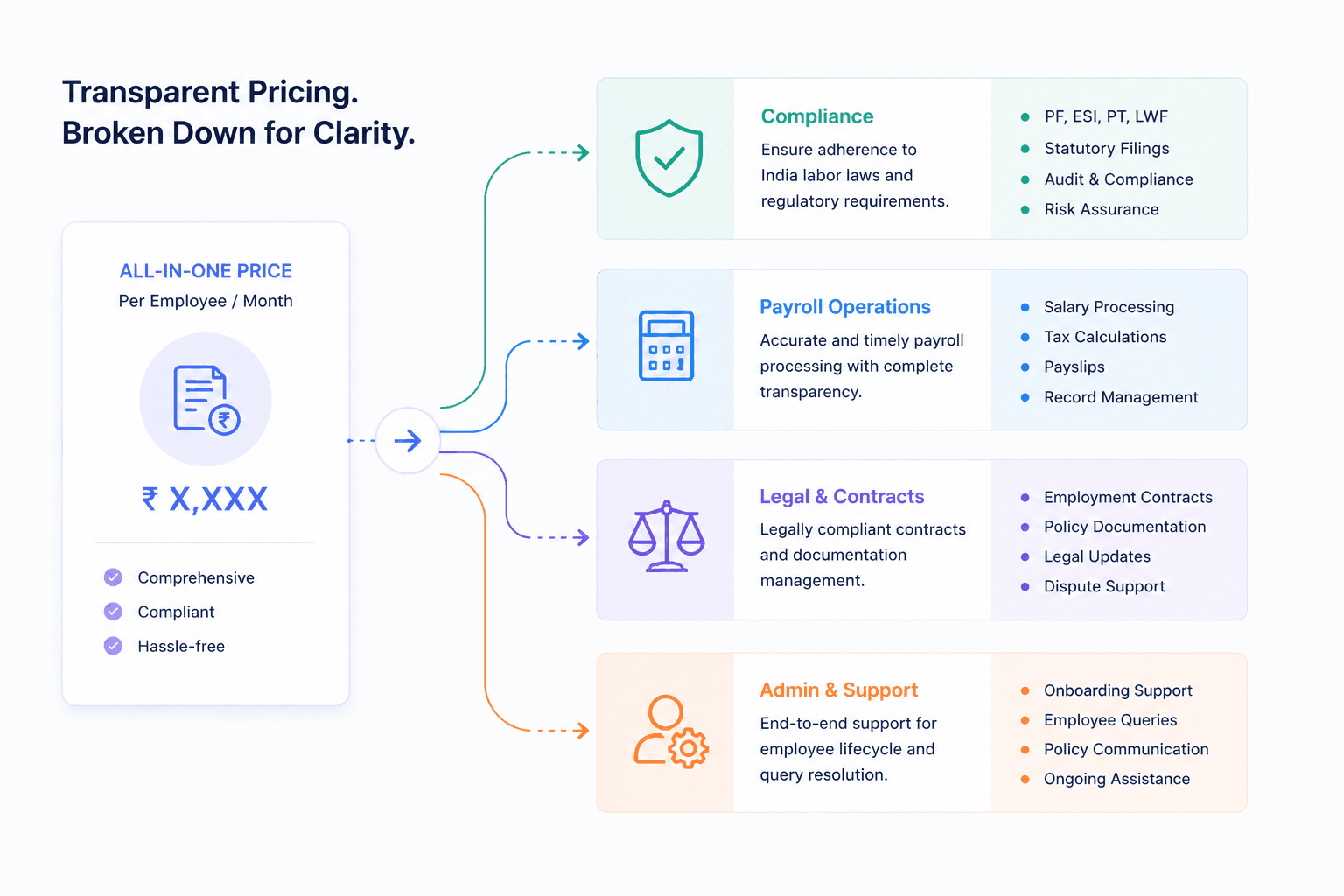
At Kaamwork, we run this exact structure for US startups that want to hire in India the right way. The EOR model in India includes sourcing support, payroll, compliance, and a local HR layer that keeps attrition below 5%, against a sector average above 20%. The EOR fee is $599 per month per employee, on top of the employee's agreed salary. Profiles delivered within 24 hours of your role brief.
Talk to Kaamwork to get a cost estimate for your specific roles and a comparison against your current US hiring plan.
Share this article

Founder & CEO | Kaam.Work
Nilesh Parwani, a Kelley School BBA graduate, worked at UBS and Warburg Pincus before founding PrintBell (acquired by Cimpress). In 2020, he launched kaam.work, a remote work platform focused on flexible talent and distributed teams.