India Labour Codes 2026: What US Employers Must Change
The India labour codes took effect on November 21, 2025. US employers must keep wages at 50% or more of pay, give fixed-term staff gratuity after one year, recalculate gratuity on the higher wage base and update contracts and payroll. An EOR handles most of this.

ByNilesh Parwani / November 25, 2026 / 7 min read
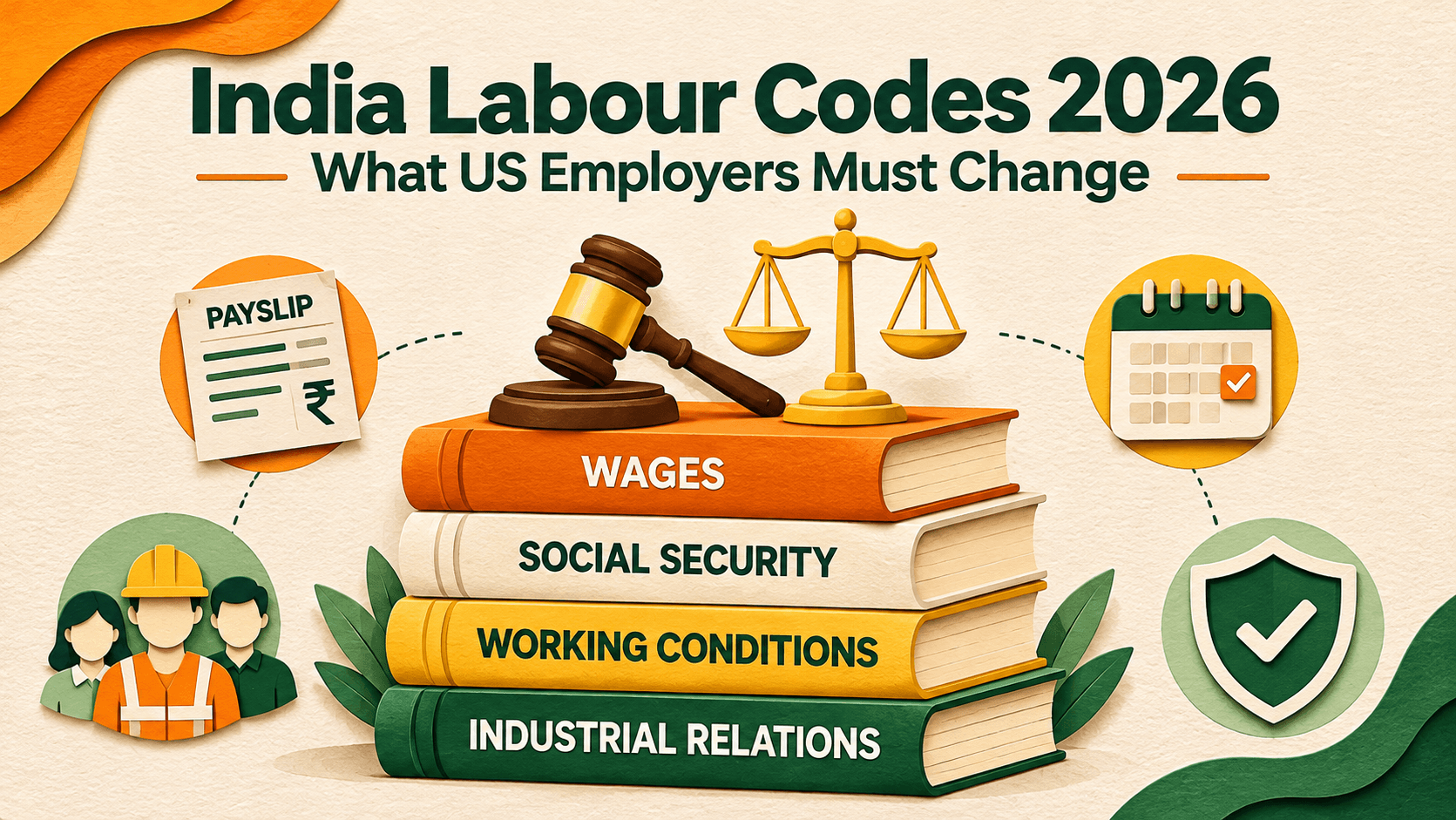
- The Four India Labour Codes at a Glance
- Change 1: The 50% Wage Rule
- Change 2: Gratuity for Fixed-Term Employees After One Year
- Change 3: Gratuity Costs Rise on a Bigger Wage Base
- Change 4: Wider Coverage and Formal Processes
- Worked Example: The Cost Impact of the India Labour Codes
- What US Employers Must Change in 2026: A Checklist
- If You Hire Through an EOR
- Where Kaamwork Fits
- Frequently Asked Questions
- 1. When did the India labour codes take effect?
- The Bottom Line
India brought in four new labour codes to replace 29 older central labour laws. They are the Code on Wages, 2019, the Industrial Relations Code, 2020, the Code on Social Security, 2020, and the Occupational Safety, Health and Working Conditions Code, 2020. All four took effect on November 21, 2025. Some parts are still being rolled out as central and state rules are notified. If you're a US company with employees in India, or plan to hire there, three changes need your attention. First, the codes introduce a common definition of wages. Wages must make up at least 50% of total pay. Companies that keep basic pay low and put more money into allowances may now have higher gratuity costs and, in some cases, higher provident fund contributions. Second, fixed-term employees get the same statutory benefits as permanent employees. They're also eligible for gratuity after one year of service, rather than five. Third, the codes bring gig and platform workers into the social security framework. They also put more emphasis on written contracts, proper records and clear processes for workplace disputes. In 2026, employers need to make a few changes. Check that wages meet the 50% rule and work out gratuity again. Review fixed-term and contractor agreements, update employment contracts and HR policies, and make sure payroll follows the new rules. If you hire in India through an employer of record (EOR), the provider should handle much of the compliance work. You'll still need to approve salary structures and account for any increase in costs. If you employ people through your own Indian entity, you're responsible for making these changes yourself. This guide looks at what changed under the India labour codes, works through an example of the cost impact and gives US employers a checklist for 2026.
Before the India labour codes, India's employment law was a patchwork of 29 central statutes, many written decades ago, plus state rules on top. Most US companies dealt with it through a local payroll provider and never looked closely.
The India labour codes changed that. They consolidate those laws into four, and they change how pay is structured, how benefits are calculated and who counts as covered.
If you employ even one person in India, the India labour codes affect your costs and your contracts. Here is what changed and what to do about it.
The Four India Labour Codes at a Glance
All four India labour codes came into effect on November 21, 2025. The Employees' Provident Fund Act, 1952, was not replaced. Some details, including certain thresholds and state rules, were still being notified after the codes took effect. Check the latest rules for each state where you have employees.
Change 1: The 50% Wage Rule
This is the change in the India labour codes that touches almost every payslip, and the one US employers ask about most.
Before the India labour codes, many Indian salaries had a low basic pay and large allowances. Because gratuity, provident fund and bonus were calculated on basic pay, a low basic kept those costs down.
The four India labour codes use the same definition of wages. Wages must make up at least 50% of an employee's total pay. If allowances go above the remaining 50%, the excess gets added back to wages when calculating statutory benefits.
What this means for US employers: salary structures with basic pay below 50% need to be restructured, and benefits calculated on wages will usually go up.
Change 2: Gratuity for Fixed-Term Employees After One Year
Under the India labour codes, fixed-term employees get the same statutory benefits as permanent employees, including EPF, ESI, bonus and gratuity in proportion to their service. They become eligible for gratuity after one year of service.
Under the India labour codes, permanent employees still qualify for gratuity after five years of continuous service.
What this means for US employers: if you use fixed-term contracts in India to avoid long-term liabilities, those contracts now carry gratuity after a year. Budget for it.
Change 3: Gratuity Costs Rise on a Bigger Wage Base
Because the India labour codes require wages to be at least 50% of pay, gratuity is calculated on a larger base for many employees. Employment law firms expect employer gratuity liability to rise as a result.
For more on how the India labour codes affect payouts, our guide to gratuity in India explains the formula in detail.
Change 4: Wider Coverage and Formal Processes
The India labour codes extend social security to gig and platform workers and bring more workers into a uniform framework. The Industrial Relations Code puts more weight on conciliation and formal dispute processes.
What this means for US employers: if you use long-term Indian contractors who work like employees, the India labour codes make that harder to defend. Our guide to employee misclassification covers the test.
Worked Example: The Cost Impact of the India Labour Codes
Take one engineer on a CTC of INR 24 lakh a year. Assume basic pay was 40% of CTC before the India labour codes and moves to 50%. Gratuity is accrued at about 4.81% of basic. USD figures use INR 83.5 per USD and are illustrations.
The extra cost per employee may not look like much, but across a team, it adds up year after year. Your EPF policy also makes a difference. If you contribute based on the statutory wage ceiling, your EPF cost may stay the same under the new labour codes. If you contribute on the full basic salary, both your contribution and the employee's deduction will be higher. That also means less take-home pay for the employee.
What US Employers Must Change in 2026: A Checklist
- Audit salary structures. Under the India labour codes, check that basic pay and dearness allowance are at least 50% of total pay for every India employee.
- Restructure where needed. Rebalance basic and allowances, and explain any change in monthly take-home to employees before it happens.
- Recalculate gratuity provisions. Use the India labour codes wage base, and add provisions for fixed-term staff after one year.
- Set your EPF policy. Decide whether to contribute based on the statutory wage ceiling or the full basic salary. Apply the same approach consistently.
- Check fixed-term and contractor agreements. Make sure fixed-term employees get the benefits they're entitled to. Also review long-term contractor arrangements to see if any roles should be treated as employment.
- Update contracts and policies. Align employment contracts, leave policies and HR handbooks with the India labour codes.
- Check state rules. Confirm how the states where your employees work have notified their rules.
- Confirm with your EOR or payroll provider. Ask in writing how they have applied each of the India labour codes.
To see how these rules affect take-home pay and employer cost for a specific salary, use the method in our India payroll calculator guide.
If You Hire Through an EOR
An employer of record is the legal employer in India, so it is responsible for applying the India labour codes to payroll, contracts and benefits. That removes most of the compliance work from your side.
Under the India labour codes, you still make the commercial decisions: approving new salary structures, accepting the budget impact and choosing the EPF policy. Ask your EOR to show you the before-and-after cost for each employee.
Where Kaamwork Fits
This is our product, so weigh this section accordingly.
Kaamwork is an India-only employer of record for US and UK companies. It structures salaries in line with the India labour codes from the offer stage, handles payroll, PF, ESIC, professional tax and gratuity through a dedicated HR expert in India, and charges a flat $599 per employee per month on top of salary. See how it works on our EOR in India solution page.
Frequently Asked Questions
1. When did the India labour codes take effect?
All four codes came into force on November 21, 2025. Some provisions are being implemented as central and state rules are notified.
2. What are the four India labour codes?
They are the Code on Wages, 2019; the Industrial Relations Code, 2020; the Code on Social Security, 2020; and the Occupational Safety, Health and Working Conditions Code, 2020.
3. What does the 50% wage rule mean?
Wages, including basic pay and dearness allowance, must make up at least 50% of total remuneration. If allowances exceed the permitted limit, the excess is added back when calculating statutory benefits.
4. Do fixed-term employees qualify for gratuity under the India labour codes?
Yes. Fixed-term employees can qualify after one year of service, with gratuity calculated based on their period of employment. Permanent employees generally need five years of service.
5. Will the India labour codes reduce take-home pay?
They can. If basic pay increases and EPF is calculated on the full basic salary, the employee's contribution will also rise. Using the statutory wage ceiling can limit the impact.
6. Do the India labour codes apply when I hire through an EOR?
Yes. The EOR is the legal employer and is responsible for applying the labour codes. You'll still need to approve salary structures and account for any change in costs.
The Bottom Line
The India labour codes are not a reason to stop hiring in India. They are a reason to check your salary structures, gratuity budget and contracts now rather than after an audit or an employee complaint.
Most of the change the India labour codes bring is a one-time restructure followed by slightly higher benefit costs. Do it once, do it properly, and the India labour codes become part of normal payroll.
For US and UK companies that want India payroll and the labour codes handled from day one, talk to Kaamwork.
Share this article

Founder & CEO | Kaam.Work
Nilesh Parwani, a Kelley School BBA graduate, worked at UBS and Warburg Pincus before founding PrintBell (acquired by Cimpress). In 2020, he launched kaam.work, a remote work platform focused on flexible talent and distributed teams.