Employer of Record for International Employees: How It Actually Works
An employer of record for international employees legally hires your worker in their country, issues a local contract, runs payroll, withholds tax and pays statutory benefits. You choose the person, set their pay and direct their work. You pay the EOR salary costs plus a monthly fee.

ByNilesh Parwani / November 23, 2026 / 5 min read
- The Three-Party Setup
- How It Works, Step by Step
- What You Control and What the Employer of Record for International Employees Controls
- How Long It Takes
- What It Costs
- What an Employer of Record for International Employees Does Not Do
- EOR vs Other Ways to Employ Someone Abroad
- Where Kaamwork Fits
- Frequently Asked Questions
- The Bottom Line
Most explanations of an employer of record for international employees stop at the definition. That is the easy part. The questions US companies actually ask come after: Who signs what? Where does the money go? Who is liable if something goes wrong? How long does it take? And what does an EOR not do?
This guide to the employer of record for international employees answers those, using hiring a software engineer in India as the running example. The mechanics are similar in most countries.
The Three-Party Setup
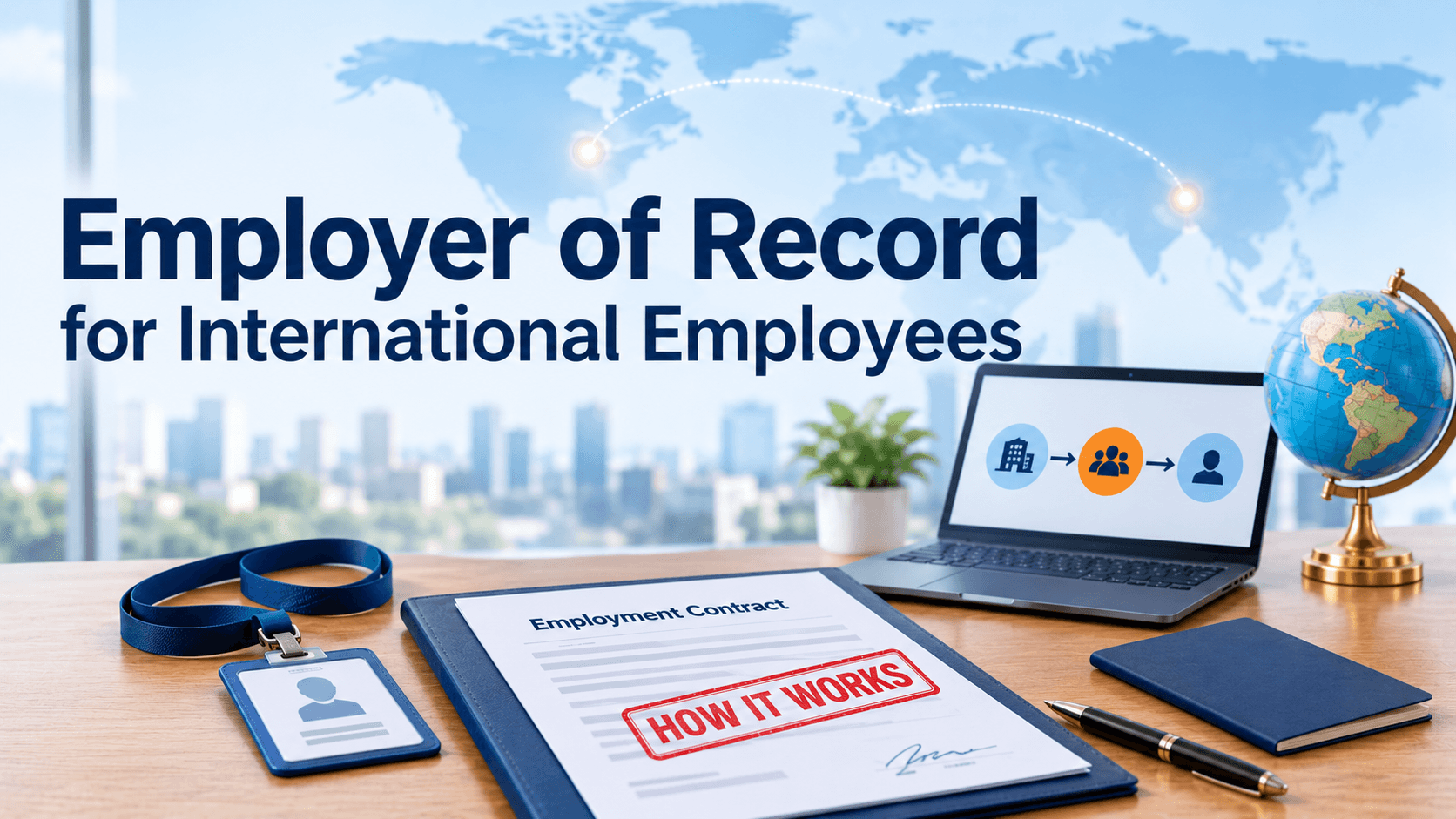
An employer of record for international employees creates a triangle with three relationships.
The important point about an employer of record for international employees: the EOR is the legal employer, but you are the one the employee works for. They use your tools, join your stand-ups and report to your managers.
How It Works, Step by Step
Step 1: You choose the person
You find and interview the candidate, or some providers of an employer of record for international employees source candidates for you. Either way, you make the hiring decision and agree on salary and start date.
Step 2: The EOR prepares the employment contract
The EOR draws up a contract based on local employment laws. In India, this includes notice periods, leave, gratuity and statutory contributions. The contract should also state that any IP created by the employee belongs to your company.
Step 3: Onboarding
Once the contract is signed, the EOR collects the employee's ID and tax documents and completes the required registrations. It also sets up payroll, including EPF, ESIC (if applicable), professional tax and income tax deductions in India. Benefits and equipment are usually arranged during this stage.
Step 4: Monthly payroll and payments
Every month, the EOR sends you a bill for the employee's salary, employer contributions and its service fee. You pay the bill, and the EOR handles the rest, including salary payments and statutory deductions. The EOR then:
- Pays the employee's net salary in local currency.
- Withholds and deposits income tax.
- Deposits employer and employee statutory contributions.
- Files the required returns and issues payslips.
Step 5: Ongoing management
You run the work. The employer of record for international employees handles HR administration: leave records, benefit changes, payslip questions, tax forms at year end and changes to contracts when you give a raise.
Step 6: Offboarding or moving employees
When an employee leaves, the EOR handles the notice period, final salary, pending leave and gratuity (if applicable). If you decide to open your own entity in India later, it can also help transfer employees to your new company.
What You Control and What the Employer of Record for International Employees Controls
Some providers of an employer of record for international employees leave more of the HR work to you; others put HR people on the ground. Ask which model you are buying.
How Long It Takes
Timelines for an employer of record for international employees depend on the country and the provider. Some EORs say they can issue offer letters within 48 hours in India. In practice, the slowest step is usually finding the right person, not the paperwork. Setting up your own entity in India, by comparison, typically takes three to six months.
What It Costs
You pay three layers:
- Salary, at local market rates.
- Employer statutory costs, which vary by country. In India, these include EPF, ESIC for lower salaries and a gratuity accrual.
- The fee for the employer of record for international employees, usually a flat monthly amount per employee. Published fees from major providers run from about $399 to $699 per employee per month in 2026.
For a full breakdown, see what EOR services include and what they cost.
What an Employer of Record for International Employees Does Not Do
An employer of record for international employees solves employment compliance. It does not solve everything.
- Immigration. An employer of record for international employees employs people who already have the right to work in that country. It does not get a US visa for anyone.
- Your product or delivery. An employer of record for international employees does not manage the work itself.
- All tax risk. If an employee's activities create a taxable presence for your company abroad, that is a separate issue. Our guide to permanent establishment risk explains how to manage it.
- Recruiting, unless your employer of record for international employees offers it. Many global EORs start only once you have chosen the candidate.
EOR vs Other Ways to Employ Someone Abroad
Treating a long-term, full-time worker as a contractor can create misclassification risk, which an employer of record for international employees avoids. And an EOR is different from a PEO; see EOR vs PEO.
Where Kaamwork Fits
Kaamwork is our product and an employer of record for international employees in India, so weigh this section accordingly.
Kaamwork is an employer of record for US and UK companies hiring in India. It charges a flat $599 per employee per month with no setup fee, sources and screens candidates, and assigns a dedicated HR expert in India. Payroll, PF, ESIC, professional tax and gratuity are handled, and add-ons such as laptops and office space are billed at actual cost.
If you are hiring in many countries, a global EOR will cover more ground. See how Kaamwork works on our EOR in India solution page.
Frequently Asked Questions
1. How does an employer of record work for international employees?
The EOR becomes the legal employer in the employee's country, issues a local contract and runs payroll, taxes and benefits. You choose the person and direct their work, and pay the EOR monthly.
2. With an employer of record for international employees, who is legally responsible for the employee?
The EOR is the legal employer and is responsible for employment law compliance. You are responsible for the work you assign and for following the service agreement.
3. Who owns the IP an international employee creates?
Your company should. Make sure both the service agreement and the employment contract assign IP to you.
4. Can an employer of record for international employees sponsor a US visa?
No. An EOR employs people in their own country. It does not handle US immigration.
5. How quickly can I hire through an employer of record for international employees?
The contract and payroll setup can take days. Finding the right candidate usually takes longer.
6. Can I move staff from an employer of record for international employees to my own entity later?
Yes. Most EORs support a transfer once you set up a local entity. Check the notice period and any transfer fee in your service agreement.
The Bottom Line
An employer of record for international employees is a simple idea with a few moving parts: a service agreement with you, a local contract with the employee, and a monthly invoice that covers salary, statutory costs and a fee. You keep control of who you hire and what they work on. The EOR carries the local employment paperwork and compliance.
Understand the triangle, the money flow and the limits, and choosing an employer of record for international employees becomes much easier.
→ See how Kaamwork works for India
For US and UK companies building full-time teams in India, talk to Kaamwork.
Share this article

Founder & CEO | Kaam.Work
Nilesh Parwani, a Kelley School BBA graduate, worked at UBS and Warburg Pincus before founding PrintBell (acquired by Cimpress). In 2020, he launched kaam.work, a remote work platform focused on flexible talent and distributed teams.