The Build Operate Transfer Model for India Tech Teams: How BOT Works
In the build operate transfer model, a partner builds your India tech team, runs it for one to four years, then hands the staff, assets and often the entity to you for a pre-agreed fee. It suits centres of 50+. Smaller teams can start with an EOR instead.

ByNilesh Parwani / November 24, 2026 / 7 min read
- How the Build Operate Transfer Model Works: Three Phases
- Why US Tech Companies Use the Build Operate Transfer Model
- What the Build Operate Transfer Model Costs
- Contract Terms That Matter in a Build Operate Transfer Model
- Risks of the Build Operate Transfer Model
- Build Operate Transfer Model vs EOR-to-Entity
- When the Build Operate Transfer Model Fits
- Where Kaamwork Fits
- Frequently Asked Questions
- The Bottom Line
The build operate transfer model is a way to set up a tech team in India through a partner, run it under the partner for a period, and then take full ownership. In the build phase, the partner hires engineers, finds office space and sets up payroll, IT and compliance. In the operate phase, the partner runs the centre day to day while the team works on your product. In the transfer phase, the employees, assets and often a legal entity move to your company, usually after two to five years and against a pre-agreed transfer fee. US companies choose the build operate transfer model when they want their own India engineering centre, or global capability center (GCC), but do not want to learn Indian hiring, labour law and real estate from scratch. It reduces early risk and gets a team working faster than setting up an entity alone, which typically costs $20,000 to $150,000 and takes three to six months. The trade-offs are real, though. You keep paying the provider a management fee while it runs the team, and the cost of transferring the team can be high. If the contract doesn't clearly say who employs the developers, who owns the IP and how the transfer fee is worked out, you could end up negotiating those details when you're ready to leave. That's not a great position to be in. Before signing a build-operate-transfer (BOT) contract, agree on four things: when the transfer can happen, how the fee is calculated, what happens to employee benefits such as gratuity, and what you'll pay if you leave early. Smaller teams have another option. You can hire through an employer of record (EOR) first, then move the employees to your own entity when the team grows. This guide covers how both approaches work, what they cost, the contract terms to check and how to choose between a full BOT model and the EOR-to-entity route.
The build operate transfer model started in public infrastructure. A private company builds a road or a power plant, runs it for years, then hands it to the government.
Tech teams borrowed the build operate transfer model. Instead of a toll road, the asset is an engineering centre in Bengaluru, Hyderabad or Pune. Instead of a government, the eventual owner is you.
It is not the only way to build an India team. But for companies that want their own centre without building one from zero, the build operate transfer model is worth understanding properly.
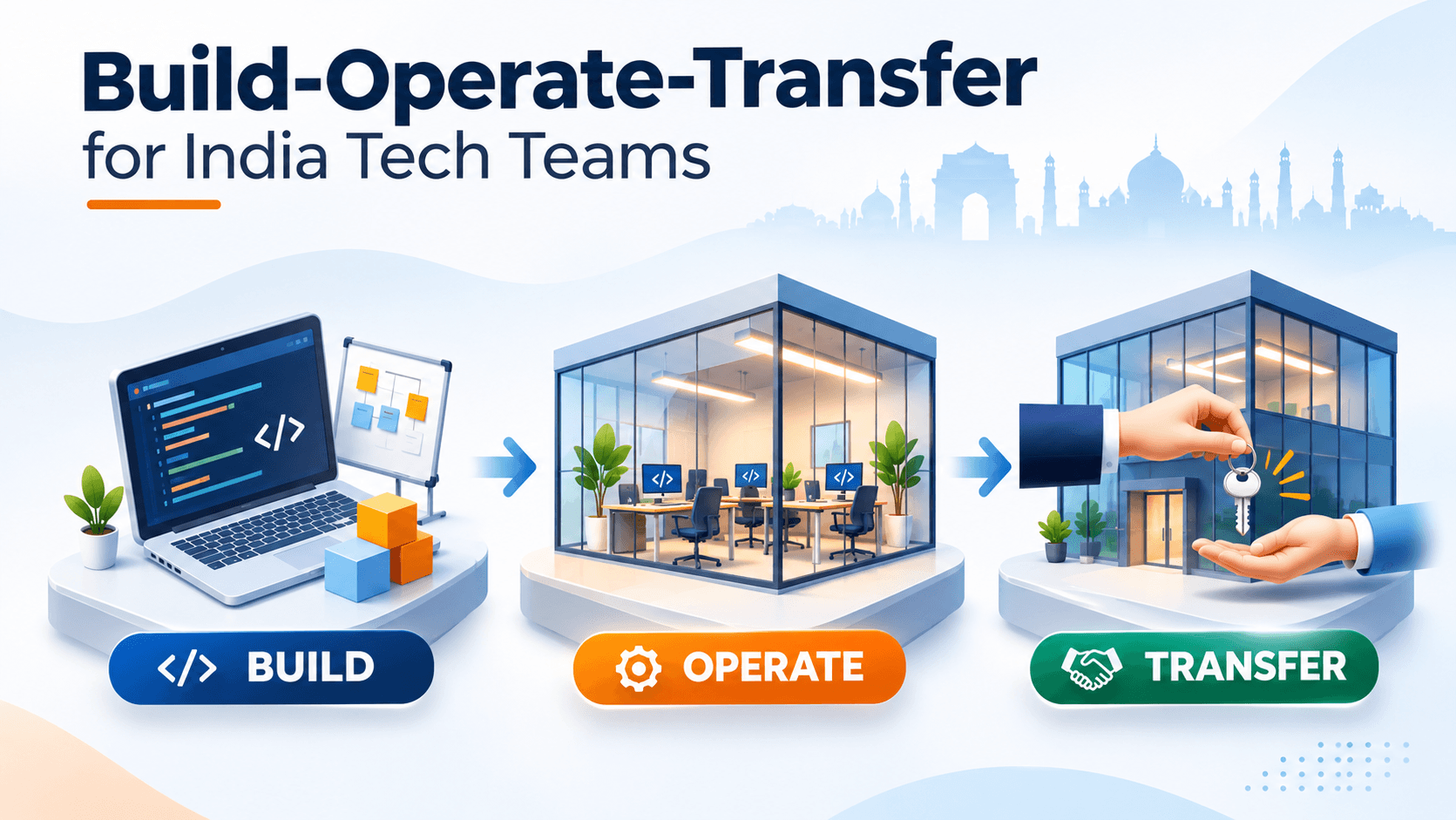
How the Build Operate Transfer Model Works: Three Phases
Build. The partner gets the team up and running. It hires developers, arranges office space and laptops, sets up payroll, completes statutory registrations and puts HR policies in place. You still approve each person before they're hired.
Operate. The partner runs the centre while your managers direct the work. This is where the build operate transfer model earns its fee: the partner handles attrition, appraisals, benefits, compliance filings and facilities, while your team focuses on product.
Transfer. At the agreed time, the team moves over to your company. This usually means setting up or acquiring an Indian entity, transferring employees while keeping their service history intact, and taking over the office lease and equipment.
Why US Tech Companies Use the Build Operate Transfer Model
Speed. A partner that already has hiring pipelines, an office and payroll can have engineers working within weeks. Setting up your own entity first typically takes three to six months.
Lower early risk. If the India plan does not work, you have not sunk money into an entity, a lease and a local leadership team. The build operate transfer model lets you test before you own.
Local knowledge. Indian labour law, state-level professional tax, EPF, ESIC, gratuity and the labour codes in force since November 2025 all need local expertise. The partner brings it.
A clear end state. Unlike staff augmentation, the build operate transfer model is designed to end with you owning the team. The engineers know they will become your employees, which helps retention.
What the Build Operate Transfer Model Costs
Build operate transfer model costs vary widely by partner, city and team size, so treat any single figure with caution. A build operate transfer model engagement usually has four cost lines.
The transfer fee is where build operate transfer model deals go wrong. If the formula is not fixed at the start, you negotiate it at the moment you most need the partner's co-operation.
Contract Terms That Matter in a Build Operate Transfer Model
Transfer trigger. A date, a headcount, or your choice with notice. A build operate transfer model contract should let you call the transfer, not wait for the partner.
Transfer fee formula. Fixed in writing on day one, with the calculation shown.
Employee continuity. Employees should move with continuous service so gratuity and leave balances carry over. Our guide to gratuity in India explains why this matters.
IP ownership. All IP created by the team should be assigned to you as it is created, not at transfer.
Non-solicit and early exit. What happens if you want to end the build operate transfer model early, or move only part of the team?
Leadership hires. Who hires the centre head and senior managers, and do they move with the transfer?
Risks of the Build Operate Transfer Model
Dependence on one partner. In a build operate transfer model, for years, the partner controls payroll, HR and facilities. A weak partner hurts every engineer's experience.
Misaligned incentives. If the partner earns a markup on cost, it has little reason to keep costs down.
Transfer friction. At the end of a build operate transfer model, moving employees, leases and contracts takes time and paperwork, even with a good partner. Plan for it.
Overkill for small teams. A build operate transfer model makes most sense for a centre that will grow past 30 to 50 people. For ten engineers, it is often more structure than you need.
Build Operate Transfer Model vs EOR-to-Entity
There is a lighter route to the same end state, and it suits many smaller teams.
The EOR path gives you most of what the build operate transfer model offers in the early years, with lower fees and no transfer fee. The full BOT gives you more: a branded office, a leadership team and a ready-made entity.
When the Build Operate Transfer Model Fits
- You plan a dedicated centre of 50 or more engineers.
- You want a branded office and a local leadership team from the start.
- You expect to own a full GCC within three to five years.
- You are comfortable paying a management fee for the operate phase.
If you need ten engineers next quarter and are not sure about a full centre, start smaller. You can move into a build operate transfer model or your own entity later.
Where Kaamwork Fits
This is our product, so weigh this section accordingly.
Kaamwork is an India-only employer of record. It is not a full build operate transfer model partner with its own campuses. What it offers is the simpler path: Kaamwork employs your engineers for a flat $599 per employee per month on top of salary, sources and screens candidates, and handles payroll, PF, ESIC and gratuity through a dedicated HR expert in India. When your team is ready, Kaamwork helps move employees into your own entity or global capability center, with service continuity.
See how the first step works on our EOR in India solution page.
Frequently Asked Questions
1. What is the build operate transfer model in software development?
A partner builds and runs a tech team in another country for your company, then transfers the employees, assets and often the legal entity to you after an agreed period.
2. How long does a build operate transfer model take?
The build phase usually takes a few months, the operate phase one to four years, and the transfer one to three months.
3. What does a build operate transfer model cost?
Salaries pass through at cost, plus a management fee, set-up costs and a transfer fee. Fees vary widely, so get the transfer formula fixed in the contract.
4. Is BOT the same as a GCC?
No. A GCC is the end result: your own capability centre. The build operate transfer model is one way to get there.
5. Do employees keep their service when transferred?
They should. Make sure the contract moves employees on continuous service so gratuity and leave carry over.
6. What is the alternative to a build operate transfer model?
For smaller teams, hiring through an employer of record and then moving employees into your own entity gives a similar path with lower fees.
The Bottom Line
The build operate transfer model is a good answer to a specific question: how do we get our own India centre without building it from nothing? For a planned centre of 50 or more, it often works well, as long as the transfer terms are fixed on day one.
For smaller teams, the same idea works in a lighter form. Start with an employer of record, prove the team, then move it into your own entity.
→ See how Kaamwork helps you build a GCC in India
For US and UK companies building engineering teams in India that may grow into their own centre, talk to Kaamwork.
Share this article

Founder & CEO | Kaam.Work
Nilesh Parwani, a Kelley School BBA graduate, worked at UBS and Warburg Pincus before founding PrintBell (acquired by Cimpress). In 2020, he launched kaam.work, a remote work platform focused on flexible talent and distributed teams.