How to Hire Offshore Developers in India: Models, Rates and Risks
To hire offshore developers in India, pick the model first: freelancers for small tasks, vendors for short projects, an EOR for full-time staff without an entity. India rates run about $15 to $80 an hour. For long-term roles, an EOR usually costs less and keeps people longer.

ByNilesh Parwani / November 24, 2026 / 8 min read
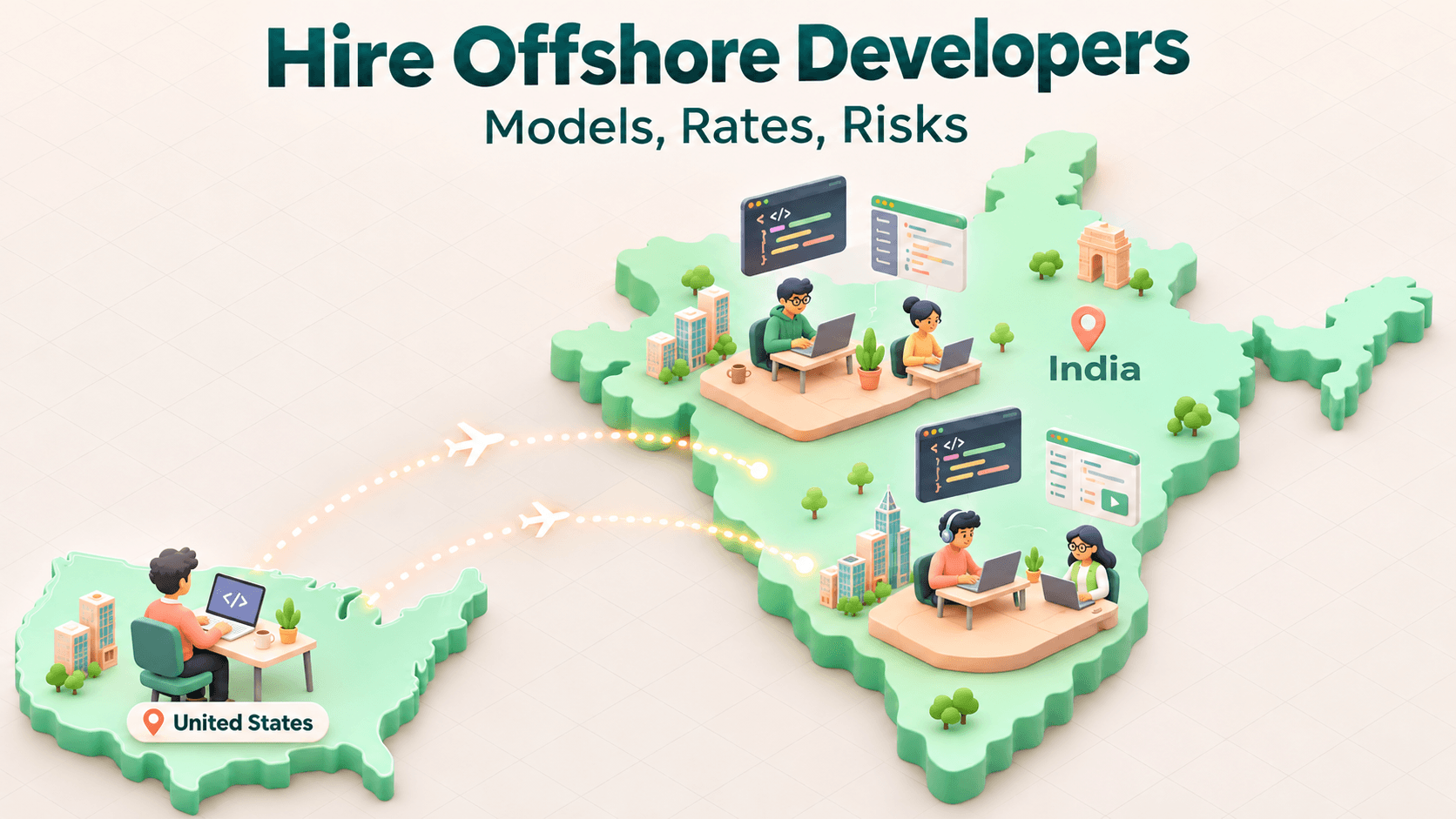
To hire offshore developers in India, first decide how long you need them and who should be their legal employer. That one decision picks your model. Freelancers suit small, short tasks with a clear end. Agencies and staff augmentation vendors suit projects and surge capacity, and they bill an hourly rate that includes their margin. An EOR is a good option if you want offshore developers to work as full-time members of your team without opening an entity in India. In 2026, hiring developers in India costs roughly $15 to $80 an hour, depending on experience and the tech stack. Most mid-to-senior developers hired through vendors fall somewhere between $18 and $50 an hour. The hourly rate isn't the only thing to look at. People leaving, delays during onboarding and IP ownership issues can end up costing more than expected. When you hire offshore developers, start with a clear job description and salary range. Decide how you want to hire, shortlist candidates and use a paid technical task to assess their skills. Interviews alone won't tell you everything. Before hiring, check who will be the legal employer, who owns the code and how EPF, gratuity and other benefits are handled. Once the developer joins, give them access to your tools, include them in stand-ups and assign someone to manage their work. If you're hiring for the long term, an EOR can cost less than paying a vendor by the hour. You pay a fixed EOR fee instead of a markup on the developer's salary.
Most US companies that try to hire offshore developers make the same first move. They post a role on a freelance site, get forty proposals overnight, and pick the one with the best rate and a decent portfolio.
Sometimes that works. Often it does not. The developer disappears after a month, or the code needs rewriting, or the person was quietly working three other contracts.
When companies hire offshore developers badly, the problem is rarely India. It is the model. Choosing how you hire offshore developers decides who they work for, how long they stay and what you actually pay. This guide is about making that choice on purpose.
Five Ways to Hire Offshore Developers in India
Each way to hire offshore developers answers the question "how do we hire offshore developers?" differently. The right one depends on duration, control and how much management time you have.
Employer of record. You choose the developer and direct the work. The employer of record issues the Indian employment contract, runs payroll and handles EPF, ESIC, professional tax and gratuity. The developer is a full-time employee of the EOR who works only for you. This is the model to use when you hire offshore developers as a permanent part of your team.
Freelancer. Fast and cheap if you hire offshore developers for a two-week task. Risky for anything core. A freelancer has no obligation to stay, and if a long-term freelancer works only for you under your managers, Indian authorities can treat the arrangement as disguised employment.
Staff augmentation vendor. The vendor supplies an engineer from its bench and bills you a rate that includes its margin. It is the quickest way to hire offshore developers for a three-month push. The trade-off is that the developer's career, pay and next assignment stay with the vendor.
Project outsourcing. You buy an outcome, not people, so you do not hire offshore developers directly. It works well for a defined build and badly when requirements change every sprint.
Own entity or GCC. Setting up an Indian entity typically costs $20,000 to $150,000 and takes three to six months. It makes sense to hire offshore developers this way once the team is large and permanent.
What It Costs to Hire Offshore Developers in India
In 2026, offshore developer rates in India range from around $15 to $80 an hour, depending on experience, tech stack and how you hire. Senior developers typically cost $18 to $45 an hour, compared with $75 to $150 in the US, according to one 2026 comparison.
Those are the vendor rates you pay when you hire offshore developers through an agency. When you hire offshore developers through an EOR, you pay salary instead of a marked-up hourly rate. Here is one senior developer, compared both ways. The salary is an illustration, not a market average.
The gap is smaller for junior roles and larger for senior ones. It also flips if you only need someone for a few weeks, because a full-time employee comes with notice periods and statutory obligations. Our guide to the true cost of hiring a developer in India breaks down CTC, EPF, ESIC and gratuity line by line.
How to Hire Offshore Developers: A Step-by-Step Process
Step 1: Write a clear job description. Mention the tech stack, experience level, expected overlap with your US team and salary range in INR. Be specific about the work you need done. Vague job posts tend to attract candidates who aren't quite the right fit, no matter where you're hiring.
Step 2: Pick the engagement model. Use the table above. If you expect to keep the person beyond a year, plan for full-time employment from day one rather than converting later.
Step 3: Source candidates. Job boards, referrals and recruiters all work in India. Some EORs, including Kaamwork, also source and screen candidates, typically sharing profiles within 24 hours of a job description.
Step 4: Give them a paid technical task. A short exercise based on actual work can tell you more than several interview rounds. Once it's done, ask the candidate to walk you through their code and let their future manager talk to them.
Step 5: Make an offer that makes sense. Candidates in India usually look at their monthly take-home pay, not just CTC. Include both figures in the offer. If you only show CTC, someone else offering better in-hand pay may get the candidate.
Step 6: Sort out the legal details. Make sure you know who employs the developer, that the contract transfers IP to your company, and that EPF, gratuity and leave are handled under Indian law.
Step 7: Bring them into the team. Give them a laptop, accounts, a manager to report to and a plan for their first week. Include them in stand-ups from day one. If you treat offshore developers like outside vendors, don't be surprised when they work like outside vendors.
The Risks When You Hire Offshore Developers
Attrition. India's tech market moves fast, and a developer who feels like a temporary contractor will leave for a small raise. Retention depends on treating people as your own employees: real titles, appraisals and a career path. Our founder's piece on why offshore teams lose engineers covers what changes this.
Misclassification. If you hire offshore developers as contractors but manage them like full-time staff, the arrangement can be challenged. Control, exclusivity, integration and duration all count. Our guide to employee misclassification explains the test.
IP ownership. With freelancers and vendor chains, IP can sit with the person or the vendor unless the contracts say otherwise. With an EOR, IP is assigned to your company in the employment contract.
Hidden vendor margin. Hourly rates hide how much the developer is actually paid. Underpaid developers leave sooner, so ask what share of the rate reaches the person before you hire offshore developers through a vendor.
Time-zone friction. India is 9.5 to 12.5 hours ahead of the US. Before you hire offshore developers, agree on two to four hours of overlap and write it into the role.
Compliance. India's labour codes, in force since November 21, 2025, set a single definition of wages that must be at least 50% of total pay, which affects PF and gratuity calculations. Any model you use to hire offshore developers must handle this correctly.
Freelancer, Vendor or EOR: Which Fits?
Many US companies hire offshore developers two ways at once: an EOR for the permanent core team and a vendor for surge capacity.
Where Kaamwork Fits
This is our product, so weigh this section accordingly.
Kaamwork is an India-only EOR for US and UK companies that want to hire offshore developers as full-time employees without an Indian entity. It charges a flat $599 per employee per month on top of salary, with no setup fee. It sources and screens candidates, typically sharing profiles within 24 hours. You make every hiring, salary and appraisal decision. A dedicated HR expert in India handles payroll, PF, ESIC, professional tax and gratuity.
It is not the right way to hire offshore developers for a six-week task. See how it works on our page about building a full-time team in India.
Frequently Asked Questions
1. What is the best way to hire offshore developers in India?
It depends on duration. For full-time developers you plan to keep, an employer of record gives you control and lower long-term cost. For short tasks, a freelancer or staff augmentation vendor is faster.
2. How much does it cost to hire offshore developers in India?
Vendor rates in 2026 run roughly $15 to $80 an hour, with most mid-to-senior engineers between $18 and $50. Through an EOR you pay salary, statutory costs and a flat fee instead.
3. Can I hire offshore developers in India without a company there?
Yes. An employer of record legally employs the developer on your behalf, so you do not need an Indian entity.
4. Is it legal to hire offshore developers as contractors?
Yes, for genuine project work. If a contractor works only for you, full time and long term, under your control, the arrangement can be treated as employment.
5. How long does it take to hire offshore developers?
Finding the right person usually takes two to six weeks. Once you choose, an EOR can typically have the contract and payroll ready within days.
6. Who owns the code when I hire offshore developers?
Your company should. Make sure the employment or service contract assigns all IP to you. With an EOR, this is written into the employment contract.
The Bottom Line
The rate gets the attention, but the model decides the outcome. When you hire offshore developers for a short task, keep it light: a freelancer or vendor is fine. When you hire offshore developers to build your product for years, treat them as employees from day one.
That is the difference between an offshore contractor and an offshore team.
For US and UK companies that want to hire offshore developers in India as full-time employees, with hiring support and local HR, talk to Kaamwork.
Share this article

Founder & CEO | Kaam.Work
Nilesh Parwani, a Kelley School BBA graduate, worked at UBS and Warburg Pincus before founding PrintBell (acquired by Cimpress). In 2020, he launched kaam.work, a remote work platform focused on flexible talent and distributed teams.