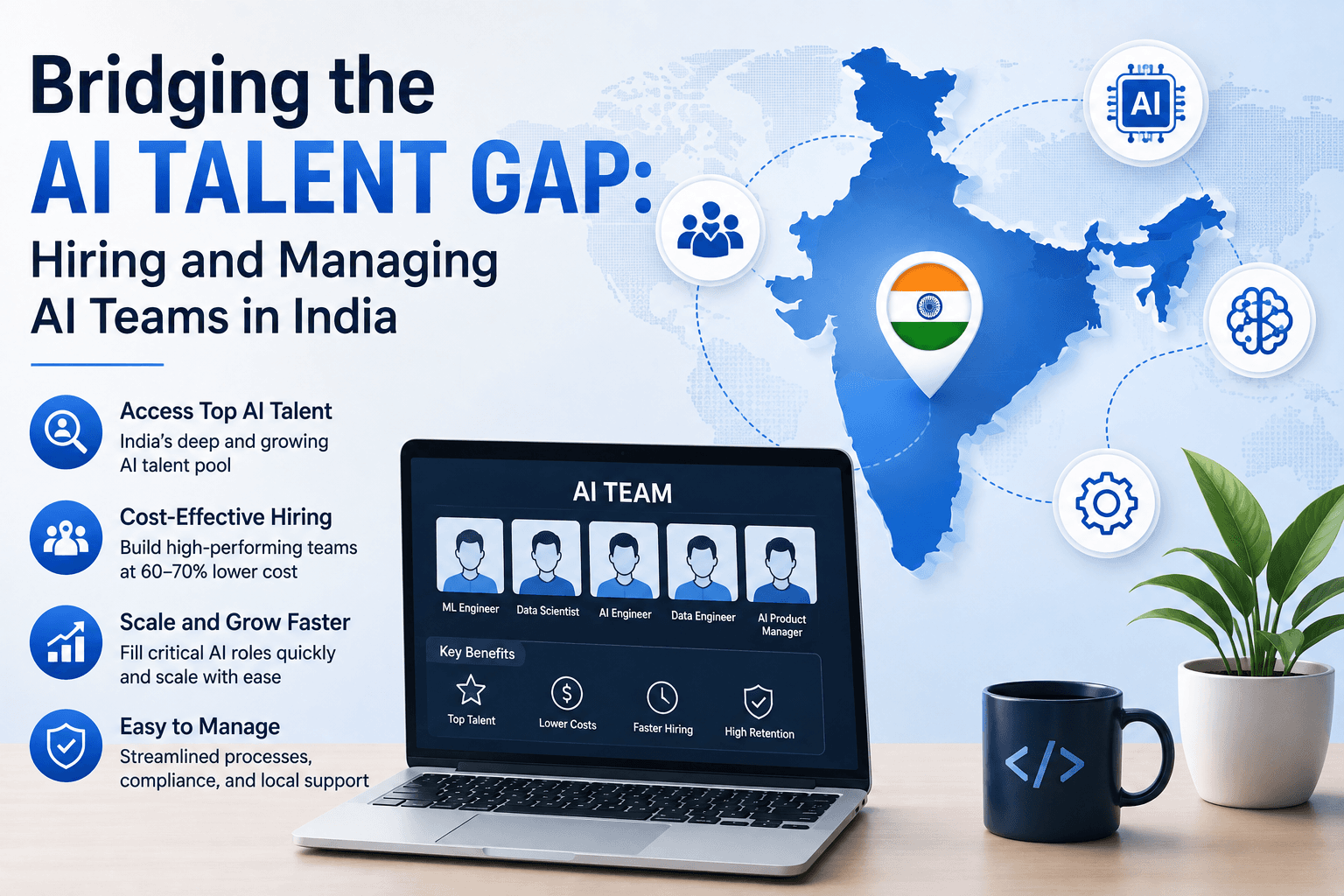
Bridging the AI Talent Gap: Hiring and Managing AI Teams in India
Bridge the US AI talent gap by hiring skilled AI teams in India, with practical guidance on skills, hiring, retention, management, and cost-effective team building.

ByNilesh Parwani / August 25, 2026 / 10 min read
- Understanding the AI Talent Gap: Which Parts of the AI Talent Gap Matter Most
- Running an AI Skills Gap Analysis: The Step That Defines Which Part of the AI Talent Gap You Are Solving
- Where India Closes the AI Talent Gap Best: Role-by-Role Breakdown
- How to Hire India AI Teams That Keep the AI Talent Gap Closed Long-Term
- Managing India AI Teams: What Determines Whether the AI Talent Gap Stays Closed
- Frequently Asked Questions
- The Bottom Line
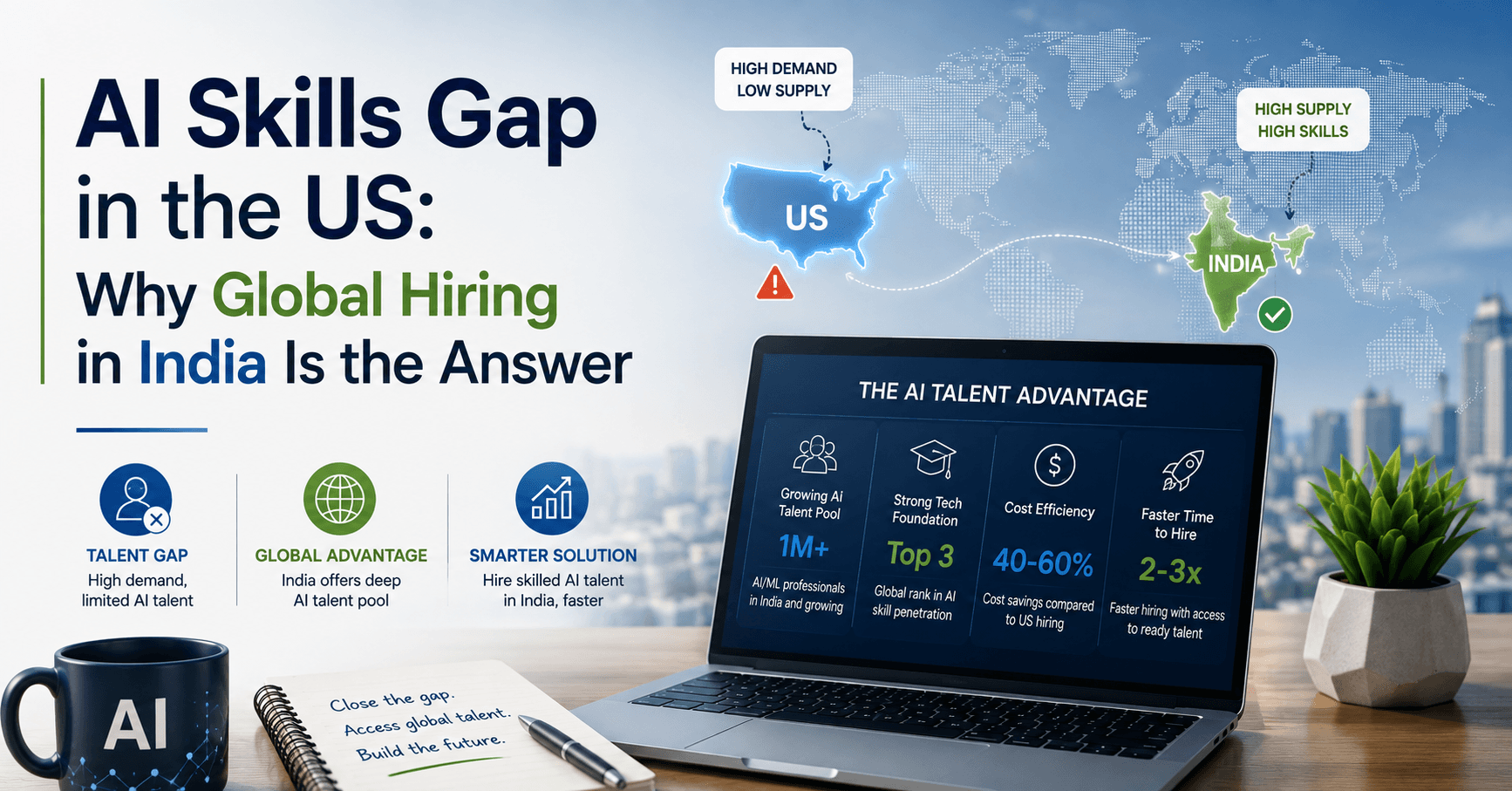
The ai talent gap in the US is not closing. Gartner's 2025 Technology Talent Survey put the US AI talent shortage at 65%. LinkedIn's Jobs on the Rise data showed AI engineer postings more than doubling since mid-2024 while qualified candidate supply grew at a fraction of that rate. Every AI engineering team in the US is hiring against a shrinking pool of qualified people at escalating compensation.
India is where the ai talent gap closes. Not because Indian engineers are a cheaper substitute for US talent, but because India has built the world's largest and fastest-growing pool of production AI engineering capability outside the US. NASSCOM-BCG 2024 data counted 420,000 employees in AI job functions. Stanford's 2025 AI Vibrancy Index ranked India third globally in AI capability. India's AI hiring rate is 33% annually, the highest in the world.
This guide covers how US companies are bridging the ai talent gap by hiring in India: how to identify which gaps India can realistically close, how to run a practical ai skills gap analysis before sourcing, and how to manage India AI teams in ways that keep attrition under 5% instead of the industry average of 25%.
Understanding the AI Talent Gap: Which Parts of the AI Talent Gap Matter Most
The ai talent gap in the US is not uniform. It is concentrated in specific roles and specific skills, and closing it requires clarity on exactly which part of the gap you are trying to fill before you hire anyone.
At the broadest level, the ai talent gap breaks down into three layers. Each layer of the ai talent gap requires a different hiring approach.
Layer 1: Production AI engineering. Engineers who can ship AI-powered products to production, wire LLMs into real systems, build reliable RAG pipelines, and maintain them under production conditions. LinkedIn data shows AI engineer job postings growing 74% year-over-year. This is the layer of the ai talent gap that has grown fastest and is deepest. Most US startups and product companies feel this layer most acutely.
Layer 2: ML engineering and data science. Engineers who can build and maintain custom machine learning models on proprietary data. The ai talent gap at this layer is real but narrower than layer 1, because ML engineering is an older discipline with a more established talent pipeline. Senior ML engineers are expensive in the US. Mid-level ones are undersupplied.
Layer 3: AI leadership and strategy. AI product managers, AI architects, and engineering leads who can set the strategic direction for AI capability-building across an organization. The ai talent gap at this layer is the most expensive to close domestically: US salaries for senior AI PMs run $180,000 to $250,000, and the combination of product fundamentals plus genuine ML knowledge is genuinely scarce.
India addresses all three layers of the ai talent gap, but at different effectiveness levels. Layer 1 and Layer 2 are where India's AI talent pool is deepest and most accessible. Layer 3 requires more careful sourcing because the strategic AI leadership profile is less common, though it exists at FAANG India offices and funded AI-native startups.
Running an AI Skills Gap Analysis: The Step That Defines Which Part of the AI Talent Gap You Are Solving
Running this analysis is the step most US companies skip, and skipping it produces the wrong hires. An ai skills gap analysis does not have to be complex, but it needs to answer three specific questions before the first sourcing search begins.
Question 1: What production AI capabilities do we have today?
Map what your current team can actually build and deploy. Not what they have studied or what tools they know, but what they have shipped and maintained in production. This step starts here because the gap is defined against current capability, not against an abstract ideal.
Question 2: What production AI capabilities does the roadmap require in the next 12 months?
For each AI initiative on the roadmap, identify the specific skills required at the production level: RAG pipeline design, LLM evaluation, fine-tuning, agent architecture, model serving infrastructure, ML feature pipelines. This process maps these requirements against the current capability inventory from question 1. The delta is the gap.
Question 3: Which gaps are role gaps versus skill gaps?
A role gap means you need a new person. A skill gap means an existing team member can close it with focused upskilling in 60 to 90 days. Confusing the two produces hiring plans that over-hire for problems that training would have solved, or under-hires for capability gaps that require a dedicated specialist.
For most US companies at seed to Series B, the analysis produces three to five specific capability gaps. Typically: production LLM engineering, RAG system quality, evaluation framework design, ML serving infrastructure, and data pipeline reliability. These five gaps map directly to the AI engineering roles that India's talent market is strongest in.
The output is a prioritized hiring brief: which roles to hire in what sequence, at what experience level, against what production skills evidence. It is the document that separates a sourcing process that produces the right people from one that produces people who look right on paper.
Where India Closes the AI Talent Gap Best: Role-by-Role Breakdown
Once this analysis is complete, the next question is which parts of the gap India's talent pool closes versus which require a US hire.
India's AI engineering talent pool is strongest in the roles that address Layer 1 and Layer 2 of the ai talent gap:
AI and LLM engineers with production experience. Bangalore, Hyderabad, and Pune have a growing cohort of engineers who built their careers during the LLM era and have shipped production RAG systems, agentic frameworks, and LLM evaluation pipelines at product companies and funded startups. The ai talent gap for this profile in the US is acute. In India, it is bridgeable.
Data scientists with ML deployment experience. India's data science talent pool is large. The subset with genuine production deployment experience, model monitoring expertise, and the mental model shift from notebook to production system, is smaller but accessible through sourced platforms and specialist AI talent companies.
ML and data engineers. India's ML engineering and data engineering talent is deep, well-trained, and available at 65 to 75% below US cost for comparable roles. The ai talent gap for these roles in the US is as much about cost as scarcity. India closes both dimensions simultaneously.
AI product managers. Experienced AI PMs who combine product fundamentals with genuine ML knowledge exist in India, primarily at FAANG India offices and funded AI-native startups. They are more expensive than generalist India PMs and require more careful sourcing, but they are accessible.
The ai talent gap India closes less effectively: frontier AI research (the people building and training the next generation of foundation models), regulatory or compliance-domain AI expertise that requires US market knowledge, and AI roles that require daily in-person collaboration with a US-based executive team.
How to Hire India AI Teams That Keep the AI Talent Gap Closed Long-Term
Closing the ai talent gap with India hires is not a one-time transaction. Every part of the ai talent gap that India closes through a hire needs to stay closed through retention. It is a team-building decision with compounding returns if managed correctly and compounding attrition costs if managed poorly.
Hire for production evidence, not credentials.
The most common mistake when using India hiring to close the ai talent gap is filtering on IIT pedigree or company name without a production screen. The ai talent gap is a skills gap, and skills are demonstrated through what someone built, deployed, and maintained, not where they studied. Every India AI interview process aimed at closing the ai talent gap should include a technical exercise that requires demonstrating a real production skill: designing an evaluation framework, walking through a RAG pipeline's failure modes, explaining a model monitoring setup.
Structure the role for technical ownership, not ticket execution.
India AI engineers brought in to close the ai talent gap but then handed pre-digested specifications without product context are replaying an offshore outsourcing model. That model produces the 25% annual attrition that makes the ai talent gap perpetual rather than bridgeable. India AI engineers who own technical decisions within their domain, understand why the product exists, and hear priorities from the people setting them stay. Attrition on the direct-ownership model runs under 5%.
Use an EOR that handles compliance without adding a management layer.
Every India AI hire needs to be employed through either an India entity or an EOR with a direct India entity. The EOR handling your India payroll should not be inserting a country head or account manager between your US team and your India engineers. The compliance function and the management function should be separate. An EOR that conflates them is adding the overhead that drives the ai talent gap from bridgeable to frustrating.
At Kaamwork, the EOR model explicitly removes the intermediary layer. Each US manager works directly with their India team. The EOR handles payroll, PF, ESIC, TDS, gratuity, and termination support. The product relationship stays direct.
Build compensation frameworks that retain.
India's AI salary market grew 9% in 2026 per Aon compensation benchmarks. An India AI team hired on competitive offers in year one and left on the same compensation in year two is a team that updates its LinkedIn profiles at 18 months. Annual review cycles, explicit progression pathways, and compensation tied to market growth rather than frozen at offer level are what convert a successful hire into a retained team member.
→ See how Kaamwork's talent-centric model keeps India AI team attrition under 5%: kaam.work/why-kaamwork/talent-centric-model
Build Your India AI Team With Kaamwork URL placeholder: https://www.kaam.work/contact
Managing India AI Teams: What Determines Whether the AI Talent Gap Stays Closed
Hiring closes the ai talent gap temporarily, and only temporarily. Management determines whether it stays closed.
The management practices that produce durable India AI teams:
Weekly direct syncs between US leads and India engineers.
Async-first is efficient for execution work. It is corrosive for the relationship between a US engineering lead and an India AI engineer who needs to understand product context, surface technical concerns, and build the working relationship that makes them effective over two or three years. Weekly direct video syncs between US leads and India engineers are not overhead. They are the management investment that pays for itself in retention.
Documented technical standards and review processes.
India AI teams that operate without explicit code review standards, evaluation criteria, and production readiness checklists produce inconsistent output and accumulate technical debt. This is not an India-specific problem. It is a distributed team problem. The AI teams that close the ai talent gap durably invest in documentation and review processes that would embarrass a US-only team to skip.
Inclusion in product planning, not just sprint execution.
India AI engineers who attend product reviews, listen to customer feedback sessions, and understand what metrics the team is chasing make better technical decisions than engineers who receive specifications without context. Including India team members in product planning is a retention lever and a quality lever simultaneously.
Clear escalation paths for production issues.
When an AI system degrades in production at 2am IST, India engineers need clear escalation paths that do not require waking up a US lead who is asleep. Production incident playbooks, on-call rotation structures that account for time zone offset, and clear documentation of who owns which system decision are operational requirements for India AI teams, not nice-to-haves.
Frequently Asked Questions
- What is the AI talent gap and why does it affect US companies specifically?
The ai talent gap is the difference between the number of qualified AI engineers, data scientists, and AI product managers that US companies need and the number available in the domestic labor market. Gartner's 2025 survey put the US AI talent shortage at 65%. The ai talent gap is structural rather than cyclical: AI product investment has grown faster than the domestic talent pipeline can fill. US companies bridging the ai talent gap increasingly look to India, where AI hiring is growing at 33% annually and the available talent pool includes over 420,000 employees in AI job functions. - What is an AI skills gap analysis and how do you run one?
An ai skills gap analysis maps your current team's production AI capabilities against what your roadmap requires in the next 12 months. It answers three questions: what can your current team actually build and deploy; what does the roadmap need; and which gaps require a new hire versus 60 to 90 days of focused upskilling for someone already on the team. The output is a prioritized hiring brief, not a list of tools to learn. - Which AI skills gaps does India hiring close most effectively when bridging the ai talent gap?
India's AI talent pool closes the ai skills gap most effectively for production LLM engineering, RAG system design and evaluation, ML engineering and deployment infrastructure, data engineering, and AI product management at the execution level. The ai skills gap India closes less well is frontier AI research, US regulatory or compliance domain expertise, and AI leadership roles that require daily in-person proximity to a US executive team. - How do you retain India AI talent once the ai talent gap is closed and keep it closed?
Retaining India AI talent requires four things: hiring for production skills and giving those skills real ownership to exercise, building direct US-to-India working relationships without a country head intermediary, running annual compensation reviews against a market that is growing at 9% per year, and including India engineers in product planning rather than just sprint execution. The attrition difference between teams managed well and managed poorly is the difference between 5% and 25% annual turnover. - How much does it cost to bridge the ai talent gap with India hires and what is the ROI?
For a mid-level AI engineer in Bangalore at INR 30 to 40 LPA, the total annual employer cost including statutory contributions and EOR fee runs approximately $45,000 to $55,000 USD. The equivalent US hire costs $180,000 to $250,000 in total compensation. A five-person India AI team that bridges the ai talent gap at the LLM engineering and data science layer costs approximately $225,000 to $275,000 per year. The US equivalent costs $900,000 to $1.25 million. - What is the difference between the ai talent gap and the AI skills gap?
The ai talent gap refers to the shortage of qualified people available in the labor market. The ai skills gap refers to the difference between skills a specific team has and the skills the team's roadmap requires. A company can face an ai talent gap, meaning not enough engineers to hire in the market, and an ai skills gap (the engineers it has do not have the right skills) simultaneously. This addresses the latter by mapping current capability against roadmap requirements and identifying whether the solution is hiring, upskilling, or both.
The Bottom Line
The ai talent gap in the US is structural. Closing the ai talent gap domestically requires competing for a thin pool of candidates at escalating salaries. India offers a different arithmetic: a larger talent pool, a faster-growing pipeline, and employment infrastructure mature enough to onboard a senior AI engineer in 72 hours.
The ai skills gap analysis is the step that converts a general decision to address the ai talent gap in India into a specific, sequenced hiring plan. Run it before sourcing begins. Prioritize production evidence over credentials. Build the direct working relationships that retain engineers rather than cycling them.
The ai talent gap does not close by hiring once. The ai talent gap closes by building a team that compounds in capability over time. It closes by building a team that stays, grows, and compounds in institutional knowledge over time. That requires a management model that treats India AI engineers as the center of the capability, not as a remote execution arm.
For US and UK companies ready to start bridging the ai talent gap with India AI teams from day one: kaam.work
Talk to Kaamwork About Bridging Your AI Talent Gap URL placeholder: https://www.kaam.work/contact
Share this article

Founder & CEO | Kaam.Work
Nilesh Parwani, a Kelley School BBA graduate, worked at UBS and Warburg Pincus before founding PrintBell (acquired by Cimpress). In 2020, he launched kaam.work, a remote work platform focused on flexible talent and distributed teams.