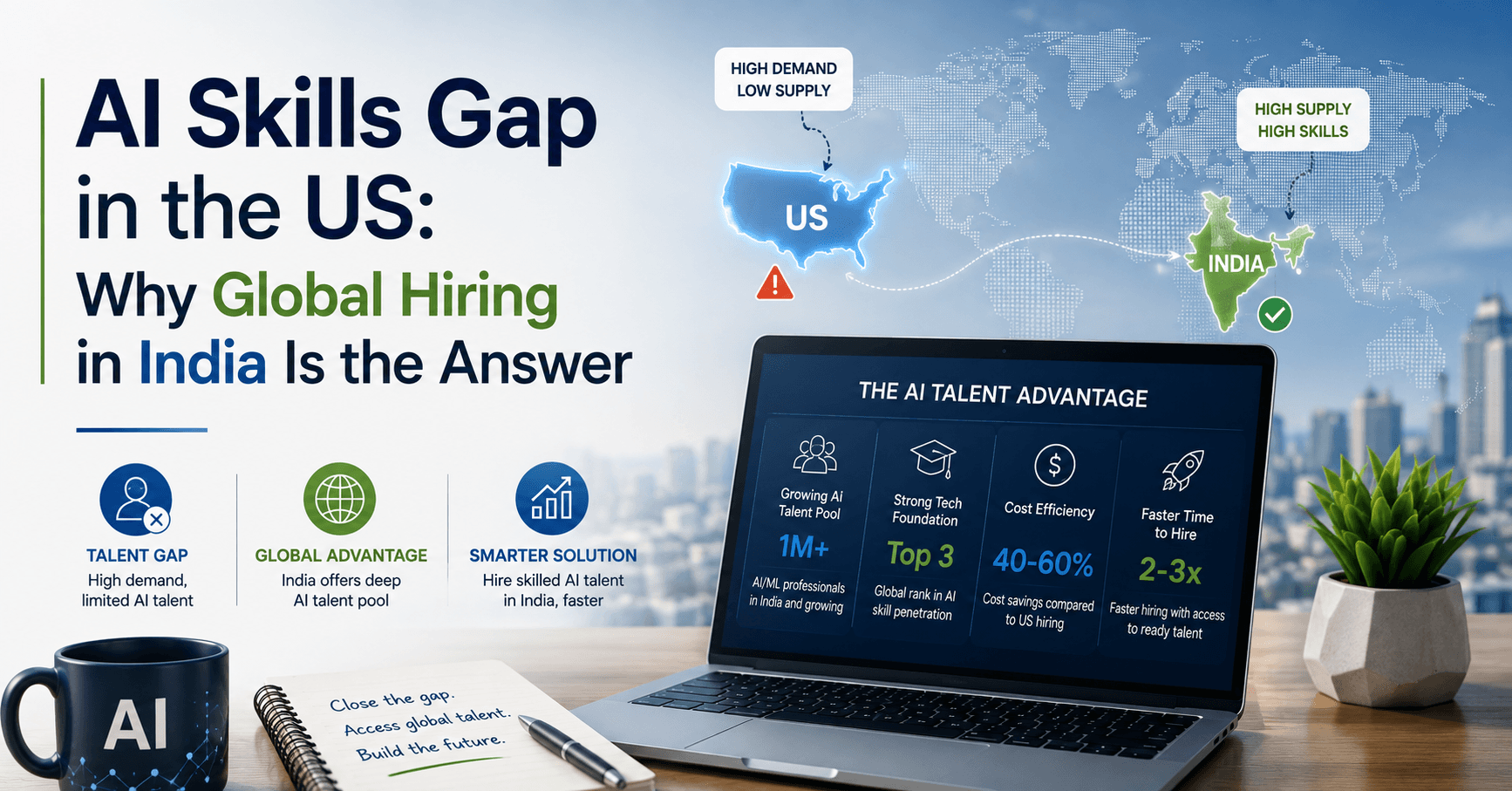
AI Skills Gap in the US: Why Global Hiring in India Is the Answer
The US AI skills gap is widening, with demand far exceeding the supply of qualified talent. Discover why India offers a strong solution, including access to production-ready AI engineers, faster hiring, and 65–75% lower costs for US companies building AI teams.

ByNilesh Parwani / August 30, 2026 / 11 min read
- The US AI Skills Gap in 2026: What the Numbers Actually Show
- Why the Global Talent Shortage Makes India the Right Response to the AI Skills Gap
- Closing the AI Skills Gap With India Talent: The Real Cost Comparison
- What the AI Skills Gap Solution Looks Like by Experience Level in India
- How to Close the AI Skills Gap With India Hiring: What Works in Practice
- Frequently Asked Questions
- The Bottom Line
The ai skills gap in the US is not a pipeline problem that will fix itself over the next hiring cycle. The numbers are specific enough to say this with confidence.
Global AI talent demand exceeds supply by 3.2 to 1. There are 1.6 million open AI positions globally and approximately 518,000 qualified candidates to fill them. Deloitte found that 68% of executives face a moderate to extreme ai skills gap. The World Economic Forum's Future of Jobs Report 2025 identified the skills gap as the single biggest barrier to AI transformation, cited by 63% of employers. And 85% of tech leaders have postponed important AI projects specifically because they could not hire the people needed to run them.
The ai talent shortage in the US is not a temporary condition. It is structural. The number of engineers and data scientists who can build, deploy, and maintain production AI systems has not grown at anywhere near the rate of demand. And it will not grow at that rate domestically within a timeframe that matters for companies making product decisions in 2026.
India is where the ai skills gap closes. Not because Indian talent is a substitute or a workaround, but because India has built the world's largest growing pool of production AI engineering capability outside the US at 65 to 75% below US cost. This guide explains why the ai skills gap in the US makes India the right hiring decision, how to approach it, and what to expect.
The US AI Skills Gap in 2026: What the Numbers Actually Show
The ai skills gap in the US is not evenly distributed. It concentrates in specific roles, at specific experience levels, in specific skill domains.
By role: ML engineers face a 6 to 7 month average time-to-fill in 2026, the longest of any technical role category. AI engineers are the fastest-growing role on LinkedIn for the second consecutive year. AI product managers at the intersection of product fundamentals and genuine ML knowledge are nearly impossible to hire at seed to Series B compensation levels in the US.
By skill domain: The ai skills gap is deepest in LLM engineering (building production applications on foundation models), MLOps (operating AI systems reliably at scale), AI ethics and governance (increasingly required as AI products face regulatory scrutiny), and agentic AI engineering (building multi-step AI systems with real-world tool access). These are not skills that new computer science graduates enter the market with. They require two to four years of specific production experience to develop.
By industry: The ai talent shortage is most acute in financial services, healthcare, and manufacturing, per a 2026 report from iternal.ai and BCG. These sectors face 6 to 7 month hiring cycles for specialized AI roles and high-value use cases (fraud detection, clinical AI, predictive maintenance) that cannot run without skilled practitioners. The ai skills gap in these industries is not a hiring problem. It is a business continuity problem.
By compensation: AI roles command 67% higher salaries than traditional software positions in the US, with 38% year-over-year growth across all experience levels. The ai talent shortage has driven median US ML engineer base to approximately $165,000. Senior AI engineers at top-tier companies earn $200,000 to $400,000 in total compensation. These are compensation levels that eliminate most seed-stage and Series A companies from domestic competition before they post a job.
The ai skills gap and the ai talent shortage are the same problem viewed from two angles. Neither the ai skills gap nor the ai talent shortage resolves through domestic hiring alone. The skills gap describes the missing capability. The talent shortage describes the missing people. In the US in 2026, both are acute, structural, and unresolvable through domestic hiring alone within any useful timeline.
Why the Global Talent Shortage Makes India the Right Response to the AI Skills Gap
The global talent shortage in AI affects every market. The US faces a 3.2 to 1 demand-to-supply ratio. The UK has a 73% employer shortage rate. China faces 51%. But within this global talent shortage, India is positioned distinctively.
India has a 3.0 AI skill penetration index on LinkedIn, meaning AI skills appear on Indian professional profiles at three times the global average. India's AI hiring growth rate is 33% annually, the highest in the world. India commands 16% of the global AI talent pool, projected to reach 1.25 million AI professionals by 2027. NASSCOM-BCG data shows AI engineer roles grew 67% year-on-year in India in 2026.
This does not mean India has surplus AI talent relative to its own demand. India's own AI market is competitive and growing fast. But it does mean India has a deeper, faster-growing pool of production AI engineers than any other market outside the US, at a cost structure that makes the global talent shortage tractable rather than insurmountable.
The ai talent shortage in India, where it exists, concentrates at the top of the experience curve: frontier AI researchers, engineering leads with 12 or more years of experience, and AI architects who have designed systems at FAANG scale. Mid-level to senior production AI engineers, data scientists with ML deployment experience, and MLOps engineers are accessible in India. These are exactly the profiles that close the US ai skills gap for most companies at seed to Series B stage.
Closing the AI Skills Gap With India Talent: The Real Cost Comparison
The ai skills gap in the US creates a specific economic pressure: companies are being priced out of the domestic market for the talent they need. The India alternative changes that calculus.
US all-in cost for a mid-level ML engineer:
Base salary: $165,000 Employer payroll taxes and benefits: approximately $35,000 to $50,000 Total annual employer cost: approximately $200,000 to $215,000
India all-in cost for a comparable mid-level ML engineer (Bangalore, through EOR):
CTC: INR 35 to 50 LPA (approximately $42,000 to $60,000) Employer statutory contributions (PF, ESIC, gratuity): approximately 9 to 11% above CTC EOR fee: $599/month ($7,188/year) Total annual employer cost: approximately $55,000 to $75,000
The all-in cost difference at mid level: US costs $200,000 to $215,000. India costs $55,000 to $75,000. A company with a US ai skills gap can hire three to four India ML engineers for the cost of one US ML engineer.
For a five-person AI engineering team needed to close the ai skills gap at a Series A company:
That $635,000 annual saving is the answer to why India closes the ai skills gap for companies that cannot compete for US AI talent on domestic compensation alone.
What the AI Skills Gap Solution Looks Like by Experience Level in India
Not every level of the US ai skills gap maps equally well to India sourcing. The match depends on which part of the gap you are trying to fill.
Entry to mid-level (1 to 4 years): India's AI talent pool at this level is large and growing. The limitation is production experience: many candidates have completed courses, contributed to Kaggle, and built academic projects but have not maintained a production AI system through the full lifecycle of deployment, drift, retraining, and iteration. Screen carefully for evidence of production work.
Mid to senior level (4 to 8 years): This is where India's ai skills gap solution is strongest. Engineers in this band who have worked at product companies, funded startups, or FAANG India offices have production experience that directly addresses the US ai skills gap. The supply is meaningful. The competition for this segment from India's domestic BFSI, healthcare, and tech sectors is real but manageable. At INR 35 to 65 LPA, this segment is accessible.
Senior and above (8 to 12 years): Supply narrows. Engineers at this level in India are competed for aggressively by GCCs running global AI programs, top BFSI AI teams, and domestic product unicorns. The ai talent shortage at this level in India mirrors the US ai skills gap in character if not in scale. Expect longer sourcing cycles and premium compensation.
Staff/Principal level (12+ years): This level is difficult to hire in India for the same reasons it is difficult to hire in the US. The supply is thin globally. Compensation expectations at the India senior end (INR 80 to 150 LPA) narrow the cost advantage significantly. For roles at this level, US or hybrid models (India team with US technical lead) may be more realistic than fully India-based hiring.
How to Close the AI Skills Gap With India Hiring: What Works in Practice
The decision to use India to address the US ai skills gap is easy to make and hard to execute well. Execution is where most companies underperform.
Run an AI skills gap analysis before sourcing - the first step in any India ai skills gap response.
Map which specific capabilities your team lacks against what the next 12 months of the roadmap requires. The ai skills gap analysis identifies whether you need ML engineering (custom model building), AI engineering (LLM application development), data engineering (pipeline reliability), or MLOps (production operations). Each requires a different sourcing profile. Sourcing for "AI engineers" without this analysis produces hires that miss the actual gap.
Hire for production evidence, not credentials.
The US ai skills gap is acute enough that companies accept candidates who look good on paper. In India, the resume-to-production-quality gap is equally real. Every India AI interview process should include a screen for what the candidate has built, deployed, and maintained. A candidate who can walk through a model drift incident, a RAG system failure mode they diagnosed, or a data pipeline they rebuilt from scratch is demonstrating the production experience that closes the ai skills gap. One who discusses coursework and personal projects is not.
Get employment infrastructure ready before sourcing begins.
The US ai skills gap creates urgency. Strong India candidates accept competing offers within days of receiving them. An EOR with a direct India entity can onboard a hire in 48 to 72 hours after offer acceptance. A company that is still figuring out employment structure after the candidate accepts loses to the company that had the infrastructure ready.
At Kaamwork, the EOR fee is $599 per employee per month. Candidate profiles arrive within 24 hours of a role kickoff. Employment onboarding completes in 48 to 72 hours after acceptance.
Build direct working relationships, not vendor relationships.
The US ai skills gap is not just a numbers problem. It is a knowledge problem. The engineers who close the ai skills gap need to understand what they are building and why. India AI engineers who work directly with US engineering leads, hear product priorities from decision-makers, and own technical decisions within their domain build the institutional knowledge that makes the ai skills gap solution durable. India AI engineers who receive filtered specifications through intermediary layers are filling positions but not closing gaps.
→ See how Kaamwork's talent-centric model builds direct US-to-India team relationships: kaam.work/why-kaamwork/talent-centric-model
Frequently Asked Questions
- What is the AI skills gap, how is it defined, and how severe is the US ai skills gap in 2026?
The ai skills gap is the difference between the AI engineering capability organizations need and what they can hire domestically. In the US in 2026: global AI demand exceeds supply by 3.2 to 1, with 1.6 million open positions and 518,000 qualified candidates. Deloitte found 68% of executives face a moderate to extreme ai skills gap. 85% of tech leaders have postponed AI projects specifically due to the ai talent shortage. The average time-to-fill for ML engineering roles is 6 to 7 months. - Why is India the answer to the US AI talent shortage?
India has the world's highest AI hiring growth rate at 33% annually, a 3.0 AI skill penetration index on LinkedIn (three times the global average), and 16% of the global AI talent pool. The ai talent shortage in the US is structural: not enough domestic engineers with production AI experience at any price point accessible to most companies. India provides mid-level to senior production AI engineers at 65 to 75% below US cost. A five-person India AI team that closes the ai skills gap for a Series A company costs approximately $255,000 to $340,000 per year versus $900,000 to $990,000 for the same team in the US. - What is the global talent shortage situation for AI roles?
The global talent shortage for AI roles is acute across major markets. The US faces a 3.2 to 1 demand-to-supply ratio. The UK faces a 73% employer shortage rate. China faces 51%. AI roles command 67% higher salaries than traditional software positions, with 38% year-over-year compensation growth. The global talent shortage is structural: the gap between the production of AI-capable engineers and the demand for them has not narrowed and is not expected to narrow significantly within a 3 to 5 year horizon. - Is there an AI talent shortage in India too?
Yes, at the senior and leadership level. The ai talent shortage in India concentrates at the top of the experience curve: 12+ year engineering leads, frontier AI researchers, and AI architects with FAANG-scale production experience. At mid-level (4 to 8 years) and senior (8 to 12 years), the Indian market has a meaningful supply of production-capable AI engineers, data scientists, and MLOps specialists. This is the segment that directly addresses the US ai skills gap. The ai talent shortage in India at this level is real but less severe than in the US because India's AI talent pool is growing faster than its domestic demand. - How long does it take to close the AI skills gap using India hiring?
The sourcing and onboarding timeline for India AI hiring through an EOR like Kaamwork: candidate profiles within 24 hours of role kickoff, offer typically within 1 to 3 weeks of first interview for qualified candidates, employment onboarding within 48 to 72 hours of offer acceptance. The full timeline from decision to first working day for a mid-level India AI engineer is typically 2 to 5 weeks. The equivalent US hiring process for the same profile, accounting for the ai talent shortage, runs 6 to 7 months at current market conditions. - What ai skills gap analysis should US companies run before using India hiring to close the ai skills gap?
An ai skills gap analysis before India sourcing should answer: which specific capabilities does the team lack (ML engineering, AI engineering, data engineering, MLOps); at what experience level is the gap (production mid-level vs senior vs strategic); which roles are missing people versus which require upskilling of existing team members; and what does the next 12 months of the AI roadmap actually need versus what the team can already deliver. The ai skills gap analysis output is a prioritized hiring brief with role, experience level, and required production evidence rather than a general "we need AI engineers" mandate.
The Bottom Line
The US ai skills gap is not going to close through domestic hiring. The math does not work: 1.6 million open positions, 518,000 qualified candidates, 6 to 7 month average time-to-fill, and compensation levels that price most companies out of the domestic market before the search begins.
India provides a solution to the ai skills gap that is not a compromise. Mid-level to senior production AI engineers, data scientists with ML deployment experience, and MLOps engineers are available in India at 65 to 75% below US cost. The global talent shortage that makes the ai skills gap intractable domestically makes India a structural advantage for US companies willing to build international teams.
The execution requires precision: an ai skills gap analysis before sourcing, production evidence screens rather than credential matching, employment compliance infrastructure ready before candidates are identified, and direct working relationships that retain engineers rather than cycling them every 18 months.
Companies that get the execution right are not filling positions. They are closing the ai skills gap in a way that compounds in capability over two and three years.
For US and UK companies ready to close the ai skills gap with India AI talent: kaam.work
Close Your AI Skills Gap With Kaamwork URL placeholder: https://www.kaam.work/contact
Share this article

Founder & CEO | Kaam.Work
Nilesh Parwani, a Kelley School BBA graduate, worked at UBS and Warburg Pincus before founding PrintBell (acquired by Cimpress). In 2020, he launched kaam.work, a remote work platform focused on flexible talent and distributed teams.