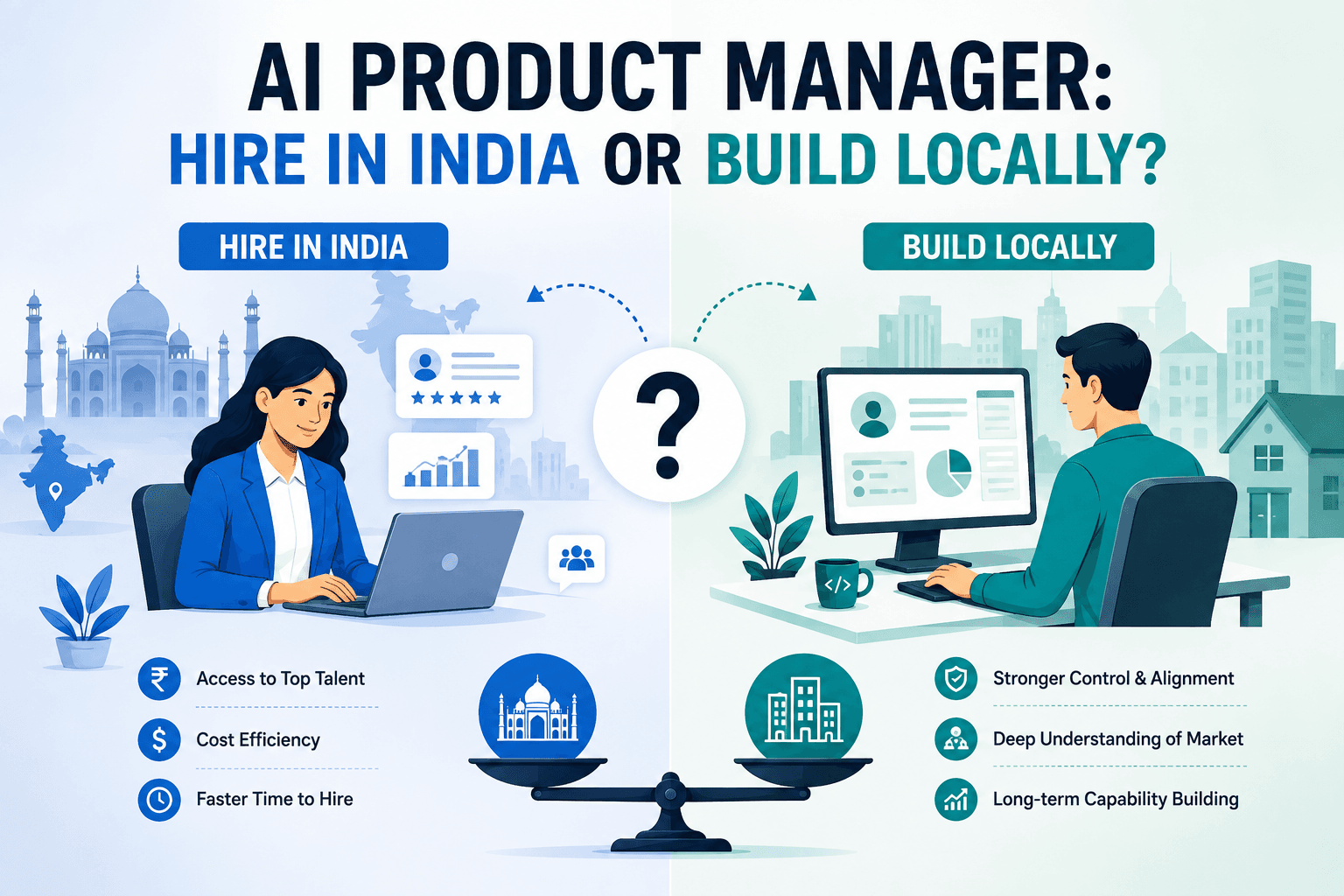
AI Product Manager: Hire in India or Build Locally?
AI product managers are in high demand, but US hiring costs can reach $180K–$250K. This guide compares AI PM salaries, talent, and hiring options in the US and India for 2026.

ByNilesh Parwani / August 20, 2026 / 10 min read
- What Is an AI Product Manager?
- What Does an AI Product Manager Do Day to Day?
- AI Product Manager Salary: US vs India in 2026
- AI Product Manager Salary in the US
- AI Product Manager Salary in India
- The All-In Cost Comparison
- Where the India AI PM Talent Pool Comes From
- US Hire vs India Hire: When Each Decision Makes Sense
- Frequently Asked Questions
- The Bottom Line
The ai product manager has become one of the hardest roles to fill in US tech in 2026. Job postings for AI PM roles have grown roughly 300% since 2023. US salaries for the role now range from $133,000 to $250,000, with a 25 to 40% premium above comparable generalist product managers. At Frontier AI Labs and well-funded startups, total compensation for a senior AI product manager reaches $200,000 to $250,000 before equity.
For companies that need this capability but cannot justify that price tag at their current stage, India is worth a serious look. The ai product manager talent pool in Bangalore, Hyderabad, and Pune is deep, experienced, and growing faster than the US market has time to absorb. Salaries in India for the same role run INR 18 to 45 LPA at mid level, with senior roles at FAANG India offices and unicorns reaching INR 70 to 150 LPA total comp.
This guide covers what an ai product manager actually does, what the role costs across markets, where the India talent pipeline comes from, and what to consider when deciding between a local hire and an India-based hire.
What Is an AI Product Manager?
What is an ai product manager in 2026? The role is product management applied specifically to products and features powered by artificial intelligence or machine learning. An ai product manager bridges the gap between data science and engineering teams on one side and business strategy and user needs on the other.
A traditional product manager defines what gets built, prioritizes features, and measures success through user engagement and revenue. An ai product manager does all of that but adds a layer of complexity that generalist PMs are not trained for: managing probabilistic systems, working with non-deterministic outputs, overseeing model lifecycles, and making calls about when a model is ready to ship versus when it is still too unreliable.
What is an ai product manager responsible for specifically? The core ownership areas break down as follows:
AI strategy and use case definition: identifying which problems in the product are suited to AI solutions and which are better served by rule-based approaches. Data readiness assessment: determining what training data exists, what needs to be collected, how to label it, and when the dataset is large and clean enough to build on. Model lifecycle management: owning the product journey from initial experimentation through shadow deployment, A/B testing, gradual rollout, and ongoing monitoring for model drift and performance decay. Dual metrics ownership: tracking both product outcomes (engagement, retention, revenue) and model performance metrics (accuracy, latency, precision, recall, false positive rates). Responsible AI governance: overseeing bias audits, fairness evaluations, transparency requirements, and ethical review processes before and after launch. Stakeholder communication: translating what AI can and cannot do into plain language for executive stakeholders who may have unrealistic expectations in both directions.
What an ai product manager does not do: they do not build models, write ML training code, or maintain infrastructure. That work belongs to data scientists and ML engineers. The ai product manager sets the direction and success criteria; the engineering team executes.
What Does an AI Product Manager Do Day to Day?
What does an ai product manager do in a typical week? The working pattern differs meaningfully from a generalist PM.
More time with data and engineering teams. An ai product manager spends more of their week in technical conversations than a traditional PM. They need enough fluency in model architecture, data pipelines, and evaluation frameworks to ask the right questions, spot unrealistic timelines, and recognize when a model's performance on evaluation data is not representative of real-world behavior.
More time on evaluation design. Shipping an AI feature requires defining what good looks like before any model runs. What does an ai product manager do here? They design the evaluation criteria: which metrics matter, what thresholds are acceptable, what the failure modes are, and what a shadow deployment is intended to test.
More time on post-launch monitoring. Generalist PMs ship features and move to the next sprint. An ai product manager treats the post-launch period as a distinct phase with its own workload. Model drift, where a model's real-world performance degrades as the distribution of inputs changes, requires ongoing attention in ways that traditional software features do not.
Less time on standard requirement documentation. AI products are defined through data requirements, model specifications, and evaluation frameworks rather than traditional user stories and acceptance criteria. An ai product manager who spends most of their time writing detailed PRDs for engineering is likely working in a role that has been relabeled rather than one that genuinely requires AI product skills.
AI Product Manager Salary: US vs India in 2026
The ai product manager salary gap between the US and India is the central reason US companies hire this role offshore. The differential is real, significant, and unlikely to close quickly.
AI Product Manager Salary in the US
US ai product manager salary in 2026 ranges from $133,000 to $200,000+ in base salary, with total compensation including equity and bonus reaching $180,000 to $250,000 at mid-to-senior level. Senior AI PMs at frontier labs (OpenAI, Anthropic, Google DeepMind) and leading AI-native companies earn substantially more. The 25 to 40% premium over generalist PM roles reflects the genuine scarcity of candidates who combine strong product fundamentals with real ML knowledge.
AI Product Manager Salary in India
AI product manager salary in India runs INR 18 to 45 LPA at mid level in 2026, per Glassdoor, AmbitionBox, and LinkedIn salary data. The average ai product manager salary in India is approximately INR 30 LPA (Glassdoor, May 2026, 21 verified salary reports). Top earners reach INR 80 to 82 LPA.
By company type:
Bangalore leads all Indian cities for ai product manager salary with a 15 to 25% premium, driven by the concentration of Google, Microsoft, Amazon, Adobe, and AI-first startups. A Bangalore-based ai product manager at the P50 earns approximately INR 30 LPA in base CTC, with Glassdoor median total comp reported at around $107,000 USD, roughly 55 to 60% of the US median for equivalent experience.
The LLM and AI strategy skill combination pushes mid-level ai product manager salary in India from INR 20 LPA to INR 35 LPA. Demonstrated experience shipping production AI features, not just AI-adjacent product work, commands the largest premium.
The All-In Cost Comparison
For a US company building or hiring an ai product manager, the total employer cost comparison between a US hire and an India hire through an EOR:
At roughly 25% of the US cost for a comparable mid-level ai product manager, the India hire case is financially straightforward. The question is whether the talent is comparable, and at the mid-level for companies building AI products rather than frontier AI labs, it often is.
Where the India AI PM Talent Pool Comes From
Understanding the India ai product manager supply chain helps US companies calibrate their expectations. This is not a thin or artificial talent pool.
Engineering-to-PM transitions. India's tech industry has a deep tradition of engineers moving into product roles after three to six years in development. An ai product manager who spent four years as an ML engineer at Flipkart, Swiggy, or Ola before transitioning to product brings the kind of model-level technical intuition that US companies struggle to find in candidates who came to PM from business analysis or consulting.
IIT and IIM pipeline. India's premier engineering (IIT) and management (IIM, ISB) institutes produce graduates who are actively recruited for product roles at global tech companies. The IIT plus ML research background is a common profile for senior ai product managers in Bangalore, and the compensation expectations for this profile are still well below US market rates.
Existing GCC PM talent. US tech companies that have run India GCCs for a decade or more (Microsoft, Google, Salesforce, SAP) have built product teams in India that include senior ai product managers with direct experience shipping AI features for global products. This talent is moveable. An early-stage US startup cannot out-pay a Google India offer on cash, but it can offer equity, ownership, and scope that large GCCs cannot match.
The AI-native cohort. A generation of India engineers and PMs who started their careers during the LLM era are now three to five years into product roles. These are not people who pivoted to AI - they grew up professionally building AI products. This cohort is smaller than the broader PM pool but is the segment with the freshest and most relevant skills for US companies building AI-native products.
US Hire vs India Hire: When Each Decision Makes Sense
The ai product manager hiring decision is not a simple cost arbitrage. It is a trade-off between proximity, context, and price.
Hire locally when: The ai product manager role requires deep, daily collaboration with a US-based executive team on strategic decisions that cannot wait for async communication. The product involves US regulatory or compliance domains where on-the-ground market expertise matters. You are at a stage where the ai product manager will be the first PM hire and needs to establish product culture, hire under them, and operate as a founding team member with significant equity upside.
Hire in India when: You need ai product manager capability at mid level to execute a defined AI product roadmap rather than set strategic direction from scratch. The role involves working with a data science and engineering team that is already predominantly India-based. You are running a GCC or offshore engineering team and want a co-located product leader who works in the same time zone and builds direct relationships with the India engineers. Your budget makes a US hire at $200,000+ total comp unviable at current stage.
The model that works best for many Series A and B US companies: a US-based head of product or VP who sets strategy and owns customer and executive relationships, with an India-based ai product manager who runs execution alongside the India engineering team. The ai product manager in India is not a substitute for strategic product leadership, they are the execution layer that makes the strategy work.
→ See how Kaamwork builds direct India team relationships for US product companies: kaam.work/why-kaamwork/talent-centric-model
Frequently Asked Questions
- What is an AI product manager?
An ai product manager is a product leader who owns the strategy, roadmap, and delivery of products and features powered by artificial intelligence or machine learning. Unlike a traditional PM, an ai product manager works with probabilistic systems rather than deterministic software, which requires additional skills in data readiness assessment, model lifecycle management, evaluation framework design, and responsible AI governance. The role sits at the intersection of product strategy, data science, and ML engineering. - What does an AI product manager do differently from a traditional PM?
What does an ai product manager do that a traditional PM does not? They define AI use cases based on data availability rather than just user demand, manage model lifecycles from experimentation through production monitoring, design evaluation frameworks for non-deterministic outputs, track model-specific metrics alongside business metrics, and oversee responsible AI practices including bias audits and transparency requirements. The post-launch monitoring phase is significantly more intensive for an ai product manager than for a generalist PM. - What is AI product manager salary in India in 2026?
AI product manager salary in India ranges from INR 18 to 45 LPA at mid level in 2026. The average ai product manager salary in India per Glassdoor (May 2026, 21 verified reports) is INR 30 LPA. Senior ai product managers at FAANG India offices and funded unicorns earn INR 70 to 150 LPA in total compensation including RSUs. Bangalore leads all cities with a 15 to 25% premium over other metros. - How does AI product manager salary in India compare to the US?
US ai product manager salary ranges from $133,000 to $250,000 in total compensation. India ai product manager salary in Bangalore runs approximately INR 25 to 45 LPA at mid level, with Glassdoor median total comp around $107,000 USD, roughly 55 to 60% of the US median for comparable experience. The all-in annual employer cost for a mid-level India hire through an EOR, including statutory contributions and EOR fee, runs approximately $50,000 to $55,000 USD. - What skills does an AI product manager need?
Core skills for an ai product manager include: data literacy (understanding statistical fundamentals, model evaluation metrics, and data pipelines), ML fluency (enough to assess feasibility, spot unrealistic timelines, and recognize model failure modes without writing code), product strategy for AI use cases, A/B test design for non-deterministic systems, responsible AI governance, and strong stakeholder communication for translating probabilistic outputs into clear business narratives. Demonstrated experience shipping production AI features is the most valued differentiator in 2026. - Is India a good place to hire an AI product manager?
Yes, particularly for execution-focused roles working alongside India-based engineering teams. The ai product manager talent pool in Bangalore and Hyderabad draws from IIT and IIM graduates, engineers who have transitioned to product roles after ML experience, and a growing cohort of AI-native PMs who built their careers during the LLM era. For US companies building AI products at Series A to B stage, an India-based ai product manager alongside a US-based product leader is a cost-effective and operationally sound structure. - What is the difference between an AI product manager and a traditional PM?
The core difference is the nature of what they manage. A traditional PM oversees deterministic software: features behave consistently given the same input. An ai product manager oversees probabilistic systems: the same input can produce different outputs, models can degrade over time as data distributions shift, and success requires ongoing monitoring rather than a single ship-and-move-on event. The ai product manager role demands deeper technical fluency and a different approach to defining, launching, and evaluating product success.
The Bottom Line
The ai product manager is not a role that gets easier to hire as AI becomes more central to product development. The scarcity of candidates who combine genuine product fundamentals with real ML knowledge is structural, and the 300% growth in AI PM job postings has not been matched by a proportional increase in qualified supply.
For US companies at seed to Series B: if the budget for a US-based ai product manager at $180,000 to $250,000 total comp is not there, India is not a compromise. An experienced ai product manager in Bangalore with a background in ML engineering and two years of product ownership at a product-first company is a strong hire at any stage.
The model that works: US product leadership sets direction, an India-based ai product manager owns execution alongside the India engineering team, and the direct working relationship, with no country head and no account manager in the middle, drives the retention that turns a good hire into a long-term team member.
For US and UK companies hiring an ai product manager in India with full employment compliance from day one: kaam.work
Share this article

Founder & CEO | Kaam.Work
Nilesh Parwani, a Kelley School BBA graduate, worked at UBS and Warburg Pincus before founding PrintBell (acquired by Cimpress). In 2020, he launched kaam.work, a remote work platform focused on flexible talent and distributed teams.