Maternity Leave in India vs the US: What Employers Are Legally Required to Provide
Hiring in India means navigating the DPDP Act 2023, consent requirements, and secure employee data handling. Learn the compliance essentials US companies need for background checks, payroll, hiring, and HR processes while staying fully compliant with Indian data protection laws.

ByNilesh Parwani / July 15, 2026 / 10 min read
- Maternity Leave in India: What the Law Requires in 2026
- Maternity Leave in the US: What the Law Requires in 2026
- Maternity Leave in India vs the US: Side-by-Side Comparison
- What This Means for US Companies Hiring in India
- How an EOR Manages Maternity Leave Compliance for US Companies
- Frequently Asked Questions
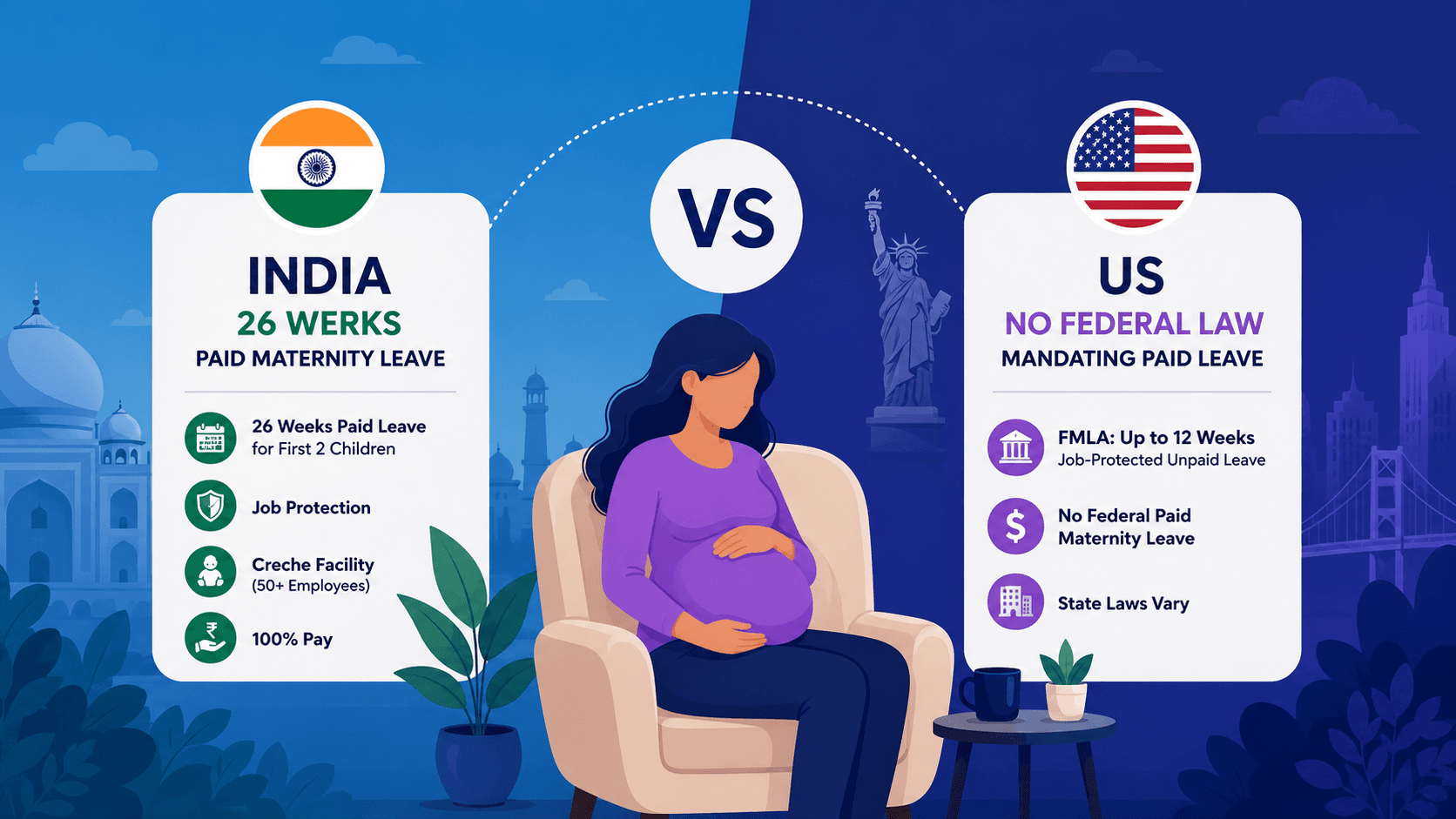
India mandates 26 weeks of fully paid maternity leave for the first two children. The United States has no federal law requiring a single day of paid maternity leave.
That gap is not a minor policy difference. It is one of the starkest employer obligation contrasts between any two major economies. For US companies building teams in India, understanding maternity leave in India is not optional. Non-compliance with India's Maternity Benefit Act carries criminal liability: imprisonment of not less than three months, extendable to one year, plus fines, both applied simultaneously.
This guide covers what maternity leave in the US and India each require, what employers in both countries must actually provide, what changed with India's March 2026 Supreme Court ruling, how the two systems compare side by side, and what compliance looks like for a US company managing an India-based team.
Maternity Leave in India: What the Law Requires in 2026
Maternity leave in India is governed by the Code on Social Security 2020, which came into effect on November 21, 2025. The Code subsumed the Maternity Benefit Act 1961 and carries forward all its core protections with minor updates. The practical obligations for employers in 2026 match what the 1961 Act required: full wages for 26 weeks, a creche at 50 or more employees, and termination protection.
How Many Weeks of Maternity Leave in India?
The leave duration depends on the number of children:
- First and second child: 26 weeks of paid leave, with up to 8 weeks taken before the expected delivery date.
- Third child and beyond: 12 weeks of paid leave.
- Adoption: 12 weeks of paid leave from the date the child is handed over to the adoptive mother, regardless of the child's age at adoption (updated by Supreme Court ruling, March 17, 2026).
- Commissioning mother (surrogacy): 12 weeks of paid leave from the date of handover, regardless of child's age (same March 2026 ruling).
- Miscarriage or medical termination: 6 weeks of paid leave from the date of the event. No 80-day minimum employment requirement applies for this entitlement.
The March 17, 2026 Supreme Court ruling is significant for employers. Until that date, adoptive and commissioning mothers were entitled to maternity leave only if the child was under three months of age at the time of handover. The Court struck down that age restriction, ruling it violated the child's right to care and the mother's constitutional rights. Any India leave policy drafted before March 2026 needs to be reviewed and updated.
Who Is Eligible for Maternity Leave in India?
Eligibility requires 80 days of work with the same employer in the 12 months before the expected delivery date. This applies to permanent, temporary, and contractual employees. The Code on Social Security also extends coverage to gig workers for the first time, though the specific implementation timeline for that category is still being finalized.
The India maternity benefit act obligations apply to establishments with 10 or more employees. Businesses with fewer than 10 employees and self-employed women remain excluded from the statutory coverage.
What Must the Employer Pay?
The employer pays 100% of the employee's average daily wage for the entire leave duration. There is one exception: employees covered under the Employees' State Insurance (ESIC) scheme, those earning below Rs 21,000 per month, receive maternity benefits directly from ESIC rather than from the employer. For most mid-level and senior tech employees in India earning above Rs 21,000 per month, the employer bears the full cost of the maternity pay.
Additional Employer Obligations Under India's Maternity Leave Law
Beyond the paid leave duration, employers in India have four additional mandatory obligations under the India maternity benefit act framework:
Creche facility. Employers with 50 or more employees must provide a creche within a prescribed distance of the workplace, either independently or jointly with other establishments. Employees are entitled to four visits per day to the creche during working hours, including rest time.
Work from home option. Employers may, by mutual agreement, allow the returning employee to work from home after maternity leave, particularly where the nature of the work permits it.
Termination protection. An employer cannot dismiss, discharge, or give notice of dismissal to a woman employee during the period of maternity leave. Doing so is a criminal offense under the Code on Social Security 2020.
Disclosure during hiring. Employers must inform every female employee at the time of appointment about the maternity benefits available to her.
Penalties for Non-Compliance with Maternity Leave in India
Non-compliance with paid leave India employees are entitled to under the maternity benefit framework carries criminal liability. An employer who fails to pay maternity benefit, or who dismisses a woman employee in violation of the Code, faces imprisonment of not less than three months, extendable to one year, plus a fine of not less than Rs 10,000, extendable to Rs 50,000. Both penalties apply simultaneously, not as an alternative.
Maternity Leave in the US: What the Law Requires in 2026
Maternity leave in the US operates on a fundamentally different model. The United States is one of the few developed economies with no federal law mandating paid maternity leave for childbirth, adoption, or foster care.
The Family and Medical Leave Act (FMLA)
The primary federal law governing maternity leave in the US is the Family and Medical Leave Act 1993. FMLA allows eligible employees to take up to 12 weeks of unpaid, job-protected leave for the birth or adoption of a child.
FMLA coverage has significant limitations:
- It covers only employers with 50 or more employees.
- The employee must have worked for the employer for at least 12 months.
- The employee must have worked at least 1,250 hours in the past 12 months.
- The employee must work at a location where the employer has 50 or more employees within a 75-mile radius.
These thresholds mean FMLA covers approximately 60% of the US workforce. The remaining 40%, including most employees at small businesses, have no federal leave protection at all.
FMLA leave is unpaid. The employer is not required to pay the employee during the 12-week period. Many employees use accrued PTO, vacation, or sick leave during FMLA to receive some income, but this depends entirely on company policy.
State Laws on Maternity Leave in the US
Several US states have enacted paid family leave laws that require partial wage replacement during parental leave. As of 2026, the states with mandatory paid family or medical leave programs include California, New York, New Jersey, Washington, Massachusetts, Connecticut, Colorado, Oregon, and several others.
In these states, paid leave benefits are typically funded through employee and employer payroll contributions to a state insurance fund. Benefits range from approximately 60% to 90% of the employee's average weekly wage, up to a weekly cap. California's SDI program, for example, provides up to 60% to 70% of the employee's base wage for up to 8 weeks under its Paid Family Leave program.
For US companies with employees in states without paid family leave laws, the federal floor is FMLA: 12 weeks unpaid, with the limitations above.
What US Employers Are Not Required to Do
Under federal law alone, US employers are not required to:
- Provide any paid maternity leave
- Provide maternity leave to employees in businesses with fewer than 50 employees
- Provide any leave to employees who have worked less than 12 months
- Return an employee to the same role after leave (only a comparable role is required under FMLA)
Maternity Leave in India vs the US: Side-by-Side Comparison
The summary reading of this table: India's maternity leave framework is more comprehensive, mandatory, and legally enforced at a criminal level than anything US federal law requires. For a US company building an India team, this is not a cultural benefit to offer. It is a legal obligation to comply with.
What This Means for US Companies Hiring in India
Three specific obligations require immediate attention for any US company with India-based female employees.
First: budget for 26 weeks of fully paid leave. If you hire a mid-level engineer in Bangalore at Rs 35 LPA CTC and she has her first child, you are legally required to pay her full salary for 26 weeks. That is approximately six months of salary cost with no offset unless she is ESIC-covered, which most employees at that salary level are not.
Second: update any adoption leave policies written before March 2026. The Supreme Court's March 17, 2026 ruling removed the child age restriction for adoptive and commissioning mothers. If your leave policy previously limited adoption leave to situations where the child was under three months old at handover, that policy is now non-compliant.
Third: review your termination procedures. Dismissing a pregnant employee or an employee on maternity leave is a criminal offense in India, not a civil one. This applies regardless of the reason given for termination. If you need to exit an employee who is pregnant or on maternity leave, the process requires specific legal guidance before any action is taken.
How an EOR Manages Maternity Leave Compliance for US Companies
When you hire India-based employees through Kaamwork's EOR model, Kaamwork is the legal employer under Indian law. Maternity benefit obligations under the Code on Social Security 2020 sit with Kaamwork as the legal employer, not directly with your US entity.
Kaamwork's employment contracts include all statutory maternity leave provisions, including the updated adoption leave terms post the March 2026 Supreme Court ruling. Maternity pay is processed through Kaamwork's payroll infrastructure. ESIC contributions are managed for eligible employees. And the termination protection provisions are enforced through Kaamwork's HR protocols, ensuring no exit decision is processed for an employee on maternity leave without proper legal review.
The flat EOR fee is $599 per month per employee, on top of the employee's agreed salary. Statutory leave pay during maternity leave is part of the India labour law obligations Kaamwork manages as the legal employer.
See how Kaamwork's EOR model works in India, read the complete India payroll compliance guide, understand how to terminate an employee in India compliantly, and review the best way to hire in India as a US startup to understand the full compliance picture before your first India hire.
Maternity leave in India is 26 weeks of fully paid leave, backed by criminal penalties for non-compliance. Maternity leave in the US is 12 weeks of unpaid leave under FMLA, available only to employees at companies with 50 or more employees, covering roughly 60% of the workforce. The two systems are not comparable in mandate, duration, or enforcement.
For US companies hiring in India, the maternity leave obligation is straightforward in what it requires and severe in what it costs to ignore. Budget for it, update your adoption leave policies, protect pregnant employees from any exit action, and ensure your employment contracts reflect the March 2026 Supreme Court ruling.
If you want a line-by-line walkthrough of what India's maternity leave obligations mean for your specific team structure, Kaamwork can walk you through the compliance requirements. Talk to Kaamwork today.
Frequently Asked Questions
Q: How many weeks is maternity leave in India?
Maternity leave in India is 26 weeks of fully paid leave for the first two children and 12 weeks from the third child onwards, under the Code on Social Security 2020, effective November 21, 2025. Up to 8 weeks of the 26-week entitlement can be taken before the expected delivery date. Adoptive and commissioning mothers receive 12 weeks of paid leave from the date of handover, with no restriction on the child's age at adoption following a Supreme Court ruling on March 17, 2026. Women experiencing a miscarriage or medical termination of pregnancy are entitled to 6 weeks of paid leave.
Q: What is the India Maternity Benefit Act and does it still apply in 2026?
The Maternity Benefit Act 1961 was the original law governing maternity leave in India. In 2026, it has been subsumed by the Code on Social Security 2020, which came into effect on November 21, 2025. The core obligations from the India maternity benefit act carry forward unchanged: 26 weeks of paid leave for the first two children, 12 weeks from the third, full wage replacement paid by the employer, creche requirements for employers with 50 or more employees, and criminal liability for dismissing an employee during maternity leave.
Q: Does maternity leave in the US require paid benefits?
No. There is no federal law in the United States requiring paid maternity leave. The Family and Medical Leave Act 1993 provides up to 12 weeks of unpaid, job-protected leave for eligible employees at companies with 50 or more employees. Several states including California, New York, New Jersey, and Washington have enacted paid family leave programs that provide partial wage replacement (typically 60% to 90%) funded through payroll contributions. Employers in states without these programs are not federally required to provide any paid maternity leave.
Q: What happens if an employer in India does not comply with maternity leave obligations?
Non-compliance with maternity leave in India carries criminal liability under the Code on Social Security 2020. An employer who fails to pay maternity benefit, or who dismisses an employee during maternity leave, faces imprisonment of not less than three months, extendable to one year, plus a fine of not less than Rs 10,000, extendable to Rs 50,000. Both the imprisonment term and the fine apply simultaneously. The enforcement mechanism under the Code has shifted to an Inspector-cum-Facilitator system. Employers who maintain proper documentation and pay correctly are less likely to face punitive action on first contact.
Q: What changed about maternity leave in India in 2026?
The most significant 2026 change to maternity leave in India came from a Supreme Court ruling on March 17, 2026. The Court struck down the previous restriction that limited adoption and surrogacy maternity leave to cases where the child was under three months of age at the time of handover. Under the ruling, adoptive and commissioning mothers are now entitled to 12 weeks of paid maternity leave regardless of the child's age at adoption. Any India employment policy or leave handbook drafted before March 2026 that includes the child age restriction is now non-compliant and must be updated.
Q: Can a US company manage India maternity leave compliance through an EOR?
Yes. When a US company hires India-based employees through an Employer of Record like Kaamwork, Kaamwork is the legal employer under Indian law and assumes the maternity leave obligations under the Code on Social Security 2020. Employment contracts include all statutory provisions, maternity pay is processed through Kaamwork's payroll system, and termination protection obligations are enforced through Kaamwork's HR protocols. The EOR model removes the risk of non-compliance for US companies unfamiliar with India's maternity leave framework, including the March 2026 adoption leave update.
Share this article

Founder & CEO | Kaam.Work
Nilesh Parwani, a Kelley School BBA graduate, worked at UBS and Warburg Pincus before founding PrintBell (acquired by Cimpress). In 2020, he launched kaam.work, a remote work platform focused on flexible talent and distributed teams.