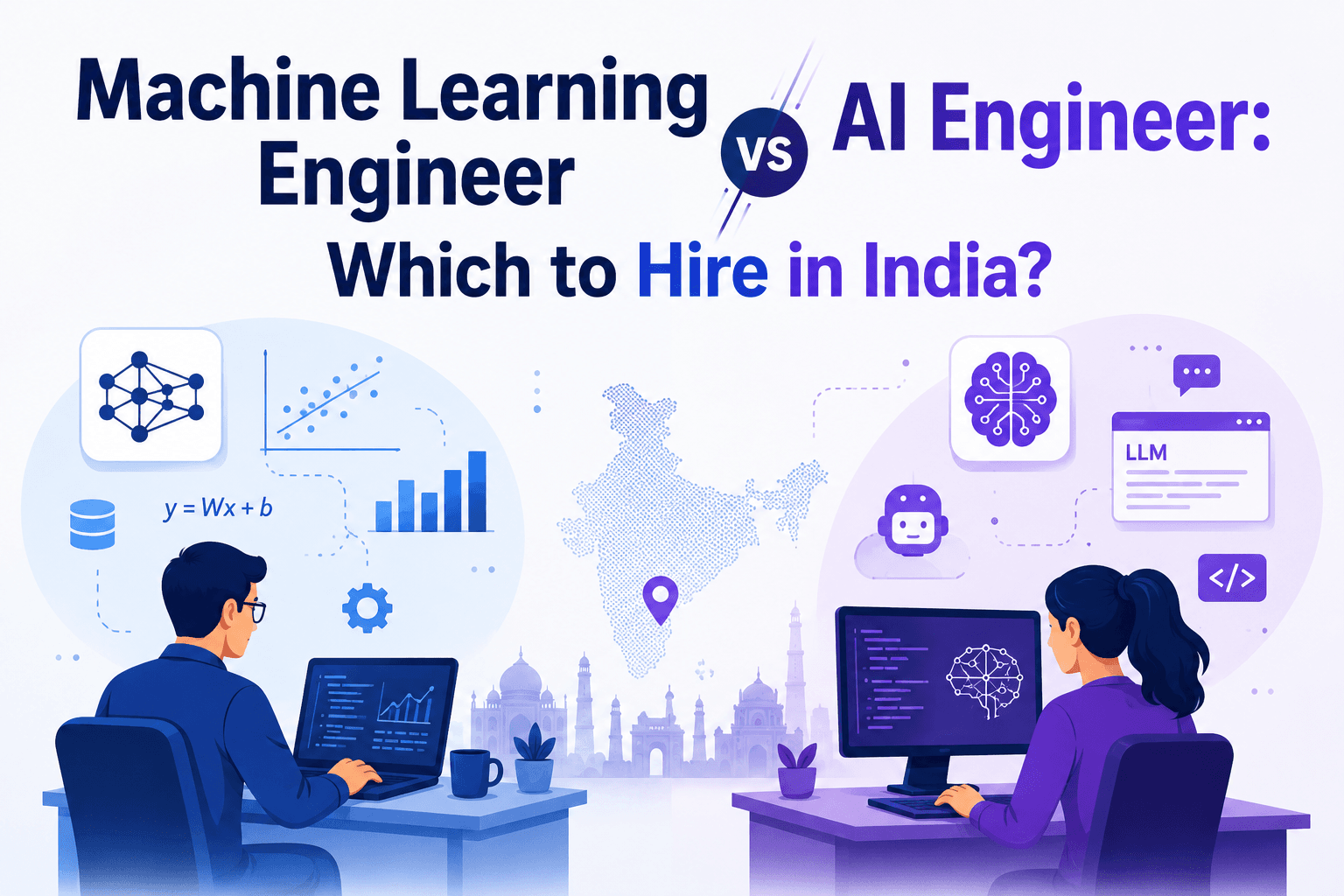
Machine Learning Engineer vs AI Engineer: Which to Hire in India?
AI engineers build applications using foundation models, while ML engineers develop custom models. This guide compares their roles, salaries, skills, and helps US companies decide which talent to hire in India.

ByNilesh Parwani / August 21, 2026 / 10 min read
- What Is the AI Engineer Role? The Machine Learning Engineer vs AI Engineer Starting Point
- What Does a Machine Learning Engineer Do? The Other Side of the Machine Learning Engineer vs AI Engineer Divide
- Machine Learning Engineer vs AI Engineer: Where the Two Stacks Actually Fork
- Machine Learning Engineer vs AI Engineer Salary: US and India in 2026
- US Salary Benchmarks
- India Salary Benchmarks
- Machine Learning Engineer vs AI Engineer: A Decision Framework for Which to Hire First
- Hiring a Machine Learning Engineer vs AI Engineer in India: What to Screen For
- Frequently Asked Questions
- The Bottom Line
The machine learning engineer vs ai engineer debate has become one of the most common hiring conversations. And the machine learning engineer vs ai engineer confusion costs companies real time when they hire the wrong profile first. in US tech in 2026, and one of the most confused.
In May 2026, US job boards listed 4,781 machine learning engineer postings and 4,091 AI engineer postings. The two roles share approximately 67% of their top-30 skills. Python, LLMs, AWS, PyTorch, TensorFlow, and generative AI appear in both job descriptions. Yet the day-to-day work is genuinely different, the salary gap is $20,000 at median US base, and hiring the wrong one first can stall a product for six months.
This guide breaks down the machine learning engineer vs ai engineer distinction at the level that matters for hiring decisions: what each role actually owns, where the stacks diverge, what they cost in the US and in India, and a clear framework for which one your next hire should be.
What Is the AI Engineer Role? The Machine Learning Engineer vs AI Engineer Starting Point
The ai engineer role is an application-layer position. An AI engineer's job is to wire foundation models - GPT, Claude, Gemini, Llama, into shippable software products. They are not building the model. They are building with the model.
What the ai engineer role owns in practice:
Retrieval-Augmented Generation (RAG) pipelines: designing how documents are chunked, embedded, stored in vector databases, and retrieved at query time. Prompt engineering and management: structuring prompts, managing context windows, designing tool-use logic, and maintaining prompt versioning. LLM API integration: calling foundation model APIs from application servers, handling rate limits, fallbacks, and latency requirements. Evaluation frameworks: designing and running evals that test whether the LLM-based system behaves correctly, consistently, and safely. Cost and latency optimization: reducing per-query inference cost and response latency to levels that make a product economically viable. Guardrails and safety: implementing content filtering, output validation, and safety checks that prevent the model from producing harmful or off-target outputs. Agent architecture: designing multi-step agentic workflows where an LLM reasons, uses tools, and takes actions with partial autonomy.
The tools that cluster around the ai engineer role but not the ML engineer role: LangChain, LlamaIndex, OpenAI SDK, Anthropic SDK, vector databases (Pinecone, Weaviate, Qdrant), and embedding management.
The ai engineer role grew 74% year-over-year in US job postings in 2026, faster than any comparable technical title. This growth is structural: every SaaS product adding an AI assistant, copilot, or automation feature needs someone who can build on top of foundation models. Most companies do not need to train their own models. They need to build reliable products on top of models that already exist.
What Does a Machine Learning Engineer Do? The Other Side of the Machine Learning Engineer vs AI Engineer Divide
The machine learning engineer vs ai engineer distinction is simplest at this level: the ML engineer builds the model. The AI engineer ships a product on top of a model someone else built.
An ML engineer owns the full lifecycle of a custom machine learning system: from raw data through feature engineering, training, evaluation, serving, and production monitoring. The model is the product, or at minimum a critical component of the product, and the ML engineer is responsible for its quality, reliability, and evolution.
What an ML engineer owns that the ai engineer role typically does not:
Data pipeline engineering: building the data flows from source systems through feature stores to training jobs, with attention to schema stability, backfill management, and leakage prevention. Feature engineering: deriving the transformed columns, time-window aggregates, and embeddings that give a model its signal. Model selection and training infrastructure: choosing between XGBoost, neural architectures, or linear models based on data characteristics and business SLA requirements, then building the training infrastructure at scale. Hyperparameter search and cross-validation: the experimental infrastructure for finding model configurations that generalize. Production monitoring for model-specific failure modes: tracking data drift, concept drift, feature distribution shift, and performance degradation over time, not just application-level errors. Custom model deployment: standing up inference services, managing model versions, handling A/B tests between model variants.
The tools that cluster around ML engineers but not the ai engineer role: scikit-learn, Apache Spark, MLflow, Kubeflow, Feast (feature store), Seldon or BentoML (model serving), statistical testing frameworks.
Machine Learning Engineer vs AI Engineer: Where the Two Stacks Actually Fork
The machine learning engineer vs ai engineer overlap is real - 67% of the top skills appear in both roles. But the remaining 33% is where the roles separate, and it is exactly this third of the stack that determines which hire solves your actual problem.
The machine learning engineer vs ai engineer decision at the hire level comes down to one question: does your product need a custom model trained on your data, or does it need a reliable system built on top of existing foundation models?
If you need fraud detection on your transaction data, churn prediction on your customer behavior, a recommendation engine on your catalog, or a computer vision model on your proprietary images - you need an ML engineer. These problems require custom models because the signal is in your data.
If you need a customer support AI, a document summarization tool, a code assistant, a search experience, or any product feature built by calling an LLM API and making the response reliable and useful, you need the ai engineer role. These problems are solved at the application layer, not the model layer.
Most 2026 AI product roadmaps need the ai engineer role first, and the ML engineer later if at all. This is the market reality that AI engineer job postings growing 74% YoY reflects.
Machine Learning Engineer vs AI Engineer Salary: US and India in 2026
US Salary Benchmarks
Machine learning engineer vs ai engineer salary in the US in 2026:
Machine learning engineer: US median base salary $165,000 (InterviewStack.io, May 2026, n=1,087). Senior ML engineers with production ownership at major tech companies earn $220,000 to $300,000+. Total comp at frontier labs can exceed $400,000.
AI engineer: US median base salary $145,000 (InterviewStack.io, May 2026, n=680). The $20,000 gap versus ML engineers reflects the older and more established ML engineer market and the specialization premium for owning the full model training lifecycle.
Senior US AI engineers with strong foundation model architecture experience, agent design expertise, and measurable product impact earn $180,000 to $250,000.
The machine learning engineer vs ai engineer salary gap narrows at the senior end because the most experienced AI engineers are building systems of comparable complexity and owning comparable production risk to senior ML engineers. The gap is widest at mid-level, where ML engineers' specialization in training infrastructure commands a premium over AI engineers building on top of pre-trained models.
India Salary Benchmarks
The machine learning engineer vs ai engineer salary picture in India follows a similar pattern but at 70 to 75% lower absolute cost:
Machine learning engineer vs ai engineer salary in India at mid-level: ML engineers command approximately INR 2 to 5 LPA more for the same experience level, matching the US pattern. Both roles sit well above the generalist software engineer band at comparable experience.
The LLM-specific premium on the ai engineer role in India is significant in 2026. An AI engineer with production experience in RAG architecture, agent frameworks, and LLM evaluation earns 30 to 40% more than an AI engineer whose experience is limited to calling LLM APIs and building basic chatbots.
Machine Learning Engineer vs AI Engineer: A Decision Framework for Which to Hire First
The machine learning engineer vs ai engineer choice reduces to the product roadmap. Run through these machine learning engineer vs ai engineer questions in order.
Question 1: Are you building on top of existing foundation models or training custom models? Building on existing models (LLM APIs, embeddings, RAG) → AI engineer role first. Training custom models on your proprietary data → ML engineer first.
If you are not sure about the machine learning engineer vs ai engineer choice, answer this: do you have labeled training data at scale? If no, the AI engineer role is the right first hire. Custom ML needs data before it needs the engineer.
Question 2: What is your primary product risk? Reliability of LLM outputs (hallucination, regression, latency, cost) → AI engineer role. Model accuracy and drift over time → ML engineer.
Question 3: What does the next six months of the product roadmap require? AI features built on foundation models (chatbot, document QA, code assistant, AI search) → AI engineer role. Predictive models from your own data (fraud, churn, recommendations, ranking) → ML engineer.
Most US startups and Series A product companies in 2026 answer the machine learning engineer vs ai engineer question in favor of the ai engineer role first. Foundation model capabilities have advanced to the point where many use cases that previously required custom training are now better served by prompt engineering and retrieval. The ML engineer becomes the right hire when the LLM-based system has hit its performance ceiling on the use case and custom training becomes the next lever.
For companies that need both, the machine learning engineer vs ai engineer sequencing is AI engineer first to ship the initial AI feature layer, then an ML engineer once you have enough production data and well-defined problems to justify custom model development.
Hiring a Machine Learning Engineer vs AI Engineer in India: What to Screen For
The machine learning engineer vs ai engineer hiring process in India differs in two important ways from the US that hiring managers need to know upfront. in two important ways from the US.
Job title stability. India's AI job market is relabeling roles rapidly. A candidate with an "AI engineer" title at a services firm may be doing work that is closer to software engineering with LLM API calls than production AI engineering. A candidate with an "ML engineer" title at a product company may have built more sophisticated systems than a person with an "AI researcher" title at a consultancy. Look at what they built, not what they were called.
Screening for production evidence. Both roles have the same qualification trap in India: strong academic credentials with limited production experience. For the machine learning engineer vs ai engineer hire, the screen is the same: what model or AI system did you own in production, what did you monitor, what broke, what did you do about it. Candidates who can answer this in detail built real systems. Candidates who describe research projects and Kaggle competitions have not.
For the ai engineer role in India specifically: ask about RAG system performance at scale, how they measured hallucination rates in production, and what their eval framework looks like. For ML engineers in India: ask about feature leakage they caught or missed, how they handled model drift, and what their training infrastructure looked like at scale.
→ See how Kaamwork sources and vets India AI engineering talent: kaam.work/why-kaamwork/talent-centric-model → Run the cost model for your specific AI engineering hire: kaam.work/global-cost-calculator
Frequently Asked Questions
- What is the difference between a machine learning engineer and an AI engineer?
The machine learning engineer vs ai engineer distinction is about what each role builds. An ML engineer builds custom machine learning models from your data: they own the training pipeline, feature engineering, model evaluation, and production serving of a model trained on your proprietary data. An AI engineer builds applications on top of existing foundation models: they work with LLM APIs, build RAG pipelines, design prompt systems, and make AI-powered products reliable and cost-effective. The roles share about 67% of their skill sets; the remaining 33% is where they fork. - What is the AI engineer role specifically?
The ai engineer role is an application-layer engineering position focused on building production software using foundation models like GPT, Claude, Gemini, or Llama. Core ownership includes RAG pipeline design, prompt engineering, LLM API integration, evaluation framework design, cost and latency optimization, and agent architecture. The ai engineer role grew 74% year-over-year in US job postings in 2026. It is distinct from an ML engineer who trains custom models, and distinct from a data scientist who focuses on analysis and model research. - What is the machine learning engineer vs AI engineer salary difference?
Machine learning engineer vs ai engineer salary in the US: ML engineers earn a median base of $165,000 versus $145,000 for AI engineers, a $20,000 gap at median (InterviewStack.io, May 2026). The gap narrows at the senior end. In India, ML engineers earn approximately INR 2 to 5 LPA more than AI engineers at comparable experience levels. Both roles command a premium over generalist software engineers. - ML engineer vs AI engineer - which should I hire first?
The ml engineer vs ai engineer hiring sequence depends on your product roadmap. If you are building AI features on top of LLM APIs (chatbots, document QA, AI search, copilots), hire the ai engineer role first. If you have proprietary data and need a custom predictive model (fraud, churn, recommendation, ranking), hire the ML engineer first. Most 2026 AI product roadmaps start with the ai engineer role and add ML engineering capacity when custom model development becomes the next lever. - What does a machine learning engineer vs AI engineer do day to day? An ML engineer spends most of their day on training infrastructure, feature pipelines, model experiments, and production monitoring for model-specific failure modes like drift and leakage. An AI engineer spends most of their day on retrieval system design, prompt management, evaluation frameworks, LLM API integration, and inference cost optimization. The machine learning engineer vs ai engineer daily work is genuinely different even though the two roles share 67% of their technical skill requirements.
- Can one engineer do both the ML engineer and AI engineer role?
In a small team at seed stage, yes, a strong generalist can span both. But the skillsets that separate the roles (statistical modeling and training infrastructure for ML; RAG design and LLM evaluation for AI) require dedicated focus to build deep expertise. At Series A and beyond, companies typically hire for the role that matches their current roadmap priority and add the other as the product scales into more complex AI requirements.
The Bottom Line
Ultimately, the machine learning engineer vs ai engineer debate is not about which role is more advanced or more important. It is about which problem you are solving.
Building on top of foundation models to ship AI-powered product features: the ai engineer role is the hire. Building custom ML models on your proprietary data to solve problems that foundation models cannot address: the ML engineer is the hire. Most 2026 AI product roadmaps need the ai engineer role first.
In India, both roles are available at 70 to 75% below US cost at comparable experience levels. Mid-level AI engineers in Bangalore cost INR 28 to 50 LPA all-in before EOR fees, versus $145,000 median US base for the same role. The machine learning engineer vs ai engineer salary gap in India mirrors the US pattern: ML engineers command a small premium that reflects their specialization in custom model training.
The hiring process is identical regardless of which role you prioritize: screen for production evidence, not credentials, and verify what the candidate actually built, monitored, and fixed in a real system.
For US and UK companies hiring ML engineers and AI engineers in India with full employment compliance from the first hire: kaam.work
Share this article

Founder & CEO | Kaam.Work
Nilesh Parwani, a Kelley School BBA graduate, worked at UBS and Warburg Pincus before founding PrintBell (acquired by Cimpress). In 2020, he launched kaam.work, a remote work platform focused on flexible talent and distributed teams.