Is the AI Hype Translating to Real AI Jobs in India?
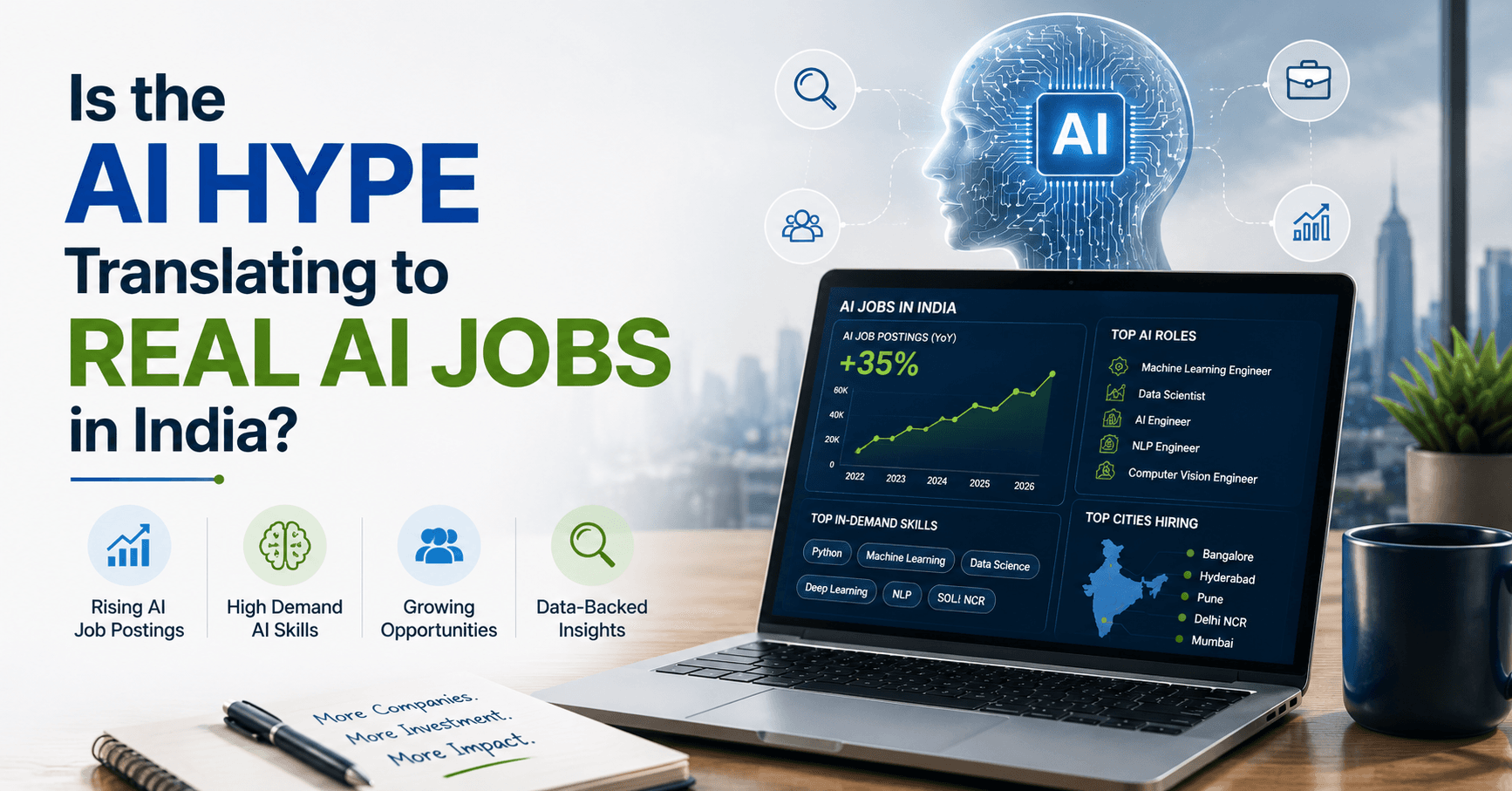
AI jobs in India are growing in 2026, but the reality is more nuanced than the headlines. Explore real AI hiring data, in-demand roles, talent pool trends, salary advantages, and what US companies should know when hiring production-ready AI talent in India.

ByNilesh Parwani / August 30, 2026 / 10 min read
- The AI Hype Cycle and Where India Is On It
- AI Hype vs Reality: What the 2026 Data Actually Shows
- Which AI Jobs in India Are Real and Which Are AI Hype
- The AI Hype Cycle and the IT Services Compression
- AI Job Market Impact 2030: What the Data Projects
- What This Means for US Companies Hiring India AI Talent
- Frequently Asked Questions
- The Bottom Line
The ai hype around India's AI job market runs hard in both directions. One set of headlines says India is creating millions of AI jobs, transforming into the world's AI talent capital, and that every engineer needs to upskill or get left behind. Another set says AI is hollowing out India's IT sector, eliminating entry-level roles at scale, and that the job apocalypse that has been predicted for a decade is finally arriving.
Both narratives feed on the same ai hype cycle. Neither is fully accurate. The truth, as the 2026 data shows, is more specific and more useful than either story.
So: is the ai hype translating to real AI jobs in India? Yes, partially, in specific roles, in specific cities, for specific skill profiles. No, in the broad way the headlines imply. This is the ai hype vs reality breakdown.
The AI Hype Cycle and Where India Is On It
The Gartner ai hype cycle places most AI technologies at a predictable arc: a technology trigger creates inflated expectations, a peak of inflated expectations follows, a trough of disillusionment comes next, then a slope of enlightenment, then a productivity plateau where real value is extracted at scale.
Where is India's AI job market on the ai hype cycle in 2026? Somewhere between the trough of disillusionment and the slope of enlightenment, depending on which role and which sector you are looking at.
The inflated expectations phase of the ai hype cycle in India is behind us for most foundational AI claims. The "AI will create 50 million jobs in India by 2025" predictions from 2022 did not materialize on schedule. The "AI will eliminate 90% of IT jobs" counter-predictions have also failed to arrive. What is actually happening is quieter, more specific, and more consequential than either extreme of the ai hype cycle suggested.
The ai hype cycle for India's AI job market has produced one accurate prediction and one inaccurate one. The accurate prediction: demand for AI-specific engineering talent has surged and will continue to surge. The inaccurate prediction: that this surge would lift all technical roles in India simultaneously, or that it would cause mass displacement at the pace and scale the ai hype implied.
AI Hype vs Reality: What the 2026 Data Actually Shows
Cutting through ai hype requires looking at the actual numbers, not the narratives built around them. The 2026 data on India's AI job market is specific enough to distinguish ai hype from real hiring movement.
The real growth:
AI and machine learning hiring on Naukri rose 25% year-on-year in June 2026, compared to 6% growth for white-collar hiring overall. IT and software services hiring fell 3% in the same month. This is the clearest single data point separating ai hype from real market movement: AI-specific roles growing at more than four times the rate of general tech hiring, while traditional IT services contracts.
AI-linked job postings in India reached approximately 3.82 lakh in 2026, up 32% from 2.9 lakh in 2025. The share of all Indian job postings mentioning AI rose from 8.2% in September 2024 to 14% in January 2026. These are real numbers from Naukri JobSpeak (July 2026), Indeed Hiring Lab, and NASSCOM, not ai hype projections.
NASSCOM-BCG data shows AI engineer roles grew 67% year-on-year in 2026. LinkedIn's Jobs on the Rise list for India shows Prompt Engineer entering at number one and AI Engineer jumping to number two from number twelve a year earlier.
The ai hype vs reality gap:
India has approximately 9.2 lakh AI professionals in total. Of those, only 2.57 lakh sit in dedicated AI roles. The remaining 6.63 lakh are professionals who added AI skills on top of an existing, different job. This data from Quess Corp's India AI Workforce Analysis 2026 (based on 3.5 lakh job postings) reveals the ai hype vs reality gap clearly: most AI "job growth" in India is AI-fluent people in traditional roles, not a wave of new dedicated AI positions.
The practical implication: when a headline says India's AI workforce is 9 lakh strong, the ai hype vs reality distinction matters. Only 28% of those are in roles where AI engineering is the primary function. The other 72% are accountants who can use AI to close books faster, engineers who use Copilot, analysts who use AI to structure reports.
Which AI Jobs in India Are Real and Which Are AI Hype
Separating real AI jobs from ai hype in India's hiring market comes down to understanding which roles have genuine production demand behind them versus which are being labeled "AI" because AI skills appear in the job description.
Real, growing, high-demand roles:
AI and ML engineers with production system experience are in genuine, growing demand. Naukri AI/ML postings rose 25% in June 2026. These are not ai hype positions. They are roles at product companies, GCCs, and funded startups that need engineers who can build and maintain AI systems at production quality.
Data engineers who understand ML pipeline requirements are in equally genuine demand. The data infrastructure that AI systems run on needs engineers who understand both data reliability and ML data requirements. This role category is undersupplied relative to demand.
AI product managers at the execution level, working alongside India-based engineering teams on AI feature roadmaps, are a real and growing hire category. The supply of candidates who combine PM fundamentals with genuine ML knowledge in India is smaller than the demand.
MLOps engineers are growing faster than most other AI-adjacent roles because the operational challenges of running AI systems at scale are becoming more acute as companies move from prototype to production.
The ai hype overhang:
"AI engineer" postings at IT services firms often describe roles that involve using AI tools to deliver traditional IT services faster. These are real jobs, but they are not the AI engineering roles that product companies are hiring for. A candidate titled "AI Engineer" at a large IT services firm may be configuring AI plugins in enterprise software rather than building production ML systems. The ai hype around these titles inflates the apparent size of India's specialized AI engineering talent pool.
"AI trainer" and "AI annotator" roles grew rapidly in 2023 and 2024 as foundation model companies invested in data labeling and RLHF annotation. These roles have contracted as the most intensive training phases of the largest models completed. The ai hype around these roles was real in 2023. By 2026, they are a smaller segment than headlines from two years ago would suggest.
The AI Hype Cycle and the IT Services Compression
The clearest evidence that ai hype vs reality is playing out in a specific way in India is the simultaneous growth of AI-specialist hiring and contraction of IT services volume hiring.
India's top five IT companies (TCS, Infosys, Wipro, HCL, Tech Mahindra) collectively added approximately 170,000 hires in FY2026 versus an average of 230,000 per year in the prior five years. TCS cut its fresh graduate hiring to 25,000 from a historical average of 40,000. Net hiring by the top five Indian IT firms dropped by roughly 7,000 in the financial year ended March 2026.
This is the displacement face of the ai hype cycle becoming reality. AI is compressing the volume hiring model that built India's IT services industry. Entry-level testing, basic coding assistance, and structured documentation work that hundreds of thousands of fresh graduates performed each year is increasingly automated.
But the ai hype about mass unemployment has not arrived either. NASSCOM's Strategic Review 2026 estimated the Indian tech industry added a net 135,000 jobs in FY2026. India's overall tech employment is not contracting. It is shifting toward higher-skill, higher-pay roles. The jobs being created pay more than the jobs being compressed.
The ai hype cycle said this would happen fast and dramatically. The reality is that it is happening steadily and selectively. Engineers who upskill are finding better-paying work. Engineers who do not are finding the same generalist roles harder to get.
AI Job Market Impact 2030: What the Data Projects
The ai job market impact 2030 projections from credible sources diverge significantly from the more dramatic ai hype forecasts.
The WEF Future of Jobs Report 2025 projected 170 million new jobs created globally by 2030 against 92 million displaced, for a net positive of 78 million. For India, the report projected that nearly 1 in 5 roles would change meaningfully by 2030, not disappear but change.
India's government has set a target of 4 million new AI-related jobs by 2030. NASSCOM estimates India will need close to 1 million AI-skilled professionals by 2027, against a current trained talent pool of 5 to 6.5 lakh. The ai job market impact 2030 for India is not mass unemployment. It is a skills gap that grows faster than the education system is currently closing it.
The ai job market impact 2030 projections that are not ai hype: the divergence between AI-specialist and generalist tech salaries will widen. The top five IT services firms will continue to reduce volume hiring and invest in higher-skill specialized teams. AI skill penetration across all professional roles will become a baseline expectation rather than a differentiator. India's 3.0 AI skill penetration index (three times the global average on LinkedIn) will compound into a structural advantage in the global AI talent market.
The ai job market impact 2030 projection that is ai hype: that AI will produce either AI-driven mass unemployment or AI-driven mass employment at the pace and scale that the most dramatic forecasts suggest. Both are overstated. The change is real, significant, and operating on a human timescale, not a headline cycle timescale.
What This Means for US Companies Hiring India AI Talent
The distinction between ai hype and real India AI hiring demand matters directly for US companies building India teams.
The ai hype vs reality check for India hiring:
"India has 9 lakh AI professionals" is real but misleading. 2.57 lakh of them are in dedicated AI roles. The other 6.63 lakh are AI-fluent professionals in other functions. When hiring for a production ML engineer or AI product manager role, you are recruiting from a pool of 2.57 lakh, not 9 lakh. That pool is growing fast, but it is not as deep as the ai hype number implies.
Where the real opportunity sits:
AI and ML engineers with production experience at product companies (Bangalore, Hyderabad, Pune) are accessible, in demand, and available at 65 to 75% below US cost for comparable roles. The ai hype around this segment is warranted. The demand is real, the supply is real, and the cost advantage is real.
The mid-level engineers who upskilled to AI tooling in the past 18 to 24 months from generalist software engineering backgrounds are an undervalued segment. They combine production software engineering discipline with AI skills and are priced below fully senior AI specialists. The ai hype cycle has not yet fully priced this cohort.
The hiring risk from ai hype:
Assuming that because India has a large AI workforce, senior production AI talent is easy to find and hire. It is not. The screening challenge, distinguishing engineers who have shipped and maintained production AI systems from those who have studied AI or used AI tools in service delivery roles, remains the primary execution risk in India AI hiring.
The companies that hire India AI talent successfully are the ones that apply rigorous production screening, move fast after identifying the right candidate, and have employment compliance infrastructure ready before the offer goes out.
→ See how Kaamwork vets and sources India production AI talent: kaam.work/why-kaamwork/talent-centric-model → Compare India AI hiring costs against US equivalents: kaam.work/global-cost-calculator
[CTA BUTTON] Placement: After US companies section, before FAQ Button text: Build Your India AI Team With Kaamwork URL placeholder: https://www.kaam.work/contact
Frequently Asked Questions
- Is AI hype in India's job market overblown?
Partially. The ai hype around mass unemployment has not arrived: India's tech employment is net positive in 2026, with NASSCOM reporting 135,000 new jobs in FY2026 and AI specialist hiring growing 25% year-on-year on Naukri. The ai hype around a universal AI hiring boom is also overblown: most India AI job growth is AI-fluent professionals in traditional roles, not a wave of new dedicated AI engineering positions. The real signal sits between the headlines. - What is the AI hype cycle and where is India on it?
The ai hype cycle (Gartner's framework) tracks technologies from a trigger through inflated expectations, disillusionment, enlightenment, and a productivity plateau. India's AI job market is past peak ai hype and into the enlightenment phase in 2026, where real value is being extracted at scale in specific roles (AI engineers, ML engineers, data engineers) while inflated expectations from 2022 to 2024 are correcting for volume IT services roles. - What does AI hype vs reality look like for India AI jobs in 2026?
AI hype vs reality for India AI jobs: real , AI/ML hiring on Naukri up 25% year-on-year in June 2026; AI-linked job postings reaching 3.82 lakh in 2026; AI Engineer at number two on LinkedIn's Jobs on the Rise India. AI hype overhang , India's "9 lakh AI workforce" includes 6.63 lakh professionals who added AI skills to existing non-AI roles; "AI job growth" headlines frequently conflate AI-specialist roles with AI-fluent generalist hiring. - What is the AI job market impact 2030 for India specifically?
The ai job market impact 2030 for India per credible forecasts: 4 million new AI-related jobs (government target), 1 million AI-skilled professionals needed by NASSCOM's 2027 estimate (against a current pool of 5 to 6.5 lakh), and a structural skills gap that grows faster than the education system currently closes it. The WEF projects net global job creation of 78 million by 2030. India, with 33% annual AI hiring growth and 3.0x global average AI skill penetration, is positioned as a net beneficiary. Mass unemployment and mass employment at ai hype cycle projections are both unlikely. Steady structural change is the more accurate description. - Should US companies be concerned about AI hype inflating India AI talent pool claims?
Yes. When evaluating India AI talent data, the ai hype vs reality distinction matters: India has 9.2 lakh AI professionals, but only 2.57 lakh in dedicated AI roles. When hiring production ML engineers or AI product managers, the relevant pool is the 2.57 lakh, not the broader number. That pool is growing at 67% year-on-year for AI engineer roles specifically, and remains accessible at 65 to 75% below US cost for comparable experience. The ai hype does not invalidate the opportunity. It requires more precise screening to realize it.
The Bottom Line
The ai hype around India's AI job market is real and productive in one sense: it has accurately predicted the direction of change. AI specialist roles are growing. Traditional IT volume hiring is compressing. Skills premiums for production AI experience are widening. These things are happening.
The ai hype is misleading in another sense: it conflates the direction of change with the scale and speed. India is not producing millions of AI engineers per year. It is producing a growing pool of production-capable AI talent in specific cities and specific companies, at a rate that can supply US companies building India AI teams without supplying the entire global demand overnight.
That is the ai hype vs reality distinction that matters for hiring decisions. The opportunity is real. The pool is smaller than the headlines. Production screening is what separates a great India AI hire from a resume that checks the ai hype boxes without the substance behind them.
For US and UK companies building India AI teams with rigorous sourcing and full employment compliance from day one: kaam.work
Hire Real India AI Talent With Kaamwork URL placeholder: https://www.kaam.work/contact
Share this article

Founder & CEO | Kaam.Work
Nilesh Parwani, a Kelley School BBA graduate, worked at UBS and Warburg Pincus before founding PrintBell (acquired by Cimpress). In 2020, he launched kaam.work, a remote work platform focused on flexible talent and distributed teams.