Do You Need a Computer Science Degree to Get Hired for AI Roles in India?
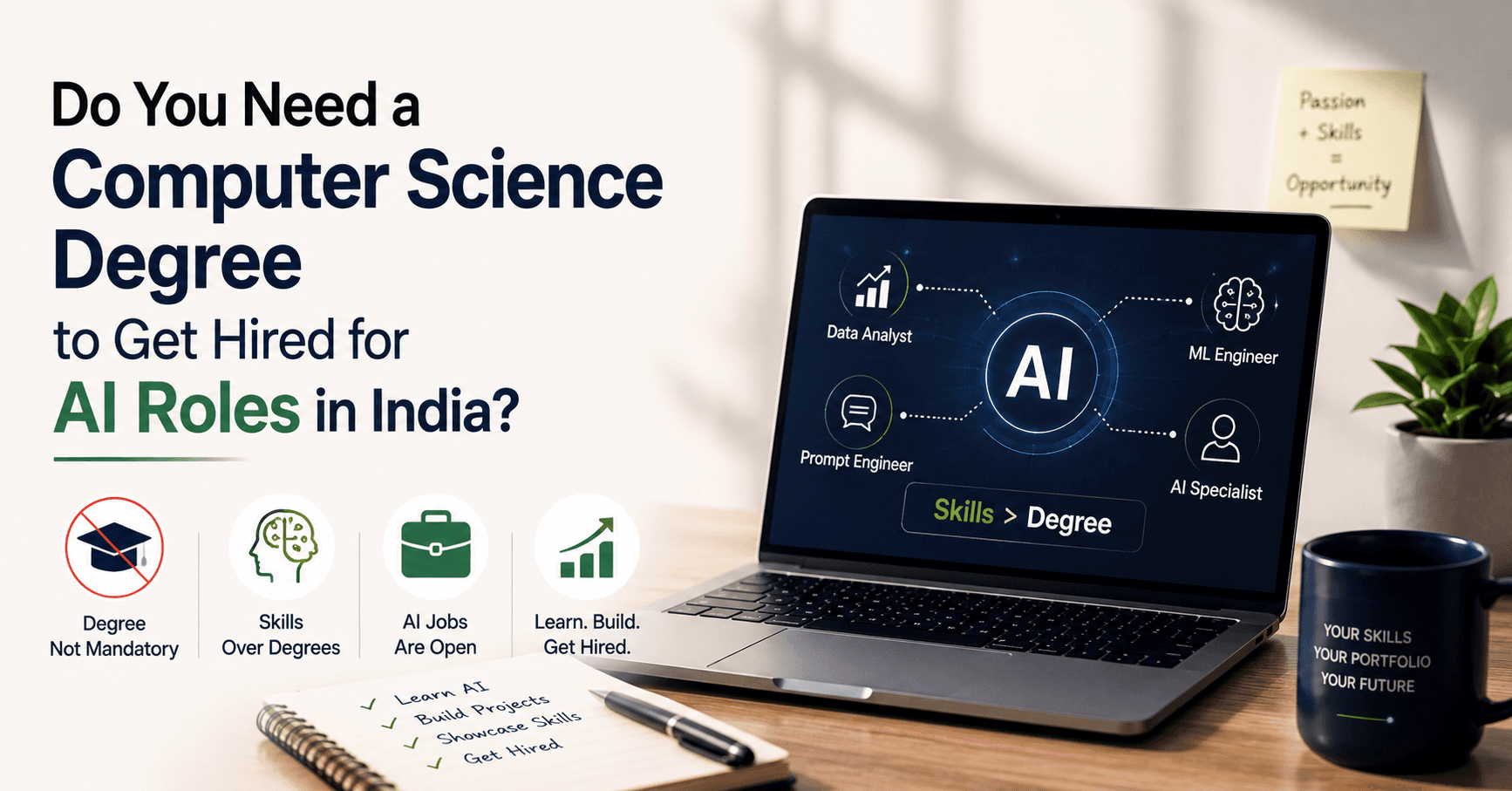
You don’t necessarily need a CS degree to get an AI job in India in 2026. Explore degree-optional AI roles, essential skills, portfolio requirements, realistic timelines, and why production experience can matter more than credentials for applied AI engineering roles.

ByNilesh Parwani / August 31, 2026 / 12 min read
- How to Get a Job in AI in India: What Has Changed in 2026
- AI Roles Where a CS Degree Still Matters When You Want to Get a Job in AI
- AI Roles Where How to Get a Job in AI Without a Degree Is Genuinely Achievable
- The AI Engineer Requirements That Actually Get Non-Degree Candidates Hired
- How to Get a Job in AI Without a Degree: The Realistic 2026 Timeline
- What This Means for US Companies Looking to Hire India AI Talent
- Frequently Asked Questions
- The Bottom Line
The short answer on how to get a job in AI without a degree in India: it depends on which AI role you are targeting, and the dependency is smaller than it was three years ago.
India's AI employers in 2026 have largely moved to portfolio-first evaluation. Demand for AI jobs has increased 21% while degree requirements have decreased 15% for the same positions. NASSCOM and Indeed's AI Talent Report confirmed that Indian employers now prioritize demonstrable AI-ready skills over credentials. The question is not whether a CS degree helps, because it does, but whether it is the only viable path. How to get a job in AI without a degree is no longer the outlier question it was in 2022. It is not.
This guide covers how to get a job in AI without a degree in India in 2026, what it realistically requires, and where the path is open versus where it is still restricted., what the ai engineer requirements actually are at different role levels, where degrees still matter, and what US companies hiring India AI talent need to understand about the degree-credential shift.
How to Get a Job in AI in India: What Has Changed in 2026
Five years ago, AI work in India primarily meant building models from scratch. That required strong mathematical foundations in linear algebra, calculus, probability, and statistics, which a CS degree from a reputable institution reliably provided. Employers used degree pedigree as a proxy for mathematical depth and coding fundamentals.
In 2026, the majority of AI work in India and globally involves applying, fine-tuning, and deploying existing models. This is the structural reason why how to get a job in AI without a degree has become a realistic question. rather than building foundation models from scratch. An engineer integrating Claude or GPT into a customer support workflow, building a RAG pipeline for a legal document search tool, or maintaining a fraud detection model in production at an Indian bank is doing AI engineering work that requires Python fluency, API design skills, deployment experience, and domain knowledge. It does not require a deep mathematical background of the kind a CS PhD develops.
This shift in what AI work actually involves is the primary reason why the answer to how to get a job in AI without a degree has changed. The role category that is growing fastest, applied AI engineering at the LLM and integration layer, is the category where how to get a job in AI without a degree is most achievable. than any AI engineering work that existed before 2022.
The degree question now has a more specific answer: which type of AI role are you targeting?
AI Roles Where a CS Degree Still Matters When You Want to Get a Job in AI
AI research scientist and foundation model work. Roles at Google DeepMind India, Microsoft Research, academic institutions, and elite AI labs typically require a master's degree or PhD in computer science, mathematics, or a related quantitative field. These are the roles that advance the underlying science of AI. The mathematical depth required is genuine and a CS or mathematics degree is the most reliable signal of it.
Senior ML engineer roles at tier-1 companies. A mid-level to senior ML engineer who owns training infrastructure, feature engineering pipelines, and production model architecture at a FAANG India office or top-tier AI product company benefits substantially from a CS background. The depth of systems understanding and the mathematical fluency required for this work are easier to acquire through structured CS education than self-directed learning. This does not mean non-CS candidates cannot reach this level. It means the path is longer and the portfolio evidence required is more substantial.
For these roles, a computer science degree from IIT, BITS, or a recognized NIT provides a credibility signal that lowers the bar for portfolio requirements. An IIT graduate typically needs two to three strong portfolio projects to clear the interview screening at a top company. A non-CS candidate targeting the same roles needs four to five projects demonstrating equivalent depth, plus stronger interview performance to compensate for the missing pedigree signal.
AI Roles Where How to Get a Job in AI Without a Degree Is Genuinely Achievable
This is where the conversation has changed most significantly in 2026. The roles listed below are being filled by non-CS candidates in India on merit, portfolio, and demonstrated production skills.
Applied AI engineer and LLM engineer , where how to get a job in ai without a degree is most accessible. Building production applications on top of foundation models: RAG pipelines, chatbot systems, document intelligence tools, AI-powered automations. The core ai engineer requirements for these roles in 2026 are Python proficiency, LLM API experience (OpenAI, Anthropic, Gemini), vector database knowledge, prompt engineering discipline, and a portfolio of shipped applications. A B.Com graduate with two years of coding experience who has built three RAG systems and can walk through their evaluation framework is a competitive candidate for applied AI engineering roles at funded startups and GCCs.
Data scientist at the analytics and ML layer , another track for how to get a job in ai without a CS degree. Not the research-heavy, model-building data scientist at a frontier company, but the data scientist building and maintaining predictive models for business decisions at a mid-market company or BFSI firm. Understanding statistics, machine learning algorithms, and Python is sufficient for many of these roles. A candidate with a mathematics or statistics degree, or even a finance degree combined with self-directed ML learning, can get into this track.
AI product manager , a track for how to get a job in ai from a business or social science background. Product managers who understand AI systems well enough to write meaningful specifications, evaluate model performance, and communicate trade-offs to both engineering and business stakeholders. A background in business, economics, or social sciences combined with genuine AI tooling knowledge and domain expertise is a legitimate path to how to get a job in AI as a PM. The ai engineer requirements for this role are different from the technical track: product intuition, communication, and AI fluency matter more than coding depth.
Data engineer , a solid track for how to get a job in ai from a technical non-CS background. Building and maintaining data pipelines for AI systems. SQL, Python, cloud data platforms (AWS, GCP, Azure), and an understanding of ML data requirements are the core skills. Many of India's best data engineers have backgrounds in science, mathematics, or even self-taught programming. A CS degree helps but is not a hard requirement.
Domain-specific AI roles , the strongest path for how to get a job in ai from a non-technical background. A finance professional who builds an AI-powered credit analysis tool, a healthcare worker who develops clinical AI workflows, or a logistics analyst who builds demand forecasting models. These hybrid roles value domain expertise plus AI tooling skills, and a non-CS domain-specific background is the differentiator, not a disadvantage.
The AI Engineer Requirements That Actually Get Non-Degree Candidates Hired
The ai engineer requirements that hiring managers in 2026 actually screen for , particularly when evaluating non-degree candidates , are worth naming precisely. are worth naming precisely.
Python proficiency , the baseline ai engineer requirement. Hiring managers want candidates who can write clean, functional code that works in a production environment. This does not mean perfect algorithmic performance. It means readable code, proper error handling, awareness of async patterns for I/O-bound AI applications, and the ability to debug systematically rather than guess.
Demonstrated portfolio projects , the core ai engineer requirement for non-degree candidates. The single most important ai engineer requirement for non-degree candidates, and arguably for all candidates, is a portfolio of projects that solved real problems. Not tutorials completed, not courses taken, not Kaggle competitions participated in. Projects that were conceived, built, deployed somewhere real, and iterated based on feedback. Three to four projects of this quality are a stronger signal than a credential.
Understanding the specific ai engineer requirements for the layer you are targeting. An applied AI engineer needs to understand LLM evaluation, RAG architecture trade-offs, and prompt reliability. An ML engineer needs to understand training data requirements, model evaluation metrics, and drift monitoring. An AI product manager needs to understand what models can and cannot do and how to measure AI product success. The ai engineer requirements vary significantly by role. Preparing for the wrong set of ai engineer requirements is the most common interview failure mode for non-degree candidates.
Production experience , the ai engineer requirement that separates hires from candidates. The question hiring managers ask when learning how to get a job in AI without a degree is: can I trust this person to make the right decision in a production environment when something breaks? Portfolio projects that include monitoring, error handling, edge case management, and iteration logs answer this question better than projects that show a working demo and nothing else.
Communication and articulation , an underrated ai engineer requirement. For any AI role that involves working with stakeholders who are not ML experts, which is most of them, the ability to explain what a model does, what its failure modes are, and what the trade-offs of a particular approach are is a core ai engineer requirement. Candidates who can only talk to engineers about technical details are harder to place than candidates who can explain AI behavior to a product manager or a client.
How to Get a Job in AI Without a Degree: The Realistic 2026 Timeline
For candidates in India asking how to get a job in AI from a non-CS background, and there are many of them in 2026,, the realistic timeline in 2026 breaks into three phases.
Phase 1: Foundations (2 to 4 months) , the base ai engineer requirements
Python to functional proficiency. Basic machine learning concepts: supervised and unsupervised learning, model evaluation, cross-validation. Introduction to one major AI framework: either LangChain/LlamaIndex for applied AI or scikit-learn/PyTorch for ML engineering. Linear algebra and statistics at the level required to read research paper abstracts and understand evaluation metrics without getting lost.
This phase is not about becoming an expert. It is about reaching the threshold where building real projects is possible rather than just following tutorials.
Phase 2: Portfolio building (3 to 6 months) , the core of how to get a job in ai without a degree
Build three to four projects that solve genuine problems. For an applied AI engineer: a document QA system with a real evaluation harness, an AI-powered automation for a real workflow, a RAG pipeline with documented performance results. For an ML engineer: a predictive model on a real dataset with proper feature engineering, model comparison, and deployment. Each project should have a GitHub repository with clear documentation, deployment on a cloud platform or accessible demo, and a write-up that explains the design decisions and what was learned.
This is the phase where how to get a job in AI without a degree becomes achievable. The portfolio compensates for the missing degree signal.
Phase 3: Getting hired (1 to 3 months) , applying what you know about how to get a job in ai
Apply before feeling fully ready. Most candidates who ask how to get a job in AI wait too long to apply, underestimating how much the portfolio already communicates. The first 10 to 15 applications are a learning exercise regardless of outcome. Feedback from rejection is more useful than extended preparation.
This is one of the most consistent pieces of advice for anyone learning how to get a job in AI: prioritize companies and roles where AI engineering is the core function rather than a support function. How to get a job in AI at a company that treats it as core: start with product-first AI startups. An IT services firm running an AI practice treats them as a cost center. The former produces better experience for the next job.
What This Means for US Companies Looking to Hire India AI Talent
US companies building India AI teams need to understand the degree landscape for one practical reason: the best India AI talent for applied AI roles is not exclusively, or even primarily, at IITs.
The engineers who have shipped the most interesting production AI systems in India in 2026 often have:
- A tier-2 engineering college background with four to five strong production projects
- A mathematics or statistics degree with self-directed ML learning
- A non-CS degree combined with two to three years of applied AI work at a funded startup
- A career transition background where domain expertise plus AI tooling creates a profile that an IIT CS generalist cannot match in the specific domain
Filtering India AI hiring to IIT and BITS graduates, or to CS degrees specifically, misses a substantial segment of the available talent. The ai engineer requirements that predict production performance in applied AI roles are demonstrated technical skills and portfolio quality, not college pedigree.
For US companies using an EOR to hire India AI engineers: the sourcing process should screen for portfolio evidence first and educational credentials second. Ask what was built, how it performed in production, what broke, and how it was fixed. The candidate who can answer those questions from a tier-2 college with four real projects is a better applied AI hire than the IIT graduate who has completed courses but has not shipped anything.
→ See how Kaamwork sources production-verified India AI talent: kaam.work/why-kaamwork/talent-centric-model
[CTA BUTTON] Placement: After US companies section, before FAQ Button text: Talk to Kaamwork About Hiring India AI Engineers URL placeholder: https://www.kaam.work/contact
Frequently Asked Questions
- How to get a job in AI without a degree in India in 2026?
How to get a job in AI without a degree in India: build Python proficiency to functional production level, complete three to four portfolio projects that solve real problems and are deployed or demonstrably usable, and target applied AI engineer roles at funded startups and GCCs rather than research roles at AI labs or senior ML positions at tier-1 companies. The ai engineer requirements that determine hiring decisions in 2026 are portfolio quality, coding ability, and demonstrated production experience, not degree credentials. NASSCOM and Indeed's AI Talent Report confirms that Indian employers now prioritize demonstrable AI-ready skills over degrees. - How to get a job in AI if you have a non-engineering degree?
How to get a job in AI from a non-engineering background depends on which track you take. Commerce, finance, and economics backgrounds have a clear path to AI product management or financial AI analysis roles. Arts and humanities backgrounds have a path to prompt engineering, AI content, and AI ethics roles. Science graduates (mathematics, statistics, physics) have the strongest path to data science and ML engineering without a CS degree. For all tracks, how to get a job in AI comes down to demonstrating the specific skills the role requires through a portfolio, regardless of what the degree says. - What are the AI engineer requirements for roles that do not require a CS degree?
AI engineer requirements for applied AI engineering roles in 2026: Python proficiency at a functional production level; experience building with LLM APIs (OpenAI, Anthropic, Gemini); knowledge of RAG systems and vector databases; ability to design and run evaluations for LLM-based systems; deployment experience on cloud platforms (AWS, GCP, Azure); and a portfolio of three to four projects that were built, deployed, and iterated. These ai engineer requirements are learnable without a CS degree through focused study and project work over six to twelve months. - Does an IIT degree still matter for AI hiring in India?
Yes, for specific role categories. An IIT degree provides credibility signal for senior ML engineering roles, AI research positions, and tier-1 company interviews that reduces the portfolio requirements needed to clear screening. An IIT graduate may need two to three portfolio projects where a non-IIT candidate targeting the same roles needs four to five. For applied AI engineering roles at funded startups, GCCs, and product companies, the IIT signal matters less. Hiring managers at these companies screen primarily for what was built, not where the candidate studied. How to get a job in AI at this layer is a skills-and-portfolio question, not a pedigree question. - How long does it take to learn how to get a job in AI from a non-CS background?
The realistic timeline for how to get a job in AI from a non-CS background in India: two to four months for Python and ML foundations, three to six months for portfolio building, and one to three months of active applications. The full timeline is six to twelve months for most candidates who already have a technical background (mathematics, science, engineering in another field) and twelve to eighteen months for candidates starting from a non-technical background. The candidates who move fastest are those who start applying while still building the portfolio rather than waiting until they feel completely ready. - What is the difference in how to get a job in AI for degree vs non-degree candidates?
The difference in how to get a job in AI for CS degree vs non-degree candidates in India is primarily about the amount of portfolio evidence required, not about whether the path exists. Degree candidates from top institutions need two to three strong projects to clear screening. Non-degree candidates for the same roles need four to five projects of equivalent quality. For applied AI engineering roles specifically, the gap is narrower because the ai engineer requirements for these roles center on LLM application skills that most CS degree programs did not teach. A non-degree candidate with strong applied AI engineering portfolio projects is competitive for applied roles at any company.
The Bottom Line
How to get a job in AI without a degree in India is a solvable problem in 2026. Not because degrees no longer matter. Because how to get a job in ai has split into two distinct tracks: into two distinct tracks: research and frontier ML, where degrees matter significantly, and applied AI engineering, where portfolio quality and production evidence matter more than credentials.
The demand shift is real: AI job demand up 21% while degree requirements down 15%. The portfolio path for how to get a job in ai without a degree is more crowded than it was two years ago because more people know it exists, but the bar for what constitutes a strong portfolio has also risen. Three to four production-quality projects is the ai engineer requirement that defines the portfolio standard in 2026.
For US companies hiring India AI talent: filtering by degree is filtering by the wrong ai engineer requirements signal for applied AI roles. The engineers who will actually close your AI talent gap are the ones who have shipped and maintained production AI systems, regardless of where they studied.
For US and UK companies hiring India AI engineers based on production evidence rather than credentials: kaam.work
Hire Portfolio-First India AI Engineers With Kaamwork URL placeholder: https://www.kaam.work/contact
Share this article

Founder & CEO | Kaam.Work
Nilesh Parwani, a Kelley School BBA graduate, worked at UBS and Warburg Pincus before founding PrintBell (acquired by Cimpress). In 2020, he launched kaam.work, a remote work platform focused on flexible talent and distributed teams.