Background Checks in India: What US Companies Can (and Can't) Verify
Hiring in India requires a different approach to background verification than in the US. Learn what employers can legally verify, what requires candidate consent, common limitations, timelines, costs, and how compliant background checks help reduce hiring risks for US companies in 2026.

ByNilesh Parwani / July 15, 2026 / 10 min read
- Are Background Checks in India Legal?
- What Can a US Company Actually Verify? The Full List
- What You Cannot Verify in India
- How Long Does Background Verification in India Take?
- What Does a Background Check in India Cost?
- The 5 Rules US Companies Must Follow
- How an EOR Handles Background Checks in India
- Frequently Asked Questions
Resume fraud is rising fast in India. According to background verification providers operating in India, AI-generated resumes and inflated credentials have made pre-employment screening more important in 2026 than at any point in the last decade.
For US companies hiring in India, background checks in India work differently than the FCRA-regulated, centralized US process. There is no single national criminal database. Education verification requires contacting individual institutions. Employment history verification goes through HR departments or EPFO (Employee Provident Fund Organisation) records. And every step requires written candidate consent under the Digital Personal Data Protection Act 2023.
This guide covers exactly what US companies can verify when hiring India-based employees, what the law prohibits or limits, how the process works step by step, what it costs, and how an Employer of Record handles all of it on your behalf.
Are Background Checks in India Legal?
Yes. Background checks in India are entirely legal and widely practiced across private sector hiring.
Written candidate consent is mandatory before initiating any background verification process. Under the Digital Personal Data Protection Act (DPDP) 2023, criminal records, employment history, and financial data are classified as sensitive personal data. This means they must be collected for a specific, stated purpose, stored securely, and not shared with unauthorized parties.
Background checks are not universally mandatory by law in India. No statute requires every employer to conduct them across all industries and roles. The sectors where background verification is most stringent and sometimes effectively mandatory include banking, insurance, financial services, healthcare, and IT for roles involving sensitive data access.
For US companies hiring India-based engineers, data scientists, and technical staff, background verification in India has become standard practice. It protects against credential fraud, dual employment (where a candidate is already employed elsewhere and has not disclosed it), and identity misrepresentation.
The key legal framework covering background checks in India includes:
- The Digital Personal Data Protection Act 2023 (DPDP Act): governs consent, purpose limitation, and data storage
- The Information Technology Act 2000 and IT Rules 2011: covers data security practices and sensitive personal data handling
- Indian employment contracts and offer letter terms: typically include background verification clauses as a condition of employment
What Can a US Company Actually Verify? The Full List
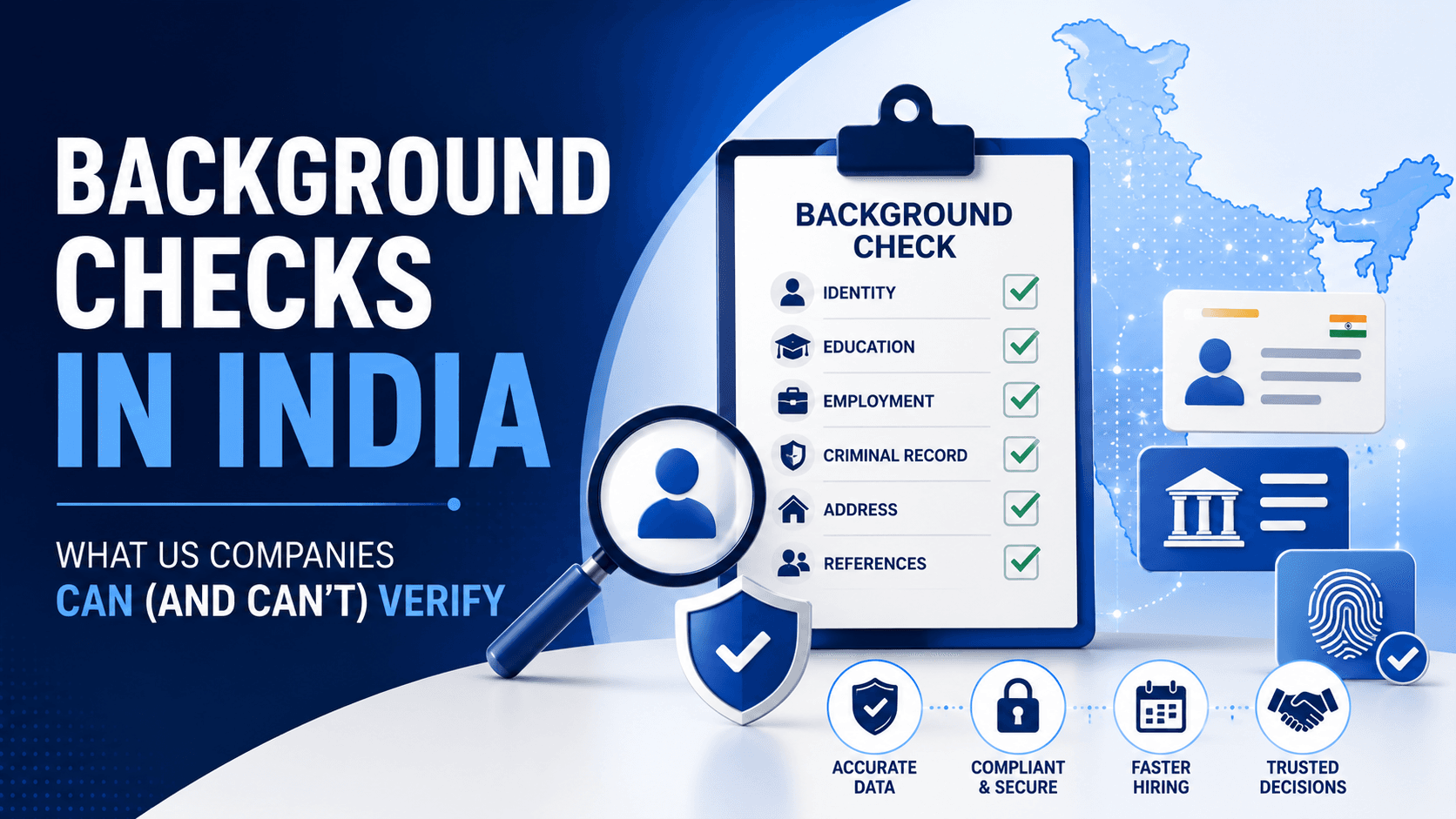
Background verification in India covers six primary check types. Here is what each involves, what is possible, and where the limitations apply.
1. Identity Verification
What you can verify: Government-issued identity through Aadhaar (national ID), PAN card (tax identification), passport, or voter ID. In 2026, DigiLocker is increasingly used by candidates to share authentic government-verified digital documents instantly without physical copies.
How it works: The candidate provides one or more ID documents. The verification agency confirms authenticity against government databases. Aadhaar verification uses the UIDAI (Unique Identification Authority of India) API for digital confirmation.
Limitations: Aadhaar data is protected under the Aadhaar Act. Employers cannot access the Aadhaar number directly in bulk or store it for purposes beyond identity confirmation. The verification result is typically a yes or no match, not a data dump.
2. Education Verification
What you can verify: Degrees, diplomas, certificates, and professional qualifications from Indian universities, colleges, and technical institutes.
How it works: Verification agencies contact institutions directly or access the National Academic Depository (NAD), a government-maintained digital repository of academic awards. For older institutions not in NAD, physical outreach to the university registrar is required.
Limitations: Education verification timelines vary significantly. Tier 1 institutions (IITs, IIMs, NITs) typically verify within 3 to 7 days. Smaller regional institutions can take 2 to 4 weeks. Diploma mills exist in India, which is exactly why education verification is critical for technical roles.
US company note: Degree fraud is one of the most common resume embellishments in India's IT sector. Education verification for engineering and data science roles is non-negotiable.
3. Employment History Verification
What you can verify: Dates of employment, job title, department, and sometimes reason for leaving. Salary verification is also possible in some cases.
How it works: Two routes exist. The first is direct employer contact with previous HR or payroll departments. The second, faster route uses EPFO database records. Every formal employer in India files monthly EPF contributions linked to the employee's Universal Account Number (UAN). Pulling UAN records reveals the full formal employment history, employment dates, and which employers made contributions.
Limitations: EPFO records only cover formal employment. Contract or freelance work is not in the system. Employers are not legally obligated to disclose reasons for termination to third parties. Some companies verify employment but refuse to confirm salary due to internal policies.
US company note: EPFO records also surface dual employment, where a candidate is working two jobs simultaneously and has not disclosed the second one. This is a specific risk for remote-first hiring that EPFO checks directly addresses.
4. Criminal Record Verification
What you can verify: Criminal history through police station records and court databases.
How it works: Unlike the US, India has no single centralized criminal database. The process involves the candidate obtaining a police clearance certificate from their local police station, which the verification agency then independently confirms. For court records, agencies access eCourts (the national electronic court system), FIR databases where accessible, and High Court records for serious matters.
Limitations: The absence of a central database means coverage depends on which jurisdictions the candidate has lived in. Records may not exist digitally for older cases. Criminal history assessment must be relevant to the role: a decade-old minor offense should not automatically disqualify a candidate for an unrelated position. This proportionality principle is increasingly expected under DPDP guidelines.
Cost and time: Criminal checks take longer than other check types, typically 5 to 15 business days depending on location and jurisdiction. Rural addresses take longer than urban.
5. Address Verification
What you can verify: Current and previous residential addresses declared by the candidate.
How it works: Physical field visits by verification agents remain standard for address verification in India. An agent visits the declared address, confirms the residence, and photographs the location. Digital alternatives using DigiLocker-linked address documents are increasing in 2026 but have not fully replaced physical verification for most employers.
Limitations: India's addressing infrastructure is inconsistent. Rural and semi-urban addresses may not appear in standard mapping systems. Field visits take longer and are more expensive for remote locations.
6. Reference Checks
What you can verify: Qualitative assessment of job performance, work style, reliability, and character from previous managers or professional contacts.
How it works: The verification agency or HR team contacts references provided by the candidate and conducts structured interviews. In India, reference check calls follow a professional but culturally different pattern from US reference checks. Explicit negative feedback about a candidate is less common. Indirect signals and what is not said can be as informative as what is said.
Limitations: References provided by the candidate are inherently self-selected. Independent reference checking (contacting managers not listed by the candidate) requires candidate consent. Some companies in India have policies against giving verbal references and only confirm dates of employment.
What You Cannot Verify in India
Some checks that US companies use routinely are either legally restricted or practically unavailable in India.
Credit checks without senior role justification: Credit history is sensitive personal data under the DPDP Act. Collecting it requires a clear, documented legitimate purpose tied to the role. Credit checks are appropriate for finance, treasury, and executive roles. Using them as a standard check for software engineers or data analysts does not meet the purpose limitation requirement.
Social media history as a formal check: Social media screening is legally ambiguous in India. While employers do search candidate profiles, using social media data in formal hiring decisions creates discrimination risk (caste, religion, and gender are protected characteristics) and potential DPDP violations. It is not a reliable or legally clean pre-employment screening method in India.
Unlimited historical criminal records: Criminal records cannot be pulled indiscriminately for all roles regardless of relevance. The check must serve a legitimate business purpose proportionate to the role's risk.
Aadhaar number storage: Employers cannot store the full Aadhaar number. The UIDAI regulations prohibit private entities from collecting and retaining Aadhaar in bulk.
How Long Does Background Verification in India Take?
Digital platforms have reduced verification timelines from several weeks to just a few days for most standard check types. The outliers are criminal checks (geography-dependent) and education verification at smaller institutions.
What Does a Background Check in India Cost?
Costs in India are significantly lower than US background check pricing.
Most US companies hiring India-based software engineers and technical staff use the standard package at $40 to $75 per candidate. Volume discounts reduce per-candidate costs by 15 to 20% for companies hiring at scale. Expedited processing for a 48-hour turnaround adds a 30% premium.
The 5 Rules US Companies Must Follow
Running background checks in India as a foreign employer requires following five specific legal and process requirements.
1. Written consent before anything else. Obtain a signed Letter of Authorization (LOA) from the candidate explicitly authorizing the specific checks you intend to run. Implied consent is not legally defensible under the DPDP Act. The LOA must state the purpose of the check, what data will be collected, who it will be shared with, and how it will be stored.
2. Purpose limitation. Collect only the data needed for the role in question. Running a credit check on a software engineer when there is no financial risk in the role does not meet the DPDP's purpose limitation requirement.
3. Candidate transparency throughout. Inform candidates about the screening process before it begins. If discrepancies arise during verification, give candidates a fair opportunity to explain before making any adverse hiring decision. Adjudicating a failed check without disclosure creates legal exposure.
4. Secure data handling and limited retention. Sensitive personal data including criminal records, financial history, and employment details must be stored securely and deleted after the legitimate purpose is fulfilled. Do not retain background check reports indefinitely.
5. Non-discrimination. Background checks cannot be used to discriminate on the basis of caste, religion, gender, or other protected characteristics. A failed criminal check must be assessed for relevance to the specific role, not used as a blanket disqualification.
How an EOR Handles Background Checks in India
When you hire in India through Kaamwork's EOR model, Kaamwork manages the background verification process on your behalf.
Kaamwork is the legal employer on paper. That means Kaamwork owns the consent collection process, manages the relationship with verification partners, coordinates the candidate communication during screening, and ensures the full check runs in compliance with the DPDP Act and Indian employment law. You define what checks you want for each role. Kaamwork executes the process and delivers the verification report before onboarding proceeds.
This matters particularly for US companies unfamiliar with India's complex verification landscape, diverse state-level nuances, and cultural differences in how reference checks work in practice. An EOR with established verification agency relationships gets faster turnaround times, better pricing on volume, and a documented compliance trail that protects you from DPDP liability.
Kaamwork's flat EOR fee of $599 per month per employee, on top of the employee's agreed salary, covers the employment compliance infrastructure. Background check costs are separate and priced per candidate based on the package selected.
See how Kaamwork's EOR model works in India, understand the best way to hire in India as a US startup, read how payroll compliance works in India, and compare EOR vs contractor in India to understand how the full India hiring process fits together before your first hire.
Background checks in India are legal, practical, and essential for any US company building a technical team in India. The process differs from US background screening in two critical ways: it requires written consent before anything starts, and it does not operate from a single centralized database. Identity, education, employment history, criminal records, address, and references can all be verified through established channels. Credit and social media checks are restricted by purpose and role relevance.
The fastest and most compliant way to manage background verification in India as a US company is to run it through an EOR. The verification is integrated into the onboarding process, handled by local experts, and documented in full compliance with the DPDP Act.
If you want to understand what a compliant India hiring process looks like for your specific roles, Kaamwork can walk you through the full sequence from offer to onboarding. Talk to Kaamwork today.
Frequently Asked Questions
Q: Are background checks in India legal?
Yes. Background checks in India are entirely legal and widely practiced across private sector hiring. The most critical legal requirement is obtaining written candidate consent before initiating any verification. Under the Digital Personal Data Protection Act 2023, criminal records, employment history, and financial data are classified as sensitive personal data and must be collected for a specific stated purpose, stored securely, and not shared beyond the hiring process.
Q: What does background verification in India include?
Background verification in India typically covers identity verification through Aadhaar, PAN, or passport; education verification through university registries or the National Academic Depository; employment history through direct employer contact or EPFO database records; criminal record checks through police clearance certificates and eCourts; address verification through field visits or DigiLocker documents; and reference checks through structured calls with previous managers. The standard package for a software engineer covers identity, education, and the last two employers at a cost of $40 to $75.
Q: How long does pre-employment screening in India take?
A standard pre-employment screening package in India covering identity, education, and two employment checks takes 7 to 14 business days at standard speed. Expedited processing for the same package runs 3 to 5 business days at a 30% premium. Criminal checks take the longest at 5 to 15 business days depending on jurisdiction. Education verification at smaller institutions can extend to 25 business days in some cases.
Q: What cannot be verified during background checks in India?
Credit history cannot be checked without a clear, documented legitimate purpose tied to the role. Social media screening is legally ambiguous and creates discrimination risk under Indian law. Aadhaar numbers cannot be stored in bulk by private employers. Criminal history must be assessed for relevance to the specific role and cannot be used as a blanket disqualification. Implied consent does not satisfy the DPDP Act: only explicit written consent through a Letter of Authorization is legally defensible.
Q: Does an EOR handle background checks in India?
Yes. An Employer of Record like Kaamwork manages the full background verification process for India hires as part of onboarding. The EOR collects written consent, coordinates verification with established local agencies, manages candidate communication during screening, and ensures compliance with the DPDP Act. US companies using an EOR for India hiring do not need to understand the local verification landscape or manage verification agency relationships directly. Background check costs are separate from the EOR fee and range from $40 to $150 per candidate depending on the package.
Share this article

Founder & CEO | Kaam.Work
Nilesh Parwani, a Kelley School BBA graduate, worked at UBS and Warburg Pincus before founding PrintBell (acquired by Cimpress). In 2020, he launched kaam.work, a remote work platform focused on flexible talent and distributed teams.