Form 16 in India: A Guide for US Payroll and Finance Teams
Form 16 is India’s mandatory salary TDS certificate for employees. Learn what US employers need to know about issuance, deadlines, penalties, EOR responsibilities, and the transition to Form 130 from 2026-27.

ByNilesh Parwani / August 12, 2026 / 8 min read
- What Is Form 16?
- Form 16 Payroll: Who Issues It and When
- Form 16 Income Tax India: What the Two Parts Contain
- Part A: The Government-Verified TDS Summary
- Part B: The Salary and Deductions Breakdown
- The Penalty for Late Issuance
- What US Employers Need to Know About Form 16 in Practice
- If You Use an EOR
- If You Run Your Own India Entity
- Form 16 Is Being Renamed: What Changes From 2026-27
- Frequently Asked Questions
- The Bottom Line
Every June, India's salaried workforce waits on a single document before they can file their income tax return. That document is Form 16. As a US employer with India hires, you are responsible for making sure it gets issued accurately and on time, whether you run payroll directly or through an Employer of Record.
Miss the deadline by a day and a per-employee penalty starts running. Miss it by a month across a 20-person team and you are looking at a five-figure compliance cost before anyone files a return.
This guide explains what Form 16 is, what it contains, what your obligations are as an employer, and what changes to expect from 2026 onward.
What Is Form 16?
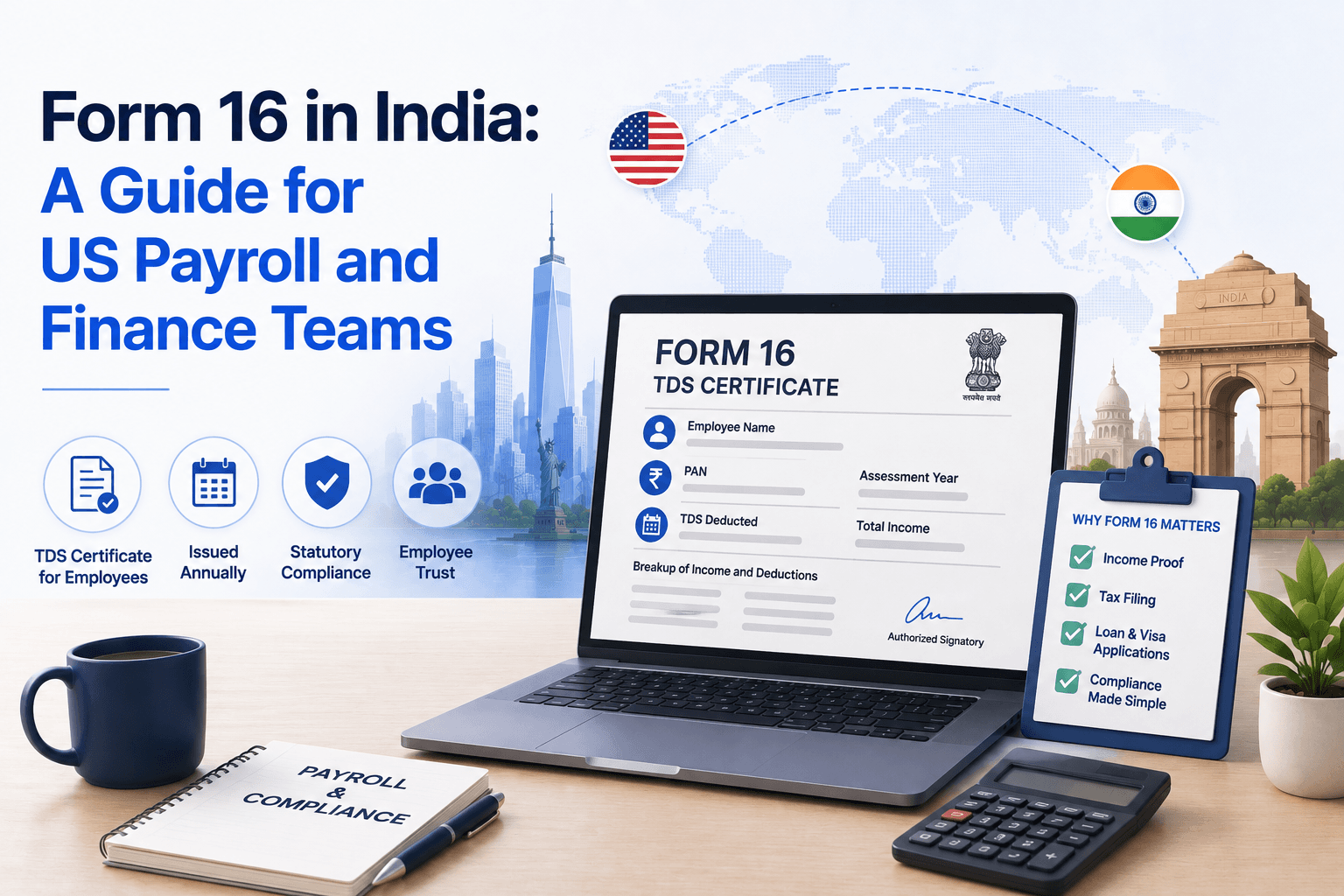
Form 16 is a TDS (Tax Deducted at Source) certificate issued by employers to their salaried employees in India. It is issued under Section 203 of the Income Tax Act, 1961, and it serves one core purpose: confirming that the employer deducted tax from the employee's salary during the financial year and deposited that tax with the Indian government.
Think of it as the Indian equivalent of a W-2 in the US, except it is issued annually by a fixed statutory deadline rather than rolled into a broader year-end process your payroll software handles automatically.
Every salaried employee in India uses Form 16 to file their income tax return (ITR). It shows how much they earned, how much tax was deducted month by month, and how that tax liability was calculated. Without it, employees can still file, but they have to piece together the same information from salary slips, bank statements, and the government's own Annual Information Statement (AIS). Form 16 makes that process clean and verifiable.
Form 16 Payroll: Who Issues It and When
The employer issues Form 16, or the Employer of Record if you hire in India through one. Since the EOR is the legal employer on paper, the Form 16 carries the EOR's name, PAN, and TAN, not yours.
The statutory deadline is June 15 of the assessment year. For the financial year 2025-26 (April 1, 2025 to March 31, 2026), the deadline was June 15, 2026. This gives employees roughly six weeks before the July 31 ITR filing deadline to review their certificate, reconcile it against the government's AIS, and file their return.
The June 15 deadline applies to every employee who was on payroll at any point during the financial year, including people who left mid-year. An employee who worked for you from April 2025 to September 2025 and then resigned is still entitled to a Form 16 for that period.
Form 16 Income Tax India: What the Two Parts Contain
Form 16 has two distinct parts. Each serves a different function and comes from a different source.
Part A: The Government-Verified TDS Summary
Part A is generated by the employer from the TRACES portal, the income tax department's online system for tracking TDS deposits. It carries a unique certificate number that the government assigns, which makes it the verified half of the document.
Part A includes:
- Employer PAN and TAN
- Employee PAN
- Name and address of both employer and employee
- Financial year and assessment year
- Summary of tax deducted and deposited, broken down by quarter
- Challan details confirming government receipt of the tax
Part A cannot be prepared by the employer internally. It must be downloaded from TRACES after the quarterly TDS returns (Form 24Q) have been filed and processed. This means your payroll cycle for the full year needs to be clean and filed before Part A can be generated.
Part B: The Salary and Deductions Breakdown
Part B is prepared by the employer or their payroll provider. It contains the detailed computation of the employee's taxable salary, including:
- Gross salary components (basic, HRA, special allowances)
- Exemptions claimed (HRA exemption, LTA, standard deduction)
- Taxable income after deductions under Chapter VI-A (80C, 80D, etc.)
- Tax computed on total income
- Rebates applied
- TDS deducted and the net tax payable or refundable
One important point for US finance teams: gross salary in Form 16 Part B is the employee's gross payslip figure, not the CTC. CTC includes employer-side costs like PF contributions and gratuity accruals. These are employer costs, not employee income, and they do not appear in Form 16.
The Penalty for Late Issuance
<cite index="49-1">Failure to issue Form 16 by June 15 attracts a penalty of INR 100 per day for each day the default continues, for each certificate, under Section 272A(2)(g) of the Income Tax Act, 1961. The penalty is capped at the amount of tax deductible for that employee.</cite>
The "per certificate" structure is what makes this expensive for employers with any scale. <cite index="53-1">For a company with 20 employees, a one-month delay costs INR 60,000 (20 employees x INR 100 x 30 days).</cite>
The penalty cap prevents the exposure from becoming catastrophic for high-salary employees with large TDS amounts, but the daily accrual across a workforce creates real financial risk for any payroll team that treats the June 15 date as approximate.
The deadline applies to the certificate reaching the employee, not to when it is generated internally. Generating Form 16 on June 14 and distributing it on June 20 is still a late issuance.
What US Employers Need to Know About Form 16 in Practice
If You Use an EOR
<cite index="53-1">EOR providers issue Form 16 in their own name as the legal employer.</cite> Your India hires will receive a Form 16 from the EOR, not from your company. This is correct. It is not a sign that something is wrong with the employment structure.
Your job is to confirm with your EOR, before the end of March each year, that their payroll records for your employees are accurate. Any errors in TDS computation, salary components, or declared deductions need to be caught before the fourth-quarter TDS return is filed (due May 31), because Part A of Form 16 cannot be generated from TRACES until that return is processed.
If an error surfaces after Form 16 is issued, the EOR needs to file a revised TDS return and generate a corrected Form 16. That process takes time and creates stress for the employee trying to file their ITR before July 31. Getting the payroll data right before year-end is far easier than correcting it after.
If You Run Your Own India Entity
You generate Form 16 directly and are responsible for both Part A (from TRACES) and Part B (from your payroll records). Your finance or payroll team needs a valid Digital Signature Certificate (DSC) to sign Form 16 electronically, which is now the standard issuance method. Paper Form 16s are technically valid but operationally slower and harder for employees to upload to the ITR portal.
The process runs in this order: file Form 24Q for all four quarters, then download Part A from TRACES, then prepare Part B from payroll records, then merge, sign digitally, and distribute by June 15.
For a deeper look at how India payroll deadlines work across the full financial year, see:How Payroll Actually Runs in India: A Month-by-Month Breakdown
Form 16 Is Being Renamed: What Changes From 2026-27
This is worth flagging for any US finance team building long-term India payroll processes.
<cite index="45-1">The Income Tax Act, 1961, was officially repealed on April 1, 2026. The Income Tax Act, 2025, and the Income Tax Rules, 2026, are now the governing framework for all salary taxation in India. Under this new law, Form 16 has been formally replaced by Form 130, governed under Section 395 of the Income Tax Act, 2025.</cite>
<cite index="43-1">For FY 2025-26, your employer will still issue Form 16 as usual. For Tax Year 2026-27 (income earned from April 1, 2026 onwards), the certificate that employees will receive is Form 130, to be issued by June 15, 2027.</cite>
The core purpose does not change. Form 130 still certifies that TDS was deducted from salary and deposited with the government. The structure is more detailed under the new Act, but for US employers the practical implications are the same: issue it accurately, issue it on time, and make sure your EOR or payroll provider has updated their systems for the new format before Tax Year 2026-27 closes.
Frequently Asked Questions
- What is Form 16 in simple terms?
Form 16 is the annual certificate your Indian employer or EOR issues to confirm how much salary you were paid and how much income tax was deducted and deposited with the government during the financial year. Salaried employees in India use it to file their income tax return. It has two parts: Part A (the government-verified TDS summary, downloaded from the TRACES portal) and Part B (the detailed salary and deductions breakdown prepared by the employer). - Who is responsible for issuing Form 16?
The employer is responsible. If you hire in India through an Employer of Record, the EOR issues Form 16 in its own name as the legal employer. The cost and obligation flow back to the EOR's compliance operations, but as the client company you need to make sure the payroll data the EOR holds for your employees is accurate before year-end. - Does every Indian employee get Form 16?
Only employees whose salary attracts TDS are legally required to receive Form 16. If an employee's income falls below the taxable threshold, the employer is not obligated to issue it. That said, most organized-sector employers issue Form 16 or an equivalent salary statement to all employees for recordkeeping, regardless of TDS applicability. - What is the deadline for issuing Form 16?
June 15 of the assessment year. For FY 2025-26, that was June 15, 2026. The deadline applies to the certificate reaching the employee, not just being generated internally. - What happens if Form 16 is issued late?
A penalty of INR 100 per day per certificate runs under Section 272A(2)(g) of the Income Tax Act, 1961, capped at the amount of tax deductible for that employee. For employers with 10 or 20 India hires, even a 30-day delay creates a meaningful financial exposure. Beyond the penalty, late Form 16 disrupts the employee's ITR filing, creating friction and eroding trust in the employer. - Is Form 16 the same as Form 16A?
No. Form 16 covers TDS on salary income. Form 16A is the TDS certificate for non-salary payments: interest income, professional fees, rent, and similar. If your India employee does any consulting work on the side and you deduct TDS on that payment, Form 16A is the relevant certificate, not Form 16. - What is Form 130 and does it replace Form 16?
Form 130 is the successor to Form 16 under India's new Income Tax Act, 2025. It applies from Tax Year 2026-27 onward. For FY 2025-26, Form 16 continues in the existing format. The core function is the same: certifying salary TDS deducted and deposited. If your EOR or payroll provider has not confirmed they are ready for Form 130 by the time Tax Year 2026-27 closes, ask the question now. - Does using an EOR in India mean I never have to think about Form 16?
Not entirely. The EOR handles issuance, and you will not see Form 16 on your own invoices. But if your employee's salary data is wrong in the EOR's payroll system because of a miscommunication on CTC structure, bonuses, or regime selection, the error shows up in their Form 16. That triggers a revised TDS return and a corrected Form 16, which delays the employee's ITR filing. Reviewing payroll data accuracy before March 31 each year is the practical check that prevents this.
The Bottom Line
Form 16 is not a document your India employees handle alone. It starts with how accurately you set up their payroll, how cleanly you run monthly TDS, and whether you or your EOR file the quarterly TDS returns on time. By June 15, the certificate is just the output of a process that ran for 12 months before it.
For US finance teams, the most useful frame is this: Form 16 is the annual proof that India payroll ran correctly. If it does not arrive accurately and on time, the problem is not the form itself. It is somewhere upstream in the payroll cycle.
Whether you handle India payroll directly or through an EOR, getting that upstream process right is the only thing that makes June 15 a non-event.
For US and UK companies hiring in India with full payroll compliance and on-time Form 16 issuance managed by Kaamwork: kaam.work
Share this article

Founder & CEO | Kaam.Work
Nilesh Parwani, a Kelley School BBA graduate, worked at UBS and Warburg Pincus before founding PrintBell (acquired by Cimpress). In 2020, he launched kaam.work, a remote work platform focused on flexible talent and distributed teams.