Building an AI Center of Excellence with Offshore Talent
An AI Center of Excellence helps US companies build a dedicated AI team in India at 60–70% lower cost than the US. This guide covers the team structure, costs, roles, and offshore operating model.

ByNilesh Parwani / August 20, 2026 / 12 min read
- What Is an AI Center of Excellence and What Does It Do?
- AI Outsourcing vs an AI Center of Excellence: A Distinction That Changes Everything
- The Core Roles Every AI Center of Excellence Needs
- Minimum Viable AI Center of Excellence: Offshore India Cost
- The Hub-and-Spoke Model: How an Offshore AI Center of Excellence Actually Runs
- What AI Outsourcing Companies Deliver and When They Beat the AI Center of Excellence Model
- Retaining Talent in an Offshore AI Center of Excellence
- Frequently Asked Questions
- The Bottom Line
Most US companies approaching an ai center of excellence from scratch face the same problem: the talent it requires costs more than their current headcount model supports.
A fully US-based ai center of excellence, staffed with data scientists at $160,000 to $200,000, ML engineers at $170,000 to $220,000, MLOps specialists, and an AI product manager at $180,000 to $250,000, runs $1.5 million to $2.5 million per year before overhead for a team of ten. That is a GCC-level budget at a team that many Series A and B companies have not yet justified internally.
India changes the math. The same roles, sourced from the same caliber of engineers who trained at IITs and worked at Amazon, Microsoft, and Flipkart, cost 60 to 70% less at the annual CTC level. India is ranked third globally in Stanford's 2025 AI Vibrancy Index, has the highest AI hiring growth rate in the world at approximately 33% annually, and has AI skill penetration 2.5x the global average. The ai center of excellence talent pool in Bangalore, Hyderabad, and Pune is not a thin or emerging market. It is the world's deepest outside the US.
This guide covers what an ai center of excellence actually is, how to structure one with offshore talent, how to distinguish genuine ai center of excellence building from ai outsourcing, and what operational model keeps offshore AI teams producing rather than cycling.
What Is an AI Center of Excellence and What Does It Do?
An ai center of excellence (AI CoE) is an internal team that establishes and owns the standards, infrastructure, and capabilities for AI development across an organization. It is not a single project team and not an external vendor relationship. It is a permanent function that sets the rails for how AI is built, governed, and deployed company-wide.
The ai center of excellence serves four functions:
Standards and governance across the ai center of excellence. The CoE defines how AI projects are scoped, what evaluation criteria must be met before deployment, how models are monitored post-launch, and what responsible AI requirements apply to bias, fairness, and transparency. Without this function, different teams build AI differently, creating inconsistency in quality and unpredictable governance risk.
Shared infrastructure owned by the ai center of excellence. The CoE maintains the ML platform, data pipelines, model registry, feature stores, and deployment infrastructure that product teams use rather than rebuild from scratch. A team building a recommendation feature should not have to set up MLflow, configure a serving layer, or design A/B testing infrastructure. The ai center of excellence provides these as shared capabilities.
Talent development - the ai center of excellence as an internal academy. The CoE runs internal learning programs, establishes engineering standards, and creates career pathways for AI practitioners within the organization. In a market where India's tech attrition ran at approximately 19% across the industry in 2024, the ai center of excellence that invests in this function retains engineers that pure project teams lose (down from 25% at peak), career development visibility is the retention lever that salary alone cannot match.
Project enablement - the ai center of excellence as internal consultancy. The CoE works alongside product teams to scope AI use cases, assess data readiness, select appropriate model approaches, and review results before production deployment. It is the internal consultancy that ensures AI is applied well, not just applied.
An ai center of excellence is distinct from a project-based AI team, which builds a specific model and disbands. The CoE is the permanent infrastructure that makes multiple AI projects possible at lower cost and higher quality than if each team started from scratch.
AI Outsourcing vs an AI Center of Excellence: A Distinction That Changes Everything
Most companies considering offshore AI talent are initially thinking about ai outsourcing: engaging an external firm to deliver a defined AI deliverable. AI outsourcing has its place, but it solves a different problem from what an ai center of excellence addresses.
AI outsourcing companies deliver projects. They scope a model, build it, hand it over, and move on. The institutional knowledge stays with the vendor. When the model drifts, when the data pipeline breaks, when a new use case needs the same foundation, you are paying the ai outsourcing vendor again for work that an internal team would handle as routine operations.
The ai center of excellence retains knowledge - and that retained knowledge is what makes the second year of an offshore AI team more productive than the first. Standards, patterns, infrastructure, and domain understanding compound inside the organization rather than accumulating in a vendor's delivery portfolio. For companies building AI as a core capability rather than a one-time feature, the CoE model generates compounding returns that ai outsourcing companies cannot replicate.
The practical test: if you expect to build more than two or three AI features in the next 18 months, the ai center of excellence model is more cost-effective than repeated ai outsourcing engagements. If you need one specific AI deliverable with no follow-on, ai outsourcing companies are the right tool.
The offshore ai center of excellence sits between these two extremes — and it is the option most US companies at Series A to B stage have not seriously evaluated. It is internal talent, working under your direction, accumulating institutional knowledge inside your organization, governed by your standards. But it is based in India, costs 60 to 70% less than the US equivalent, and operates through an EOR or GCC structure rather than a domestic headcount model.
The Core Roles Every AI Center of Excellence Needs
A functioning ai center of excellence requires five role types. The right composition of these roles is what separates an ai center of excellence that compounds in value from one that stalls. The right headcount at each level depends on the organization's AI ambition and current maturity, but this is the minimum viable structure for a CoE that can both set standards and deliver.
AI Product Manager. Owns the strategy and roadmap for AI capabilities. Defines use cases, assesses data readiness, sets evaluation criteria, and manages stakeholder communication. In the offshore model, the AI PM is typically India-based and co-located with the engineering team. In India, experienced AI PMs earn INR 30 to 60 LPA depending on background and company type.
Data Scientists. Build and validate models. Own the ML research function: identifying the right model architecture for each use case, running experiments, evaluating results against defined criteria, and handing off production-ready models to MLOps. In Bangalore, senior data scientists earn INR 25 to 55 LPA.
ML Engineers. Turn validated models into production systems. They build the serving infrastructure, optimize latency and throughput, set up monitoring, and manage retraining pipelines. The ML engineer is the bridge between research and production. In India, senior ML engineers earn INR 28 to 60 LPA.
MLOps Engineers. Own the platform: model registry, feature stores, CI/CD for ML, deployment automation, and monitoring infrastructure. The MLOps function prevents the ai center of excellence from becoming a collection of ad hoc scripts and one-off notebooks. In India, senior MLOps engineers earn INR 25 to 50 LPA.
Data Engineers. Build and maintain the data pipelines that feed the CoE's models. Data quality and availability are the most common constraint on AI project velocity. Data engineers who understand both the business context and the ML requirements are the unglamorous critical path. In India, senior data engineers earn INR 22 to 45 LPA.
Minimum Viable AI Center of Excellence: Offshore India Cost
The same eight-person ai center of excellence team in the US would cost $1.4 million to $2.0 million per year at market rates. The offshore model delivers the same capability at 25 to 33% of the US cost.
The Hub-and-Spoke Model: How an Offshore AI Center of Excellence Actually Runs
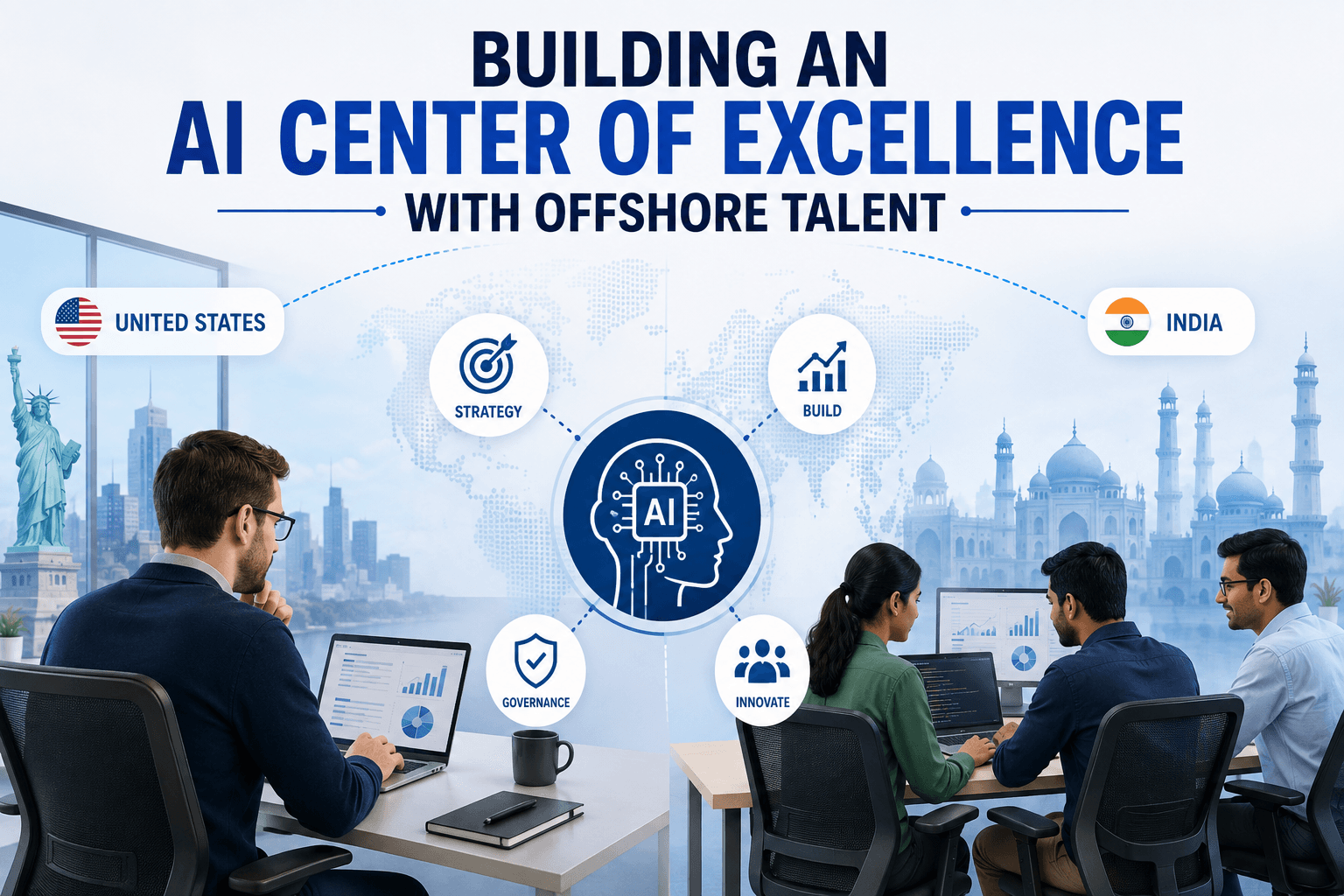
The ai center of excellence structure that works best for US companies with India-based AI talent runs on a hub-and-spoke model. The US side holds the spoke: executive sponsorship, customer context, business strategy, and stakeholder relationships. The India side holds the hub: engineering depth, research execution, platform operations, and day-to-day delivery.
The hub of the ai center of excellence is not a delivery arm. It is the center. The data scientists, ML engineers, MLOps specialists, and data engineers who build, run, and maintain the AI infrastructure are the core of the ai center of excellence. The US product leadership connects that capability to business priorities.
What makes this model work is the same thing that makes any offshore engineering relationship work: direct connection between the India team and the US decision-makers. A data scientist in Hyderabad who understands why a model matters - not just the technical specification, but the product context, the customer problem, and the business stakes, builds better models and stays longer. That context comes from direct communication, not from a project manager's summary of a US stakeholder call.
This is precisely where the ai center of excellence model diverges from ai outsourcing companies, and why the distinction matters operationally, not just philosophically. An ai outsourcing engagement keeps the India team isolated from product context by design. The CoE model integrates the India team into product planning, sprint reviews, and model performance discussions in ways that build institutional knowledge rather than consuming it.
What AI Outsourcing Companies Deliver and When They Beat the AI Center of Excellence Model
AI outsourcing companies are external vendors who deliver defined AI projects under a services contract. The major players in 2026 include large IT services firms (TCS, Infosys, Wipro), specialist AI consultancies (Tredence, Tiger Analytics, TheMathCompany), and offshore-first delivery shops across India.
AI outsourcing companies make sense when:
The AI use case is fully defined and bounded. You know exactly what you want to build, what data you have, and what success looks like. The vendor executes; you review and accept.
You need a one-time capability that will not require ongoing ownership. A risk scoring model for a single product line that will not need retraining or extension benefits from ai outsourcing. A recommendation engine that needs to evolve with user behavior does not.
Speed to first model matters more than cost over two years. AI outsourcing companies can mobilize faster than a hiring process for an offshore ai center of excellence team. If the timeline is under 90 days to a working prototype, ai outsourcing companies have a structural advantage.
AI outsourcing companies do not make sense when:
You expect the AI use case to evolve. Vendor handovers create knowledge gaps that cost months to close when requirements change.
You are building AI as a core product capability. Companies that differentiate on AI need the institutional knowledge inside, not in an ai outsourcing company's delivery portfolio.
You need the team to accumulate context over time. The ai center of excellence model returns more value in year two than year one, and more in year three than year two. AI outsourcing companies reset to zero at the end of every contract.
→ See how Kaamwork builds direct India teams for US product companies: kaam.work/why-kaamwork/talent-centric-model → Compare building an offshore team versus using ai outsourcing companies: kaam.work/why-kaamwork/kaamwork-vs-competitors
[CTA BUTTON] Placement: After AI outsourcing section, before FAQ Button text: Talk to Kaamwork About Building Your AI Center of Excellence in India URL placeholder: https://www.kaam.work/contact
Retaining Talent in an Offshore AI Center of Excellence
India's tech attrition decreased in 2024 after the peak years, per NASSCOM, but AI-specific talent remains highly mobile. Salary growth for AI roles in India is projected at 9% annually in 2026 (Aon). Pay alone does not retain the top performers the ai center of excellence needs.
What does retain them:
Complex, high-ownership work. AI engineers who are given strategic problems to solve, not just tickets to execute, stay longer and produce better output. An ai center of excellence that hands the India team pre-digested specifications and expects execution only is replicating the ai outsourcing model with extra steps. The CoE model should give India engineers ownership of the technical approach, not just delivery of a predefined solution.
Visible career progression. India's top AI talent has options. A data scientist who has been at the same level for 18 months with no path to staff or lead will update their LinkedIn profile. Build explicit progression pathways inside the ai center of excellence structure: senior to staff, ML engineer to ML architect, data scientist to research lead.
Direct connection to product outcomes. Engineers who know whether their model improved user retention or reduced fraud losses are more engaged than engineers who hand off a model and never see what happens next. Close the feedback loop between the India ai center of excellence team and the business outcome their work affects.
Competitive compensation with annual reviews. At 9% projected salary growth across India's AI talent market in 2026, a CoE that freezes compensation after year one is essentially accepting attrition. Budget for annual increases and structure them to reward tenure and impact, not just market correction.
Frequently Asked Questions
What is an AI center of excellence?
An ai center of excellence is an internal function that sets standards, builds shared infrastructure, and develops AI capabilities across an organization. It is distinct from a project team (which builds one model and disbands) and from ai outsourcing (where an external vendor delivers a defined scope and retains the institutional knowledge). The ai center of excellence is the permanent internal capability that makes multiple AI projects possible at lower cost and higher quality than if each team started from scratch.
How is an AI center of excellence different from AI outsourcing?
AI outsourcing companies deliver projects under vendor contracts. The institutional knowledge stays with the vendor. An ai center of excellence is internal talent that accumulates knowledge, builds shared infrastructure, and compounds in capability over time. For companies building AI as a core product capability, the ai center of excellence model generates compounding returns that ai outsourcing cannot match.
What roles does an offshore AI center of excellence need?
The minimum viable offshore ai center of excellence team requires: an AI product manager to own strategy and stakeholder alignment; data scientists to build and validate models; ML engineers to move models from research to production; an MLOps engineer to own the ML platform and deployment infrastructure; and data engineers to build and maintain data pipelines. An eight-person team at these roles costs approximately $330,000 to $462,000 per year in India through an EOR, compared to $1.4 million to $2.0 million for the same team in the US.
What does an offshore AI center of excellence in India actually cost? All-in annual employer cost for an eight-person ai center of excellence in India through an EOR runs approximately $330,000 to $462,000 per year. This includes gross CTC, employer-side statutory contributions (PF, gratuity), and the EOR fee at $599 per employee per month. The equivalent US team costs $1.4 million to $2.0 million annually. The offshore model delivers the same capability at 25 to 33% of the US cost.
When should I use AI outsourcing companies instead of building an offshore AI center of excellence?
Use ai outsourcing companies when the AI use case is fully defined, bounded, and not expected to evolve; when you need a one-time deliverable with no ongoing ownership requirements; or when the timeline to a first working model is under 90 days. Build an offshore ai center of excellence, not an ai outsourcing engagement, when you expect to build multiple AI capabilities over time, when AI is a core product differentiator, or when you need institutional knowledge to compound inside your organization rather than in a vendor's delivery portfolio.
How do you retain top AI talent in an offshore AI center of excellence? The three most effective ai center of excellence retention levers are: giving engineers high-ownership work with strategic problems rather than pre-digested specifications; building explicit career progression pathways with visible next levels; and closing the feedback loop between engineers and the product outcomes their models drive. Salary is necessary but not sufficient. AI talent in India with two years of experience at a company that gives them challenging work and visible career paths stays. Talent that executes tickets against a spec for the same two years does not.
The Bottom Line
An ai center of excellence built with offshore India talent is not a cost-cutting exercise dressed up in organizational language. It is the highest-leverage way for a US company without a $2 million AI headcount budget to build a durable, compounding AI capability.
The talent pool exists. India has 420,000 employees in AI job functions, ranks third globally in Stanford's AI Vibrancy Index, and produces AI engineers at a growth rate no other market matches. The infrastructure for employing them as full-time team members, not vendors, is mature: EORs with direct India entities, established GCC models, and compliance frameworks that make a Bangalore data scientist and a San Francisco ML lead members of the same team in every operational sense.
The ai center of excellence succeeds or fails on one variable that no staffing model or ai outsourcing arrangement can substitute for: whether the India team is treated as the center of the capability or as a remote execution arm. The ones that work give India engineers ownership, context, and career visibility. The ones that replicate the ai outsourcing model using full-time employment paperwork get ai outsourcing results at full-time employment cost.
For US and UK companies building an ai center of excellence in India with full employment compliance and direct team relationships from day one: kaam.work
Start Building Your India AI Center of Excellence URL placeholder: https://www.kaam.work/contact
Share this article

Founder & CEO | Kaam.Work
Nilesh Parwani, a Kelley School BBA graduate, worked at UBS and Warburg Pincus before founding PrintBell (acquired by Cimpress). In 2020, he launched kaam.work, a remote work platform focused on flexible talent and distributed teams.