Hire AI engineers in India: the complete 2026 guide
Hiring AI engineers in the US right now is brutal. A mid-level machine learning engineer costs you north of $170,000 in total compensation, and that number keeps climbing. Recruiters are quoting four to six month timelines to fill a single ML role. And half the candidates you talk to are already juggling three competing offers before you get to a second round. India has a talent pool that most US hiring managers dramatically underestimate. India produces over 1.5 million engineering graduates a

ByNilesh Parwani / April 14, 2026 / 18 min read
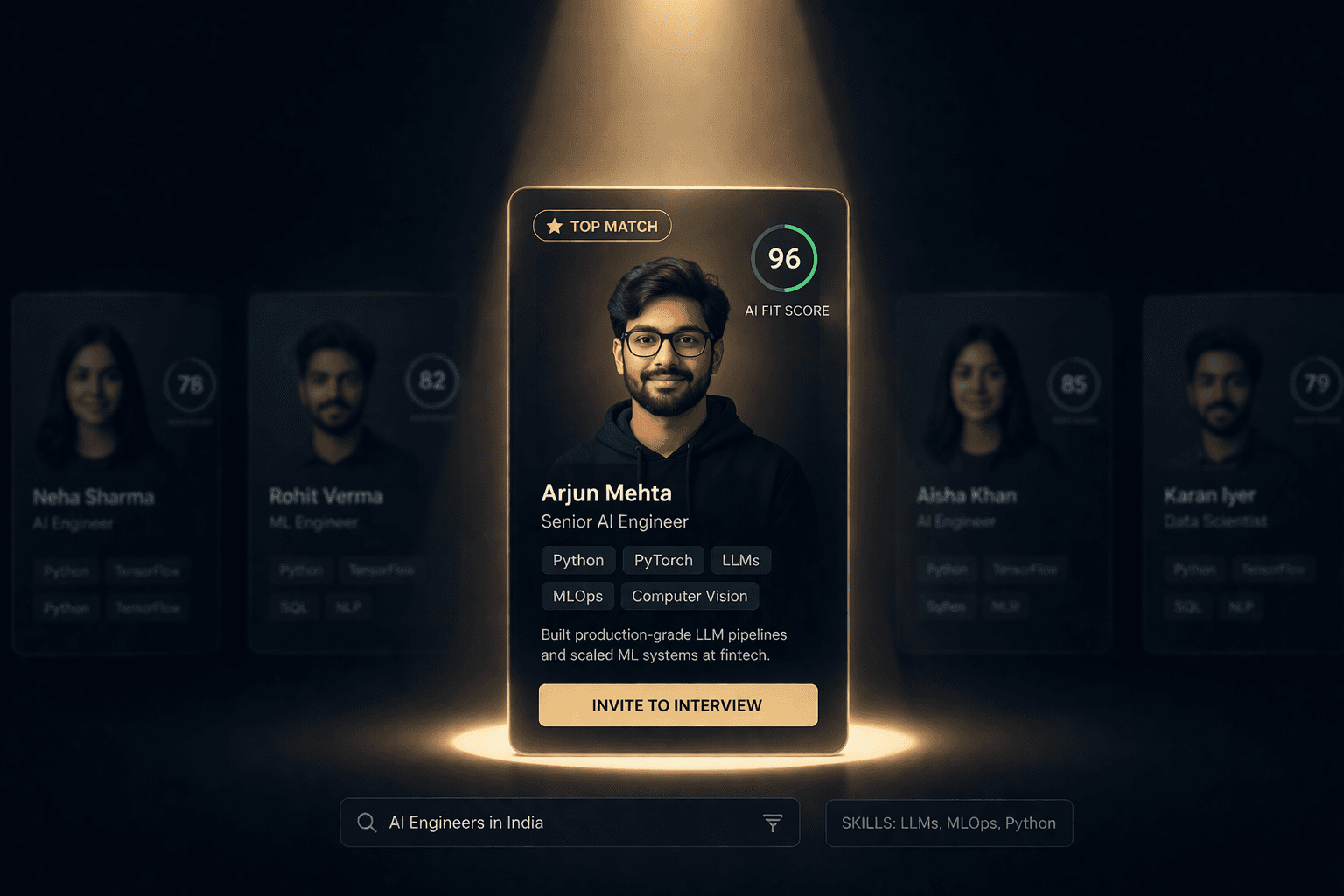
- Why companies are hiring AI engineers in India in 2026
- The institutional pipeline is deeper than you think
- The ecosystem has hit production maturity
- Cost arbitrage is real, but it isn't the full picture
- The skill gap you need to understand before hiring
- Which AI roles to hire in India (and what they cost)
- Salary reference: role × city × annual cost
- AI engineer
- Machine learning engineer
- Data scientist
- MLOps engineer
- GenAI / LLM application engineer
- AI product / applied AI engineer
- Top cities to hire AI engineers in India
- Bangalore: the largest AI hub
- Hyderabad: closing the gap fast
- Pune: solid for data and mid-cost execution
- Chennai: underrated and stable
- Delhi NCR and Mumbai
- How to think about city selection
- How to assess AI engineers remotely: the five-step framework
- Step 1: screen for actual role fit
- Step 2: review real project evidence
- Step 3: run a practical assessment
- Step 4: Assess communication and product thinking
- Step 5: verify production maturity
- A real hiring story: what this looks like in practice
- When India AI hiring doesn't work
- When the role requires same-timezone, same-room collaboration
- When cheap-first hiring backfires
- When you haven't defined what you actually need
- When the management layer isn't ready
- When IP and regulatory constraints prevent remote work
- How to hire AI engineers in India: step by step
- Define the role and stack
- Choose a city or go remote-first
- Choose your hiring model
- Set salary band and timeline
- Run structured technical assessment
- Close with speed
- Hiring models compared: EOR vs entity vs contractor
- EOR (Employer of Record)
- Own entity
- Contractors
- Staff augmentation vendors
- Why this is a strategic move, not just a cost play
- Start building your India AI team this quarter
Hiring AI engineers in the US right now is brutal. A mid-level machine learning engineer costs you north of $170,000 in total compensation, and that number keeps climbing. Recruiters are quoting four to six month timelines to fill a single ML role. And half the candidates you talk to are already juggling three competing offers before you get to a second round.
India has a talent pool that most US hiring managers dramatically underestimate. India produces over 1.5 million engineering graduates annually, and the subset of those graduates building production AI systems has grown from a niche to a genuine workforce over the past five years. The pipeline runs through IITs, IISc, IIITs, and dozens of strong private universities, then into GCCs operated by Google, Microsoft, Amazon, and JPMorgan, into well funded startups like Razorpay and Zomato, and into a mature services ecosystem that has been shipping software to Western companies for two decades.
This isn't a cheap-labor play. It's a structural talent advantage.
This guide covers where India's AI talent actually comes from (institution by institution), which cities to hire in and why, what salaries look like at a practical level, how to assess AI engineers remotely without getting burned, and which hiring model fits which situation. Platforms like Kaamwork (kaam.work/solutions/eor-india) have made compliant full time employment in India possible without setting up an entity, which removes the last logistical barrier for most companies. But the bigger point is the talent itself. If you're building an AI team and you're not looking at India, you're leaving your strongest option on the table.
Why companies are hiring AI engineers in India in 2026
The institutional pipeline is deeper than you think
Most US hiring managers know that IITs produce strong engineers. Fewer understand the full system. India's AI talent pipeline has at least four distinct institutional layers, and each one produces a different kind of engineer.
IITs are the most recognized tier internationally. IIT Kanpur's Wadhwani School of Data Science and AI runs applied research across NLP, computer vision, and reinforcement learning. IIT Bombay and IIT Delhi have joint industry programs with Microsoft and Google that produce engineers with both research publications and production deployment experience. For hiring managers, IIT talent is strongest on the research-to-applied bridge: people who can read papers, prototype models, and then actually ship them.
IISc Bangalore is closer to a research university than a traditional engineering school. It produces PhD-level researchers in deep learning, systems optimization, and computational neuroscience. If you need a research scientist who can push model architecture boundaries, IISc graduates are worth targeting specifically.
IIITs, especially IIIT Hyderabad and IIIT Bangalore, are strong feeders for applied ML and software-heavy AI roles. These programs produce engineers who can build and deploy ML pipelines rather than write papers about them. For machine learning engineer and MLOps roles, IIITs are an underrated source.
And then there's the layer most employers miss entirely. Beyond the elite institutes, India has 31 NITs, private universities like BITS Pilani and VIT, and (most importantly) a large population of experienced engineers who built their AI skills inside IT services companies, startups, and GCCs over the past five to eight years. Some of the best production ML engineers in India never attended an IIT. They went to a mid-tier college, joined a services firm, moved to a product company or GCC, and spent years shipping real systems. Ignore that pool and you cut yourself off from a massive share of qualified candidates.
The ecosystem has hit production maturity
GCCs have been a massive accelerant. JPMorgan, Goldman Sachs, Target, and Walmart now run some of their most advanced AI and data engineering work out of Indian GCCs. The startup ecosystem adds fuel: companies like Flipkart (which runs recommendation and search ML at enormous scale), Zomato (which built real time demand prediction and delivery optimization), and Razorpay (which runs production fraud detection models on millions of transactions) are training engineers on workloads that match the complexity of anything in the Valley.
Indian AI startups raised over $3.4 billion in 2024 alone, according to Tracxn's 2024 India AI Funding Report, and many of those companies are training engineers on real production ML workloads that US employers can hire from directly. The talent coming out of this ecosystem in 2026 isn't theoretical. These engineers have already done the hard part at someone else's company.
Because the ecosystem has matured, you're not hiring people who took an online course and listed "machine learning" on LinkedIn. You're hiring engineers who have shipped models, debugged data pipelines at 3am, and know the difference between a demo and a production system.
Cost arbitrage is real, but it isn't the full picture
Yes, you can hire a strong mid-level AI engineer in India for $30,000 to $45,000 a year instead of $170,000+ in the US. That gets attention. But if cost were the only factor, every company would have moved all engineering offshore decades ago.
What actually drives the shift: India's AI talent pool is structurally wider than what most US markets can offer at any price point. English is the working language. Engineering maturity in applied ML and data systems is high. And timezone overlap with US East Coast (about four hours of live collaboration daily) makes distributed AI teams genuinely workable. The companies hiring AI engineers in India in 2026 are doing it because the talent is world class, not because it's discounted.
The skill gap you need to understand before hiring
Not all "AI talent" is interchangeable. India may produce enormous numbers of engineers with some AI exposure, but the pool of people who can build production ML systems is much smaller than the headline numbers suggest.
You need to understand five distinct talent bands:
· Research talent: PhD-level, can design novel model architectures. Small pool, expensive even in India. Think IISc and top IIT graduates with publications.
· Applied ML talent: can take a proven approach, train models on your data, and integrate them into production. This is the largest pool of genuinely strong AI engineers in India, and the best value band for most companies.
· GenAI application engineers: can build on top of LLM APIs, design RAG pipelines, manage prompt engineering and agent architectures. Growing fast because every major company in Bangalore and Hyderabad is building GenAI products right now.
· MLOps and platform engineers: can build the infrastructure that makes ML work in production. CI/CD for models, monitoring, and feature stores. Undersupplied everywhere, India included.
· Data scientists: statistical modeling, business analytics, experimentation. Large pool, but quality varies wildly.
Getting the role definition wrong before you start hiring is the single most common failure mode. A company that posts "AI Engineer" when they actually need an MLOps engineer will waste months interviewing the wrong people. Especially for senior roles.
Which AI roles to hire in India (and what they cost)
Salary reference: role × city × annual cost
All figures are annual cash compensation in USD. Total loaded employer cost through EOR (including payroll, PF, ESIC, gratuity, and medical) typically runs 15–20% above the salary figures below. Sources: SalaryExpert 2026 estimates, Kaamwork hiring benchmarks, live market data from Bangalore and Hyderabad GCC pipelines.
|
Role |
Seniority |
Bangalore |
Hyderabad |
Pune / Chennai |
|
AI engineer |
Mid (3–5 yrs) |
$35,000–45,000 |
$30,000–40,000 |
$25,000–35,000 |
|
AI engineer |
Senior (7+ yrs) |
$55,000–75,000 |
$48,000–65,000 |
$38,000–52,000 |
|
ML engineer |
Mid |
$36,000–48,000 |
$30,000–42,000 |
$26,000–36,000 |
|
ML engineer |
Senior |
$55,000–80,000 |
$48,000–68,000 |
$38,000–54,000 |
|
Data scientist |
Junior |
$15,000–20,000 |
$13,000–18,000 |
$12,000–16,000 |
|
Data scientist |
Senior |
$45,000–65,000 |
$38,000–55,000 |
$30,000–45,000 |
|
MLOps engineer |
Mid |
$36,000–50,000 |
$30,000–44,000 |
$26,000–38,000 |
|
MLOps engineer |
Senior |
$55,000–75,000 |
$48,000–65,000 |
$38,000–52,000 |
|
GenAI / LLM engineer |
Mid |
$38,000–52,000 |
$32,000–45,000 |
$28,000–38,000 |
|
GenAI / LLM engineer |
Senior |
$55,000–75,000 |
$48,000–65,000 |
$38,000–52,000 |
|
AI product / applied AI |
Mid–Senior |
$42,000–60,000 |
$36,000–52,000 |
$30,000–45,000 |
These are offer-level benchmarks, not database averages. Candidates with publications, GCC pedigree, or production deployments at scale will sit at or above the top of each range.
AI engineer
The broadest title. Usually means someone who works across the ML lifecycle, from data processing through model training to deployment. Good for smaller teams where one person needs to wear multiple hats. Mid-level AI engineers with three to five years of experience typically cost $28,000 to $45,000 annually in India.
Machine learning engineer
More specialized. Focused on building, training, and optimizing ML models for production. Strong in PyTorch and TensorFlow, experienced with distributed training, comfortable with performance tuning. India's ML engineer pool is particularly strong because GCCs and product startups have been training these engineers on real workloads for years. Senior ML engineers (seven-plus years) can command $50,000 to $75,000 in Bangalore and Hyderabad.
Data scientist
The widest salary range of any role on this list because "data scientist" means wildly different things at different companies. Junior analysts with some Python start around $15,000. Senior data scientists with domain expertise and leadership experience can reach $50,000+.
MLOps engineer
Builds the infrastructure that makes ML work reliably in production. Model versioning, feature stores, monitoring pipelines, automated retraining. This role is undersupplied globally and undersupplied in India too. If you find a good one, move fast.
GenAI / LLM application engineer
The newest role and the one growing fastest. These engineers build applications on top of foundation models: RAG systems, agent architectures, fine-tuning pipelines. India's pool is expanding quickly, but demand is outpacing supply. Budget $35,000 to $55,000 for mid to senior hires.
AI product / applied AI engineer
Sits between engineering and product. Can translate a business problem into an ML solution, prototype it, and work with engineering teams to productionize it. Rare in any market, but India's product startup ecosystem (particularly in Bangalore) is producing more of these hybrid profiles than most employers realize.
The overlap between these titles is real and confusing. A "machine learning engineer" at one company does what an "AI engineer" does at another. When you write the job description, define the actual work, not the title. That single change will save you weeks of interviewing mismatched candidates.
Top cities to hire AI engineers in India
Bangalore: the largest AI hub
Bangalore is India's AI capital and it isn't particularly close. Every major GCC runs significant AI operations here. The startup density is the highest in the country. And the senior talent pool, people with seven to twelve years of production ML experience, is larger here than anywhere else in India.
Best for: senior AI and ML engineers, research-adjacent roles, startup-trained product builders, platform teams.
But Bangalore has real costs beyond salary. Compensation pressure is the highest in India. Attrition runs higher because engineers have so many options. You're competing for the same senior ML engineer that Google, Flipkart, Swiggy, and twenty funded startups are also chasing. If you want Bangalore talent, prepare to move fast and pay competitively.
Hyderabad: closing the gap fast
Hyderabad is growing faster than most people realize as an AI hub. Microsoft, Amazon, Google, ServiceNow, and a long list of enterprise companies run major engineering centers here. The cost-quality balance is strong. You can hire engineers with equivalent skill to Bangalore talent at 10 to 20% lower compensation.
The absolute top tier of the talent pool, the people who've been building production ML at scale for a decade, is smaller here than Bangalore. For most roles, though, Hyderabad is the smarter play.
Pune: solid for data and mid-cost execution
Pune has a deep university and IT services ecosystem that produces solid mid-level engineering talent. Good fit for data science teams, product development, and analytics-heavy AI roles. Compensation is meaningfully lower than Bangalore, typically 15 to 25% less for equivalent experience.
Pune isn't where you go for cutting-edge research hires. It's where you go to build a reliable, cost-effective engineering team that can execute on well defined ML workloads. Worth it.
Chennai: underrated and stable
Chennai flies under the radar in AI hiring conversations, which is actually an advantage if you're hiring there. GCC and AI growth in Chennai has accelerated through 2025 and 2026, and the city's engineering culture leans toward stability and depth rather than job-hopping.
Best for: enterprise engineering, data platforms, analytics, backend AI infrastructure.
Chennai's startup ecosystem is smaller, so you'll find fewer candidates with "built something from zero" experience. For enterprise AI work, though, Chennai offers strong talent at lower cost and lower attrition than Bangalore or Hyderabad.
Delhi NCR and Mumbai
Delhi NCR shows up in AI job data as a top five market, particularly for fintech and enterprise AI. Mumbai matters for financial services AI. Neither city matches Bangalore or Hyderabad for pure AI engineering depth, but depending on your industry and role, they deserve consideration.
How to think about city selection
The city question comes down to what you're optimizing for. If you need the absolute deepest pool and don't mind paying a premium, Bangalore is the answer every time. If you want 80% of Bangalore's talent at 80% of the cost, Hyderabad gives you the best ratio. If you're building a team of eight to twelve mid-level engineers and cost discipline matters, Pune and Chennai are strong options that most US companies overlook.
And if you genuinely don't care where your engineers sit, go remote-first across India. The infrastructure for remote work is mature in all of these cities, and remote-first lets the best candidate win regardless of geography. Some of the strongest AI engineers in India live in smaller cities and work remotely for companies based in Bangalore or the US. You lose nothing by widening the search.
How to assess AI engineers remotely: the five-step framework
This is where most companies get it wrong. They apply the same interview process they'd use for a fullstack web developer and then wonder why the AI hire isn't working out. AI assessment is different.
Step 1: screen for actual role fit
Before you write a single interview question, be precise about what you actually need. An LLM application engineer and a classical ML engineer are fundamentally different hires. If your job posting says "AI Engineer" and your actual need is someone who can build retrieval pipelines on top of GPT-4, say that. Screen resumes and initial calls for the specific work, not for generic "AI experience."
Step 2: review real project evidence
GitHub profiles help but aren't sufficient. What you're looking for: evidence that this person has built and deployed production systems. Ask about specific models they trained, how they handled data quality issues, what inference latency they achieved, how they set up monitoring. If every answer is theoretical ("I studied this in my coursework"), that's a signal.
The best India-based AI engineers, the ones coming out of GCCs and product startups, will talk about specific production systems they owned. Press for details. "I built a recommendation model" isn't enough. "I built a collaborative filtering model on 40 million user events, deployed it on SageMaker, and improved conversion by 8%" tells you something real.
Step 3: run a practical assessment
Skip LeetCode. For AI roles, a practical assessment matters far more. Assign work that mirrors actual job tasks:
· Build a small retrieval or classification pipeline from a provided dataset. Evaluate it. Explain the tradeoffs.
· Debug model performance on a dataset where something is clearly wrong (data leakage, class imbalance, bad feature engineering). See how they diagnose the problem.
· Design an inference architecture for a given use case. Think through latency, cost, and reliability.
· For GenAI roles: build a RAG pipeline, evaluate retrieval quality, and explain when you would fine-tune versus prompt-engineer versus use retrieval.
Time-box at two to four hours. Pay the candidate for their time if the assessment is substantial. Good engineers in India have options, and disrespecting their time will lose you the best people.
Step 4: Assess communication and product thinking
This matters more in remote AI teams than most employers expect. A brilliant engineer who can't explain their model choices to a product manager, or who can't write clear documentation, will create bottlenecks in a distributed team.
Ask them to explain a technical concept to a non-technical audience. Ask how they'd prioritize between two ML projects with different business impact. Listen for clarity, not just correctness.
Step 5: verify production maturity
The gap between "can train a model" and "can run ML in production" is enormous. In your final round, probe for:
· Monitoring: how do they detect model drift or data quality degradation?
· Cost control: have they optimized inference costs? How?
· Experimentation: how do they run A/B tests on model changes?
· Failure handling: what happens when the model returns garbage? What's the fallback?
· Security: do they understand data access controls, PII handling, compliance?
Engineers who can answer these questions credibly are production-ready. The rest might be strong but will need significant ramp time. That isn't disqualifying, but you should know it going in.
A real hiring story: what this looks like in practice
When a Series B fintech in San Francisco needed an ML engineer who could build fraud detection models, they spent four months trying to fill the role domestically at $195,000. They went through two recruiting agencies, ran dozens of interviews, and lost their top candidate to a competing offer from a late-stage startup.
Through an EOR in India, they sourced a Bangalore-based engineer with five years of production ML at a payments company. The engineer had built fraud scoring systems handling millions of daily transactions. He'd deployed models on AWS, built monitoring dashboards for model drift, and worked with product teams to tune precision-recall tradeoffs based on business rules. The total cost including EOR fees was under $50,000 annually. Time from first interview to first day of work: eleven days, actually closer to fourteen once the background verification cleared.
Not every hire goes this smoothly. But the pattern repeats: US companies spending months and six figures trying to fill AI roles domestically, then filling equivalent or better roles in India in under three weeks at a fraction of the cost.
When India AI hiring doesn't work
This is the section most guides skip, and it's the one that matters most if you're making this decision for real.
When the role requires same-timezone, same-room collaboration
Some AI work flat-out doesn't work across a 10-hour timezone gap. If your ML team needs to pair program with a product team in San Francisco for six hours a day, or if model debugging sessions regularly run three hours and need everyone in the room, a Bangalore hire will struggle. The four-hour overlap window with US East Coast (roughly 8am to 12pm Eastern, 5:30pm to 9:30pm IST) is real and workable, but it isn't eight hours. Teams that can't design around async workflows will hit friction fast.
When cheap-first hiring backfires
Companies that optimize for the absolute lowest salary in India end up with engineers who need significant mentoring, produce lower quality work, and sometimes leave within months for a better-paying role. The cost savings look great on a spreadsheet. The reality is six months of rework and a second round of hiring that costs more than the first. If you're paying $15,000 for an "AI engineer," you're not hiring an AI engineer. You're hiring a junior developer who listed TensorFlow on their resume.
Not always a disaster. But often enough.
When you haven't defined what you actually need
This is the failure mode that has nothing to do with India specifically, but it shows up disproportionately in offshore AI hiring because the communication gap amplifies ambiguity. If your job description says "AI Engineer" and your real need is an MLOps engineer who can set up feature stores and model monitoring, you'll interview dozens of candidates who are perfectly qualified for a job you don't actually have. Define the work precisely before you engage any hiring channel. That applies whether you're hiring in Bangalore, Austin, or London.
When the management layer isn't ready
This one is less obvious but just as common. If your US engineering leadership has never managed a distributed team, the first India hire will feel harder than it should. Not because the engineer is underperforming, but because the feedback loops, documentation habits, and meeting cadences that work for a co-located team don't translate directly. Companies that invest in async workflows, recorded standups, and clear written specs before they hire offshore have a significantly better experience than companies that figure it out afterward.
When IP and regulatory constraints prevent remote work
Certain defense, healthcare, and financial services AI work has data residency, security clearance, or regulatory requirements that make remote or offshore employment impractical. If your models touch classified data or your compliance team requires all AI development to happen within specific physical or network boundaries, India hiring may not fit. Check with legal first, not after you've made an offer.
How to hire AI engineers in India: step by step
Define the role and stack
Write a job description that specifies the actual work, tools, and outcomes. "AI Engineer" means nothing without context. "ML engineer who can build and deploy NLP models on AWS SageMaker for our customer support product" means everything.
Choose a city or go remote-first
If you want the deepest pool, search Bangalore. If you want cost-quality balance, search Hyderabad. If you want to cast the widest net, go remote-first across India and let the best candidate win regardless of city. Each approach has tradeoffs and none of them is wrong.
Choose your hiring model
Three options: set up your own entity (expensive, slow, $300,000+ and 6 to 12 months), hire contractors (fast but risky for long term AI work), or use an EOR to employ them compliantly as full time team members within days. For most companies hiring their first five to fifty AI engineers in India, EOR is the right answer.
Contractors have a specific limitation for AI work: no default IP assignment under Indian law. If you're building proprietary models and training on proprietary data, you want full time employees with proper IP agreements. Contractor models create legal gray areas that can get expensive if things go sideways.
Set salary band and timeline
Use the benchmarks from this guide. Budget $28,000 to $45,000 for mid-level AI roles, $50,000 to $75,000 for senior. Onboarding through an EOR typically runs under two weeks from signed offer to first day, about three weeks if your internal approvals process adds a buffer (actually closer to four once background verification is factored in for some companies).
Run structured technical assessment
Follow the five-step framework above. Do not shortcut the process for AI roles. A bad AI hire is more expensive than a slow AI hire. That's true everywhere, but it's especially true when the candidate is 10,000 miles away and mistakes take longer to correct.
Close with speed
Good AI engineers in India get multiple offers. When you find the right person, don't let internal approvals drag for three weeks. Make the offer, share the compensation details, explain the benefits and career path, and close within days. You're competing with Flipkart, Razorpay, Google's GCC, and a dozen funded startups for the same people. Speed is a real advantage.
Hiring models compared: EOR vs entity vs contractor
EOR (Employer of Record)
An EOR is the legal employer in India while you retain full control over the employee's work, tools, and career decisions. You can hire in days without setting up an entity. Through Kaamwork (kaam.work/pricing), the cost is $599/month per employee covering payroll, PF, ESIC, gratuity, medical insurance, and compliance. For AI teams where continuity and IP ownership matter, this is the default path for most companies.
Own entity
Setting up your own Indian subsidiary gives you maximum control but costs $300,000 to $500,000 and takes 6 to 12 months. Makes sense if you're planning to hire 50+ people and want full ownership of the infrastructure. Many companies start on EOR and transition to an entity later once they've proven the model works.
Contractors
Fast to engage, low commitment, but risky for AI work. No default IP assignment under Indian law. Classification risk if the relationship looks like employment. And contractors lack the organizational context that makes AI engineers effective over time. Use contractors for discrete, time-bound projects. Don't build your core AI team on contractor relationships.
Staff augmentation vendors
A staffing vendor provides engineers on a markup model, typically 40 to 80% above the engineer's actual compensation. You pay for convenience but lose transparency on cost and usually control over who joins your team. For AI roles where candidate quality is everything, this model rarely delivers.
Why this is a strategic move, not just a cost play
The cost savings are real and we've already covered them. But if cost were the only reason to hire AI engineers in India, every company would have done it already and there would be nothing left to say.
The strategic case runs deeper. India gives you access to a talent pool that is structurally wider than what the US market offers for most AI roles. Over 65% of India's 1.4 billion people are under 35. The country produces more STEM graduates than anywhere else. And the engineers coming out of GCCs, startups, and top universities have production experience on systems that match the complexity of anything being built in the Bay Area.
Hiring in India also gives you follow-the-sun productivity. Your India team ships work while your US team sleeps. For AI workflows that involve long training runs, evaluation cycles, and iterative deployment, that overlap isn't a gimmick. It's a genuine throughput multiplier.
And there's the resilience argument. Companies that source all their AI talent from one geography, especially one where salaries are inflating 15 to 20% annually, are building a fragile hiring strategy. A distributed team that draws from India and the US is more resilient, more scalable, and better positioned for whatever the market does next.
Start building your India AI team this quarter
The playbook is straightforward once you have the pieces.
Pick your city based on the role. Bangalore for senior AI and research-adjacent hires. Hyderabad for scale and cost-quality balance. Pune and Chennai for reliable mid-cost execution. Remote-first if you want the widest net.
Set salary expectations using real numbers, not hope. Mid-level AI engineers: $28,000 to $45,000. Senior: $50,000 to $75,000. Total loaded cost through EOR: roughly $35,000 to $55,000 all in.
Get the role definition right before you start sourcing. The five skill bands in this guide (research, applied ML, GenAI, MLOps, data science) require different candidates with different backgrounds. Conflating them is the fastest way to waste time.
Assess on production skills, not pedigree and algorithms. The five-step framework here exists because standard engineering interviews don't work for AI roles. Use it.
And when you're ready to move, Kaamwork can have your first India-based AI engineer onboarded and working within two weeks. No entity. No six-figure setup costs. Your team, your tools, your IP. The cost calculator at kaam.work/global-cost-calculator shows exactly what yours would cost, and the team at kaam.work/talk-to-us can walk you through the specifics.
Disclaimer: Salary data in this guide is based on publicly available 2025-2026 estimates and industry hiring benchmarks. Actual compensation varies by candidate, company, city, and role. Kaam
Share this article

Founder & CEO | Kaam.Work
Nilesh Parwani, a Kelley School BBA graduate, worked at UBS and Warburg Pincus before founding PrintBell (acquired by Cimpress). In 2020, he launched kaam.work, a remote work platform focused on flexible talent and distributed teams.