Tech hiring trends report 2026
Three forces are reshaping how technology companies hire in 2026, and most annual trend reports only cover one of them at a time. The first is AI demand. Robert Half's 2026 technology hiring analysis found that AI, ML, and data science postings are driving the current hiring cycle. CompTIA counted more than 275,000 active postings referencing AI skills in January 2026 alone. That number is not limited to dedicated AI roles. It includes product managers, software engineers, and operations leader

ByNilesh Parwani / April 30, 2026 / 13 min read
- The three biggest tech hiring shifts in 2026
- AI demand is outpacing broader tech hiring
- Remote work is no longer exploding, but it remains structurally important
- EOR is growing because companies need faster cross-border hiring
- Trend 1: AI is reshaping tech hiring faster than any other category
- AI, ML, and data science are the most visible growth engine
- AI skills are diffusing into more job families
- What this means for employers
- Trend 2: remote hiring has stabilized, not disappeared
- Remote work is now a durable feature, not a temporary spike
- Remote job demand remains meaningful in 2026
- What this means for tech employers
- Trend 3: the EOR market is growing because global hiring has become operational
- The EOR market is still expanding materially
- Why EOR is growing now
- Why this matters for tech hiring specifically
- The most in-demand tech skill clusters in 2026
- AI / ML / data
- Cloud / platform / systems modernization
- Cybersecurity
- Network and infrastructure resilience
- When EOR is not the right model
- What this means for employers: the new hiring playbook
- Stop hiring by headline trend alone
- Expand geographically sooner
- Choose the right model for each hire
- Build around scarcity, not headcount plans alone
- Tech hiring in 2026 is more global, more selective, and more operational than ever
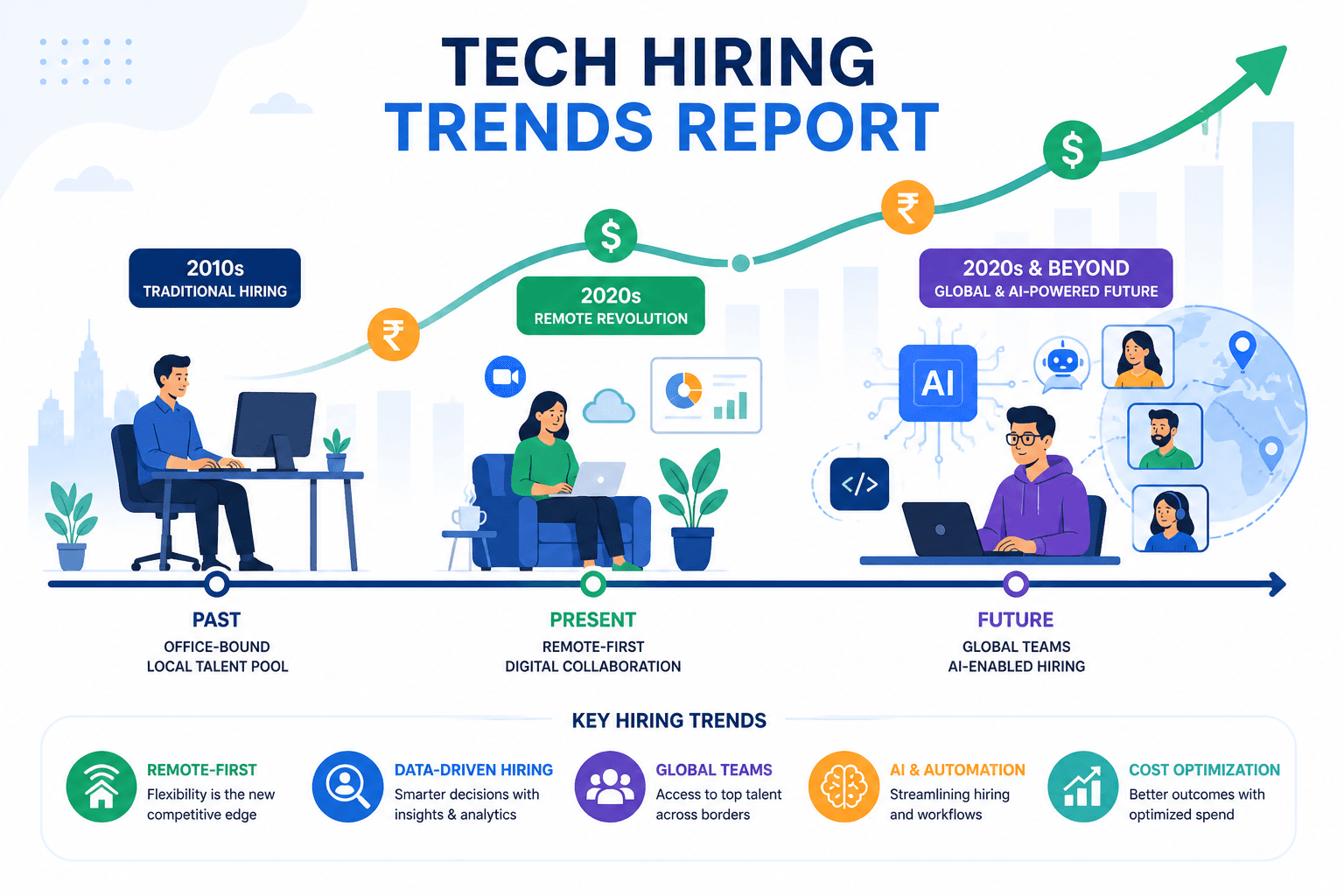
Three forces are reshaping how technology companies hire in 2026, and most annual trend reports only cover one of them at a time.
The first is AI demand. Robert Half's 2026 technology hiring analysis found that AI, ML, and data science postings are driving the current hiring cycle. CompTIA counted more than 275,000 active postings referencing AI skills in January 2026 alone. That number is not limited to dedicated AI roles. It includes product managers, software engineers, and operations leaders who now need AI fluency as part of their job.
The second is remote work. Not the hype cycle version from 2021 or the backlash narrative from 2023. According to Robert Half, roughly one-third of jobs still feature some remote work arrangement in 2026. And FlexJobs reported a 20% increase in remote job postings in Q1 2026. Remote is not surging, but it is not going away either. It has become infrastructure.
The third is the Employer of Record market. Business Research Insights places the global EOR platform market at $5.97 billion in 2026, projected to reach $10.46 billion by 2035. That growth is not accidental. When skill shortages intensify and remote work stabilizes, companies need a way to hire across borders without spending six months on entity setup.
This report connects all three trends into one hiring narrative. Because the employers who treat AI demand, remote normalization, and EOR growth as separate topics are missing the real shift: tech hiring in 2026 is no longer location-first. It is model-first.
The three biggest tech hiring shifts in 2026
AI demand is outpacing broader tech hiring
Robert Half's 2026 technology market report makes the picture clear: AI, ML, and data science are the primary growth areas driving tech hiring right now. The demand is not theoretical. It is tied to what the report calls "critical execution needs," meaning companies that are past the experimentation phase and actively deploying AI in production workflows.
This is different from the hype-driven hiring spikes of 2023 and early 2024. Back then, companies hired AI talent because they felt they should. In 2026, they are hiring because their product roadmaps, competitive positioning, and operational efficiency depend on it.
Remote work is no longer exploding, but it remains structurally important
The remote work story in 2026 is a stabilization story. Robert Half found that roughly one-third of job postings feature some remote work arrangement. That is far below the peak of 2021-2022, but far above pre-pandemic levels. FlexJobs tracked a 20% increase in remote job postings in Q1 2026 within its dataset, which suggests that demand for flexible arrangements continues to grow, just at a more measured pace.
The companies that built remote-capable infrastructure during the pandemic have not dismantled it. And candidates still expect it. Remote is not the competitive advantage it once was, but removing it would shrink your talent pool materially.
EOR is growing because companies need faster cross-border hiring
The Employer of Record market tells you where capital is flowing. Business Research Insights places the global EOR platform market at $5.97 billion in 2026, projected to reach roughly $10.46 billion by 2035. That trajectory reflects a structural shift: companies are choosing EOR as a permanent hiring model, not just a temporary bridge.
Why? Because setting up a foreign entity takes six months or more, costs six figures, and requires ongoing legal and compliance overhead. EOR lets you hire in a new country within weeks. When the labor market is tight and your competitors are already building distributed teams, speed matters. The EOR market is growing because the alternative, entity setup, is too slow for how fast companies need to move.
Trend 1: AI is reshaping tech hiring faster than any other category
AI is not just one of many hiring trends in 2026. It is the one that is warping the rest of the market around it.
AI, ML, and data science are the most visible growth engine
Robert Half's 2026 report identifies AI, ML, and data science as the roles driving the current tech hiring cycle. But here is the part that matters more: the demand is broadening, not just deepening. Early AI hiring waves were concentrated at frontier labs and large tech companies. The 2026 wave includes financial services, healthcare, retail, and manufacturing companies that need applied AI capability, not research. They need engineers who can deploy models, build data pipelines, and ship AI-powered products into production environments.
This broadening of demand has a direct consequence: more companies are competing for the same pool of experienced AI practitioners. And that pool, while growing, is not growing fast enough to match demand.
AI skills are diffusing into more job families
CompTIA's workforce data shows more than 275,000 active postings referencing AI skills in January 2026. Many of those are not "AI engineer" or "data scientist" positions. They are product management roles that require understanding of model outputs. Software engineering roles that need LLM integration capability. Business analyst positions that now include AI-assisted forecasting.
The boundary between "AI team" and "everyone else" is dissolving. In practical terms, this means AI hiring strategy is no longer just about building a dedicated AI team. It is about distributing AI skills across your entire engineering and product organization. The companies that treat AI as a separate silo, staffed by a small specialist team, are going to fall behind the ones that embed AI capability across functions.
What this means for employers
Stop thinking about AI hiring as a single line item. The real demand spans at least four capability areas: foundational data roles (data engineers, analysts), applied model roles (ML engineers, LLM engineers), platform and operations roles (MLOps, AI infrastructure), and product governance roles (AI product managers). Each requires different assessment criteria and different compensation benchmarks. For a detailed breakdown of AI-specific role demand and team design, see the full AI hiring trends 2026 analysis (kaam.work/ai-hiring-trends-2026).
Trend 2: remote hiring has stabilized, not disappeared
Remote work in 2026 is in a different chapter than the one most pundits expected.
Remote work is now a durable feature, not a temporary spike
The pandemic forced a mass experiment in remote work. The correction that followed, with return-to-office mandates from Amazon, JPMorgan, and others, led some observers to declare the experiment over. The data tells a different story. Robert Half found that about one-third of jobs in 2026 feature some remote work component. That is a permanent structural change from the pre-2020 market, where remote-friendly postings were rare outside of a few tech-forward companies.
What changed is the narrative, not the numbers. Companies are quieter about remote work policies than they were in 2021, but the underlying adoption has not meaningfully reversed. Remote and hybrid arrangements are simply part of how most technology companies operate now.
Remote job demand remains meaningful in 2026
FlexJobs reported that remote job postings in its tracked dataset increased 20% in Q1 2026 compared to the previous period. That is not an explosive surge. But it is consistent, steady growth in a category that many predicted would decline.
Two dynamics are driving this. First, companies competing for scarce technical talent cannot afford to limit themselves to a single metro area. A cloud architect in Austin, an ML engineer in Bangalore, a cybersecurity specialist in Toronto. Remote infrastructure lets you hire all three without relocating anyone. Second, candidates with in-demand skills have options, and a meaningful share of them will filter out companies that require five days in an office. You lose access to those candidates the moment you post an office-only job. That is not theory. Hiring managers report it every quarter (kaam.work/blog/hire-remote-employees-india-us).
What this means for tech employers
Remote work is no longer the differentiator it was in 2021. Back then, offering remote was enough to attract talent that competitors could not reach. In 2026, remote is table stakes for most technology roles. The question most hiring leaders should be asking is not "should we offer remote?" but "how do we use our remote infrastructure to access talent in markets where the skills are deeper and the cost structure is more sustainable?"
That question leads directly to geographic strategy. If your remote infrastructure already exists, extending it to a market like India, where senior ML engineers cost a fraction of US compensation and the talent pool runs deep, is not a leap. It is a logical next step. The companies treating remote work as a domestic-only perk are leaving global talent access on the table.
Trend 3: the EOR market is growing because global hiring has become operational
Employer of Record is no longer an HR buzzword. It is a market category approaching $6 billion because it solves a real operational problem.
The EOR market is still expanding materially
Business Research Insights estimates the global EOR platform market at $5.97 billion in 2026, with a projected trajectory to $10.46 billion by 2035. That is close to doubling over a nine-year period. The growth is not coming from one region or one industry. It is broad-based, driven by companies of all sizes that need to hire internationally without the overhead of establishing local entities.
To put the growth in operational terms: five years ago, most companies hiring internationally either set up a subsidiary (expensive, slow) or used contractors (risky, compliance-heavy). EOR created a third option. Hire full-time employees in a new country within weeks, with the EOR provider handling payroll, taxes, benefits, and local compliance. The category is growing because the use case is real and the alternatives are worse for most companies.
Why EOR is growing now
Four factors are compounding at the same time.
First, skill scarcity. When AI engineers, cloud architects, and cybersecurity specialists are in short supply domestically, companies widen their geographic search. But hiring in a new country is complex. EOR removes the complexity.
Second, speed. Setting up a foreign entity takes four to eight months and costs $50,000 to $150,000+ depending on the market. EOR collapses that timeline to weeks. When your competitor is already interviewing candidates in India while you are still consulting with a local law firm about entity registration, you are losing the talent race (kaam.work/eor-india-vs-subsidiary).
Third, remote infrastructure maturity. Companies that already run remote teams have the management systems, communication tools, and cultural practices to add international team members without starting from scratch. EOR lets them add headcount in new geographies without adding operational complexity.
Fourth, compliance risk reduction. Hiring employees in a country where you do not have an entity creates misclassification risk, tax exposure, and regulatory liability. EOR providers absorb that risk by serving as the legal employer, while the client company retains full operational control over the employee's work.
Why this matters for tech hiring specifically
Tech roles sit at the intersection of all three trends. AI engineers are scarce. Remote work enables geographic distribution. And EOR makes cross-border hiring operational. Put them together, and you get the real 2026 tech hiring story: the companies building the strongest teams are the ones combining skill-first hiring criteria with geographic flexibility and the right employment model.
A company hiring an ML engineer through EOR in Bangalore is not making a cost-cutting decision. It is making a capacity decision. The engineer exists, the skills match, and the infrastructure to manage them is already in place. The only question was the employment model, and EOR answers it.
The most in-demand tech skill clusters in 2026
Job titles change constantly. Skill clusters are more stable and more useful for planning. Based on Robert Half, CompTIA, and McKinsey's 2026 analyses, four clusters dominate tech hiring demand right now.
AI / ML / data
CompTIA and Robert Half both identify AI and data as the top skills cluster in 2026. The demand is not limited to model building. Data engineering, analytics, and AI platform work are all part of this cluster. Companies that staff only the "model" layer without investing in data infrastructure and ML operations will struggle to get AI into production. The cluster works as a system, not as a collection of individual roles.
Cloud / platform / systems modernization
Robert Half's report includes cloud and platform roles among its highest-demand categories, and McKinsey's Global Tech Agenda 2026 frames modernization as an execution priority, not a strategic aspiration. Companies that have been talking about cloud migration for years are now under pressure to actually complete it. That means hiring cloud architects, platform engineers, and DevOps talent who can deliver migration projects, not just plan them.
Cybersecurity
Cybersecurity demand has been near the top of employer priorities for half a decade, and 2026 is no different. The shortage is structural. Regulatory requirements are expanding (DORA in Europe, SEC cyber disclosure rules in the US), and every company running AI systems needs security teams that understand model vulnerabilities, data privacy, and adversarial risks. Security is no longer just about network perimeters. It is about application security, model governance, data protection across distributed teams, and compliance with regulations that did not exist three years ago. Companies hiring AI talent without parallel investment in security are building systems they cannot defend.
Network and infrastructure resilience
Robert Half explicitly includes systems and network management among the roles still in high demand. This cluster gets less attention than AI or cloud, but it is the foundation that everything else runs on. Companies scaling AI workloads need infrastructure that can handle the compute demands. Companies running distributed teams need network architecture that supports reliable global collaboration. And companies that ignored infrastructure debt during the pandemic sprint are now paying for it with outages, performance degradation, and escalating cloud bills.
This is the quiet demand cluster that nobody writes trend reports about, but every CTO is hiring for. If you are building an AI team on top of fragile infrastructure, the AI team will spend half its time waiting for the platform to catch up.
When EOR is not the right model
This report would be incomplete without an honest assessment of when EOR is not the best choice.
"We need a large, permanent presence in India with 500+ employees." At that scale, setting up your own entity (a subsidiary or GCC) starts making economic sense. The per-employee cost advantage of running your own legal structure kicks in somewhere above 200-300 employees, depending on the market. EOR is ideal for teams of 1 to 200. Above that threshold, it is worth modeling the math (kaam.work/eor-india-vs-subsidiary).
"We need the person physically on-site in our US office." EOR is a cross-border model. If the role genuinely requires daily physical presence at your headquarters, domestic hiring or visa sponsorship is the right path. But be honest about how many roles actually require that in 2026. For most tech positions, the answer is fewer than leadership assumes.
"We are hiring one contractor for a six-week project." EOR is built for ongoing, full-time employment. If you need a short-term specialist, contractor management (at $29/month through platforms like Kaamwork) is the leaner model. Do not use a full-time employment structure for project work.
What this means for employers: the new hiring playbook
Stop hiring by headline trend alone
The loudest hiring trend in 2026 is AI. But companies that stack their hiring plans with AI roles while neglecting cloud, data, security, and infrastructure talent are building a lopsided organization. AI models do not deploy themselves. They need platforms, pipelines, security review, and production infrastructure. Hire for the system, not just the headline.
Expand geographically sooner
If remote work is stable and EOR infrastructure is growing, global hiring should be part of the default plan from day one, not a fallback after you have spent three months failing to fill a role domestically. The talent pool in India alone includes senior engineers from Amazon, Expedia, BCG, and Google (kaam.work/blog/hire-top-talent-india-amazon-expedia). The cost structure is 65% lower than US equivalents. And you can have someone onboarded and working within 48 hours through EOR.
The question is no longer "should we hire globally?" It is "why haven't we started yet?"
Choose the right model for each hire
Not every role needs the same employment model. The decision tree looks like this:
- Domestic, on-site hire: Use when the role requires physical presence at your location and you have local hiring infrastructure.
- Domestic remote hire: Use when the role can be remote but you need a US-based employee for regulatory, client, or timezone reasons.
- EOR hire (international): Use when you are hiring full-time in a country where you do not have an entity, and you want speed, compliance, and operational simplicity (kaam.work/solutions/eor-india).
- Global contractor: Use for short-term, project-based, or fractional work in any country. Leaner than EOR, but fewer employment protections for the worker.
Most companies default to one model for every hire. The smarter play is matching the model to the role.
Build around scarcity, not headcount plans alone
Annual headcount plans assume that the talent exists and is willing to work for you at the compensation you budgeted. In 2026, that assumption fails for AI, cybersecurity, and senior platform roles. The supply is not keeping up.
The alternative: build your hiring strategy around skill access and speed. Which skills are hardest to find locally? Where in the world are those skills available? What employment model gets you from "approved headcount" to "person working" fastest?
Consider a practical example. You budget for a senior ML engineer in San Francisco at $250,000+ total compensation. After three months of searching, you have two qualified candidates, both entertaining competing offers. Meanwhile, the same caliber of talent in Hyderabad or Pune costs $45,000 to $75,000 through an EOR model, and you can have them interviewing within a week. The math is not subtle. The employers who answer the geography and model questions first, win. The ones who wait for the perfect local candidate lose months and ship nothing in the meantime.
Tech hiring in 2026 is more global, more selective, and more operational than ever
Here is the short version.
AI demand is rising fastest. Robert Half, CompTIA, and McKinsey all confirm it. But the demand is broader than dedicated AI roles. AI skills are embedding into every job family.
Remote work is not going away. It has stabilized at a meaningful baseline, roughly one-third of jobs, and remote postings are still growing. It is no longer a competitive advantage. It is a prerequisite for accessing the full talent market.
And EOR is growing because companies need a way to act on global hiring opportunities faster than entity setup allows. The market is approaching $6 billion in 2026. It will likely cross $10 billion by 2035.
The winning employers in 2026 will hire by skill cluster and geography, not by outdated location-first assumptions. They will choose the right employment model for each role instead of defaulting to the same one every time. And they will move faster than competitors because their hiring infrastructure, remote systems, global compliance, and talent sourcing, is already in place.
The cost calculator at kaam.work/global-cost-calculator shows what any role costs by market and seniority. If you have not modeled the numbers yet, start there. If you already know where the gaps are, talk to us directly (kaam.work/talk-to-us).
Disclaimer: Market data referenced in this report is based on published 2025-2026 analysis from Robert Half, CompTIA, FlexJobs, Business Research Insights, and McKinsey. Growth projections are estimates and may vary by methodology and time period. EOR market figures represent the global EOR platform market, not EOR services revenue broadly. This article is not a formal research report. Kaamwork pricing is current as of April 2026.
Share this article

Founder & CEO | Kaam.Work
Nilesh Parwani, a Kelley School BBA graduate, worked at UBS and Warburg Pincus before founding PrintBell (acquired by Cimpress). In 2020, he launched kaam.work, a remote work platform focused on flexible talent and distributed teams.