India developer cost calculator
Most companies start with salary when they budget for an India hire. Salary is the wrong number. A software engineer in India earns between ₹16.56 lakh and ₹47.43 lakh in total compensation according to Levels.fyi 2025-2026 data. That range is useful, but it doesn't tell you what the employer actually pays. On top of salary, Indian labor law requires the employer to contribute 12% to EPF (per EPFO), 3.25% toward ESI where applicable (per ESIC), plus gratuity accruals, bonus provisions, and prof

ByNilesh Parwani / April 30, 2026 / 9 min read
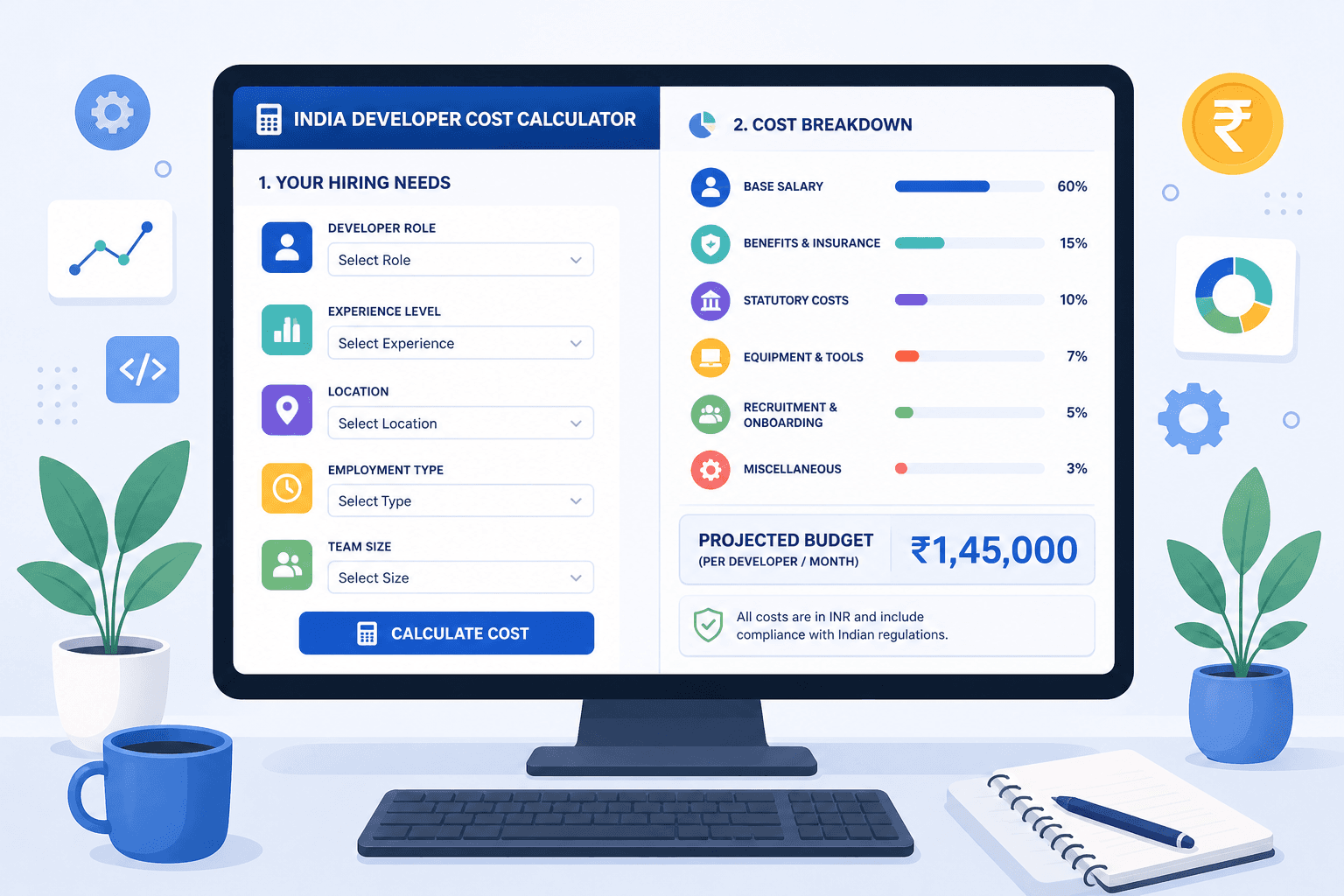
- At a glance: India developer cost vs US benchmark
- What the calculator includes
- India salary range by role
- Statutory employer costs
- US benchmark comparison
- Inputs for the tool
- Required inputs
- Optional inputs
- Why this input design works
- Calculator logic: how the cost estimate works
- Step 1: pull salary band
- Step 2: add India employer cost layers
- Step 3: add optional hiring model cost
- Step 4: build US comparison
- Step 5: show result bands, not fake precision
- What the results show
- Suggested roles to include at launch
- Core roles
- Expansion roles
- Why role coverage matters
- City adjustments to add
- Bangalore
- Hyderabad, Pune, and Chennai
- Remote India and non-metro
- How the calculator handles city logic
- Why this tool is better than a basic salary calculator
- It goes beyond salary
- It is hiring-focused, not employee-focused
- It includes a US comparison
- It supports planning, not just curiosity
- "But I already know India is cheaper"
- When this calculator won't help
- What affects developer cost in India
- Why India employer cost is higher than salary
- Why India is still cheaper than US hiring
- Use total employer cost, not headline salary
Most companies start with salary when they budget for an India hire. Salary is the wrong number.
A software engineer in India earns between ₹16.56 lakh and ₹47.43 lakh in total compensation according to Levels.fyi 2025-2026 data. That range is useful, but it doesn't tell you what the employer actually pays. On top of salary, Indian labor law requires the employer to contribute 12% to EPF (per EPFO), 3.25% toward ESI where applicable (per ESIC), plus gratuity accruals, bonus provisions, and professional tax. Those statutory layers add 15-25% to the headline salary.
Compare that to the US, where a median software engineer pulls $190,500 in total compensation according to Levels.fyi. Even after stacking every Indian statutory cost onto the India salary, the gap is massive. But you need both numbers side by side, with the statutory math visible, to make that case to your CFO. That is what this calculator does.
At a glance: India developer cost vs US benchmark
Source: Levels.fyi India/US 2025-2026 benchmarks, EPFO, ESIC, Payment of Gratuity Act 1972, KFF Employer Health Benefits Survey 2024.
And with India salary hikes projected at around 9.1% for 2026 according to the Economic Times, the cost math will shift, which is why the calculator uses current-year benchmarks and lets you toggle a hike assumption.
What the calculator includes
India salary range by role
The calculator starts with role-specific salary bands. A backend engineer commands a different range than a QA engineer, and an ML engineer sits above both. The default roles:
- Software Engineer
- Backend Engineer
- Frontend Engineer
- Full Stack Engineer
- DevOps Engineer
- QA Engineer
- Data Engineer
- ML Engineer
Each role pulls a salary range rather than a fake-precision single number. The anchor data comes from Levels.fyi India for the software engineer family, with directional adjustments for specialized roles based on AmbitionBox and Glassdoor India 2026 data. Ranges are honest. Ranges are what your finance team can actually budget around.
Statutory employer costs
Most salary calculators skip this part. Indian labor law requires employers to pay several contributions on top of salary:
- EPF: 12% of PF-eligible wages (EPFO)
- ESI: 3.25% of gross wages (ESIC), only if gross salary is at or below ₹21,000/month (most developers exceed this, so the calculator lets you toggle ESI)
- Gratuity accrual: ~4.81% of basic salary from day one (Payment of Gratuity Act 1972)
- Professional tax: varies by state, capped at ₹2,500/year
- Statutory bonus: applicable on wages up to ₹21,000/month (Payment of Bonus Act)
For a deeper walkthrough of PF, ESI, TDS, and professional tax, see the India payroll for foreign companies guide (kaam.work/india-payroll-for-foreign-companies).
US benchmark comparison
The calculator pulls a US benchmark from Levels.fyi (median total comp $190,500) and frames it as total employer cost. US employer cost includes FICA match, health insurance, 401(k) match, and other benefits that push the real number above quoted compensation. The result: India total employer cost versus US total employer cost, with savings in dollars and percentage.
Inputs for the tool
Required inputs
The calculator asks for seven things. Each one shapes the output.
- Role: choose from the core and expansion roles listed above
- Seniority: Junior, Mid, or Senior (changes the salary band pull)
- City: Bangalore, Hyderabad, Pune, Chennai, Delhi NCR, or Remote India
- Annual salary or target budget: use the default range or enter a manual override
- Benefits included: yes or no (toggles whether employer-sponsored health insurance and stipends are added)
- ESI applicable: auto-detect based on salary, or manual override
- Compare to US: yes or no (adds the US benchmark card to results)
Optional inputs
For teams that want to model the full picture:
- Annual bonus percentage
- Health insurance allowance
- Equipment or laptop stipend
- EOR fee toggle (adds a flat monthly EOR fee to the India cost if you're hiring through an Employer of Record)
- Salary hike assumption for year 2, defaulting to 9.1% per the Economic Times 2026 projection
Why this input design works
Seven required inputs, five optional toggles. Simple enough to finish, flexible enough for finance-grade estimates. The critical difference from a generic payroll calculator: this is a role-first hiring calculator. The user journey is "I want to hire a backend engineer in Pune, what will it cost me?" not "I want to calculate take-home pay for an employee earning ₹X."
Calculator logic: how the cost estimate works
Step 1: pull salary band
The calculator starts with three inputs: role, seniority, and city. It pulls a salary range from the benchmark data. If you enter a manual salary, it uses that instead but still shows the market range for comparison.
Step 2: add India employer cost layers
India total employer cost = salary + employer PF + employer ESI (if applicable) + gratuity accrual + professional tax + bonus and benefits provision.
The formula follows employer cost logic similar to India Salary Calculator and SynkPay: EPF at 12%, ESI at 3.25% where applicable, gratuity at 4.81% of basic, professional tax by state. Applied to the salary band from step 1.
Step 3: add optional hiring model cost
If the EOR toggle is on, the calculator adds the monthly EOR fee to the annual cost. Recruiter fees or onboarding costs can be added as a one-time line item if enabled.
Step 4: build US comparison
The calculator pulls the US benchmark from Levels.fyi, adjusts for employer-side costs (FICA, benefits, insurance), and shows the US total employer cost next to the India total, with savings in dollars and percentage.
Step 5: show result bands, not fake precision
The output shows three bands: low estimate (bottom of salary range, minimal benefits), mid estimate (median salary, standard benefits), and high estimate (top of range, full benefits stack). This is how finance teams actually budget.
[CALCULATOR TOOL]
Interactive calculator: select a developer role, seniority level, and city to see India total employer cost with statutory breakdowns and US cost comparison.
What the results show
The calculator returns five output cards. Card one shows the India salary range for the selected role and city. Card two breaks down statutory costs line by line:
Card three shows total India employer cost (monthly, annual, and low/mid/high band). Card four puts that number next to the US benchmark (median $190,500 total comp per Levels.fyi) and calculates the savings in dollars and percentage.
Card five is what most calculators skip: a hiring insight. "At this salary band, ESI does not apply." Or "Bangalore commands a 15-20% premium over Hyderabad for this role." Or "Even at the top of the India range, total employer cost is 62% below the US benchmark." Context that makes the output actionable.
Suggested roles to include at launch
Core roles
Software Engineer, Backend Engineer, Frontend Engineer, Full Stack Engineer, Mobile Engineer, DevOps Engineer, and QA Engineer. These seven cover the majority of India developer hiring and have the strongest public salary data from Levels.fyi.
Expansion roles
Data Engineer, ML Engineer, Data Scientist, and MLOps Engineer. Salary bands are wider because the market is less standardized. For MLOps specifically, the MLOps engineer hiring guide (kaam.work/hire-mlops-engineers-india) covers salary, skills, and sourcing.
Why role coverage matters
A QA engineer at the 50th percentile in Pune costs materially less than an ML engineer at the 75th percentile in Bangalore. The salary difference flows through every statutory calculation. One-size-fits-all calculators hide that reality.
City adjustments to add
Bangalore
The most expensive tech market in India. The premium: 15-20% above the national median for most developer roles according to SalaryExpert Bangalore role data. The calculator uses Bangalore as the anchor and adjusts other cities relative to it.
Hyderabad, Pune, and Chennai
These three cities sit 5-15% below Bangalore for equivalent roles. Hyderabad has grown fast (Microsoft, Google, Amazon all have large offices there), but salaries haven't caught up to Bangalore. Pune and Chennai follow a similar pattern.
Remote India and non-metro
Non-metro developers, especially those who relocated from Bangalore during the remote work shift, often accept 10-25% below metro rates. The calculator models this as a "Remote India" option with a lower cost band.
How the calculator handles city logic
Public role-specific salary data by city in India is uneven. Bangalore has the strongest data. The calculator uses Bangalore as the anchor and applies directional adjustment bands for other cities. If you have proprietary salary data for your hiring city, the manual salary override lets you plug that in directly.
Why this tool is better than a basic salary calculator
It goes beyond salary
Most India salary calculators tell you what an employee earns. This one tells you what an employer pays. Salary is one line item. PF, ESI, gratuity, bonus provisions, professional tax, benefits, and hiring model costs are the rest. Skip them and your budget is wrong by 15-25%.
It is hiring-focused, not employee-focused
India Salary Calculator and SynkPay do good payroll math. But their user is an employee checking take-home pay. This calculator's user is a VP of Engineering asking "what will it cost me to hire a senior backend engineer in Hyderabad through an EOR?" Different question. Different tool.
It includes a US comparison
The India cost number alone is not enough. You need to see it next to the US cost for the same role. That comparison turns a salary lookup into a business case. The US benchmark comes from Levels.fyi (median total comp $190,500), framed as total employer cost. This is the comparison your CFO will actually use.
It supports planning, not just curiosity
The output is three cost bands, a statutory breakdown, a US delta, and a hiring insight. That is enough to put into a budget model or a board deck.
"But I already know India is cheaper"
Knowing it is cheaper is not the same as knowing the number. And the number matters more than you think.
"We already looked at India salaries online." Salary is not employer cost. If you budgeted based on Glassdoor or LinkedIn salary data, you're missing 15-25% in statutory costs. PF alone adds 12% (per EPFO). Gratuity adds another ~4.81%. Your budget is off before you've started.
"We have a spreadsheet that models this." Does your spreadsheet adjust for ESI applicability at the salary threshold? Does it model city-level professional tax? Does it account for the 9.1% hike projection (per Economic Times) in year two? If not, your spreadsheet is a rough guess dressed up as a model.
"Our recruiter quoted us a number." Recruiter quotes bundle their margin into the number. You can't see which portion is salary, which is statutory, and which is margin. This calculator unbundles everything.
When this calculator won't help
If you need a senior engineer sitting in your US office three days a week, the India cost calculator is irrelevant. Same if the role requires US security clearances or export control compliance.
And if you're comparing H-1B sponsorship costs against EOR for a specific candidate, the H-1B cost calculator (kaam.work/h1b-cost-calculator) is the right tool. That one models USCIS fees, lottery risk, and processing timelines. This calculator is about modeling total employer cost for a developer role in India, with a US benchmark for context. Different questions.
What affects developer cost in India
Six factors move the number. Role and seniority set the salary band. City determines the premium or discount. ESI applicability depends on salary (the ₹21,000/month ceiling means most mid-to-senior developers fall outside ESI). Benefits choices layer on top. And hiring model matters: entity, EOR, or staffing partner each carries different cost structures. For EOR versus entity, see the comparison guide (kaam.work/eor-india-vs-subsidiary).
Why India employer cost is higher than salary
Every employer in India pays more than the CTC number they quote to the candidate. EPF adds 12% of PF-eligible wages. ESI adds 3.25% for employees below the ceiling. Gratuity accrues at approximately 4.81% of basic from day one (the five-year rule governs payout, not accrual). Professional tax is employer-deducted. And the Payment of Bonus Act requires provisions on wages up to ₹21,000/month.
That is a 15-25% gap between headline salary and true employer cost. This calculator makes that gap visible.
Why India is still cheaper than US hiring
A senior software engineer in India at the top of the Levels.fyi range earns ₹47.43 lakh (roughly $56,500). A median US software engineer earns $190,500 per Levels.fyi. Even at the top of the India range with every statutory contribution stacked on, total employer cost sits around ₹58 lakh (roughly $69,000). That is 64% below the US total employer cost.
The gap narrows for very senior roles, but for core software engineering hires, the cost difference is structural.
Use total employer cost, not headline salary
If you're evaluating India as a hiring market, the only number that matters is total employer cost. Not salary. Not CTC. The real number, with PF, ESI, gratuity, professional tax, bonus, benefits, and hiring model cost all accounted for. This calculator gives you that number in under 60 seconds.
And if you want to move from modeling to actually hiring, Kaamwork handles EOR employment in India at a flat $599/month per employee with no percentage markups and no hidden fees (kaam.work/talk-to-us). Your team, your decisions, our backend.
Disclaimer: This calculator provides estimates based on publicly available salary benchmarks (Levels.fyi), statutory rates (EPFO, ESIC, Payment of Gratuity Act 1972, Payment of Bonus Act 1965), and directional city adjustments (SalaryExpert). Actual employer costs vary based on specific salary structures, state-level regulations, benefit choices, and hiring model. Salary data reflects 2025-2026 benchmarks and may change. This tool is not a substitute for professional payroll or legal advice. For current India EOR pricing and employment terms, contact Kaamwork directly (kaam.work/talk-to-us).
Share this article

Founder & CEO | Kaam.Work
Nilesh Parwani, a Kelley School BBA graduate, worked at UBS and Warburg Pincus before founding PrintBell (acquired by Cimpress). In 2020, he launched kaam.work, a remote work platform focused on flexible talent and distributed teams.