Most in-demand tech jobs 2026 (and where to find the talent)
Tech hiring in 2026 is not spread evenly across the industry. It is concentrating. Hard. Robert Half's 2026 technology hiring analysis found that demand is clustering around five execution-heavy pillars: AI and machine learning, cybersecurity, cloud engineering, software development, and systems and network management. Those are not speculative bets on future technologies. They are the roles companies need right now to keep production systems running, ship AI products, and defend against increa

ByNilesh Parwani / April 30, 2026 / 16 min read
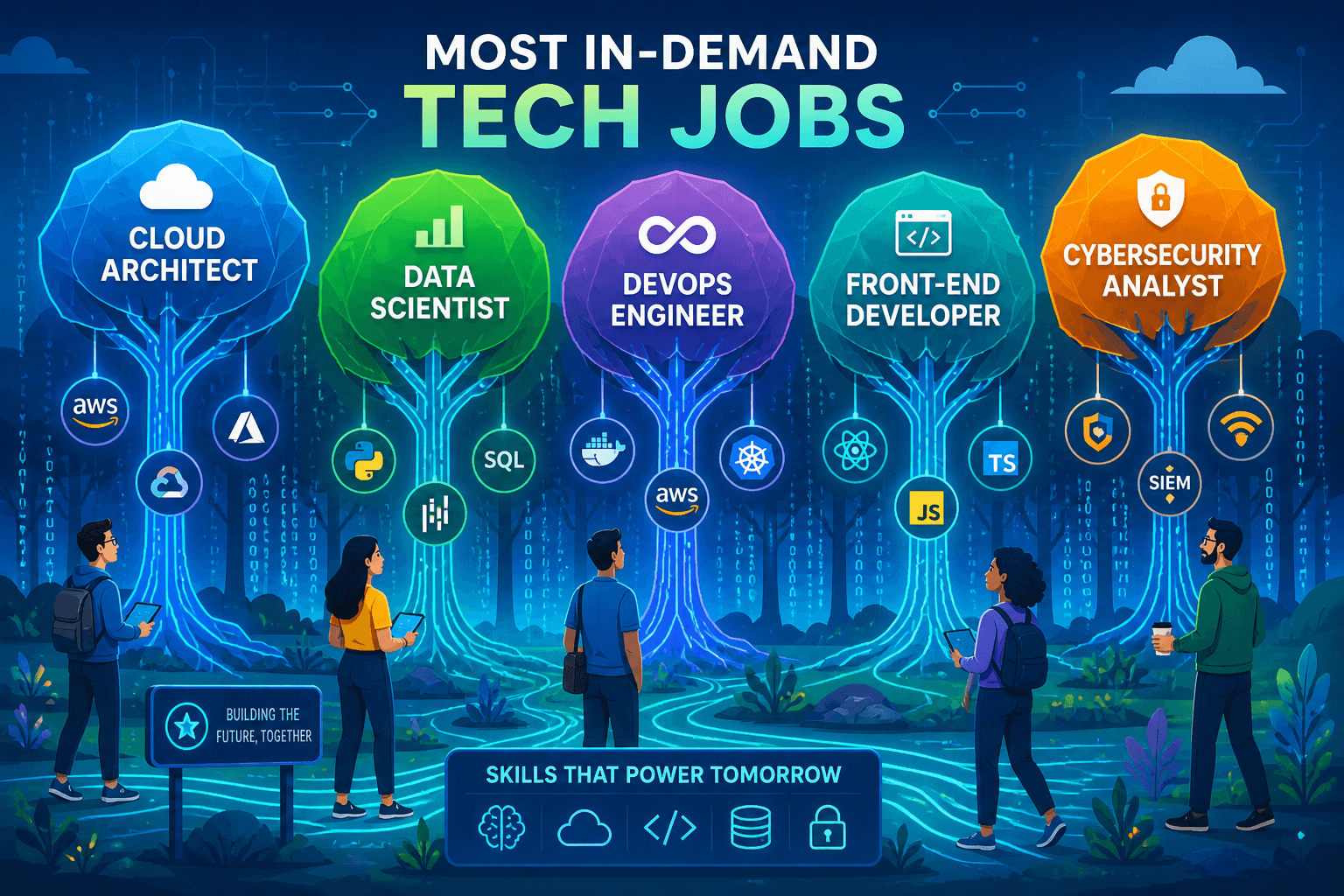
- The 2026 tech hiring picture at a glance
- The big picture: what is driving tech hiring in 2026?
- AI is expanding demand, not collapsing it
- The market is shifting toward specialized, production-ready skills
- AI-skilled roles are broader than AI-titled roles
- The 15 most in-demand tech jobs in 2026
- AI and data roles
- Cybersecurity roles
- Cloud and infrastructure roles
- Software engineering roles
- Emerging and cross-functional roles
- Systems and infrastructure roles
- Where to find the talent for these roles
- India is one of the strongest answers for scale hiring
- India is especially strong for AI, cloud, cybersecurity, and data roles
- Best India talent hubs, city by city
- AI jobs in demand: the fastest-moving segment of the market
- AI roles are now a top hiring priority
- India has supply, but also a shortage inside the supply
- What this means for employers hiring AI talent
- The most in-demand tech skills in 2026
- Skills clusters employers should prioritize
- What the skills gap data says
- What this means for hiring
- How employers should prioritize hiring in 2026
- Don't chase titles blindly
- Use India when local supply is thin or overpriced
- Match role to hiring model
- When hiring in India does not make sense
- "We have been trying to hire locally for months. Now what?"
- Build your 2026 tech team where the talent actually is
Tech hiring in 2026 is not spread evenly across the industry. It is concentrating. Hard.
Robert Half's 2026 technology hiring analysis found that demand is clustering around five execution-heavy pillars: AI and machine learning, cybersecurity, cloud engineering, software development, and systems and network management. Those are not speculative bets on future technologies. They are the roles companies need right now to keep production systems running, ship AI products, and defend against increasingly sophisticated threats.
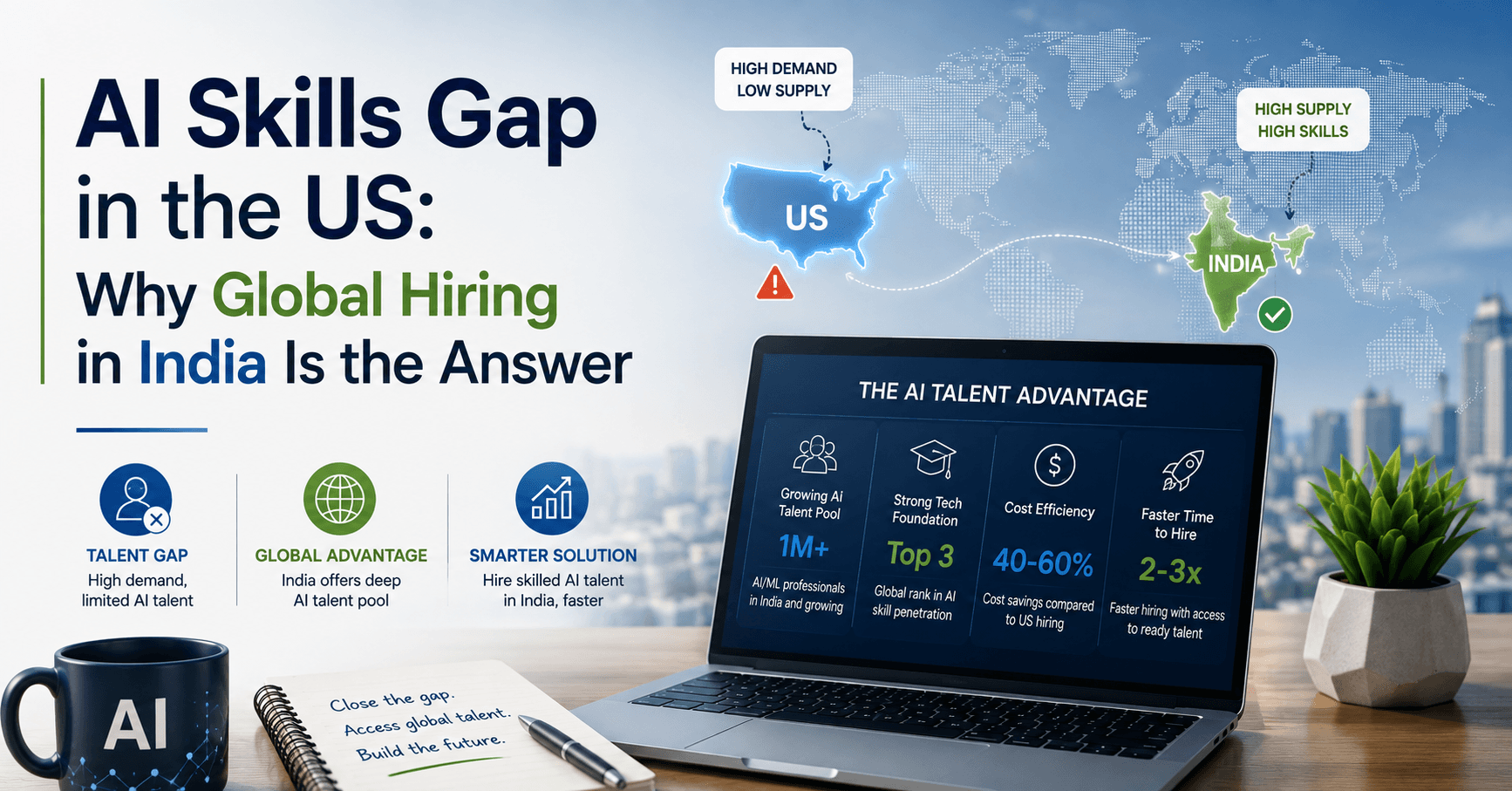
And on the supply side? India's tech workforce is projected to reach 5.8 million professionals, according to nasscom and DD News reporting. GitHub's Octoverse data projects India will become the world's largest developer community by 2030. That is not a distant future. It is already reshaping how global companies think about where to find engineers, data scientists, and security specialists.
This page covers the 15 most in-demand tech roles for 2026, what is driving each one, where the talent actually lives, and how employers should prioritize hiring when demand outpaces local supply. Because the question is no longer "which jobs are hot?" It is "where do I find someone who can actually do them?"
The 2026 tech hiring picture at a glance
Sources: Robert Half 2026, CompTIA, TechRepublic, Business Insider/TrueUp, Quess GCC Q1FY26, nasscom.
The big picture: what is driving tech hiring in 2026?
AI is expanding demand, not collapsing it
There was a persistent narrative in 2024 and early 2025 that AI would hollow out tech employment. Replace the engineers. Automate the analysts. Shrink the headcount.
The data says the opposite. Robert Half's 2026 technology hiring analysis identifies AI, ML, and data science as one of the primary drivers of new tech hiring. Business Insider and TrueUp's job market tracking shows software engineering openings surging again in 2026, not contracting. AI is creating work, not eliminating it, because deploying models into production environments requires infrastructure engineers, data pipeline builders, security teams, and product managers who can translate model output into business value. The net effect is more hiring, concentrated in different roles than five years ago.
The market is shifting toward specialized, production-ready skills
Employers are not hiring generalists who "know a little AI." They are hiring people who can deploy Kubernetes clusters, build zero-trust security architectures, or operationalize ML pipelines in production. InfotechLead's 2026 India tech hiring coverage confirms a rebound in hiring for AI, cloud, cybersecurity, and data platform roles specifically. The Quess GCC Q1FY26 report flags GenAI, cloud-native engineering, zero-trust cybersecurity, and advanced SRE as high-complexity, high-scarcity skill areas inside global capability centers.
The pattern is clear. Companies want people who can build and operate systems, not people who can talk about them.
AI-skilled roles are broader than AI-titled roles
Here is the part most "top jobs" lists miss. CompTIA's 2026 tech workforce coverage found 275,000+ active job postings referencing AI skills in January 2026. But the majority of those postings were not titled "AI engineer" or "machine learning engineer." They were software engineering roles, product management positions, analyst jobs, and operations roles that now require some level of AI literacy or integration ability. AI has stopped being a job title and started being a skill requirement embedded across the tech workforce. That distinction matters for employers who are trying to plan headcount.
The 15 most in-demand tech jobs in 2026
These roles are drawn from demand signals in Robert Half's 2026 analysis, CIO's summary of in-demand tech positions, TechRepublic's coverage of LinkedIn's fastest-growing jobs, and India-specific GCC and talent reports. They are grouped by function, not ranked, because rank depends heavily on industry and company stage.
AI and data roles
1. AI engineer
AI engineers build and integrate AI systems into products and services. TechRepublic identified AI engineers among LinkedIn's fastest-growing job titles for 2026, and the role spans everything from deploying computer vision models to building agent-based workflows. India talent availability is strong in Bangalore and Hyderabad, where GCCs and product companies have been building AI teams for years (we covered the India AI talent map in detail at kaam.work/indias-ai-talent-boom-beyond-bangalore). Hiring takeaway: screen for production deployment experience, not just model-building ability.
2. Machine learning engineer
ML engineers remain the backbone of any team shipping AI products. Robert Half's analysis places ML squarely inside the AI/data science hiring cluster that is driving 2026 demand. The role has matured past the research-heavy phase. Employers want applied engineers who have shipped recommendation systems, fraud detection, or NLP pipelines. India has one of the deeper ML talent pools globally, particularly in Bangalore, Pune, and Hyderabad. Hiring takeaway: domain-specific ML experience now matters more than academic credentials.
3. Data engineer
Every AI system runs on data infrastructure, and data engineers build that infrastructure. Pipelines, feature stores, data quality frameworks, real-time ingestion, the entire plumbing layer that ML models depend on. This role is consistently in demand but chronically undervalued in hiring plans. Companies that underinvest in data engineering end up with data scientists spending 60-70% of their time on data wrangling instead of modeling (Robert Half). Strong talent availability in Bangalore, Pune, and Chennai. Hiring takeaway: if your AI team is struggling, the missing piece is probably a data engineer, not another data scientist.
4. Data scientist
The Bureau of Labor Statistics projects data scientist employment growing 34% from 2024 to 2034, and CIO reports the role growing 414% above the national job growth average per CompTIA analysis. Domain-specific data scientists, those who combine statistical skill with industry knowledge in fintech, healthcare, or supply chain, command premiums. India produces a large number of data science graduates annually, but the best ones get absorbed quickly by domestic companies like Flipkart, Zomato, and Razorpay. Hiring takeaway: move fast, because domestic competition for senior data scientists in India is real.
Cybersecurity roles
5. Cybersecurity analyst / security engineer
Robert Half and CIO both identify cybersecurity as a top hiring priority for 2026. The drivers are straightforward: regulatory mandates (SEC disclosure rules, DORA in the EU), the shift to zero-trust architectures, and the simple fact that attack surfaces keep expanding. India has a growing cybersecurity talent pool across Bangalore, NCR/Gurugram, and Hyderabad, but the Quess Q1FY26 report flags zero-trust cybersecurity as a scarce, high-complexity skill even inside India's GCC ecosystem. Hiring takeaway: cybersecurity is one of the hardest roles to fill globally, and starting the search in India gives you access to a wider pool, but expect competition for senior candidates.
Cloud and infrastructure roles
6. Cloud engineer
Cloud migration and modernization remain among the largest technology spending categories globally. Robert Half places cloud squarely in the 2026 demand cluster. Cloud engineers who can design, build, and optimize environments across AWS, Azure, or GCP are in heavy demand. India is especially strong here. Hyderabad and Bangalore are the dominant hubs, driven by GCC operations from Microsoft, Google, Amazon, and dozens of enterprise tech companies running cloud-first workloads. Hiring takeaway: India's cloud talent depth is one of its strongest advantages for international hiring.
7. DevOps engineer
DevOps sits at the intersection of software delivery speed and infrastructure reliability. The role has evolved from "CI/CD pipeline builder" to a broader engineering discipline covering infrastructure as code, container orchestration, monitoring, and incident response. Strong demand in 2026 across every industry that ships software. India's DevOps talent pool is deep in Bangalore, Pune, and Hyderabad. Hiring takeaway: DevOps engineers are plentiful in India relative to US and European markets, which makes it one of the easier roles to fill through international hiring.
8. Site reliability engineer (SRE)
SRE roles are growing as companies realize that building software is only half the problem. Keeping it running reliably at scale is the other half. The Quess GCC Q1FY26 report specifically identifies advanced SRE as a high-scarcity skill area. India has SRE talent, but the senior end of the market is competitive because GCCs from Google, Meta, and Microsoft actively recruit experienced SREs in Bangalore and Hyderabad. Hiring takeaway: SRE is one of those roles where seniority matters enormously. Junior SREs are available. Seniors with production incident experience at scale are harder to find.
Software engineering roles
9. Full-stack developer
Full-stack remains one of the highest-volume tech hiring categories. These are the engineers who ship product features end to end, from React or Next.js frontends to Node.js or Python backends. Business Insider and TrueUp data show software openings surging in 2026, and full-stack roles make up a large share of that volume. India produces more full-stack developers than almost any other market. Every major city has deep supply. Hiring takeaway: this is one of the most cost-effective roles to fill in India, with strong talent available from Bangalore to Jaipur to Kochi.
10. Backend engineer
Backend engineers build the APIs, databases, service architectures, and platform internals that products depend on. The role overlaps with cloud and DevOps but is squarely focused on application logic and data management. Demand is strong and consistent. India's backend engineering talent is particularly deep in Bangalore, Pune, and Chennai, where enterprise and product companies have built large engineering organizations over the past decade. Hiring takeaway: backend is a stable, high-volume hiring category where India consistently delivers.
Emerging and cross-functional roles
11. AI product manager
AI PMs are the people who decide what to build, how to prioritize model investments, and when an AI feature is actually ready for production. The role barely existed as a formal hiring category two years ago. Now it is growing as companies realize that engineers building AI systems need product leadership that understands model tradeoffs, evaluation metrics, and responsible AI governance. This is a harder role to fill in India than pure engineering positions because it requires a blend of product sense, technical depth, and business judgment. Bangalore and NCR/Gurugram have the strongest candidate pools. Hiring takeaway: look for candidates who have shipped AI-powered product features, not just candidates who have managed engineering teams.
12. MLOps engineer
MLOps bridges the gap between building a model in a notebook and running it in production. The role covers model deployment, monitoring, retraining pipelines, infrastructure management, and lifecycle governance. It is chronically undersupplied globally. If your AI models are stuck in development and never make it to production, this is the hire that unblocks the pipeline (we wrote a full MLOps hiring guide at kaam.work/hire-mlops-engineers-india). India has MLOps talent in Bangalore and Hyderabad, but demand from domestic companies and GCCs keeps the senior end of the market tight. Hiring takeaway: MLOps is worth paying a premium for because the ROI on getting models into production is enormous.
13. Solutions architect
Solutions architects sit between engineering, sales, and customer success, designing technical implementations that map product capabilities to client requirements. The role is in steady demand across cloud, cybersecurity, and enterprise SaaS companies. India has strong solutions architecture talent, especially in Hyderabad and NCR/Gurugram, where consulting-heavy firms (Deloitte, Accenture, Infosys) have trained thousands of professionals in this discipline. Hiring takeaway: India is an underrated source for solutions architects because the consulting ecosystem produces candidates with both technical depth and client-facing experience.
Systems and infrastructure roles
14. Systems / network administrator
CIO's summary of Robert Half's 2026 analysis clusters systems and network administration among the top in-demand role families. These are the professionals who keep servers, networks, and internal infrastructure running. They are not as headline-grabbing as AI roles, but every company with on-premises infrastructure or hybrid environments depends on them. India talent is available across Chennai, NCR, and Pune. Hiring takeaway: systems administration is a reliable, cost-effective hire in India with lower competition than AI or cloud roles.
15. Data center technician / infrastructure specialist
TechRepublic's March 2026 coverage identified data center technicians among LinkedIn's fastest-growing job titles. As cloud providers, enterprises, and AI companies expand physical infrastructure, the people who install, maintain, and troubleshoot servers, storage, and networking equipment are in growing demand. This is primarily an on-site role, which limits the remote hiring opportunity compared to software positions. But for companies building data center operations in India (an increasingly common investment), talent is available in Chennai, Mumbai, and Hyderabad. Hiring takeaway: this role is location-dependent, but India's growing data center buildout means local supply is expanding.
Where to find the talent for these roles
India is one of the strongest answers for scale hiring
Most "top jobs" articles name the roles and stop. They do not answer the question that actually matters to a hiring manager: where do I find these people?
India's technology workforce is expected to reach 5.8 million professionals, according to nasscom and DD News. GitHub's Octoverse reporting projects India will become the world's largest developer community by 2030. These are not vague projections. India already has one of the deepest engineering talent pools on the planet, and it is growing faster than most other markets.
India is especially strong for AI, cloud, cybersecurity, and data roles
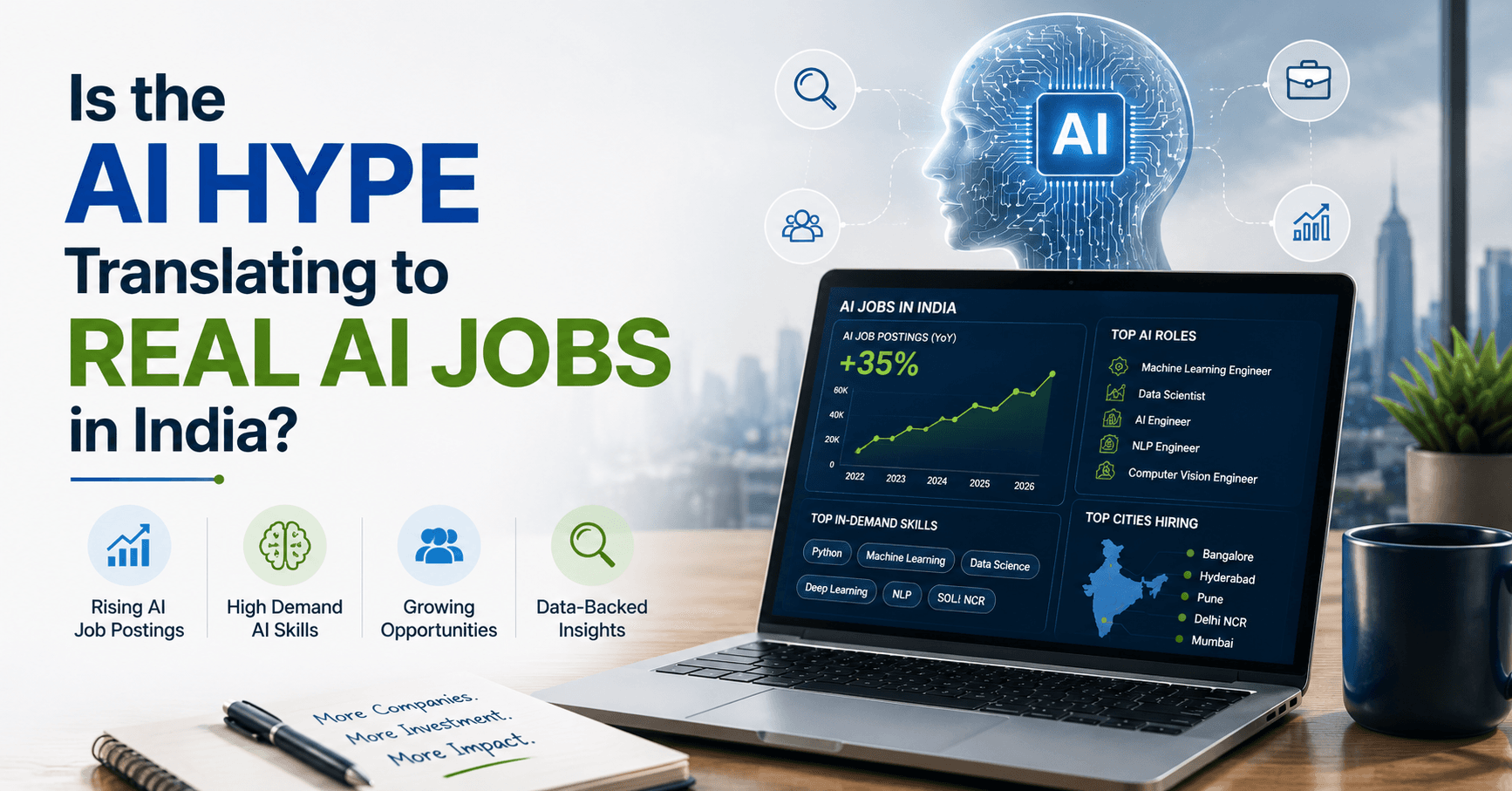
Deloitte and nasscom project AI talent demand in India to grow from roughly 600,000-650,000 positions to more than 1.25 million by 2027. That growth rate reflects both domestic demand (from companies like Flipkart, PhonePe, Swiggy, and Meesho) and international demand from GCCs and direct-hire arrangements. ET GCC reporting and the Quess Q1FY26 report identify AI, cloud, cybersecurity, SRE, and advanced engineering roles as the highest-priority skill clusters for global capability center hiring.
The depth is real. But so is the competition for the best candidates. India is not a market where you post a job and wait. The top 10-15% of candidates in AI and cloud get multiple offers within weeks of becoming available. Speed matters.
Best India talent hubs, city by city
Bangalore has the broadest and deepest tech talent pool in India. Every role on this list has strong candidate availability here. Home to hundreds of GCCs (Google, Microsoft, Amazon, Goldman Sachs, JP Morgan) and a massive startup ecosystem that trains engineers in production-grade work. If you can only hire in one India city, Bangalore is the default.
Hyderabad is the strongest GCC and enterprise growth story in India right now. Microsoft, Google, Amazon, Apple, Deloitte, and Wells Fargo all run large operations here. Particularly strong for cloud, cybersecurity, and data engineering roles. Office and talent costs run 15-25% lower than Bangalore, which makes it attractive for scale teams.
Pune is a strong applied engineering hub. Deep talent in backend engineering, DevOps, and data platforms. Companies like ThoughtWorks, Persistent, and several GCCs have been hiring here for years. Good fit for teams that need solid mid-level engineering execution without Bangalore-level cost.
Chennai has strong enterprise, data, and platform engineering talent. Large presence from Infosys, TCS, Zoho, and a growing GCC ecosystem. Particularly good for systems administration, backend, and data roles. Cost of living and salaries tend to be lower than Bangalore and Hyderabad.
NCR/Gurugram offers a product, enterprise, and consulting-heavy talent mix. Home to major operations from Deloitte, EY, McKinsey, and HCLTech. Strong for solutions architecture, AI product management, and cybersecurity. The candidate pool skews toward professionals with client-facing experience and consulting backgrounds.
Kaamwork helps companies hire across all five of these hubs through a single EOR model: no entity setup, no registration delays, fully compliant onboarding in as little as 48 hours (kaam.work/solutions/eor-india).
AI jobs in demand: the fastest-moving segment of the market
AI roles are now a top hiring priority
Robert Half and TechRepublic both place AI-linked roles among the fastest-rising and most in-demand tech positions for 2026. AI engineers, ML engineers, data scientists, and MLOps engineers are not niche hires anymore. They are core team members for any company shipping AI-powered products or integrating AI into existing workflows. We covered the AI segment of this trend in depth in our CTO briefing on AI hiring (kaam.work/ai-hiring-trends-2026).
India has supply, but also a shortage inside the supply
Here is where the conversation gets more nuanced than most trend reports allow. Deloitte and nasscom project India's AI talent demand to exceed 1.25 million positions by 2027. That sounds like a massive talent pool. And it is, at the aggregate level.
But ET GCC reporting on the AI skills gap in India paints a harder picture. In some specialized segments, particularly production-grade GenAI, advanced computer vision, and LLM infrastructure engineering, only one qualified engineer may be available for every ten open positions. The scarcity is not in raw headcount. It is in specialization depth.
What this means for employers hiring AI talent
AI talent is available in India. The volume is there. But if you need someone who has fine-tuned a large language model in production, built an agent-based workflow that handles real customer interactions, or architected an ML platform serving millions of inferences per day, you are competing with every GCC and funded startup in Bangalore for the same small pool of candidates.
The takeaway: start the search early, move fast on offers, and do not assume that "India has lots of AI talent" means your specific role will be easy to fill. General AI skills are available. Deep production specialization is scarce. Know which one you actually need.
The most in-demand tech skills in 2026
Skills clusters employers should prioritize
The roles above map to a specific set of skill clusters that keep appearing across every major 2026 workforce report.
- AI and machine learning: TensorFlow, PyTorch, model fine-tuning, RAG architectures, LLM deployment, evaluation frameworks
- Data engineering: Spark, Kafka, Airflow, dbt, data lake architecture, real-time pipelines
- Cloud architecture: AWS, Azure, GCP, infrastructure as code (Terraform, Pulumi), container orchestration (Kubernetes)
- Cybersecurity and zero-trust: SIEM, endpoint detection, identity management, zero-trust network architecture, compliance automation
- DevOps and SRE: CI/CD, observability (Datadog, Grafana), incident management, chaos engineering
- Platform engineering: Internal developer platforms, service mesh, API gateway design
- AI product and governance: Model evaluation, AI safety, responsible AI frameworks, experiment design
What the skills gap data says
NIIT's India Skills Gap Report 2026 identifies AI, cybersecurity, digital transformation, and data skills as the most critical capability gaps facing Indian employers. Quess's Q1FY26 report specifically flags cloud-native engineering, GenAI, zero-trust cybersecurity, and advanced SRE as scarce, high-complexity skill areas inside GCCs.
What this means for hiring
Hire for capabilities, not job titles. A "DevOps engineer" who knows Terraform, Kubernetes, and can build observability pipelines is a completely different hire from a "DevOps engineer" who only writes Jenkins scripts. A "data scientist" who can build production ML pipelines is different from one who only works in Jupyter notebooks. The title tells you what category someone falls into. The skills tell you whether they can actually do the work.
How employers should prioritize hiring in 2026
Don't chase titles blindly
Robert Half and CIO both confirm that the highest-demand role clusters in 2026 are AI and data, cybersecurity, cloud and platform, and execution-heavy software roles. But "highest demand" does not mean "what your company needs most." A 50-person SaaS company does not need an AI engineer before it has a working data pipeline. A fintech scaling its compliance infrastructure might need cybersecurity hires before anything else.
Prioritize based on your actual bottleneck, not on what is trending.
Use India when local supply is thin or overpriced
Here is the honest framing. Some roles are easier to fill locally. A VP of Engineering who needs to sit with the executive team three days a week in San Francisco is not a role you hire for in India. A principal solutions architect who runs client workshops in person is better sourced domestically.
But for the majority of the 15 roles on this page, roles that are execution-heavy, individually contributory, and deliverable through remote or distributed workflows, India offers a deeper bench at a structurally lower cost. A senior ML engineer in the Bay Area costs $250,000+ in total compensation. The same profile in Bangalore costs $45,000-$75,000 through an EOR arrangement. That is not about "cheap labor." That is about accessing a talent pool that is structurally deeper than what most US and European employers realize (kaam.work/global-cost-calculator).
Match role to hiring model
Not every role needs the same hiring approach.
The model depends on scale, timeline, and how strategic the role is. For most companies hiring between 1 and 30 engineers, EOR is the fastest and most flexible path (kaam.work/core-services/onboard-and-manage). No entity setup. No six-month registration process. Start interviewing this week, onboard within two weeks.
When hiring in India does not make sense
Timezone overlap gives you about 4 hours of real-time collaboration per day with US Pacific time (more with East Coast). For roles that require constant synchronous communication, that overlap can be a constraint. Most engineering, data, and platform roles handle this fine with morning standup calls and async workflows. But if the role requires being in live meetings from 9 AM to 5 PM Eastern, an India-based hire will burn out or become unavailable for half those hours.
Also, truly senior leadership roles, the people who need to influence culture, run cross-functional strategy sessions, and be present for board meetings, generally need to be co-located with the rest of the leadership team. That is not an India limitation. It is a distributed-work limitation.
"We have been trying to hire locally for months. Now what?"
"We posted the role three months ago and can't find anyone."
That is the most common thing we hear from engineering leaders looking for AI, data, or cybersecurity talent. And it makes sense. If your local market has 2-3 qualified candidates for every 10 open roles, no amount of recruiter outreach fixes the math. Widening the search to India's 5.8 million tech professionals changes the equation entirely.
"We can't afford Bay Area salaries for every role."
You do not need to. A senior data engineer in the US costs $180,000-$220,000 in total compensation. In India, the same experience level costs $35,000-$55,000 through an EOR. The work output is comparable because the talent pool includes engineers trained at the same GCCs (Google, Microsoft, Amazon) that employ their US counterparts.
"We don't have an entity in India and don't want to set one up."
You do not need one. An Employer of Record handles the legal employment, payroll, compliance, benefits, and tax filings. Kaamwork does this for a flat $599/month per employee, no setup fees, no percentage-of-salary markups (kaam.work/talk-to-us). Your team member works for you. Kaamwork handles the backend.
Build your 2026 tech team where the talent actually is
The most in-demand tech jobs in 2026 are clear: AI engineering, data science, cybersecurity, cloud, DevOps, SRE, and software engineering. The supply constraints are equally clear: local markets in the US and Europe are overheated for most of these roles, and the candidates who are available command premium compensation.
India is not a workaround. It is where the talent is. A projected 5.8 million tech professionals, AI demand scaling toward 1.25 million positions by 2027, and the world's fastest-growing developer community (according to GitHub's Octoverse data) make it the most credible answer to the question every hiring manager is asking.
The cost calculator at kaam.work/global-cost-calculator shows what any of these roles costs by market and seniority level. And if you are ready to stop posting into an empty local market and start building your team where the bench is deepest, that conversation starts at kaam.work/talk-to-us.
Disclaimer: Market data referenced in this article is based on published 2025-2026 analysis from Robert Half, CompTIA, CIO, TechRepublic, Business Insider/TrueUp, nasscom, DD News, Deloitte, GitHub Octoverse, BLS, NIIT, Quess, and ET GCC. Growth projections are estimates and may vary by methodology and time period. Kaamwork pricing is current as of April 2026.
Share this article

Founder & CEO | Kaam.Work
Nilesh Parwani, a Kelley School BBA graduate, worked at UBS and Warburg Pincus before founding PrintBell (acquired by Cimpress). In 2020, he launched kaam.work, a remote work platform focused on flexible talent and distributed teams.