True cost of hiring a developer in India (beyond salary)
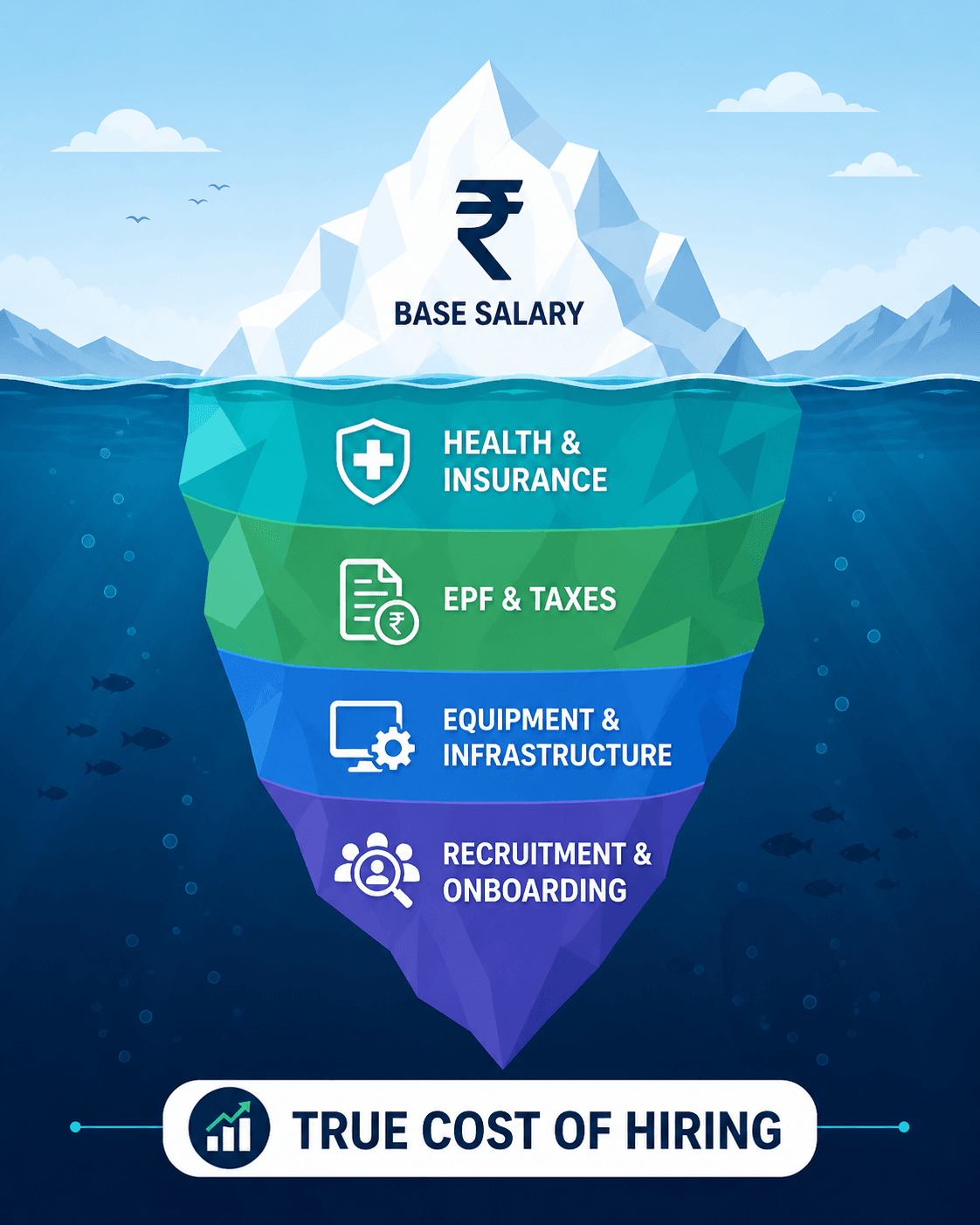
Most foreign employers look at a developer salary number in India, compare it against a US salary number, and stop there. "We're saving 65%. Done." That math is wrong. Not because the salary gap is fake, but because salary is not the same thing as employer cost. Not in India, and not in the US either. In India, the employer pays statutory contributions on top of cash salary: 12% Provident Fund contribution (EPFO), 3.25% ESI where applicable (ESIC), gratuity accrual at roughly 4.81% of basic sa

ByNilesh Parwani / April 29, 2026 / 15 min read
- India developer cost at a glance
- Salary is only one layer of developer cost
- In India, employer cost includes more than cash salary
- In the US, employer cost also includes taxes and benefits
- Why this matters
- What makes up the true cost of hiring a developer in India?
- Base salary
- EPF (Provident Fund)
- ESI (Employees' State Insurance)
- Gratuity
- Professional tax
- Bonus
- EPF explained: the 12% employer cost layer
- What EPF is
- Why it matters for developer hiring cost
- What to watch
- ESI explained: the 3.25% cost that does not apply to everyone
- Official employer rate
- Why it is salary-sensitive
- Why this matters in cost modeling
- Gratuity, bonus, and professional tax: the smaller costs that add up
- Gratuity
- Bonus
- Professional tax
- Why foreign employers miss these
- How to calculate total CTC for a developer in India
- The formula
- Important note
- CTC vs total employer cost
- Real cost examples: junior, mid-level, and senior developer in India
- Junior developer (React/Node.js, 1-2 years experience)
- Mid-level developer (Python/cloud, 4-6 years experience)
- Senior developer (full-stack/architect, 8+ years experience)
- India vs US: total cost comparison for hiring a developer
- What makes up US employer cost
- Why US total cost can run much higher than salary
- How to compare fairly
- Common mistakes employers make when estimating India developer cost
- Use total employer cost in every hiring comparison
- India is still cost-advantaged, and the real win is informed planning
- Junior vs senior economics differ
- State, benefits, and payroll model matter
- Use total employer cost in all hiring comparisons
- When salary-only comparisons still work
- What "cheapest salary" really means for your hiring budget
Most foreign employers look at a developer salary number in India, compare it against a US salary number, and stop there. "We're saving 65%. Done."
That math is wrong. Not because the salary gap is fake, but because salary is not the same thing as employer cost. Not in India, and not in the US either.
In India, the employer pays statutory contributions on top of cash salary: 12% Provident Fund contribution (EPFO), 3.25% ESI where applicable (ESIC), gratuity accrual at roughly 4.81% of basic salary (Payment of Gratuity Act), professional tax that varies by state, and statutory bonus for certain employee bands. None of these show up in the salary number your recruiter quotes you. All of them show up in your actual spend.
In the US, the same principle applies. According to the Bureau of Labor Statistics Employer Costs for Employee Compensation (BLS ECEC), total employer compensation includes wages and salaries plus benefits: health insurance, retirement contributions, Social Security and Medicare taxes, workers' comp, and paid leave. The gap between "salary" and "total employer cost" in the US typically runs 30% to 40% above base pay.
India is still cheaper. By a lot. But if you're comparing an India salary against a US total employer cost, you're comparing the wrong numbers and overstating your actual savings. This guide breaks down every component of the true cost of hiring a developer in India, gives you the formula, walks through three real cost examples, and then puts India and US numbers side by side so you can budget with precision.
India developer cost at a glance
Sources: EPFO contribution schedule, ESIC official contribution rates, Payment of Gratuity Act 1972, Karnataka Professional Tax portal (February 2026 schedule), Payment of Bonus Act 1965.
Salary is only one layer of developer cost
In India, employer cost includes more than cash salary
When an Indian recruiter tells you a developer costs "₹12 lakh per annum," they usually mean gross salary. The number the employee sees on their offer letter. But the employer's actual outflow is higher than that because statutory contributions sit on top.
Employer PF adds 12% of PF wages (EPFO). ESI adds 3.25% for employees under the wage ceiling (ESIC). Gratuity accrues at approximately 4.81% of basic salary even though the payout happens later (Payment of Gratuity Act). Professional tax, bonus provisions, and medical insurance add more on top. The total employer cost for an India-based developer typically runs 15% to 25% above gross salary depending on salary level and structure.
That gap matters when you're building an annual hiring budget across 10, 20, or 50 people.
In the US, employer cost also includes taxes and benefits
The US is no different in principle. According to the BLS ECEC, total employer compensation includes wages plus benefits. For private-sector workers, benefits account for roughly 29% to 32% of total compensation. That includes employer-side Social Security and Medicare taxes (7.65% combined), health insurance premiums, 401(k) contributions, workers' compensation, paid leave accrual, and other mandatory or customary costs.
A US developer with a $120,000 base salary can easily cost the employer $155,000 to $170,000 in total annual spend once you add payroll taxes, health insurance, 401(k) match, and paid time off.
Why this matters
India is still materially cheaper in most developer hiring scenarios. That is not the debate. The point is that smart employers compare total cost against total cost. Comparing India gross salary against US total compensation overstates the India savings and creates budget surprises when statutory costs come through. Comparing total against total gives your CFO a number they can actually plan around.
What makes up the true cost of hiring a developer in India?
Six cost components sit between "salary" and "total employer cost." Here is each one with the numbers that matter for budgeting.
Base salary
The starting point. What shows up in the offer letter. For developers, this ranges from roughly ₹4 lakh/year (entry-level, smaller cities) to ₹40+ lakh (senior engineers at well-funded startups and GCCs). But base salary is where cost modeling begins. Not where it ends.
EPF (Provident Fund)
The employer contributes 12% of PF wages to EPFO, on top of the employee's own 12% deduction. For a developer with PF wages of ₹50,000/month, the employer pays ₹6,000/month in PF contribution alone. That is ₹72,000/year that never appears in the salary number. After the 2025 wage code changes, PF wages must be at least 50% of total remuneration, so companies can no longer suppress the PF base with creative salary structuring.
ESI (Employees' State Insurance)
The employer pays 3.25% under the ESIC scheme, but only for employees earning gross salary of ₹21,000/month or less (ESIC). Most mid-level and senior developers exceed this ceiling, so ESI drops out at higher salary bands. For junior hires, it is a real line item.
Gratuity
A long-term employer liability under the Payment of Gratuity Act 1972. The standard accrual rate is approximately 4.81% of basic salary annually. On a basic of ₹50,000/month, that is about ₹2,405/month in employer accrual. Skip the provisioning and you end up with surprise liabilities that compound over time.
Professional tax
State-specific, not national. Karnataka charges ₹200/month for most brackets, with a special ₹300 deduction in February (Karnataka PT portal, February 2026 schedule). Maximum in any state is ₹2,500/year. The employer handles registration and remittance even though the cost is deducted from the employee's salary.
Bonus
The Payment of Bonus Act 1965 mandates 8.33% minimum for employees earning up to ₹21,000/month in basic wages. Most developers exceed this, so statutory bonus often does not apply. But performance bonuses in the CTC package are standard and should appear in your cost model regardless.
EPF explained: the 12% employer cost layer
What EPF is
The Employees' Provident Fund is India's mandatory retirement savings framework, managed by the EPFO. Both employer and employee contribute 12% of PF wages every month. The employer's 12% splits into two parts: 3.67% to the employee's EPF account and 8.33% to the Employees' Pension Scheme (EPS), capped at a pension salary of ₹15,000/month. The employer also pays roughly 0.50% in EDLI and admin charges (EPFO).
Why it matters for developer hiring cost
EPF is the single largest hidden cost beyond salary for most foreign employers.
A developer with PF wages of ₹60,000/month costs the employer ₹7,200/month in PF contribution plus ₹300/month in admin charges. Annual EPF-related employer outflow: ₹90,000. Across a team of 15 developers, that is ₹13.5 lakh per year that salary benchmarking alone would have missed.
What to watch
After the 2025 labour code implementation, basic pay must constitute at least 50% of total remuneration for PF purposes. Companies that previously structured salaries with low basic and high allowances to minimize PF now face a higher contribution base. Ask your payroll partner exactly how PF wages are calculated. The structuring directly affects this cost line (kaam.work/india-payroll-for-foreign-companies).
ESI explained: the 3.25% cost that does not apply to everyone
Official employer rate
The employer contributes 3.25% of gross wages toward ESI. The employee contributes 0.75%. These rates come from the ESIC official contribution page. Combined, ESI adds 4% of gross wages to the payroll equation, though only the employer's 3.25% is net-new employer cost.
Why it is salary-sensitive
ESI applies only to employees earning gross salary of ₹21,000/month or less (ESIC). Once gross salary crosses this threshold, ESI contributions stop entirely. For developer hiring, this means ESI is relevant only at the very junior end. A developer earning ₹18,000/month triggers ESI at ₹585/month in employer cost. A mid-level developer earning ₹60,000/month is well above the ceiling. No ESI.
As of April 2026, the ₹21,000 threshold remains the operative limit per ESIC, though there has been policy discussion about future increases.
Why this matters in cost modeling
A junior frontend developer earning ₹20,000/month triggers ESI. The same role at ₹25,000/month does not. This step function in employer cost is invisible in salary-only budgeting. If you're hiring across salary bands, your cost model needs role-level granularity on ESI applicability.
Gratuity, bonus, and professional tax: the smaller costs that add up
Gratuity
Gratuity feels theoretical until year five, which is why so many foreign employers ignore it. That is a budgeting mistake. Under the Payment of Gratuity Act 1972, every employee completing five continuous years of service is entitled to a gratuity payout. The formula: last drawn salary x 15 / 26 x years of service.
For employer cost modeling, gratuity accrues at 4.81% of basic salary per year. On basic of ₹40,000/month, that is ₹1,924/month or ₹23,088/year in accrued liability. You may not pay it out today, but your books should reflect it.
Bonus
Statutory bonus applies to employees earning up to ₹21,000/month in basic wages (Payment of Bonus Act 1965), with a minimum of 8.33% and maximum of 20%. Most mid-level and senior developers exceed this threshold, so statutory bonus drops out. But almost every Indian employer includes performance bonuses in CTC, typically one to two months of base salary per year. Either way, bonus belongs in the cost model.
Professional tax
Karnataka charges ₹200/month for most salaried employees, with a ₹300 deduction in February (Karnataka PT portal, February 2026 schedule). Annual total: ₹2,500. Maharashtra, Tamil Nadu, and Gujarat each have their own schedules.
The amounts are small. But for foreign employers running teams across multiple states, each state has its own registration, filing calendar, and portal. The compliance complexity is the real cost.
Why foreign employers miss these
They compare salary against EOR fee and call it done. But statutory contributions are part of the employee's CTC, paid from the employer's budget, regardless of hiring model. Ignoring them means your budget is off by 15% to 25% from day one.
How to calculate total CTC for a developer in India
The formula
Here is the working formula for modeling total employer cost for a developer in India:
Total employer cost = base salary + employer PF (12% of PF wages) + employer ESI (3.25% of gross, if applicable) + gratuity accrual (~4.81% of basic) + professional tax (state-specific) + bonus/variable pay + benefits (medical insurance, other perks) + admin charges (PF EDLI/admin ~0.50%)
For a developer with annual gross salary of ₹12,00,000:
- Base/gross salary: ₹12,00,000
- Employer PF at 12% (assuming PF wages = 50% of gross): ₹72,000
- Employer ESI: ₹0 (gross exceeds ₹21,000/month ceiling)
- Gratuity accrual at 4.81% of basic: ₹28,860
- Professional tax impact: handled via employee deduction, ₹0 net employer cost
- PF admin/EDLI at 0.50%: ₹3,000
- Medical insurance: ₹12,000 to ₹25,000 (varies by plan)
Estimated total employer cost: ₹13,15,860 to ₹13,28,860, or roughly 10% to 11% above gross salary.
Important note
Exact totals vary by wage structure, state, employee eligibility, and benefits policy. The formula above uses standard assumptions. Companies with higher basic pay ratios will see higher PF costs. Companies hiring in ESI-covered salary bands will see ESI costs layer in. Companies offering richer benefits packages (dental, ESOPs, relocation allowances) will push the total higher.
There is no single universal India developer cost formula. But the structure above gives you a working model that covers the statutory components and gets you within a few percentage points of actual spend. Kaamwork's cost calculator (kaam.work/global-cost-calculator) can model this for your specific scenario.
CTC vs total employer cost
Quick distinction worth knowing: CTC (cost-to-company) typically includes gross salary plus employer statutory contributions plus benefits. Total employer cost may also include EOR fees, recruitment costs, and laptop procurement. When your finance team asks "what does this developer actually cost us," they want total employer cost. When your India HR team quotes CTC, they mean something slightly narrower.
Real cost examples: junior, mid-level, and senior developer in India
Three worked examples using standard salary structures and statutory rates as of April 2026. All figures assume Karnataka as the state of employment (for professional tax reference). Salary structures follow the 50% basic salary rule per the 2025 labour code.
Junior developer (React/Node.js, 1-2 years experience)
At ₹35,000/month gross, this developer sits above the ₹21,000 ESI ceiling, so ESI does not apply. That is actually the case for most developer hires, even at the junior end.
Even at the junior level, the employer spends roughly 11% more than gross salary. That is ₹46,000+ in additional annual cost per person.
Mid-level developer (Python/cloud, 4-6 years experience)
Once you add performance bonus and a slightly better insurance plan, the mid-level developer costs 18.6% more than gross salary. On a team of 10 mid-level developers, that is ₹17.8 lakh in annual cost that salary benchmarking alone would have missed.
Senior developer (full-stack/architect, 8+ years experience)
The senior developer's total employer cost exceeds gross salary by 22.5%. The bigger the salary, the bigger the absolute gap because PF, gratuity, and bonus all scale with base pay. That ₹4 lakh gap is real money your budget needs to account for.
And none of these examples include recruitment fees, laptop procurement, or EOR service charges, all of which are additional operational costs above CTC.
India vs US: total cost comparison for hiring a developer
What makes up US employer cost
In the US, employer cost is not just salary. According to the BLS ECEC, employer compensation breaks down into wages and salaries (the cash part) plus benefits. For private-sector workers, benefits include:
- Employer Social Security and Medicare taxes: 7.65% of wages (6.2% Social Security up to the wage base, 1.45% Medicare)
- Health insurance: employer premium contribution averaging $7,000 to $15,000+ per year depending on plan and family status
- 401(k) or retirement plan match: typically 3% to 6% of salary
- Paid leave: vacation, sick days, holidays, the cost of which is already in salary but represents productivity cost
- Workers' compensation insurance: varies by state and industry
- State unemployment insurance (SUTA): varies by state
- Federal unemployment (FUTA): $42/year per employee (small but mandatory)
All in, a US employer's total cost for a developer runs roughly 1.3x to 1.4x the base salary, and that does not include recruiting fees or equity grants.
Why US total cost can run much higher than salary
Take a mid-level US developer with a base salary of $130,000.
The employer pays $26,645 to $33,145 above salary, roughly 20% to 25% above base pay. And if the company offers equity (RSUs or options), that number climbs substantially higher.
How to compare fairly
The right comparison framework:
Even after adding every statutory cost, benefit, and bonus to the India number, the total employer cost for a mid-level developer in India is roughly 8% to 9% of the US total employer cost for a comparable role. That savings number is real and defensible, but only when you compare total against total.
Comparing India gross salary against US total comp would give you a number closer to 6%. Comparing India total cost against US salary would give you 10%. Neither is correct. The table above is correct.
The precision matters. A VP of Engineering telling the board "we save 90%" based on salary comparisons is overstating. Saying "we save 91% on total employer cost" based on the math above is a number your CFO can verify and plan around.
Common mistakes employers make when estimating India developer cost
"We budgeted ₹10 lakh per developer." And the actual cost turned out to be ₹11.5 to ₹12.5 lakh after PF, gratuity, and insurance. On a 20-person team, that is ₹30 to ₹50 lakh in unbudgeted annual spend.
"ESI applies to everyone, right?" It does not. ESI kicks in only below the ₹21,000/month gross ceiling (ESIC). Some employers apply it across the board, others ignore it entirely. Both produce wrong cost numbers.
"Gratuity is a year-five problem." Accounting standards require accrual from day one at approximately 4.81% of basic (Payment of Gratuity Act). Skip it and three developers hitting five years in the same quarter creates a surprise liability.
"Professional tax is the same everywhere." Karnataka charges ₹200/month with a ₹300 February bump (Karnataka PT portal). Maharashtra uses different slab rates. Teams spread across Bangalore, Mumbai, and Hyderabad need three separate PT registrations.
"India developers cost one-fifth of US developers." Check the math. If that comparison uses India salary against US total compensation (BLS ECEC), it is comparing a partial number against a complete number. The savings are still large. They just are not quite as large as salary-only math suggests.
Use total employer cost in every hiring comparison
India is still cost-advantaged, and the real win is informed planning
Nothing in this article changes the fundamental economics. Hiring a developer in India still costs a fraction of hiring one in the US. The mid-level comparison above shows India total employer cost at roughly ₹11.4 lakh versus US total at roughly $160,000. That is a gap of more than 10x.
But the employers who build the most successful India teams are the ones who budget based on total employer cost from day one. Not because the statutory costs are large enough to break the business case, they aren't, but because accurate cost modeling prevents the kind of budget surprises that erode internal confidence in the offshore strategy.
Junior vs senior economics differ
At the junior level, ESI may apply, base salaries are lower, and the percentage gap between salary and total cost is smaller in absolute terms (around 11%). At the senior level, PF, gratuity, and bonus scale with salary, and the gap grows to 20% to 25%. A team of five senior developers in India has a very different cost profile than a team of five junior developers, even relative to salary. Model each level separately.
State, benefits, and payroll model matter
A developer in Karnataka has a different professional tax profile than one in Maharashtra or Telangana. A company offering premium medical insurance adds more to total cost than one offering a basic plan. And if you're routing payroll through an EOR, the management fee (typically a flat monthly rate per employee) is part of total operational cost but separate from CTC.
All of these matter. None of them are hard to model. But you have to model them.
Use total employer cost in all hiring comparisons
When you're comparing India hiring against US hiring, comparing EOR providers, or evaluating entity setup versus EOR, always work from total employer cost. Salary comparisons are a starting point. Total employer cost comparisons are what your finance team actually needs.
When salary-only comparisons still work
If you're hiring your first two developers in India and your question is "can I afford this?", a rough salary comparison is fine. You don't need a twelve-line cost model for your first hire. Statutory costs add 10% to 20% but they won't change a go/no-go decision at that scale.
Where total cost modeling becomes non-negotiable is when you're scaling past 10 headcount. At that level, 15% to 25% cost overrun is real money. It is the difference between one additional hire and not. And when your board asks "what does our India team actually cost," you need a number that includes everything.
What "cheapest salary" really means for your hiring budget
A ₹6 lakh developer does not cost ₹6 lakh. It costs approximately ₹6.7 to ₹7.5 lakh once you add PF, gratuity, insurance, and any bonus. A ₹18 lakh senior developer costs closer to ₹22 lakh in total employer spend. These are not edge cases or worst-case scenarios. They are the standard math for any compliant employer operating in India.
India developer hiring is still highly cost-effective against every major market. The BLS ECEC confirms that US employer costs include wages plus benefits, and those benefits push US total employer cost to 1.3x to 1.4x salary. India's statutory employer costs are actually smaller as a percentage of salary than what US employers face. The cost advantage is real and it is large.
But the employers who capture that advantage most effectively are the ones who budget total employer cost, not salary, from the first hire. Because when your finance team plans around the right number, every hiring decision after that is easier to justify, faster to approve, and harder to second-guess.
Rates and thresholds referenced in this guide are based on EPFO, ESIC, Payment of Gratuity Act 1972, Payment of Bonus Act 1965, Karnataka Professional Tax portal (February 2026 schedule), and BLS Employer Costs for Employee Compensation data. Statutory rates may be updated by the respective authorities. For employer cost modeling specific to your roles and salary bands, use the cost calculator at kaam.work/global-cost-calculator or talk to us at kaam.work/talk-to-us.
Share this article

Founder & CEO | Kaam.Work
Nilesh Parwani, a Kelley School BBA graduate, worked at UBS and Warburg Pincus before founding PrintBell (acquired by Cimpress). In 2020, he launched kaam.work, a remote work platform focused on flexible talent and distributed teams.