AI jobs in 2026: 49,200 openings and counting
Go look at any tech hiring report from early 2026 and the number is everywhere. Robert Half's 2026 technology job market analysis counted 49,200 AI, ML, and data science job postings in 2025. That is a 163% increase over 2024 (Robert Half 2026). That number deserves a second look. Not because it is big (it is), but because of when it happened. The broader tech labor market was soft through most of 2025. Layoffs in enterprise SaaS, flat hiring in DevOps, sluggish movement in traditional software

ByNilesh Parwani / April 28, 2026 / 13 min read
- 49,200 openings at a glance
- The headline number: 49,200 AI/ML openings, up 163%
- Where the 49,200 figure comes from
- Why this matters more than a trend stat
- "And counting" is a fair framing
- Why AI hiring is growing so fast in 2026
- AI is moving from experiments to production
- AI demand is spreading across more role types
- Skill demand is concentrating in fewer, more valuable profiles
- Which AI jobs are growing fastest?
- AI engineer
- Machine learning engineer
- Data scientist
- MLOps / AI platform engineer
- GenAI / LLM specialist
- AI product / applied AI roles
- The AI talent shortage is real
- Demand is growing faster than qualified supply
- The shortage is about quality and specialization, not headcount
- Why this matters globally
- Why India is part of the solution
- India already has the scale
- India's AI talent base is growing fast
- India is cheaper, yes. More importantly, it is structurally relevant
- The strongest angle for employers
- What this means for employers
- Local-first hiring may not be enough
- Focus on capabilities, not titles
- Broaden the talent map
- When local hiring still makes sense
- "But can we really build a serious AI team in India?"
- Build your AI team where the talent is
Go look at any tech hiring report from early 2026 and the number is everywhere. Robert Half's 2026 technology job market analysis counted 49,200 AI, ML, and data science job postings in 2025. That is a 163% increase over 2024 (Robert Half 2026).
That number deserves a second look. Not because it is big (it is), but because of when it happened. The broader tech labor market was soft through most of 2025. Layoffs in enterprise SaaS, flat hiring in DevOps, sluggish movement in traditional software engineering. AI hiring grew anyway. Indeed Hiring Lab's January 2026 labor market update confirmed it: job postings that mention AI are growing even while overall hiring remains subdued (Indeed Hiring Lab, January 2026).
This page covers where the AI job growth is happening, which roles are moving fastest, why the talent shortage behind that growth is a real constraint, and why India keeps showing up as the practical answer to the gap. If you're making hiring decisions for an AI-capable team in 2026, the demand side of the equation is clear. The supply side is the harder problem.
49,200 openings at a glance
The headline number: 49,200 AI/ML openings, up 163%
Where the 49,200 figure comes from
Robert Half tracks technology hiring across the US market. Their 2026 report identified AI, ML, and data science as one of the standout specialty areas with outsized growth compared to the rest of tech. The 49,200 postings they counted in 2025 represent a 163% jump from the prior year (Robert Half 2026). To put that in perspective, most other technology categories grew in single digits or were flat. AI roles didn't just grow. They pulled away from the rest of the market.
Why this matters more than a trend stat
A 163% increase is not incremental. It signals that AI hiring has moved from exploration to execution. Companies are no longer posting AI roles because they want to "experiment with machine learning." They are posting because they need production teams, deployed models, and AI-driven products. The hiring is strategic now, not speculative.
And this is happening inside a labor market that is otherwise cautious. That distinction matters. When AI roles grow this fast in a flat market, it means employers are reallocating budget toward AI and away from other priorities. That is a structural shift, not a blip.
"And counting" is a fair framing
Indeed Hiring Lab's January 2026 labor market analysis found that job postings referencing AI skills are still climbing even as the broader hiring market shows little expansion (Indeed Hiring Lab, January 2026). The implication: the 49,200 figure from 2025 is a floor, not a ceiling. AI job demand in 2026 is almost certainly higher than the 2025 snapshot suggests. If anything, the gap between AI hiring and everything else is widening.
Why AI hiring is growing so fast in 2026
AI is moving from experiments to production
Three years ago, most AI hiring was about running pilots. Build a proof of concept. Test a model. See if the numbers work. That phase is over for a large share of the market. In 2026, employers are hiring to operationalize AI: deploy models into production systems, integrate AI into customer-facing products, build the data and platform infrastructure that makes AI work at scale. Robert Half's framing of AI/ML/data science as a major growth specialty reflects this shift (Robert Half 2026). Companies are not hiring AI people to explore anymore. They are hiring because the explore phase worked and now they need to ship.
AI demand is spreading across more role types
The 49,200 number captures explicitly labeled AI/ML/data science roles. But AI-related demand is bigger than that. Indeed Hiring Lab and broader market commentary show AI skills appearing in job postings for software engineers, product managers, analysts, and operations roles (Indeed Hiring Lab, January 2026). A product manager who can evaluate LLM outputs. A backend engineer who can integrate inference APIs. A business analyst who can work with AI-assisted forecasting. None of these carry an "AI engineer" title, but all of them need AI capability. The demand is diffusing, not concentrating.
Skill demand is concentrating in fewer, more valuable profiles
Here is what makes the market feel tighter than even 49,200 suggests. The AI roles growing fastest require specific, deep skills: production ML experience, LLM application architecture, model operations, data platform engineering. These are not generic "knows Python and took a Coursera course" profiles. The people who can actually do the work are a much smaller subset than the number of people who list AI on their LinkedIn. Salary reporting from secondary sources like MeritForge and KORE1 confirms the pattern: AI skills command meaningful wage premiums because the supply of genuinely qualified people is thin relative to the demand.
Which AI jobs are growing fastest?
AI engineer
The most visible AI job title in 2026. AI engineers design and build AI-powered applications, from recommendation engines to natural language interfaces to computer vision systems. The role sits at the intersection of software engineering and machine learning, and it's the title employers default to when they need someone who can ship AI products. Secondary hiring data from KORE1 and multiple job market trackers consistently lists AI engineer as one of the fastest-growing titles in all of tech. The challenge: the title is broad enough that two people called "AI engineer" might have completely different skill sets. Screen for what they've built, not the title on their resume.
Machine learning engineer
Still one of the most structurally valuable roles in any AI team. ML engineers sit closer to production than research scientists. They train models, optimize performance, build inference pipelines, and integrate ML into systems that serve real users. If AI engineer is the broadest AI title, ML engineer is the most operationally specific. Companies that have moved past the demo stage need ML engineers more than any other AI role.
Data scientist
Data scientists and analysts haven't lost importance because of GenAI hype. If anything, the opposite. Every AI system runs on data, and someone has to understand it, clean it, analyze it, and translate it into actionable insight. The Bureau of Labor Statistics projects data scientist employment to grow 34% from 2024 to 2034 (BLS Occupational Outlook). Domain-specific data scientists, people who combine statistical skill with deep knowledge of healthcare, fintech, or supply chain, are especially hard to find and especially valuable.
MLOps / AI platform engineer
The most chronically undersupplied role in the AI stack. MLOps engineers deploy models into production, build monitoring and alerting systems, manage model lifecycle, and scale inference infrastructure. Without them, models stay in notebooks. Most AI teams are under-invested in this area, and the gap between "we built a model" and "the model runs reliably in production" is where MLOps engineers live. If your AI demos are great but your production reliability is poor, this is the hire you are missing.
GenAI / LLM specialist
A fast-rising niche that barely existed as a formal hiring category two years ago. GenAI specialists build applications on top of foundation models: retrieval-augmented generation systems, agent architectures, fine-tuning pipelines, evaluation frameworks. The scarcity value is high because the skill set is new and production experience is rare. Titles are still inconsistent across employers (GenAI engineer, LLM engineer, applied AI scientist, AI product engineer), which makes the talent harder to find through standard job board searches.
AI product / applied AI roles
AI capability is increasingly embedded into product delivery, not siloed in R&D teams. AI product managers who can scope AI-driven features, prioritize model investments against ROI, and manage the tradeoffs between model accuracy and shipping speed are becoming a real and distinct role category. Applied AI specialists who bridge the gap between research and product delivery are equally in demand. These roles are rarer than engineering talent because they require hybrid skills: enough technical depth to understand ML tradeoffs, enough product instinct to ship something users actually want.
The AI talent shortage is real
Demand is growing faster than qualified supply
The Deloitte and nasscom AI skills report frames the AI talent challenge in terms that go beyond headline numbers. India's AI talent demand, which already sits around 600,000 to 650,000 professionals, is projected to cross 1.25 million by 2027 (Deloitte + nasscom). That projection implies a gap large enough to affect hiring timelines and the pace of AI adoption itself. If the people don't exist to build and deploy the systems, the systems don't get built. Or they get built slowly and badly.
This is not a theoretical concern. It's already happening. Companies that posted AI roles in January are still trying to fill them in April. The pipeline of genuinely qualified AI talent, people who can actually build production systems rather than talk about them, is narrower than the demand curve suggests.
The shortage is about quality and specialization, not headcount
Enough people list "machine learning" on their profiles. The bottleneck is people who have done the specific work that matters: deployed models at scale, built data pipelines that handle real-world messiness, managed model performance in production environments, architected LLM applications that actually work reliably. The gap between "AI-aware" and "AI-capable" is where the shortage lives.
When the Deloitte and nasscom data projects demand rising to 1.25 million+, the unstated assumption is that the skilling pipeline needs to accelerate significantly to meet it. That acceleration is happening, but not fast enough to close the gap in the near term. Companies hiring AI talent in 2026 are competing for a smaller pool of truly qualified candidates than the job board numbers suggest.
Why this matters globally
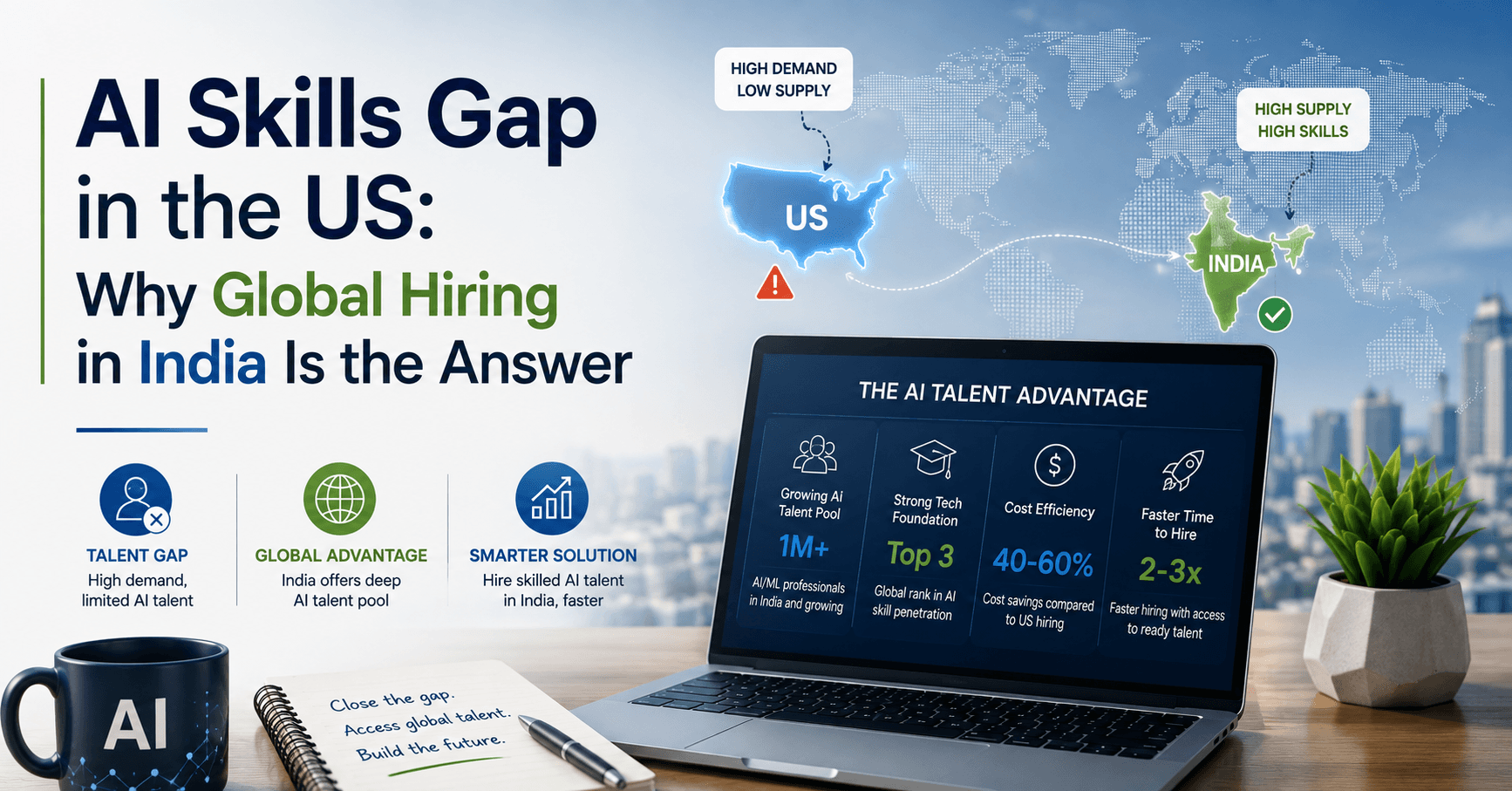
If India, one of the world's largest technology talent markets with approximately 5.8 million tech professionals (nasscom / DD News), is facing an AI skills gap, you can infer what the gap looks like in markets with a fraction of that workforce. US and UK employers relying only on local talent pools for premium AI roles are fishing in increasingly shallow water. That is not a prediction. It is what the supply-demand math implies when you look at the numbers. The talent market for AI specialists is globally tight, and no single country has enough qualified people to fill the demand on its own.
Why India is part of the solution
India already has the scale
Start with the baseline number. India's technology workforce is approximately 5.8 million professionals (nasscom / DD News). That makes it one of the deepest engineering talent pools in the world by any measure. Not all of those people work in AI, obviously. But the pool from which AI talent is drawn is structurally large. A company looking for five ML engineers in Bangalore has a fundamentally different search radius than one looking for the same profiles in Denver or Manchester. And the AI talent is spreading beyond Bangalore into Hyderabad, Pune, and Chennai (kaam.work/indias-ai-talent-boom-beyond-bangalore), which widens the aperture further.
India's AI talent base is growing fast
The Deloitte and nasscom report projects India's AI workforce to cross 1.25 million by 2027, up from 600,000 to 650,000 in recent estimates (Deloitte + nasscom). That growth is being driven by multiple forces at once: GCC expansion by companies like Google, Microsoft, JPMorgan, and Target; well-funded Indian startups running production ML (Flipkart, Zomato, Razorpay, PhonePe); a university pipeline producing over 1.5 million engineering graduates annually; and increasing government and industry investment in AI skilling programs.
The ecosystem has matured past the point where Indian AI talent means "people who completed online courses." In 2026, it means engineers who have built recommendation systems for hundreds of millions of users, deployed fraud detection models processing billions in transactions, and scaled data platforms that serve real production workloads.
India is cheaper, yes. More importantly, it is structurally relevant
The cost math is real. A mid-level ML engineer in India costs $30,000 to $45,000 per year versus $170,000+ in total US compensation. But framing India purely as a cost play misses the point.
India's relevance to AI hiring is structural. nasscom's Strategic Review 2025 positions India as a global technology and innovation hub, not a services delivery center. The country's combination of workforce scale, engineering depth, English fluency, timezone overlap with US East Coast (roughly four hours of live collaboration daily), and a maturing AI ecosystem makes it one of the very few markets that can absorb rising AI demand from global employers. Countries with smaller engineering bases and less AI ecosystem development simply cannot supply enough qualified people at any price.
The strongest angle for employers
Companies struggling to fill AI roles locally should treat India not as an offshoring fallback but as a serious talent-market response to a global shortage. The engineers are there. The infrastructure to hire them compliantly is there (kaam.work/solutions/eor-india). And the quality bar, especially from GCC-trained and startup-experienced candidates, matches what you'd expect from a top US metro. The question is not whether India has AI talent. It's whether you're organized to access it.
What this means for employers
Local-first hiring may not be enough
If AI postings are rising 163% while broader tech hiring stays flat, local-market competition for AI talent is only going to intensify. Employers relying on a single geography, especially a competitive one like the Bay Area, New York, or Seattle, are limiting themselves to a talent pool that is smaller than the demand. That math does not get better with time. It gets worse.
And the cost of waiting goes beyond salary inflation. It's execution delay. Every quarter you spend with an unfilled ML engineer role is a quarter your AI product roadmap doesn't move. Your competitors who filled that role, whether locally or globally, ship while you recruit.
Focus on capabilities, not titles
AI job titles are fragmenting faster than most HR systems can track. "AI engineer" means something different at every company. "GenAI specialist" barely existed as a title two years ago. Hiring against titles instead of capabilities is a fast way to either miss strong candidates or hire the wrong people.
Screen for what candidates have built and shipped. Can they deploy a model? Can they build a data pipeline that doesn't collapse under real-world data quality? Can they architect an LLM application that works at scale? Those questions matter more than whether their last job title was "ML engineer" or "applied AI scientist."
Broaden the talent map
India should be part of the sourcing strategy for AI engineers, ML engineers, data scientists, MLOps engineers, and applied AI specialists. The talent pool is deep enough to hire for all of these roles from a single market. And with an EOR model, you can hire compliantly in India without setting up a legal entity, at $599/month per employee, with onboarding timelines measured in days rather than months (kaam.work/solutions/build-full-time-team-in-india).
The companies that build the most capable AI teams in 2026 will not be the ones with the biggest local recruiting budgets. They will be the ones who source from the widest talent pool.
When local hiring still makes sense
Not every AI role should be filled in India. That would be a dishonest argument, and it would not serve you well.
If you need a VP of AI who sits in the same room as your CEO and presents to the board quarterly, hire locally. If your problem requires deep domain knowledge in a US-specific regulatory environment (say, FDA-regulated medical AI), local hires with that regulatory background are probably the right call. If your entire team is co-located and you have no experience managing remote engineers, adding an India hire without any distributed-team infrastructure will create friction before it creates value.
But for the majority of AI engineering, ML engineering, data science, MLOps, and applied AI roles, especially roles focused on building and shipping technical systems, the India talent pool is deep, experienced, and significantly more accessible than local alternatives. Most companies running this model well use a split structure: senior leadership and customer-facing roles in the US, technical build team in India. That structure works because it matches the talent supply reality.
"But can we really build a serious AI team in India?"
"We need these people on our team full time. This isn't a contract gig."
They will be full time. EOR employment in India means the person is a full time employee with benefits, payroll, and labor law compliance handled by the EOR. You manage the work. Kaamwork handles the employment infrastructure. There is no difference in commitment or working relationship from the engineer's side (kaam.work/core-services/onboard-and-manage).
"I'm not convinced the quality will match what we'd get locally."
Check who is already building AI in India (kaam.work/blog/hire-ai-engineers-in-india). Google, Microsoft, Amazon, JPMorgan, Goldman Sachs, Target, and Walmart all run advanced AI and ML work out of Indian GCCs. Flipkart, Zomato, and Razorpay run production ML at scale that matches or exceeds the complexity of most US startups. The talent quality question was settled years ago. The question now is whether you're positioned to access that talent.
"India is 10+ hours ahead. How does collaboration actually work?"
The overlap is about four hours of live collaboration with the US East Coast. Most distributed AI teams use that overlap for stand-ups, design reviews, and pair debugging, then let each side get heads-down build time during their respective working hours. It is not the same as having everyone in one office. But for engineering work that requires deep focus, the async time is often a net positive. Some companies find they ship faster with this model, not slower.
Build your AI team where the talent is
AI job postings hit 49,200 in 2025 and grew 163% year over year. The demand is accelerating. The talent shortage is real. And the global labor market data is pointing in one direction: companies that limit their AI hiring to local markets will fill roles more slowly and at higher cost than companies that include India in the sourcing strategy.
India's 5.8 million tech workforce, projected 1.25 million AI professionals by 2027, and production-trained engineering ecosystem make it one of the strongest answers to the AI talent problem that employers can act on right now.
If you're hiring AI engineers, ML engineers, data scientists, or MLOps specialists and local hiring isn't keeping up, see what your India team would cost. The cost calculator at kaam.work/global-cost-calculator shows the numbers by role and seniority, and they tend to surprise people on the favorable side. Or skip the calculator and talk to someone directly (kaam.work/talk-to-us).
Disclaimer: Market data referenced in this article is based on published 2025-2026 analysis from Robert Half, Indeed Hiring Lab, Deloitte, nasscom, the Bureau of Labor Statistics, and nasscom's Strategic Review 2025. Growth projections are estimates and may vary by methodology and time period. This article is not a formal research report. Kaamwork pricing is current as of April 2026.
Share this article

Founder & CEO | Kaam.Work
Nilesh Parwani, a Kelley School BBA graduate, worked at UBS and Warburg Pincus before founding PrintBell (acquired by Cimpress). In 2020, he launched kaam.work, a remote work platform focused on flexible talent and distributed teams.