US GAAP vs Indian Accounting Standards: What US Finance Teams Need to Know for a GCC
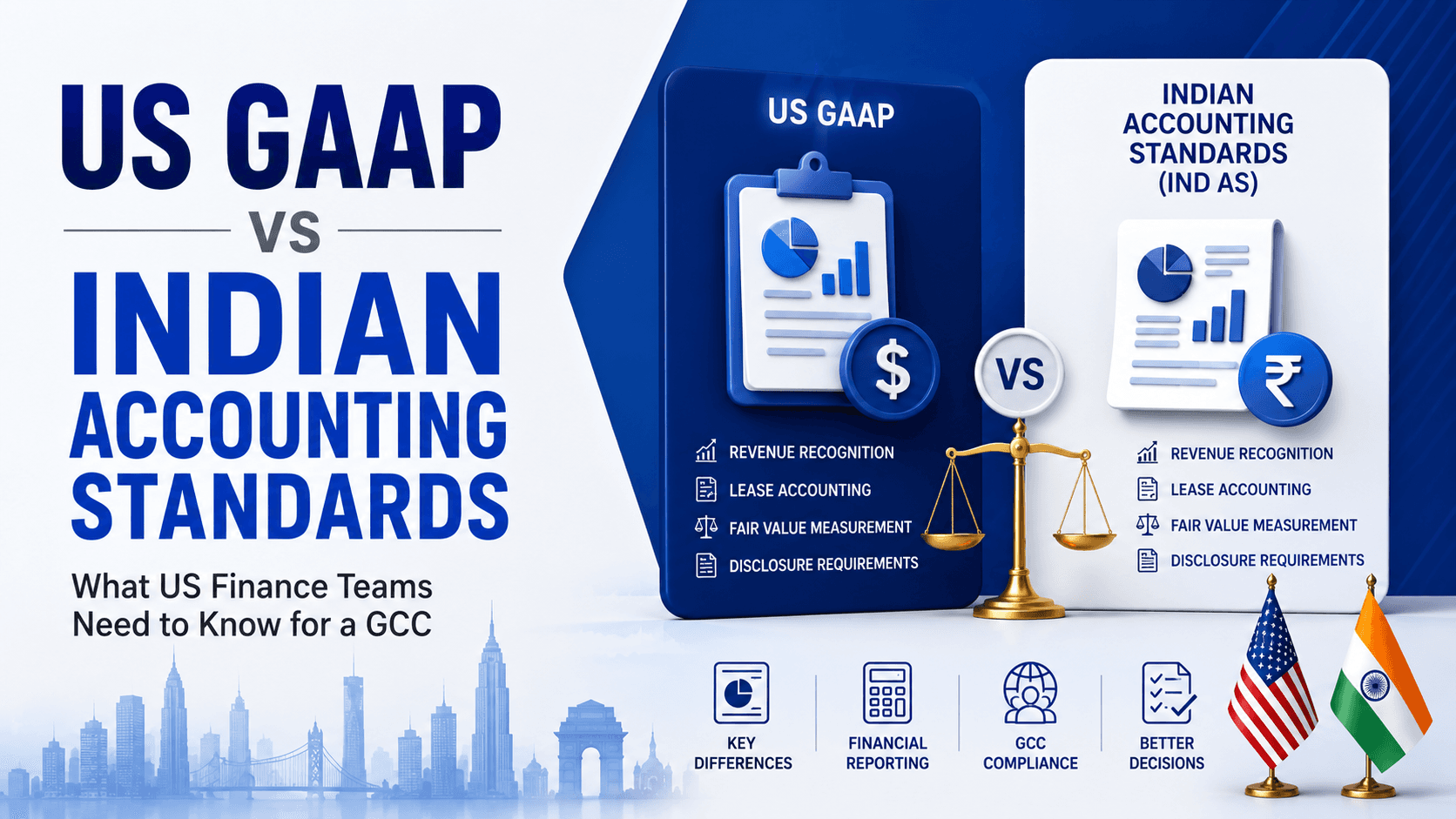
Understand the key differences between US GAAP and Indian Accounting Standards and what US finance teams need to know when setting up and managing a GCC in India.

ByNilesh Parwani / July 15, 2026 / 10 min read
- What Are Indian Accounting Standards and How Do They Relate to US GAAP?
- Key Differences Between US GAAP vs Indian Accounting Standards That Affect GCC Operations
- What Statutory Reporting Does Your India GCC Entity Carry Independently?
- What Does a GCC Finance Team Need to Run Both Frameworks Simultaneously?
- How an EOR Simplifies the GCC Finance Setup in the Early Stages
- Frequently Asked Questions
When your GCC in Bangalore files its financial statements with the Registrar of Companies, it files under Indian accounting standards. Not US GAAP. Your US parent consolidates under US GAAP. Your India entity reports under Ind AS. And the two frameworks, while closer than they were a decade ago, are not the same.
Understanding US GAAP vs Indian accounting standards is not an academic exercise for GCC finance leaders. It is a live operational requirement. The India entity carries independent statutory reporting obligations under the Companies Act 2013 that run in parallel to, and completely separate from, how the parent prepares its group financials. Missing either set of obligations creates real liability.
This guide covers GCC finance compliance in India from the US finance team's perspective: what Ind AS is, how it diverges from US GAAP in the five areas that matter most for GCCs, what statutory reporting your India entity carries independently, and how to resource the dual-framework finance function from day one.
What Are Indian Accounting Standards and How Do They Relate to US GAAP?
Most US finance executives come into GCC setup knowing US GAAP deeply. They need to understand where Ind AS sits in the global accounting landscape before any comparison is useful.
The key phrase in the Ind AS column is "converged with IFRS, with India-specific carve-outs." Ind AS is not IFRS. It is not US GAAP. It is a principles-based framework that draws from IFRS but retains India-specific adjustments in several areas. For a US finance team used to rules-based guidance, this creates a genuine shift in how judgment gets applied.
For a GCC entity, Ind AS applicability depends on the entity's net worth. Phase 1 applies to companies with net worth above Rs 500 crore or listed on a stock exchange. Phase 2 applies to companies with net worth above Rs 250 crore. Most GCCs of US Fortune 500 companies will fall under Ind AS thresholds within the first two to three years of operation. Verify the current thresholds with a local CA before the first annual filing, as MCA periodically revises the applicability rules.
Key Differences Between US GAAP vs Indian Accounting Standards That Affect GCC Operations
The IND AS vs. GAAP comparison covers many areas. For a GCC finance team, five differences create the most practical complexity. Each one requires a reconciliation adjustment when the India entity's financials are translated for US GAAP consolidation.
Each of these differences requires active management, not just awareness. The finance team must decide whether to maintain dual records for the India entity or produce a periodic GAAP-to-Ind AS reconciliation. Both approaches work. Neither is automatic.
What Statutory Reporting Does Your India GCC Entity Carry Independently?
This is the section most US CFOs discover for the first time during their first India audit. GCC finance compliance India is not just about the accounting standards. The India entity carries statutory filing obligations under the Companies Act 2013 that are completely independent of how the US parent handles group consolidation.
AOC-4 must be filed within 30 days of the AGM, and MGT-7 within 60 days. These are not optional extensions of the US parent's reporting calendar. They are independent obligations of the India entity, with penalties that accrue from the first day of default.
Transfer pricing deserves specific attention. Any intercompany transaction between the US parent and India GCC above Rs 1 crore (approximately $120,000) in a financial year requires contemporaneous documentation demonstrating arm's length pricing under Section 92D of the Income Tax Act. This documentation must be prepared before October 31, not assembled after the fact. Most first-time GCC operators underestimate both the volume of intercompany transactions that qualify and the cost of retroactive documentation when the threshold is discovered post-hoc.
What Does a GCC Finance Team Need to Run Both Frameworks Simultaneously?
The most consistent mistake US companies make when building a GCC finance function is under-resourcing Year 1. The dual-framework environment requires roles that do not exist in the US parent's org chart.
A minimum viable GCC finance function in Year 1 includes one Ind AS-trained controller, one tax specialist covering both income tax and GST, and a company secretary for ROC and FEMA filings. This headcount is separate from the finance work the GCC performs for the US parent. Both functions need to be staffed and distinct from day one.
In practice, most GCCs discover this gap at their first statutory audit when the auditor asks for documentation that was never created. Building the finance infrastructure before the first financial year closes is significantly cheaper than reconstructing records retroactively.
How an EOR Simplifies the GCC Finance Setup in the Early Stages
For companies in the pre-entity or early GCC stage, an Employer of Record removes the entire statutory reporting layer while the team is being built and the model is being validated.
When a US company uses an EOR to hire its first India team members before registering a GCC entity, the Companies Act obligations listed above do not apply to the US company directly. The EOR carries them under its own entity structure. There is no India entity, no ROC filings, no statutory audit, no GST registration, no FEMA compliance for the GCC. All of it sits with the EOR.
This is the most common path for US companies testing the GCC model: use an EOR for the first 10 to 20 hires, validate the team and the function, then transition to a registered GCC entity when the headcount and long-term commitment justify the compliance overhead.
Kaamwork's Build-Operate-Transfer model is specifically designed for this transition. The EOR fee is $599 per month per employee, on top of the employee's agreed salary. Setup cost is zero. First hire onboards in 48 hours. The $20,000 to $150,000 entity setup cost and 3 to 6 month registration timeline are deferred until the team and the function are proven.
See how Kaamwork's EOR model works in India and read the best way to structure your first India hire as a US company for the full compliance and cost framework. If you are evaluating the GCC path specifically, why companies set up GCCs in India using EOR first covers the build-direct approach in detail. For the payroll compliance layer that runs inside the GCC, Kaamwork's India payroll guide for US businesses covers the monthly cycle in full.
US GAAP vs Indian accounting standards are converging but remain different in revenue recognition, lease accounting, goodwill, and financial instruments. More critically, your India GCC entity carries independent statutory reporting obligations under the Companies Act 2013, ROC filing requirements, transfer pricing documentation, and GST compliance that run parallel to the US parent's accounting obligations. None of these obligations wait for the US parent's reporting calendar.
The finance function that manages GCC finance compliance India successfully is one that is resourced for the dual-framework environment from the first year, not the third. Building it retrospectively, after the first statutory audit finds gaps, is far more expensive than building it correctly from the start.
If you are evaluating a GCC setup in India and want to understand the finance team structure and compliance requirements for your specific situation, Kaamwork can walk you through the build plan from day one. Talk to Kaamwork today.
Frequently Asked Questions
Q: What is the difference between US GAAP and Indian accounting standards?
US GAAP vs Indian accounting standards comes down to philosophy and applicability. US GAAP is a rules-based framework developed by FASB, mandatory for US public companies, with detailed prescriptive guidance for specific transactions. Indian accounting standards split into two tiers: Ind AS, converged with IFRS, applies to larger companies and GCCs above net worth thresholds. The older AS framework applies to smaller entities. Ind AS is more principles-based than US GAAP, amortizes goodwill over up to 10 years rather than applying impairment-only testing, prohibits LIFO inventory accounting, and diverges from US GAAP in lease and revenue recognition in specific areas. For a GCC, the entity reports under Ind AS while the US parent consolidates under US GAAP, requiring a translation layer between the two frameworks.
Q: What does Ind AS vs GAAP mean for a US company's GCC in India? It means your India GCC entity files statutory financial statements in Ind AS format with the Registrar of Companies, while your US parent consolidates the same entity into its US GAAP group accounts. The finance team must maintain dual accounting records or produce a periodic GAAP-to-Ind AS reconciliation. Key areas requiring reconciliation include goodwill treatment (amortization reversal for GAAP), inventory (LIFO elimination if applicable), lease liabilities (discount rate differences under ASC 842 vs Ind AS 116), and revenue recognition (contract modification treatment). Transfer pricing documentation for intercompany transactions between the US parent and India GCC adds a third compliance layer that sits outside both accounting frameworks but is triggered by the intercompany activity that GCC operations generate.
Q: What are the statutory reporting requirements for a GCC entity in India?
A GCC entity registered under the Companies Act 2013 must file annual financial statements (Form AOC-4) within 30 days of the AGM and an annual return (Form MGT-7) within 60 days. A statutory audit by an ICAI-registered firm is mandatory before the AGM. GST returns are filed monthly. Transfer pricing documentation is required before October 31 for entities with international transactions above Rs 1 crore. FEMA compliance is required for equity investment from the US parent. Missing ROC filing deadlines triggers penalties of Rs 100 per day per form with no statutory cap, and can result in director disqualification after extended non-compliance.
Q: Does a GCC need to register in India before hiring its first employees?
No. US companies can hire their first India GCC team members through an Employer of Record without registering a local entity. The EOR assumes all statutory employer obligations, handles payroll and compliance under its own entity, and removes the need for ROC filings, statutory audit, and entity registration in the early stages. This approach is common for companies validating the GCC model before committing to a full India entity. The transition from EOR to a registered GCC entity typically happens when the team exceeds 20 to 25 employees and the compliance cost of self-management starts to make financial sense versus the ongoing EOR fee.
Q: What transfer pricing obligations does a US company have for its India GCC?
Any intercompany transactions between a US parent and its India GCC above Rs 1 crore (approximately $120,000) in a financial year require contemporaneous transfer pricing documentation under Section 92D of the Income Tax Act. Documentation must be prepared before October 31. A benchmarking study demonstrating arm's length pricing is required, supported by an intercompany service agreement. Failure to maintain documentation carries a penalty of 2% of the transaction value. For a GCC with typical intercompany service fee arrangements running $2 million to $5 million annually, a 2% penalty on undocumented transactions is a material exposure. Most first-time GCC operators engage a Big 4 or specialist India transfer pricing firm for the first two to three years.
Share this article

Founder & CEO | Kaam.Work
Nilesh Parwani, a Kelley School BBA graduate, worked at UBS and Warburg Pincus before founding PrintBell (acquired by Cimpress). In 2020, he launched kaam.work, a remote work platform focused on flexible talent and distributed teams.