EOR vs Contractor in India: Which Model Should You Choose?
The EOR vs contractor decision in India isn't a preference: it's a compliance and cost decision. Here's when each model works, what misclassification actually costs, and how to choose correctly.

ByNilesh Parwani / July 1, 2026 / 6 min read
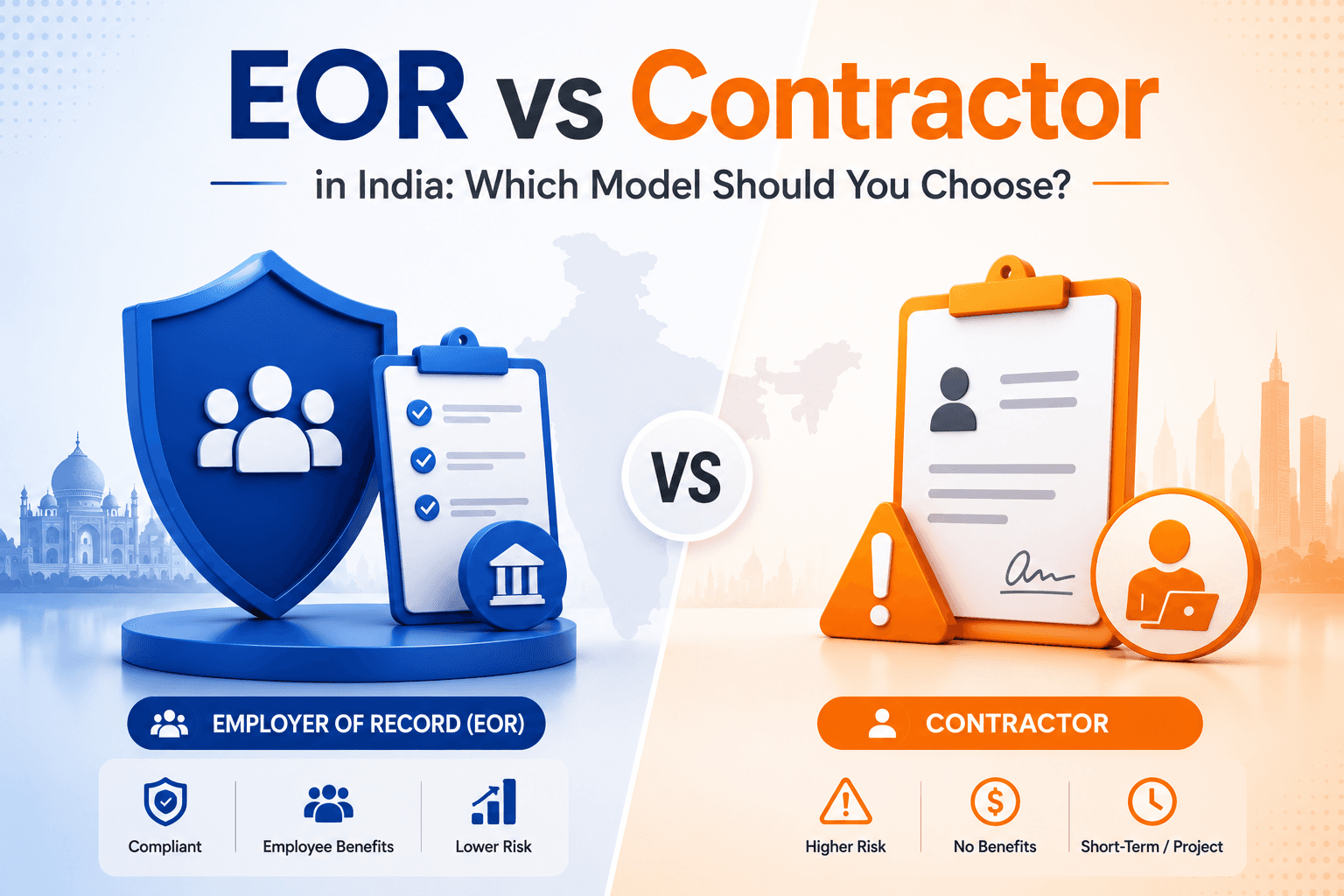
- What is the difference between an EOR and a contractor in India?
- When should you use a contractor instead of an EOR in India?
- What happens if you misclassify a contractor as an employee in India?
- What does an EOR actually cost vs a contractor in India?
- Which model gives you better IP protection?
- Can you start with a contractor and move to EOR later?
- What is the simplest decision rule for the EOR vs contractor choice?
- How does EOR vs contractor work for a team of five or more?
- Contractors work for projects. EOR is for building a team.
If you are hiring in India for the first time, you will face one decision before anything else.
Do you bring someone on as a contractor or hire them as a full-time employee through an Employer of Record? The EOR vs contractor choice is not just an HR preference. It determines your compliance exposure, your total monthly cost, how much IP protection you actually have, and how stable your team will be six months from now. This guide explains exactly when each model makes sense and what goes wrong when companies pick the wrong one.
What is the difference between an EOR and a contractor in India?
An EOR (Employer of Record) is a third-party company that becomes the legal employer of your India team. It issues employment contracts that comply with Indian labor law, runs payroll in INR, deducts TDS, and contributes to EPF and ESIC on your behalf. You direct all the work. The EOR handles the legal and administrative infrastructure behind it.
A contractor is self-employed. They invoice you directly, manage their own taxes, and receive no statutory benefits. The engagement is project-based, not employment-based.
The EOR vs contractor distinction matters more in India than in most markets. India has one of the most compliance-dense employment environments in the world. Getting the model wrong creates backdated liability, not just future risk.
When should you use a contractor instead of an EOR in India?
Use a contractor for genuinely short-term, project-based work with a fixed deliverable and a clear end date. If the engagement is three months or less, the work is outcome-based rather than hours-based, and the contractor works for multiple clients, the contractor model can hold up legally.
That is a narrow set of conditions. Most ongoing tech and operations roles do not meet them.
Watch for these red flags. If your contractor works full-time hours, uses equipment you provide, is supervised daily, or works exclusively for your company, Indian labor authorities will treat that relationship as employment regardless of what the contract says. Any one of those factors is enough to trigger reclassification.
What happens if you misclassify a contractor as an employee in India?
Misclassification is the single biggest compliance risk in the contractor model. And the consequences are backdated, not prospective.
If Indian labor authorities reclassify your contractor as an employee, liabilities apply from the first day of the original engagement. That includes EPF contributions at 12% of basic salary on the employer side, ESIC contributions, gratuity accruals after five years of service, TDS corrections and penalties, and potential back pay for statutory leave.
Permanent establishment risk is a related and often overlooked danger. If your contractor negotiates contracts, closes deals, or exercises commercial authority on your behalf in India, Indian tax authorities may treat that activity as a taxable presence. That exposes your global revenue to Indian corporate tax with no registered entity required.
Getting the model wrong can create personal liability for company directors in some scenarios. Most companies do not discover this until an audit is already underway.
What does an EOR actually cost vs a contractor in India?
This is where the EOR vs contractor comparison gets misread most often.
The contractor model looks cheaper because there is no EPF, ESIC, or gratuity. But that comparison only holds if the engagement genuinely qualifies as independent contracting under Indian law. Most do not.
For the EOR model, the correct way to read the cost is: employee's annual CTC divided by 12, plus the Kaamwork EOR fee of $599 per month. That is your total monthly employer cost. The $599 is the platform fee on top of salary, not a replacement for it.
Here is a realistic monthly cost example for a mid-level software engineer in Bangalore with a CTC of $30,000 per year:
If misclassification is discovered on a contractor engagement, backdated EPF, ESIC, and TDS liabilities across 12 to 18 months can easily exceed two years of Kaamwork's EOR fee in a single audit.
Which model gives you better IP protection?
Employment contracts issued through an EOR include IP assignment clauses that are enforceable under Indian law. All work product is contractually assigned to your company from day one.
Contractor agreements can include IP clauses too. But enforcement is weaker, particularly for work created outside the strict scope of the original contract. Courts in India have ruled against companies where contractor IP clauses were poorly drafted or where the scope of work had evolved informally.
For any role where your team is building your core product, handling proprietary data, or writing production code, an EOR is the safer structure. The employment contract provides stronger, cleaner protection than a contractor NDA and assignment clause combination.
Can you start with a contractor and move to EOR later?
Yes. Many US companies start with a contractor for a short pilot engagement and transition to EOR once the role proves out. This is a legitimate path when done correctly.
The transition must be handled carefully. The contractor relationship needs to be formally closed. A new employment contract is then issued under the EOR structure. Statutory benefit enrolments like EPF and ESIC are active from the new employment start date, not backdated to the contractor start date.
Kaamwork supports contractor-to-EOR transitions directly. The process is structured and documented to avoid any overlap between the two engagement models.
Do not attempt to informally convert a contractor to a full-time employee without a formal offboarding and re-engagement process. That conversion itself carries misclassification risk and can trigger the same backdated liabilities you were trying to avoid.
What is the simplest decision rule for the EOR vs contractor choice?
Use this rule. If the engagement is likely to run beyond six months, if the person works regular hours for your company, or if they work primarily for you rather than across multiple clients, choose EOR.
Engagements expected to last beyond six to twelve months almost always carry misclassification risk when structured as contractor agreements. Beyond that threshold, Indian labour authorities apply employee-like tests regardless of what the contract wording says.
The cost of getting this wrong, including EPFO audits, backdated liabilities, and Permanent Establishment exposure, almost always exceeds the cost of an EOR from day one.
See how Kaamwork's EOR model works in practice and what the onboarding process looks like from your first conversation to your first hire.
How does EOR vs contractor work for a team of five or more?
The EOR vs contractor decision gets more consequential as your team grows.
For one or two people, a contractor arrangement might feel manageable even if it is technically on thin legal ground. At five or more, the exposure multiplies. Each person represents a separate misclassification risk, a separate backdated liability, and a separate PE exposure if any of them have commercial authority.
EOR and entity costs are comparable in Year 1 for a five-person team. EOR wins on total cost below the 25 to 30 employee threshold. Above that threshold, a Build-Operate-Transfer model to your own Indian entity may make financial sense. Kaamwork supports both models and can advise on the right transition point for your team size.
For teams under 25 employees, EOR is almost always the lower-cost, lower-risk, faster path.
Contractors work for projects. EOR is for building a team.
India's enforcement environment for worker misclassification has tightened significantly. The 2026 Labour Codes, which consolidated 29 legacy laws into four frameworks effective November 2025, introduced stricter penalties for misclassification, including fines up to INR 1,00,000, daily penalties of INR 30,000 for continuing violations, and potential imprisonment for wilful non-payment of statutory contributions (India Briefing, December 2025). Separately, Oyster HR notes that India's employment laws and tax authorities are increasingly scrutinizing worker classifications with every new hire (Oyster HR, July 2025).
If you are hiring someone to build your product, run your operations, or own a function in your company, that is not a project. That is a job. Structure it accordingly.
Kaamwork's flat-rate EOR model gets your first hire onboarded in 48 hours for $599 per month, plus the employee's agreed salary. No setup fees. No hidden charges.
Talk to Kaamwork to compare your specific situation and get a cost estimate for your target roles in India.
Share this article

Founder & CEO | Kaam.Work
Nilesh Parwani, a Kelley School BBA graduate, worked at UBS and Warburg Pincus before founding PrintBell (acquired by Cimpress). In 2020, he launched kaam.work, a remote work platform focused on flexible talent and distributed teams.