Why 71% of H-1B Workers Are Indian
A data-driven look at why Indian nationals dominate H-1B approvals, what that concentration tells employers about global talent geography, and why it points toward a fundamentally different hiring model. Out of 399,395 approved H-1B beneficiaries in FY 2024, 283,397 were Indian nationals. That is 71% of every approved petition, according to USCIS published data. Most coverage of this number treats it as an immigration policy story. Who gets the visas, whether the system is fair, what Congress

ByNilesh Parwani / April 21, 2026 / 11 min read
- H-1B approvals at a glance
- The data: Indian nationals now account for 71% of approved H-1B beneficiaries
- The headline number
- Why this matters
- Why Indian talent dominates the H-1B pipeline
- The role of STEM and IT talent supply
- The role of English-language business compatibility
- The role of employer demand
- The role of established global-delivery ecosystems
- This is not just a visa story. It's a global talent geography story
- What the concentration really signals
- What happens when visa friction rises
- What that means
- What this means for employers
- If your H-1B strategy depends on India, your hiring strategy already does too
- Relocation is no longer the only way to access the same talent pool
- The bigger the visa friction, the stronger the case for distributed hiring
- Talent access and location strategy should be planned together
- The EOR opportunity hidden inside the H-1B data
- Same talent pool, different hiring model
- Why EOR becomes strategically interesting
- When this matters most
- Hiring in India is no longer just a cost play
- It is now a resilience play
- It is a speed play
- It is a strategic optionality play
- Common misreadings of the 71% statistic
- Misreading 1: "this just means the visa system is broken"
- Misreading 2: "this means employers have no other option"
- Misreading 3: "this is only relevant to big tech"
- A smarter hiring strategy for 2026 and beyond
- Stop treating immigration and hiring strategy as separate decisions
- Map talent pools before you map visa paths
- Decide whether the role needs US presence or just the right person
- Build India and EOR into your workforce planning
- The 71% number is a hiring signal, not just an immigration statistic
A data-driven look at why Indian nationals dominate H-1B approvals, what that concentration tells employers about global talent geography, and why it points toward a fundamentally different hiring model.
Out of 399,395 approved H-1B beneficiaries in FY 2024, 283,397 were Indian nationals. That is 71% of every approved petition, according to USCIS published data.
Most coverage of this number treats it as an immigration policy story. Who gets the visas, whether the system is fair, what Congress should do about it. That framing misses the point that matters most to anyone actually hiring engineers.
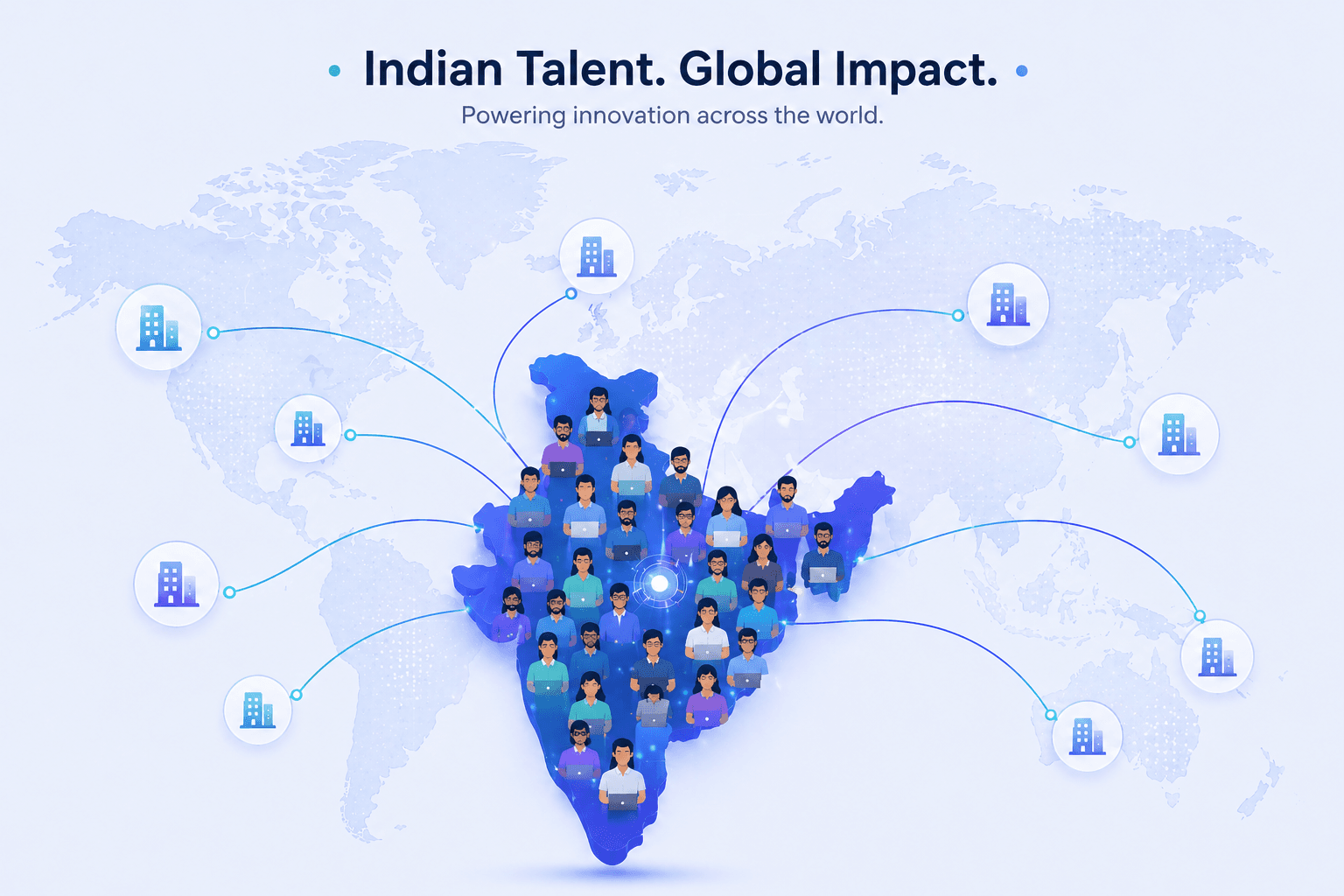
This is a talent market story. Indian professionals dominate the H-1B pipeline because that is where the global technical workforce concentrates. And if that is true, which the data says it is, employers spending six figures to relocate engineers from India to the US need to ask a harder question: do we need the relocation, or do we just need the person?
H-1B approvals at a glance
Source: USCIS FY 2024 H-1B approval data. Figures for countries 3–5 are estimates based on published USCIS demographic reporting.
India's share is not a narrow lead. It is market dominance. China accounts for less than one-sixth of India's total. Every other country is a rounding error by comparison.
[Suggested visual: bar chart of top 10 countries by H-1B approvals, or a pie chart showing India vs everyone else. Strong backlink hook if designed as an original, embeddable chart.]
The data: Indian nationals now account for 71% of approved H-1B beneficiaries
The headline number
USCIS data for FY 2024 shows 399,395 total approved H-1B beneficiaries. Of those, 283,397 are Indian nationals, or 71.0%. China is a distant second at 46,680 (11.7%). No other country accounts for more than 3% of approvals.
This pattern has been building for over a decade. India's share of H-1B approvals hovered between 65% and 73% for the past five fiscal years, according to USCIS annual reports. Not a one-year anomaly. The structural baseline.
Why this matters
Any employer with significant H-1B hiring is, in practice, running an India-dependent talent strategy whether they have framed it that way or not. That dependence carries real operational risk: H-1B policy changes, lottery odds, processing delays, and the $100,000 supplemental fee on certain overseas petitions all sit between your company and the person you want to hire. And they disproportionately affect the one country that supplies seven out of every ten approved beneficiaries.
Why Indian talent dominates the H-1B pipeline
The 71% number is not random. It reflects structural factors in India's talent market, the US employer ecosystem, and the H-1B program itself.
The role of STEM and IT talent supply
India produces roughly 1.5 million engineering graduates per year, according to the All India Council for Technical Education (AICTE). The higher education pipeline spans IITs, IISc, IIITs, NITs, BITS Pilani, and hundreds of private engineering colleges that have been training technically skilled graduates for decades. The US Department of Labor's H-1B occupational data confirms that computing and engineering roles account for the majority of approved petitions, exactly where India's talent output runs deepest.
This is not volume alone. The quality pipeline runs through GCCs operated by Google, Microsoft, Amazon, and Goldman Sachs, and through product companies building complex software at scale. India's engineering talent has production depth, not just headcount.
The role of English-language business compatibility
India's professional class operates in English as a working language. Code reviews, product discussions, documentation, Slack threads, all run in English without translation overhead. For US employers, that means Indian engineers integrate into existing workflows on day one. It is a practical advantage that compounds over time and explains part of why employer demand for Indian talent has been so persistent, much more than the visa numbers alone would suggest.
The role of employer demand
H-1B demand concentrates in computing, engineering, and quantitative analysis. USCIS occupational data consistently shows that software developers, data engineers, systems architects, and related roles make up over 60% of approved petitions. These are the roles where India has the deepest candidate pool. The concentration is not a pipeline accident. It is real employer demand meeting real talent supply.
The role of established global-delivery ecosystems
India's IT services ecosystem, built over 30 years by companies like Infosys, TCS, Wipro, and HCL, created the initial bridge between Indian technical talent and US employers. That bridge has evolved. What started as services outsourcing became GCC-based product engineering, then startup-driven innovation, then direct distributed hiring.
But the infrastructure (recruiting networks, delivery frameworks, and decades of institutional practice connecting Indian engineers to US companies) did not disappear when the model shifted. It adapted. Indian talent is embedded in global technology delivery in a way that no other country's workforce matches at equivalent scale.
This is not just a visa story. It's a global talent geography story
What the concentration really signals
The H-1B system is, among other things, a lens on where global technical talent actually lives. When 71% of approved petitions go to one country, that is a map of the world's largest, most accessible pool of English-speaking engineers with production experience.
The visa is a delivery mechanism. The underlying talent exists with or without it.
If you are thinking about the longer arc of technical hiring and how visa policy intersects with workforce strategy, the demographic signal from H-1B data is the place to start.
What happens when visa friction rises
This is where the data gets interesting. A 2024 academic study cited in Rest of World's 2026 reporting found that for every H-1B visa rejection, US firms hired between 0.4 and 0.9 workers abroad, with the majority of those hires concentrated in India, China, and Canada. Visa friction did not reduce employer demand for technical talent. It rerouted the geography of hiring.
And the rerouting disproportionately favored India. Because that is where the talent pool was already deepest.
What that means
When the visa path gets harder (higher fees, lower lottery odds, longer timelines), employers don't stop needing engineers. They find other ways to access the same people. Sometimes that means hiring in India directly. Sometimes it means using an Employer of Record to employ them compliantly without relocation. Sometimes it means expanding existing GCC operations.
Visa barriers don't eliminate talent demand. They redirect where hiring happens.
What this means for employers
If your H-1B strategy depends on India, your hiring strategy already does too
If seven out of ten of your H-1B petitions involve Indian nationals, your entire talent pipeline for these roles is concentrated in one country. That is a single-source dependency with a volatile middleman (the US immigration system) sitting between you and your hires.
Relocation is no longer the only way to access the same talent pool
For two decades, US employers accessed Indian talent primarily by relocating people on H-1B visas. That model worked when visa costs were manageable and processing was predictable. In 2026, with petition costs running into six figures for overseas cases and lottery odds that make every filing a gamble, relocation is no longer the default path. It is one option among several, and increasingly it is not the best one.
Remote and Deel both position global hiring as a practical response to H-1B volatility. Remote's employer guidance explicitly recommends reducing reliance on US sponsorship by hiring internationally in workers' home countries. Deel frames global hiring alternatives as a way to maintain talent access when visa costs spike. They are both right, but neither connects that recommendation to the demographic reality: the country you should hire in directly is the same country that already supplies 71% of your H-1B talent.
For a more detailed comparison of H-1B sponsorship versus direct India hiring, the breakdown at covers the full decision framework.
The bigger the visa friction, the stronger the case for distributed hiring
Every policy change that makes H-1B sponsorship harder strengthens the business case for hiring the same person in India. Same engineer, same skills. Without the lottery, without the six-figure petition cost, without the 12-month timeline.
Talent access and location strategy should be planned together
Most companies treat immigration and hiring as separate workflows. The talent team sources candidates. The immigration team files visas. The finance team absorbs the cost. Nobody asks whether the role actually requires US presence.
The 71% concentration makes that question unavoidable. If your best candidates are overwhelmingly in India, your hiring strategy should account for that as the starting point, not an afterthought.
The EOR opportunity hidden inside the H-1B data
Same talent pool, different hiring model
If Indian professionals represent 71% of H-1B approvals, then a large share of the talent US employers spend six figures to relocate can be hired directly in India. Same person, same qualifications. A different employment model.
An Employer of Record lets you hire that person as a full-time employee in India without setting up a local entity. Kaamwork handles payroll, provident fund, ESIC, gratuity, and medical insurance at a flat $599/month per employee. The engineer joins your team, uses your tools, builds your product. No visa lottery, no annual cap. And no relocation dependency.
Why EOR becomes strategically interesting
Compare the cost of an H-1B petition for an overseas candidate (potentially $103,000+ in fees before salary, per USCIS fee schedules and the September 2025 proclamation) against hiring the same person through EOR in India ($35,000 to $55,000 annually in total loaded cost including salary and employment infrastructure). The visa path costs more for the first year alone than the EOR path costs for two full years of employment.
Speed compounds the advantage: EOR onboarding takes under two weeks in most cases, actually closer to three once background verification clears. H-1B timelines stretch six to twelve months from lottery registration to start date.
When this matters most
The EOR model fits best when physical US presence is not a hard requirement. Software engineering, ML, data science, product design, analytics, QA, technical operations, DevOps: if the role can be done with a laptop and a stable internet connection, the location question becomes a strategy decision rather than a constraint.
For roles that genuinely require in-person US presence (on-site client work, security clearance requirements, roles tied to physical infrastructure), H-1B or other visa paths remain the right choice. That is a smaller share of roles than most employers assume.
Hiring in India is no longer just a cost play
It is now a resilience play
Building a hiring capability in India insulates your talent pipeline from H-1B volatility. Lottery odds shift and fees change with little warning. A company that can hire in India directly stays unaffected regardless of what happens at USCIS. The talent pool remains accessible whether Congress tightens the cap, raises fees again, or overhauls the lottery entirely.
It is a speed play
H-1B timelines are measured in months. Hiring in India through an EOR is measured in days. When your project timeline cannot wait for a lottery cycle and the engineering backlog is growing, speed is what decides.
It is a strategic optionality play
Hiring in India does not mean abandoning H-1B entirely. It means you have options. You can hire in India now and evaluate relocation later if the role evolves. You can run a distributed team indefinitely. You can use India hiring as a bridge during H-1B processing. Or you can keep the person where they already are, building great software from Bangalore or Hyderabad, and skip the visa conversation altogether.
The flexibility itself has value, especially when policy can change overnight.
Common misreadings of the 71% statistic
Misreading 1: "this just means the visa system is broken"
A more accurate read: the 71% reflects both the structure of the visa program and the actual distribution of global technical talent. India produces more engineers who match US employer demand in computing and software than any other country. The H-1B pipeline mirrors that reality. You can argue the system should be reformed, and many people do. But the talent geography underneath the numbers would stay the same regardless of policy changes.
Misreading 2: "this means employers have no other option"
Employers have multiple paths to Indian talent. Sponsor H-1B visas. Hire directly through EOR. Set up a local entity. Engage contractors (with caveats around IP assignment and compliance under Indian law). Use hybrid models where some roles are US-based and others are India-based. The 71% describes a current access pattern. It is not the only possible one, and for a growing number of companies it is no longer the preferred one.
Misreading 3: "this is only relevant to big tech"
USCIS data shows H-1B petitions filed across healthcare, financial services, manufacturing, consulting, and professional services. Any employer hiring for software, data, analytics, or engineering talent draws from the same global pool. A mid-size fintech building fraud detection, a healthcare company deploying diagnostic AI, a logistics firm optimizing delivery routes, a retail chain personalizing recommendations: all of them compete for Indian engineering talent. The concentration is most visible at large tech employers. The talent pipeline extends far beyond them.
A smarter hiring strategy for 2026 and beyond
Stop treating immigration and hiring strategy as separate decisions
Your immigration budget and your hiring budget serve the same goal: getting the right person working on the right problem. When those budgets live in different departments with different success metrics, you end up overspending on visa processes for roles that could be filled faster and cheaper through direct hiring in India.
Map talent pools before you map visa paths
Start with the question "where does the talent live?" rather than "how do we get visas?" For most technical roles, the answer points to India. Once you know that, the hiring model (H-1B, EOR, entity, contractor) becomes a second-order decision driven by the specific role and its requirements.
Decide whether the role needs US presence or just the right person
Be honest about which roles genuinely require someone sitting in a US office. For many software, data, and product roles, you need the person's skills and their work output. Not their physical location. Separating the talent question from the location question is the most clarifying thing you can do for your hiring strategy in 2026.
Build India and EOR into your workforce planning
If 71% of your H-1B pipeline comes from India, India should be a first-class hiring channel in your workforce plan. Not a backup. A strategic market with its own salary bands, city strategies, and compliance requirements. Kaamwork's global cost calculator at shows what India hiring looks like for your specific roles, and the team at can walk through the details.
The 71% number is a hiring signal, not just an immigration statistic
The concentration of H-1B approvals among Indian nationals is too large to treat as a trivia point or a policy debate. For employers, it is the clearest signal about where global technical talent clusters.
The response is not to sponsor more visas, though some roles will still warrant that. It is to build hiring strategies that access the same talent pool directly. The infrastructure for compliant full-time employment in India exists now. The talent is there. And the speed advantage over visa-dependent hiring is not marginal.
The question for your company in 2026 is not whether Indian talent matters to your hiring strategy. USCIS just answered that for you. The question is whether you keep accessing it through the most expensive, slowest, most uncertain channel available. Or whether you build a better path.
Disclaimer: USCIS data referenced in this article is from published FY 2024 H-1B approval statistics. The offshoring response study is based on 2024 academic research cited in 2026 industry reporting (Rest of World). This article is not legal advice. Consult an immigration attorney for visa-specific decisions. Kaamwork pricing is current as of April 2026.
Share this article

Founder & CEO | Kaam.Work
Nilesh Parwani, a Kelley School BBA graduate, worked at UBS and Warburg Pincus before founding PrintBell (acquired by Cimpress). In 2020, he launched kaam.work, a remote work platform focused on flexible talent and distributed teams.