MLOps engineers in India: salary, skills, and How to Hire
Most companies can build a machine learning model. Fewer can deploy one reliably. Even fewer can keep it running in production, monitor for drift, retrain it on fresh data, and do all of that without waking someone up at 3am. That gap between "we trained a model" and "we have ML in production" is exactly what an MLOps engineer closes. And in 2026, as AI adoption moves from pilots to real production systems, the demand for engineers who can do this work has outpaced supply in nearly every market

ByNilesh Parwani / April 22, 2026 / 12 min read
- MLOps salary snapshot: India 2026
- Why MLOps engineers are in demand in 2026
- AI adoption is moving from pilot to production
- MLOps sits at the center of production AI
- Demand is visible, even if public growth figures vary
- What an MLOps engineer actually does
- Core responsibilities
- MLOps vs ML engineer
- MLOps vs DevOps
- MLOps salary in India (2026 benchmarks)
- Broad-market salary benchmark
- Use adjacent-role benchmarks to sanity-check the market
- Practical hiring takeaway
- Why salary data is noisy
- Skills to look for when you hire an MLOps engineer
- Core technical stack
- ML-specific operational skills
- Platform and reliability skills
- Tooling familiarity
- Communication and production judgment
- How to assess an MLOps engineer in interviews
- Step 1: confirm role fit
- Step 2: use a scenario-based technical interview
- Step 3: review real systems experience
- Step 4: test production judgment
- Where to find MLOps engineers in India
- Top cities
- Best talent sources
- How to hire MLOps engineers in India: step by step
- Define the exact role
- Set a realistic salary band
- Choose your hiring model
- Run a focused assessment process
- Close with mission, not only pay
- Common mistakes companies make when hiring MLOps engineers
- Hiring DevOps instead of MLOps
- Hiring MLOps too late
- Under-scoping infrastructure ownership
- Paying ML engineer rates for a harder-to-find role
- Using generic coding tests
- How to hire the right MLOps engineer in India
Most companies can build a machine learning model. Fewer can deploy one reliably. Even fewer can keep it running in production, monitor for drift, retrain it on fresh data, and do all of that without waking someone up at 3am.
That gap between "we trained a model" and "we have ML in production" is exactly what an MLOps engineer closes. And in 2026, as AI adoption moves from pilots to real production systems, the demand for engineers who can do this work has outpaced supply in nearly every market.
India is one of the strongest hiring markets for MLOps talent, partly because of cost (the salary gap with the US is roughly 5-6x for equivalent experience) and partly because the country's deep bench of cloud, platform, and DevOps engineers has produced a real pool of people who have crossed over into ML-specific infrastructure work. GCCs, product startups, and IT platform companies have been running production ML systems in India long enough that experienced MLOps engineers actually exist here, not just ML engineers who have listed "Kubernetes" on their resume.
This guide covers what the role actually involves, what it costs, how to identify real production MLOps talent versus resume-only hybrids, and how to hire them through an EOR model without setting up a local entity.
MLOps salary snapshot: India 2026
Sources: Glassdoor India MLOps salary data (2025–2026), SalaryExpert ML Engineer benchmarks, Kaamwork hiring benchmarks. Broad-market figures reflect Glassdoor's reported range (avg ₹16L, range ₹8.27L–₹22L, top ~₹31.5L). Top-employer figures reflect GCC and product-company compensation where MLOps roles carry a premium over broad-market averages.
The gap between "broad market" and "top employers" is wider for MLOps than for most AI roles. That is covered in detail below.
Why MLOps engineers are in demand in 2026
AI adoption is moving from pilot to production
NASSCOM's 2026 industry review describes AI adoption in India as shifting from experimentation into function-specific deployment across enterprises. Companies are not running proofs of concept anymore. They are embedding ML into fraud detection, demand forecasting, recommendation engines, and customer support automation. Every one of those use cases needs someone who can deploy models, monitor them, and keep them running when data distributions shift and infrastructure fails.
MLOps sits at the center of production AI
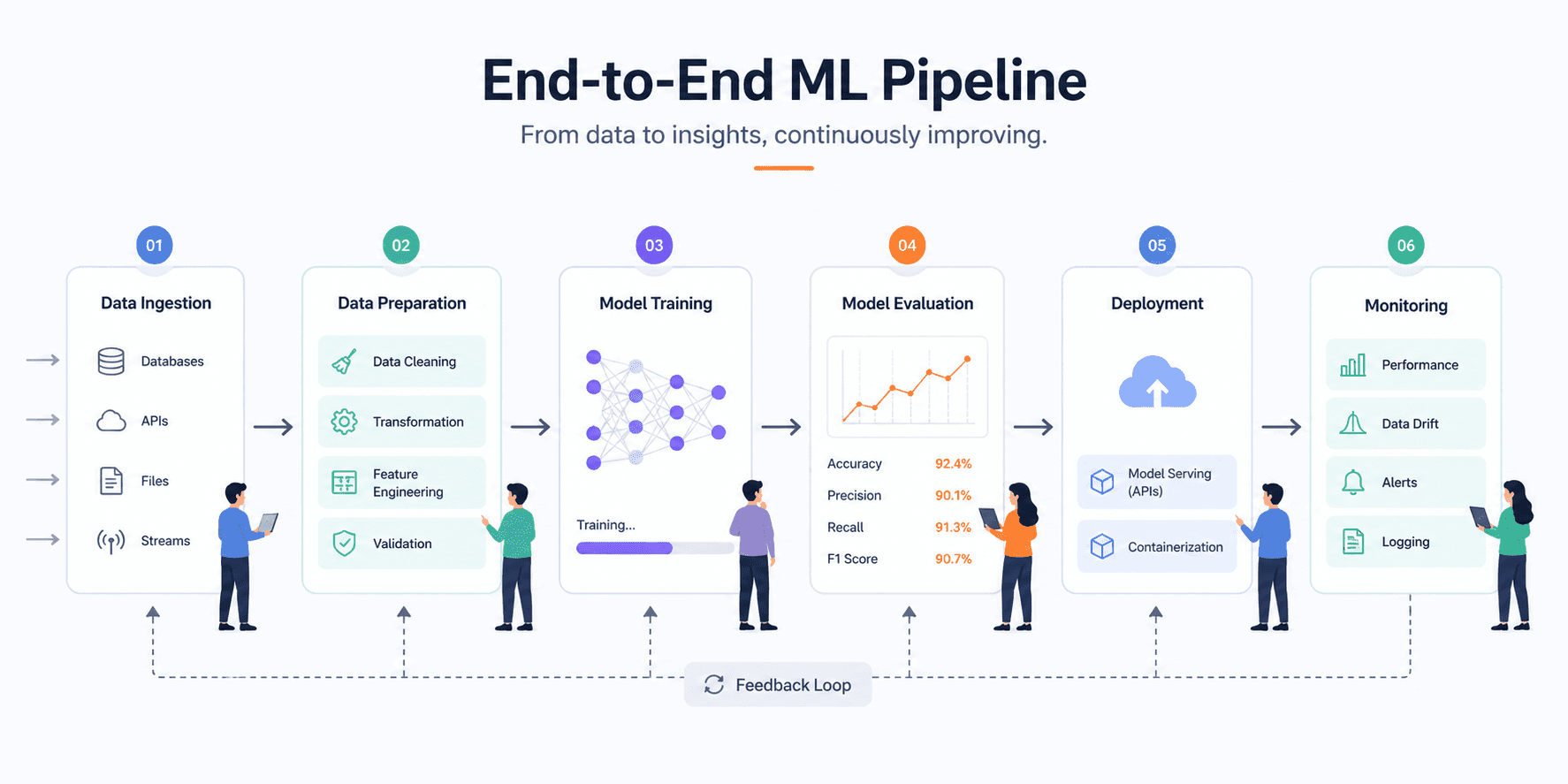
The MLOps engineer owns the lifecycle that sits between "the model works in a notebook" and "the model runs reliably in production at scale." That lifecycle includes model deployment, CI/CD for ML pipelines, feature and data pipeline management, model versioning, drift monitoring, rollback procedures, reproducibility, and governance. Without someone owning this work, models sit in staging environments and never ship. Or worse, they ship without monitoring and silently degrade.
Demand is visible, even if public growth figures vary
Live job board data from foundit (formerly Monster India) shows active MLOps demand across Bangalore, Hyderabad, Pune, Chennai, and Delhi NCR. The role has enough market traction that dedicated MLOps hiring guides now exist from multiple India-focused EOR and staffing providers. Two years ago, most of those providers had not published a single page on MLOps. The publishing pattern alone confirms the demand signal.
What an MLOps engineer actually does
Core responsibilities
An MLOps engineer productionizes ML models and keeps them running. The day-to-day work includes setting up deployment pipelines (blue-green, canary, or shadow deployments), managing model versioning and experiment tracking, building automated training and inference workflows, monitoring model performance and data quality in production, and improving system reliability, cost efficiency, and inference speed.
The work sits at the intersection of software engineering, cloud infrastructure, and machine learning. It requires someone who understands all three well enough to build the glue that connects them.
MLOps vs ML engineer
This distinction matters more than most hiring teams realize. An ML engineer focuses on model development: selecting architectures, training models, tuning hyperparameters, and integrating model outputs into products. An MLOps engineer focuses on the infrastructure that makes those models work in production: deployment, monitoring, retraining pipelines, and operational reliability.
Some engineers do both. At small teams, one person often wears both hats. But as the AI function matures, the split becomes necessary. You do not want your best model builder spending 60% of their time debugging Kubernetes pod failures.
MLOps vs DevOps
DevOps engineers build and maintain general software infrastructure: CI/CD pipelines, container orchestration, cloud networking, monitoring. MLOps engineers handle the same categories of problems but with ML-specific complexity layered on top: data versioning, model lineage, training-serving skew, drift detection, evaluation pipelines, and inference-specific performance tuning.
A strong DevOps engineer can learn MLOps. But assuming that DevOps experience plus Kubernetes knowledge equals MLOps readiness is one of the most common hiring mistakes in this space. The ML layer adds real complexity that takes time to learn.
MLOps salary in India (2026 benchmarks)
Broad-market salary benchmark
Glassdoor India currently reports the average MLOps engineer salary at approximately ₹16 lakh per year, with a typical range from roughly ₹8.27 lakh to ₹22 lakh and top reported compensation reaching ₹31.5 lakh. These figures reflect a broad cross-section of companies including IT services firms, mid-market product companies, and GCCs.
Use adjacent-role benchmarks to sanity-check the market
Public salary databases are still stronger for adjacent roles than for MLOps specifically. SalaryExpert puts the average ML engineer salary in India at about ₹24.6 lakh, with entry-level at ₹17.5 lakh and senior at ₹28.6 lakh. PayScale reports ML engineer averages closer to ₹10.1 lakh, showing how dramatically methodology affects the number.
The gap between SalaryExpert and PayScale is instructive. SalaryExpert skews toward product companies and GCCs. PayScale captures a broader sample including IT services and smaller companies. Both are "correct" for the populations they measure. Neither is the full picture.
Practical hiring takeaway
For budgeting purposes, these working salary bands are informed by Glassdoor MLOps data plus ML engineer benchmarks:
Junior MLOps engineers (1–3 years, often transitioning from DevOps or data engineering): roughly ₹8 lakh to ₹14 lakh ($10,000–$17,000). Mid-level (3–6 years, with real production deployment experience): roughly ₹14 lakh to ₹22 lakh ($17,000–$26,000). Senior (6+ years, can architect full ML platform infrastructure): roughly ₹22 lakh to ₹32 lakh+ ($26,000–$38,000+).
At top product companies and GCCs, these numbers run 40 to 60% higher. A senior MLOps engineer at a well-funded Bangalore startup or a major GCC can command ₹38 lakh to ₹55 lakh ($45,000–$65,000). That premium reflects scarcity: genuine production MLOps experience is harder to find than general ML or DevOps experience.
Why salary data is noisy
MLOps salary data in India has a signal-to-noise problem. The title is relatively new and companies classify the same work under "DevOps engineer," "platform engineer," "ML infrastructure engineer," or "data platform engineer." Salary databases file each of these titles separately. Startup compensation often includes equity that does not show up in base-salary surveys. And the gap between a "DevOps engineer who set up one model serving endpoint" and "an MLOps engineer who built an entire model lifecycle platform" can be 2x in compensation even though both might appear under the same job title.
The honest approach: use published benchmarks as a starting range, then adjust based on the specific role scope, city, and company type. The cost calculator at models total employer cost including salary, statutory contributions, and EOR fees for any India role.
Skills to look for when you hire an MLOps engineer
This is the section that separates a productive hire from a resume-only match.
Core technical stack
At minimum, an MLOps engineer should be comfortable with Python (the lingua franca of ML infrastructure), Docker and container orchestration (primarily Kubernetes), CI/CD pipeline design, at least one major cloud platform (AWS, GCP, or Azure), and infrastructure-as-code tooling like Terraform or Pulumi. These are table stakes, not differentiators. Any candidate who lacks these is not ready for an MLOps role regardless of what their resume says.
ML-specific operational skills
This is where real MLOps separates from DevOps-with-ML-on-the-resume. Look for experience with model packaging and deployment (not just "I know Docker," but "I have deployed models to a serving endpoint and handled versioning across multiple model iterations"). Experiment tracking with tools like MLflow or Weights & Biases. Model registry management. Pipeline orchestration for training and inference workflows. Drift monitoring: does the candidate understand how to detect when a model's predictions are degrading because the underlying data distribution has shifted? Data validation before model training: can they catch schema changes, missing features, or distribution anomalies before they corrupt a training run?
Inference optimization matters too. A model that takes 800ms per prediction might be technically correct but practically useless for a real-time application. Good MLOps engineers think about latency, throughput, and cost at the serving layer, not just at the training layer.
Platform and reliability skills
Production ML systems need the same reliability engineering that any production system needs, plus more. Logging and observability for both the application layer and the model layer. Autoscaling for inference endpoints that handle variable traffic. Cost optimization for GPU and compute spend (this can save thousands of dollars per month and most teams ignore it). Failure recovery: what happens when the model serving endpoint goes down? Is there a fallback? Secrets management and access control for model artifacts and training data.
Tooling familiarity
Candidates may show experience with specific tools: MLflow, Kubeflow, Airflow, SageMaker, Vertex AI, Azure ML, Feast (feature store), Argo Workflows, or containerized inference stacks like Triton or TensorFlow Serving. The specific tools matter less than whether the candidate understands the problems those tools solve. A strong MLOps engineer who has used Kubeflow can learn SageMaker. A weak candidate who has used SageMaker still cannot design a deployment pipeline.
Communication and production judgment
This matters more than many hiring teams expect, especially in distributed teams. Can the engineer explain deployment tradeoffs clearly to an ML engineer or product manager? Can they collaborate with data engineers on pipeline dependencies? Do they understand what "good enough for production" looks like, or do they gold-plate every system? The best MLOps engineers have strong opinions about reliability, cost, and speed tradeoffs and can articulate them under pressure.
How to assess an MLOps engineer in interviews
Step 1: confirm role fit
Before you ask a single technical question, make sure you are interviewing an actual MLOps candidate. Confirm that they are not a pure data scientist (strong on modeling, weak on infrastructure), a DevOps engineer with no ML systems exposure (strong on Kubernetes, never touched a model artifact), or an ML engineer with no production deployment depth (can train models, has never monitored one in production).
A ten-minute screening call that asks "describe the last ML system you deployed to production and what happened after launch" will filter out mismatches faster than any technical quiz.
Step 2: use a scenario-based technical interview
Generic coding tests tell you nothing about MLOps capability. Use prompts that mirror actual work:
Design a model deployment pipeline for a classification service handling 10,000 requests per hour. How do you handle versioning, rollback, and A/B testing between model versions? A production model's accuracy dropped 8% over the past week. Walk through your investigation process. What data would you look at? What is your rollback threshold? Your team is choosing between batch inference (run nightly) and real-time serving for a recommendation engine. What are the tradeoffs and what would you recommend?
These questions test systems thinking, not tool memorization. That is the point.
Step 3: review real systems experience
Ask for specific examples. What ML systems have they deployed and maintained? What broke, and how did they fix it? What does their observability stack look like? How do they handle model retraining: scheduled, triggered by drift, or manual? The specificity of the answers tells you whether this person has actually operated production ML or just studied it.
Step 4: test production judgment
The best MLOps engineers do not over-engineer. They build systems that are reliable enough for the current scale and can be improved later. Ask how they would handle a request to build a "perfect" ML pipeline when the team has two months and three engineers. Listen for tradeoff reasoning: what would they build first, what would they defer, and why. If every answer is "we need Kubeflow and a full feature store and automated retraining from day one," that candidate may not ship anything for six months.
Where to find MLOps engineers in India
Top cities
Based on current job board activity from foundit and broader AI hiring patterns, MLOps demand is concentrated in Bangalore (deepest pool, highest cost), Hyderabad (strong GCC presence, growing fast), Pune (solid mid-tier, good for scaling), Chennai (enterprise engineering strength), and Delhi NCR in some cases, particularly for fintech and analytics-adjacent roles.
For a detailed city-by-city breakdown of India's AI hiring landscape, including how Hyderabad, Pune, and Chennai compare to Bangalore across cost, talent depth, and attrition, see our guide to India's AI talent boom.
Best talent sources
The strongest MLOps candidates in India come from four pools. Product companies running ML in production (their platform teams build the exact systems you need). Cloud and infrastructure teams at GCCs (they have enterprise-grade deployment experience). ML teams at funded startups (they have built under constraints, which makes them resourceful). And DevOps engineers who have genuinely transitioned into ML-specific infrastructure work over two or more years, not DevOps engineers who added "MLOps" to their LinkedIn title last month.
How to hire MLOps engineers in India: step by step
Define the exact role
MLOps is not one job. Decide whether you need deployment-and-inference-heavy MLOps (focused on model serving, latency, and scaling), platform MLOps (focused on building shared ML infrastructure for multiple teams), data-pipeline-heavy MLOps (focused on feature engineering, data quality, and training automation), or LLMOps and GenAI infrastructure (focused on LLM serving, prompt management, RAG infrastructure, and fine-tuning pipelines).
Writing a job description that says "MLOps engineer" without specifying which of these you need is how you end up interviewing forty candidates and hiring none.
Set a realistic salary band
Use the benchmarks from this guide. Budget ₹14 lakh to ₹22 lakh ($17,000–$26,000) for mid-level. Budget ₹22 lakh to ₹32 lakh+ ($26,000–$38,000+) for senior. At top companies, expect to pay more. Through an EOR, total loaded employer cost (salary + statutory contributions + $599/month platform fee) typically runs 15–20% above the salary figure.
Choose your hiring model
Four options: set up a local entity (expensive, slow), hire through an EOR (compliant full-time employment without entity setup, onboarding in days), engage contractors (fast but risky for ongoing infrastructure roles where institutional knowledge matters), or use a staffing vendor (typically 40–80% markup above the engineer's actual compensation). For most companies hiring their first MLOps engineer in India, EOR gives you the best balance of speed, compliance, and cost.
Run a focused assessment process
Follow the four-step framework above. Architecture interview, production case study, systems debugging discussion, and a collaboration round. Do not use generic coding tests. MLOps is a systems role. Assess it with systems questions.
Close with mission, not only pay
Top MLOps engineers often care more about the complexity of the systems they will work on than the salary number. Talk about the scale of your ML workloads, the ownership they will have, the production impact of their work, and the tooling maturity of your stack. Engineers who have spent years building real ML infrastructure want to know they will not be starting from scratch with no budget and no buy-in.
Common mistakes companies make when hiring MLOps engineers
Hiring DevOps instead of MLOps
The most common mistake. A DevOps engineer who knows Kubernetes but has never dealt with model versioning, drift detection, or training-serving skew will spend months ramping up on ML-specific concepts. Meanwhile, your models stay in staging.
Hiring MLOps too late
Many teams hire three ML engineers before anyone thinks about deployment infrastructure. Those engineers spend months building models that cannot ship because nobody owns the production path. Hire MLOps early, ideally as your third or fourth AI hire, not your eighth.
Under-scoping infrastructure ownership
If the MLOps engineer's mandate is "deploy models" but they have no authority over the cloud environment, monitoring stack, or data pipelines, they will be blocked constantly. Give them ownership of the full deployment layer, or accept that things will move slowly.
Paying ML engineer rates for a harder-to-find role
MLOps engineers are scarcer than ML engineers in India. Trying to hire them at the same salary band as a general ML engineer will lose you candidates to companies that recognize the premium. The scarcity is real and the market prices it accordingly.
Using generic coding tests
If your interview process for an MLOps role includes "reverse a linked list," you are filtering for the wrong skill. Assess deployment design, production debugging, and systems judgment. Not algorithm speed.
How to hire the right MLOps engineer in India
MLOps demand is rising because production AI needs lifecycle ownership, and most ML teams do not have it. The role sits at the intersection of software engineering, cloud infrastructure, and machine learning, which makes it genuinely hard to hire for. India is a strong market for this hire because the depth of cloud, platform, and DevOps talent has produced a real pipeline of engineers who have crossed into ML-specific infrastructure.
Salary benchmarks help you budget, but role definition matters more than salary precision. The difference between "deployment-heavy MLOps" and "platform MLOps" is the difference between two entirely different hires. Get the scope right before you post the job.
The best MLOps hires are the ones who can take your ML systems from notebooks to reliable production. If you have models that work in staging and do not work anywhere else, that is the gap this hire fills.
Start with the cost calculator at to model your MLOps hiring cost by city and seniority. Then talk to us about building the plan.
Disclaimer: Salary data in this guide is based on publicly available 2025–2026 data from Glassdoor India, SalaryExpert, PayScale, and Kaamwork hiring benchmarks. Actual compensation varies by candidate, company, city, role scope, and compensation structure. Kaamwork pricing is current as of April 2026.
Share this article

Founder & CEO | Kaam.Work
Nilesh Parwani, a Kelley School BBA graduate, worked at UBS and Warburg Pincus before founding PrintBell (acquired by Cimpress). In 2020, he launched kaam.work, a remote work platform focused on flexible talent and distributed teams.