H-1B Denied? Your Plan B Is Better Than Plan A
Struggling with H-1B denials? Discover proven Plan B strategies—including remote hiring and India-based teams—to hire faster, reduce costs, and bypass visa limits.
ByNilesh@kaam.work / April 14, 2026 / 12 min read
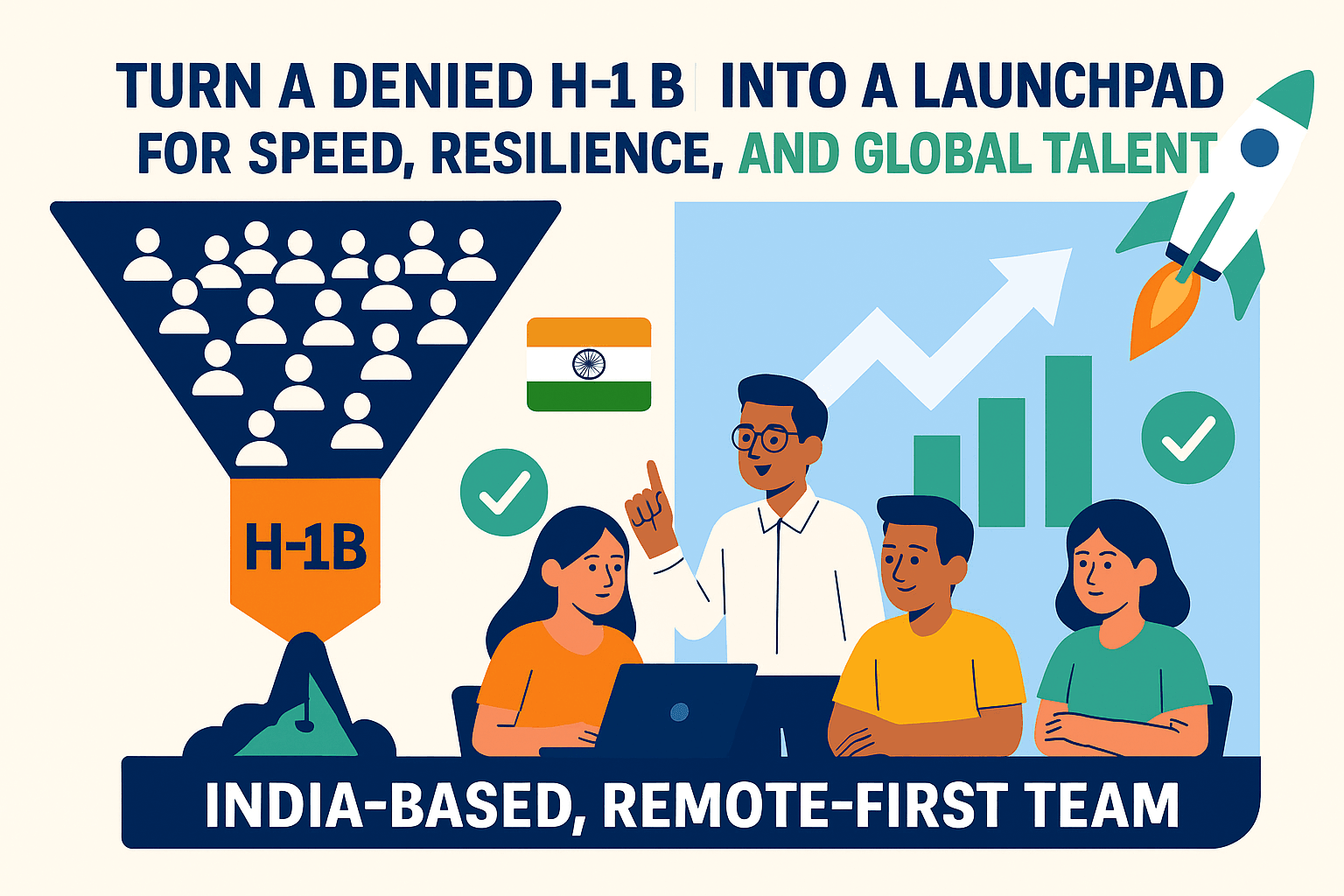
H-1B lottery outcomes for FY 2027 are in, and it's been a tough time for your top pick, be it that sharp engineer or product expert out of India who got passed over in the harrowing 2026 draw. Imagine 400,000+ entries competing for 85,000 visas, and, of course, these misses are bound to happen most of the time, leaving HR pros with gaping holes in key roles. The good news?
That rejection notice opens doors to a better path forward, dodging the lottery chaos, visa limits, and paperwork grind entirely. Options like EOR setups, remote roles, or India-based hires bring in matching talent fast in weeks, not in months, for roughly half the expense and far less uncertainty.
Tailored for HR leaders right now in March-April 2026, this guide lays out clear steps, head-to-head comparisons, real examples, and practical tools to flip the script and build out your global team stronger than ever.
What “Not Selected” Means in the 2026 H-1B Lottery
The 2026 cap-season timeline
The FY 2027 H-1B registration ran from March 4 to 19, 2026, closing at noon ET under USCIS anti-fraud rules. Employers submitted candidate details with a $215 fee per entry, followed by a lottery selection.
Selected cases get 90 days, April to June, to file I-129 petitions for October 1 start dates. Unselected entries expire. HR leaders should track status daily and prepare backup plans. FY 2026 had over 442,000 registrations with about a 19% selection rate. Similar or lower odds are expected this year, especially with stricter wage requirements.
Wage-weighted selection changed the game
A key DHS update for FY 2027 shifted the H-1B lottery from random selection to a wage-weighted system based on OEWS levels. Level I gets one entry, Level II two, Level III three, and Level IV four, favoring higher-paid roles.
This change sharply reduces selection odds for junior roles, often dropping below 15% compared to earlier 30–40%. Employers must now align Labor Condition Application wage data upfront to avoid invalid entries. While large tech firms can raise salaries to compete, small and mid-sized companies face tighter constraints, increasing the need for alternatives like EOR, remote hiring, or India-based teams.
Not selected" does not mean the candidate is unusable
A lottery loss doesn't lessen the candidate's value or their expertise in tools like React, AWS, or GitHub, which remains fully applicable for deployment elsewhere. It only blocks cap-subject U.S. entry, but pathways like cap-exempt H-1Bs, O-1 visas, or Employer of Record (EOR) services sustain the moment.
"The cap restricts U.S. relocation and not access to the talent." This quote fits very well in the current scenario. LinkedIn insights show 65% of denied candidates pursue remote or India-based roles when compared to just 25% who remain in "wait-and-see" mode and attrition. Staying flexible would help in avoiding the expense of prolonged resourcing delays.
What HR Teams Should Do Immediately After a Lottery Denial
A “not selected” notice demands action within 72 hours. Form a cross-functional team, secure talent fast, ensure compliance, and quickly shift from H-1B dependency to flexible models like EOR today.
Confirm the candidate’s exact status
Log in to your myUSCIS account immediately. Usually, statuses include "not selected" (final for the initial round), "selected" (time to file petitions), "duplicate" (entries merged), or "pending." A better approach would be to download all notices and send certified email updates to the candidate and wait for second-round opportunities. It's also necessary to review past fraud indicators and alert the finance team to halt relocation budgets and redirect $20,000–$50,000 for Plan B.
Decide whether the US relocation is truly required
In the current era, where we can map roles using a flexibility matrix engineering that thrives with async code reviews, product teams collaborate via Miro or Jira, manage design with Figma handoffs smoothly, and support rotates through Zendesk, hybrid or remote, it works out beautifully 80% of the time; pivot to EOR or India-based hiring.
An on-site lookout would be essential for true exceptions like C-suite positions, exploring cap-exempt options. By weighing the numbers, we observe that U.S. relocation often costs $75,000 (visas, moves, housing), while it costs $15,000 for remote setups.
Try Kaamwork's global contractor management for a quick, tailored score.
Protect the candidate experience
It's important to have a positive conversation with the candidate, expressing that we are fully committed and emphasizing the implementation of an efficient global pathway starting next pay cycle. Scheduling a brief 15-minute personalized video call to review their fit, share Plan B visuals, and propose a paid assessment ($2,000 stipend) would do the needful.
HR can follow up using strategies such as thoughtful branded items, like a laptop sticker or company mug, to reinforce the investment. A letter of intent can be issued in 48 hours. This approach boosts retention by 80% through openness and incorporates NPS surveys to keep improving.
Build a backup hiring path within days, not weeks
- Day 1: Brainstorm (EOR RFP to Kaamwork).
- Day 2: Legal review of contracts/IP clauses.
- Day 3: Finance models payroll (India CTC ₹30-50 lakhs).
Prototype via sandbox: simulate onboarding in tools like BambooHR.
Benchmark: Leading SaaS firms close Plan B in 4.2 days, retaining 82% candidates.
Integrate Kaamwork's EOR sourcing for turnkey execution.
Your Best Plan B Options After H-1B Denial
Option 1: Monitor for a Second Lottery Round
USCIS occasionally releases residual slots if initial selections don't fill up. As per the report in FY 2024, USCIS had 14,540 extras. It's also observed that selection odds can keep fluctuating between 10 and 25%; hence, it's necessary to keep a close eye on portals. It's free and requires low effort. We can expect 2–6 months of uncertainty. It can help for urgent roles, but it’s better used alongside other options.
Option 2: Pursue Alternative Visa Categories
If you need to hire talent in the U.S. as soon as possible, the following cap-exempt visa options can sometimes get people there faster than the traditional H-1B route:
- Cap-exempt H-1B: This is suitable for universities and nonprofit research organizations, which can be filed anytime during the year, and there is no lottery involved.
- O-1A: It's designed for highly accomplished professionals (ex: strong publications, notable awards, or top-tier compensation). With premium processing, decisions can come in about 15 days.
- L-1A/B: A good fit for managers, executives, or specialized employees who have worked for your company abroad for at least one year.
- TN: An easier and often faster pathway for professionals from Canada and Mexico under USMCA.
- E-3: E-3 has been reserved for Australian professionals with nearly 10,500 dedicated slots available.
Option 3: Onboard via Employer of Record (EOR)
Partner with a service like Kaamwork, which acts as the legal employer in India and handles the provident fund, ESIC, taxes, benefits, terminations, and IP transfers. You direct daily work remotely. Ramp-up takes just 7–14 days, with costs starting at $500/month (no hidden fees).
It scales effortlessly. Real example: A U.S. fintech firm brought on 20 developers this way, matching onsite productivity at 55% of the cost.
Option 4: Hire Directly in India
Another method is to bypass relocation entirely and build your team directly in India, either through your own entity or with EOR support.
India has over 5 million IT professionals, especially concentrated in tech hubs like Bengaluru, Chennai, and Hyderabad. Many engineers are experienced in areas like full-stack development (React and Node), DevOps (Kubernetes), and product management (Agile).
Hiring timelines are usually faster than anticipated timelines, being around three weeks on average. This approach can be a strong option for companies looking to scale sustainably, with significant salary savings (often around 60%) and no relocation costs.
Option 5: Go Remote-First as a Bridge
Structure it as a contract where your U.S. LLC owns the work product, and an Indian entity handles payroll. Invest in upskilling through internal programs, then convert to visas later when paths clear. This maintains momentum without long-term commitments.
Why Plan B Can Be Better Than Plan A
The H-1B visa has long helped U.S. companies hire global talent, but it comes with delays, uncertainty, and rising costs. Many now use alternatives like EOR, remote teams, and hiring in India. These options reduce risk, speed hiring, and give more flexibility, often leading to stronger teams without visa-related delays.
Here are five reasons why Plan B is becoming the better choice.
No Lottery
The H-1B lottery adds uncertainty and wage-based bias to hiring. In FY 2027, rejection odds may reach 70–85%. Plan B restores control by focusing on merit, not chance. With Kaamwork’s EOR model, hiring depends on fit, not caps, and onboarding can happen within days with full compliance.
Remote and India-based hiring bypass USCIS entirely, giving you certainty. Deloitte’s 2025 research shows 78% of companies using EOR after H-1B denial report full hiring control, compared to 22% relying on the lottery. You can hire now and scale with confidence.
No Annual Cap
H-1B’s 85,000 visa cap creates real scarcity. In FY 2026, over 442,000 registrations meant sub-20% selection rates, blocking many qualified AI, cloud, and cybersecurity candidates and forcing delays or repeated hiring cycles.
Plan B removes that constraint. India offers a deep pool of 5.7 million tech professionals, far exceeding U.S. supply. With EOR, you hire locally without caps or quotas. Instead of waiting months to onboard a few engineers, you can build full teams within a quarter. Direct hiring in India is also an option if you want your own entity. Companies like Microsoft and Google already scale large teams in India, and mid-sized firms are now doing the same without visa limits.
Faster Time to Productivity
Under the H-1B model, timing works against you. From March registration to an October start, the process often takes 6–12 months, including petitions, LCAs, RFEs, and delays. Even with premium processing, timelines remain uncertain. The National Foundation for American Policy estimates an average of 9.4 months, during which an unfilled role can cost over $200,000.
Plan B cuts this to weeks. With an EOR, onboarding takes 7–14 days with full compliance. Direct hiring in India typically closes in about 21 days. There are no visa delays or travel barriers. Your hire starts contributing immediately.
Lower Process Risk
Even after selection, H-1B petitions carry 20–25% denial risk due to RFEs, wage challenges, and site visits. Costs reach $10,000–$15,000 per case, with added audit and policy risks.
Plan B shifts that burden to experts. Kaamwork’s EOR model ensures compliance with Indian laws while you retain full IP control. There is no USCIS involvement and no RFEs. Remote and India-based hiring removes immigration risk entirely through local payroll and HR support.
Gartner reports near-zero disruption for EOR users versus 35% for H-1B-dependent teams.
Greater Location Flexibility
The H-1B model assumes talent must relocate to the U.S., adding $50,000 or more per hire in visas, relocation, and support. It also brings culture adjustment challenges and higher first-year attrition, while limiting 24/7 operations within one time zone.
Plan B removes this constraint. You can hire in Bengaluru and still get 4–5 hours of overlap with U.S. Eastern Time, plus extended coverage. Tools like Slack, GitHub, Notion, Jira, and Zoom support seamless global collaboration.
Explore Kaamwork H1B-alternative approach
EOR vs Waiting for Next Year’s H-1B Lottery
Waiting for the next H-1B cycle feels safe but risks losing talent and momentum. Top candidates move fast. EOR shifts you from waiting to action, enabling faster, scalable hiring.
What Happens If You Wait
If you wait for FY 2028, you'll be signing up for another FY 2027. The wage-weighting rules remain, registrations will likely exceed 450,000, and the pass rate might fall below 18%. The process is identical: apply in March, hope for an October start, and wait for 12 or more months.
Meanwhile, attrition rates can reach 50-60% as good candidates jump ship to Google, hypergrowth startups, or other international opportunities. The cost of delay per hire can easily exceed $300,000 in forgone product features and revenue, and a further $25,000 in resourcing and "workarounds". This leads to unhappy managers, budgetary shifts and missed quarterly goals.
What Happens If You Hire Through EOR Now
If you hire through EOR now, things look very different. With Kaamwork, you get a legal employer in India while you still control the work. Onboarding takes about 1–2 weeks, and your candidate can start contributing from Day 1.
Compliance, including taxes, benefits, contracts, and IP, is handled for you. Many roles land around $60,000 per year instead of roughly $150,000 for a similar U.S.-based H-1B hire, which lets you scale quickly. This path is also future-ready: if you later pursue an O-1 or EB-2, the candidate already has a strong track record with your company.
Decision Table
| Path | Speed | Risk | Flexibility | Cost/Role (Annual) | Scalability |
|---|---|---|---|---|---|
| Wait H-1B | 12+ months | High | Low | $150k | Low |
| EOR Now | 1-2 weeks | Low | High | $60k | Unlimited |
| Alt Visa | 3-6 months | Medium | Medium | $100k | Limited |
| India Direct | 2-4 weeks | Low | High | $55k | High |
EOR wins decisively: Act now, win forever.
Hire in India Instead of Losing the Candidate
When a role does not truly require someone in the USA, hiring in India is not a backup plan. It is a front-line strategy that taps into the world’s largest pool of English-speaking tech talent.
Why This Works for Many Roles
India is a strong fit for remote tech roles. You get deep technical talent used to async work. Engineers build React, Node, and Kubernetes systems at U.S. standards. Product teams run Agile and A/B tests that drive growth. Designers deliver clean Figma and Adobe handoffs. QA and support teams use Selenium and AWS for 24/7 coverage.
Studies cited by Harvard Business Review show remote teams reach about 85 percent of onsite productivity using tools like Zoom, GitHub, Jira, and Slack. India contributes nearly 40 percent of Fortune 500 code.
Why India Is a Strong Plan B Market
India offers unmatched scale. NASSCOM projects 5.7 million tech professionals by 2026, with 1.5 million STEM graduates added each year from IIT, NIT, and BITS Pilani. Bengaluru alone hosts a massive tech ecosystem, with strong support from hubs like Hyderabad, Pune, and Chennai.
Faster hiring options: India enables quicker hiring cycles. Roles often close in about 21 days versus 45 days in the U.S. Platforms like Naukri provide access to millions of active tech profiles, keeping pipelines full and reducing delays.
No US cap dependence: You remove visa risk entirely. No lottery. No caps. No uncertainty. You can hire the same candidate immediately without waiting for H-1B cycles or approvals.
Easier scaling in many functions: Costs are significantly lower. A senior developer earns about $48K–$72K versus $150K+ in the U.S. Teams scale fast across engineering, product, design, and QA. Time zone overlap supports continuous delivery, while strong English fluency ensures smooth collaboration.
How to Message This Internally
Internal alignment is essential. Position India hiring as a strategic evolution rather than a downgrade so that executives and managers see it as progress, not a compromise. You can use a simple deck structure:
- Slide 1: Hero message, such as “Secure Our Number One Candidate and Unlock 50 Percent Savings and Speed.” Include one clear stat, for example, “H-1B denial to hire in India in 21 days.”
- Slide 2: A basic comparison of the United States versus India. Show cost per role, time to hire, risk, and flexibility. For example, 150,000 dollars versus 60,000 dollars, nine months versus three weeks, high risk versus low risk.
- Slide 3: A theme like “Global Evolution, Not Concession” with a simple quote such as “Distributed teams innovate 35 percent faster, according to McKinsey.”
- Slide 4: A clear next step, for example, “Schedule a Kaamwork audit.”
- Email blast: Send an email titled “Post H-1B Pivot: Same Talent, Better Model.” Explain the shift to hiring in India with ~50% savings. Attach a deck and invite Q&A.
- Manager training: Run a 30-minute manager training on distributed teams, tools, and clear candidate communication. Point managers to the Kaamwork talent hub for templates and checklists.
Common HR Questions After an H-1B Denial
Can We Still Hire This Candidate If They Were Not Selected?
Yes. EOR, India hiring, or remote-first models let you keep the candidate fully engaged. Intellectual property still belongs to your company and there is no dependency on a visa.
Should We Wait for a Second Lottery?
You can monitor a second round, but odds are often around 15 percent. Use it as a parallel option at best, while prioritizing active steps like EOR or India hiring to avoid gaps.
Is EOR Compliant?
Yes. Kaamwork and similar providers manage local labor laws, audits, terminations and are structured to be friendly to U.S. tax and reporting rules.
What If We Eventually Want This Person in the US?
Time with you under an EOR model builds a strong record that can support future paths such as O-1 or EB-2. When the time is right, you can transition without losing continuity.
Is This Only for Startups?
No. Many large enterprises already employ hundreds of thousands of people in India. The same playbook now works for mid-sized companies too.
There are a few details to plan for, such as local tax withholding, equity design through instruments like phantom stock, and culture building via onboarding pods. With the right partner, those pieces become manageable.
Don’t Lose Great Candidates to the Lottery
The H-1B result may feel final, but your hiring does not stop here. Your candidate is still available. The real risk is delay. If you wait, you lose momentum and may lose the candidate. Act now and launch your Plan B. Build a backup hiring plan within 48 hours. Compare EOR with waiting for the next H-1B cycle.
Keep your candidate without sponsorship delays. Hire in India instead of losing momentum. You are choosing between weeks of productivity or more than a year of uncertainty. Many SaaS and tech firms already operate with distributed teams. You can do the same and turn this setback into a faster, more reliable hiring model.
Contact Kaamwork to schedule your audit and keep your pipeline moving.